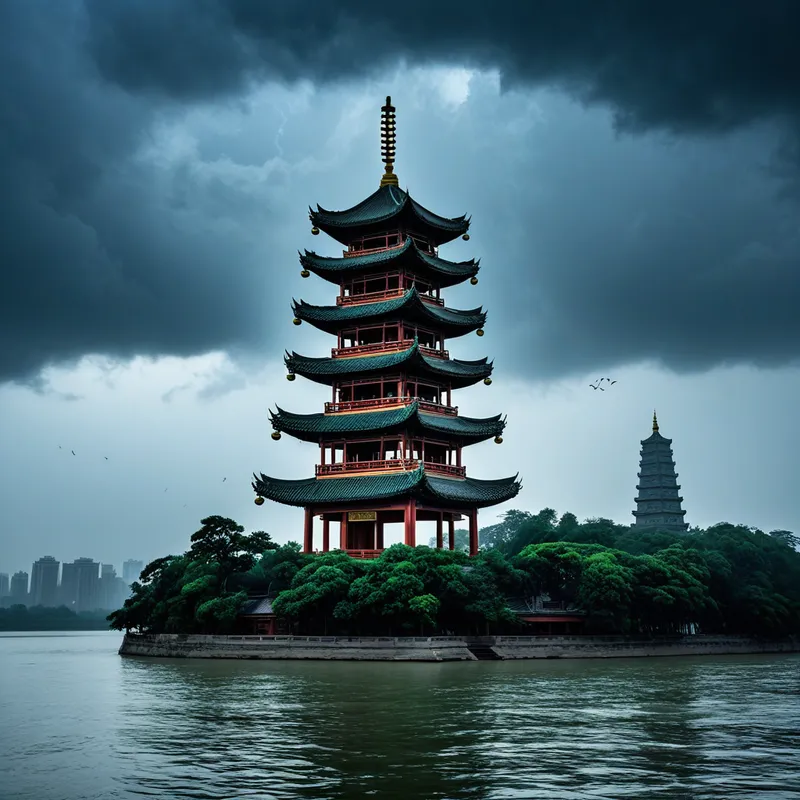
The Pagoda of the Six Harmonies Myth Meaning & Symbolism
A mythic tale of a monk who tames the chaotic river dragon by building a pagoda, harmonizing the six realms of existence.
The Tale of The Pagoda of the Six Harmonies
Listen, and hear the tale whispered by the reeds along the Qiantang River. In a time when the world was raw and spirits walked close to the skin of things, the great river was a beast of fury. Each autumn, when the moon swelled fat and full, the River Dragon would awaken. It was not a dragon of scales and fire, but one of pure, churning chaos—a mountain of water that roared from the sea, swallowing villages, drowning fields, and leaving sorrow in its wake. The people of Hangzhou lived in the shadow of this annual terror, their prayers lost in the thunderous foam.
Into this world of fear came a monk named Zhiyuan. His feet were dusty from a thousand li of road, but his eyes held the stillness of a deep pool. He came not with sword or spell, but with a vision born of sleepless nights watching the river’s madness. He heard not just water, but the dissonant wail of the world itself—the six directions of existence in violent, clashing discord.
He climbed Yuelun Hill, where the river made its furious bend. The wind tore at his robes; the spray of the coming bore stung his face. He sat in meditation, but this was no passive prayer. It was a confrontation. He cast his consciousness not against the dragon, but into the heart of the chaos, listening to its components: the North’s bitter cold argued with the South’s oppressive heat; the East’s bursting growth fought the West’s solemn decay; the Heavens’ lofty ideals ignored the Earth’s muddy sustenance. And at the center, the human heart, tossed and terrified.
Zhiyuan saw that to calm the dragon, he must first calm the cosmos within its roar. His resolution crystallized like frost. He would build a pillar of order, a needle to stitch the torn fabric of reality. He called upon the people, not for war, but for creation. Stone by stone, tier by tier, they raised the Pagoda of the Six Harmonies. Each of its thirteen eaves was designed not for beauty alone, but as a tuning fork for the universe. At its pinnacle, he placed not a jewel, but a profound intention—a silent mantra of integration.
On the night the autumn moon reached its zenith, the dragon came. The earth trembled. The river boiled backwards, a wall of destruction racing inland. The people huddled, but Zhiyuan stood before the unfinished pagoda, a lone figure against the tidal night. He did not flinch. As the watery maw approached, he rang a great bell, its sound a clear, unwavering note that cut through the chaos. He spoke no words, but projected the completed harmony of his mind—the balanced six.
And the miracle unfolded. The raging wall of water did not crash. It slowed. It coiled around the base of the hill, and in the moonlight, the form of the dragon seemed to look up. It saw the pagoda, a skeletal promise of order against the stars. The fury drained from its form. The waters subsided, not in retreat, but in peace, flowing now with a powerful, rhythmic cadence. The dragon was not slain; it was harmonized. The pagoda stood, and the river’s heart, once a storm, now beat in time with the world.
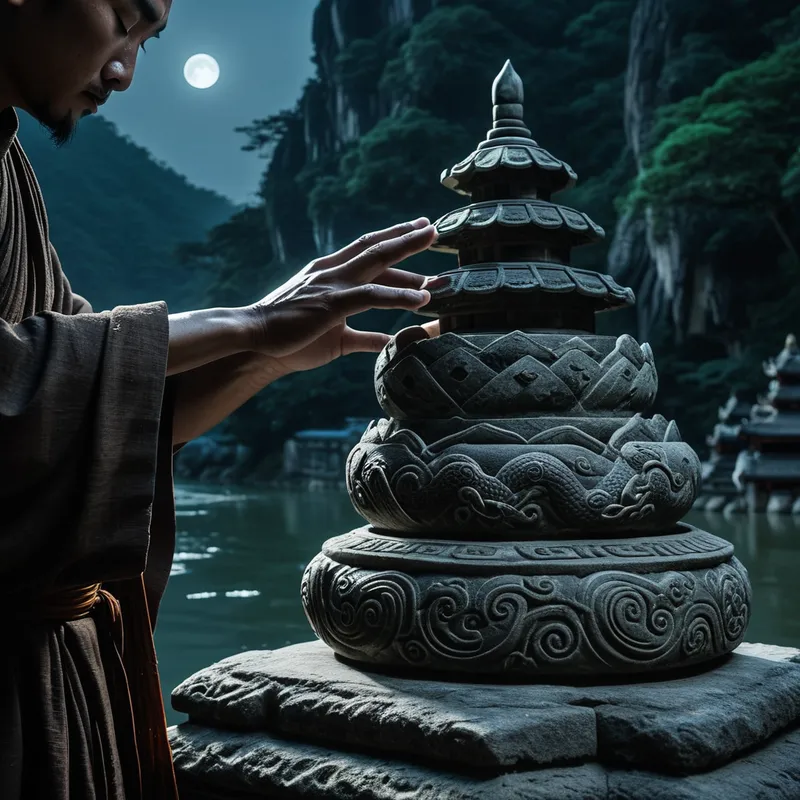
Cultural Origins & Context
This myth is woven around the very real Liuhe Pagoda in Hangzhou, a structure originally built in the 10th century during the Northern Song Dynasty for the practical purposes of navigational aid and tidal suppression. The legend of Monk Zhiyuan taming the tidal bore represents a classic cultural process: the sanctification of infrastructure. It transforms an engineering feat into a cosmological act, embedding secular necessity within a sacred narrative.
The story was passed down through local folklore, Buddhist parables, and later, literary records. It served multiple societal functions. Primarily, it was an etiological myth, explaining the (still formidable but less destructive) nature of the Qiantang tidal bore. On a deeper level, it functioned as a narrative anchor for core Chinese cosmological principles—the imperative of balancing opposites (Yin-Yang) and aligning human activity with the patterns of heaven and earth. It taught that true power lies not in domination, but in resonant understanding and the establishment of benevolent order.
Symbolic Architecture
The myth’s power is architectural, both in its plot and its symbolism. The pagoda is not merely a building; it is a cosmic diagram made stone. The “Six Harmonies” (Liuhe) represent the totality of spatial and existential relations. The chaos of the river dragon is the psyche—or the world—in a state of internal civil war, where aspects of the self are in violent, uncontrolled conflict.
The pagoda is the psyche’s spine, erected when consciousness decides to structure its own chaos.
Zhiyuan, the monk, embodies the observing ego that, through disciplined attention (samadhi), can perceive the pattern within the storm. He does not fight the dragon (the shadow, the unconscious tumult) with an opposing force. Instead, he offers it a structure to inhabit. The act of building is the act of conscious integration—taking raw, chaotic elements (stone, fear, discord) and assembling them according to a unifying, transcendent principle. The dragon’s submission is not defeat, but the recognition of its own place within a larger, more beautiful order.
The Dreamer’s Resonance
When this myth appears in the modern dreamscape, it often signals a profound process of internal reorganization. The dreamer may be inundated by emotional floods—a tidal bore of anxiety, grief, or uncontrollable life changes. Dreaming of a towering, stable structure near chaotic waters suggests the psyche is attempting to build its own pagoda: a central, stabilizing identity capable of withstanding inner and outer turbulence.
Somatic sensations might include a feeling of being shaken to one’s foundation, or conversely, a sudden, solid calm in the chest—the feeling of laying a cornerstone. Psychologically, it marks the shift from being a victim of chaos to becoming an architect of one’s own reality. The dream is a blueprint. The specific “harmonies” the dreamer must balance could be work and rest, logic and intuition, independence and relationship, or the reconciliation of past, present, and future selves. The dream-pagoda is the nascent symbol of a Self that can contain its own contradictions without disintegration.
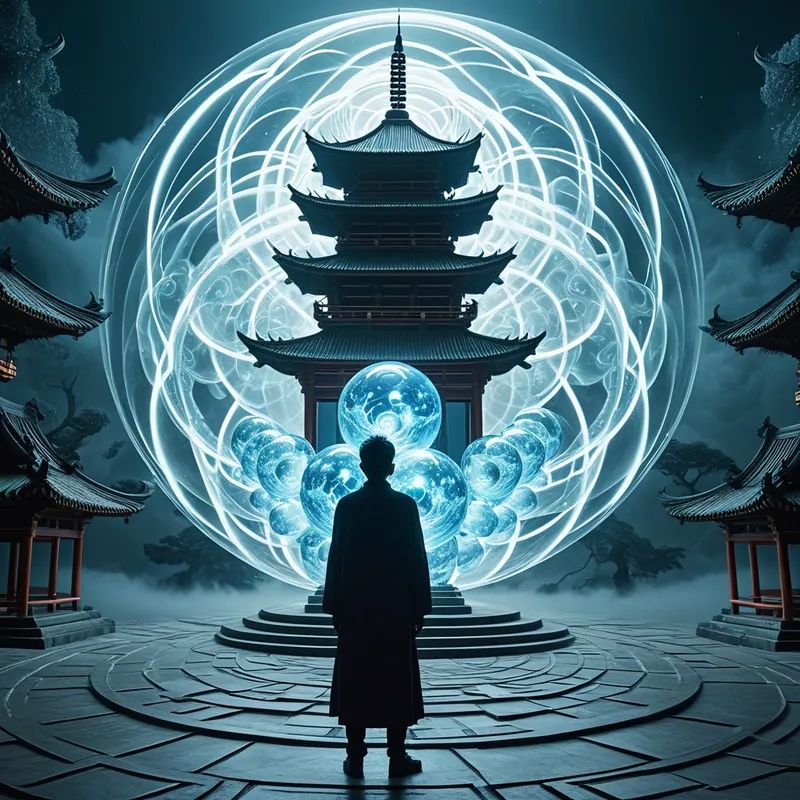
Alchemical Translation
The myth models the alchemical opus of individuation with stunning clarity. The prima materia, the base matter to be transmuted, is the raw, destructive power of the unintegrated psyche (the River Dragon). The first stage, nigredo (blackening), is the annual devastation, the depressive or chaotic phase where all seems lost.
Zhiyuan’s meditation on the hill is the albedo (whitening)—the enlightening insight that discerns the constituent elements within the black chaos. He sees the six discordant directions. The construction of the pagoda is the central work of citrinitas (yellowing), the laborious, conscious effort to assemble these disparate parts into a functioning whole according to a sacred design.
The final stage, rubedo (reddening), is not a violent conquest, but a peaceful integration. The dragon’s energy is not destroyed; it is redeemed, becoming the powerful, rhythmic flow of the lived life.
For the modern individual, the “pagoda” is the coherent personality, the life’s work, the philosophical or spiritual framework one builds. The “six harmonies” are the often-opposing demands of existence that must be brought into a dynamic, personal balance. The triumph is not the eradication of inner dragons—the passions, the shadows, the chaotic creative forces—but the construction of a vessel strong and harmonious enough to give them a purposeful direction. One becomes, like the enduring pagoda on the hill, a fixed point of conscious order around which the powerful waters of the unconscious can safely, and even beneficially, flow.
Associated Symbols
Explore related symbols from the CaleaDream lexicon: