The Ox-Cart Myth Meaning & Symbolism
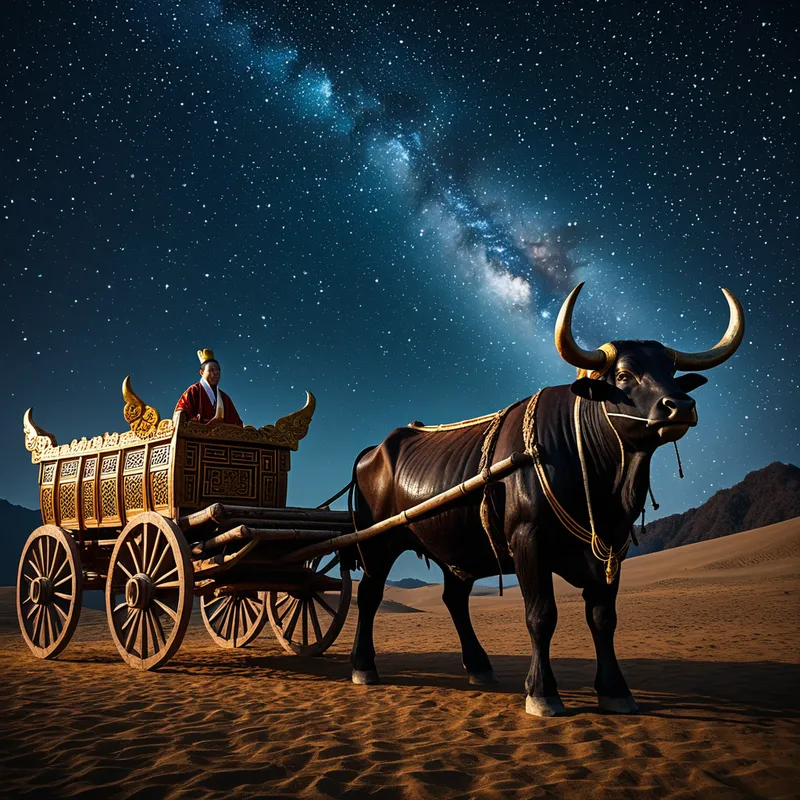
A celestial deity descends to guide humanity, yoking the ox to the cart, establishing the sacred rhythm of labor, harvest, and the measured journey of life.
The Tale of The Ox-Cart
In the time before time was measured, when [the sky](/myths/the-sky “Myth from Persian culture.”/) was a raw, unbroken vault and [the earth](/myths/the-earth “Myth from Hindu culture.”/) a formless, sleeping giant, humanity stumbled. They knew the sun’s heat and [the moon](/myths/the-moon “Myth from Tarot culture.”/)’s chill, but the seasons were a mystery that brought feast or famine without warning. They scattered seeds to the whim of [the wind](/myths/the-wind “Myth from Various culture.”/) and pulled at the soil with bare, bleeding hands. Their lives were a circle of hunger, a breath away from returning to the dust from which they came.
From the Jade Void, a being of profound stillness observed this struggle. This was no thunderous god, but a deity of deep, patient knowing, whose essence was the turning of stars and the slow growth of roots. Moved not by pity, but by a vision of harmonious order, this celestial sage descended. His form was not blinding light, but the steady glow of a hearth-fire, his robes the color of fertile loam and twilight.
He arrived not with a legion, but with two things: a patient, immense ox with eyes like deep pools of night, and the timbers for a cart. The people gathered, silent, watching as the deity’s hands—hands that had charted the courses of rivers in the sky—began to work. He did not speak. The only sounds were the whisper of wood against wood, the rasp of rope, and the ox’s deep, rhythmic breath. He fashioned a yoke, strong and smooth. He built a cart, its bed broad and deep, its wheels solid as the cycles of the moon.
Then came the sacred act. With infinite care, he placed the yoke upon the ox’s broad shoulders. The great beast lowered its head, accepting the burden not as servitude, but as purpose. The deity then took the ox by a simple rope, and led it forward. The ox leaned into the yoke. The cart’s wheels, for the first time, turned upon the earth. They did not race; they rolled with a deliberate, world-founding slowness, carving the first true furrow into the unmarked land. Where the cart passed, the chaotic earth was ordered into a line. Where the ox trod, the soil was readied.
He showed them how to follow this line, to plant in its wake. He taught them the ox’s pace, which was the pace of the seasons—slow, inevitable, powerful. He revealed that the cart was not for idle travel, but for carrying the harvest, for bearing the fruits of patient labor from field to home. The deity stayed until the rhythm was learned, until the people’s movements synced with the beast’s breath and the cart’s rumble. Then, as silently as he came, he faded back into the fabric of the sky, leaving behind the ox, the cart, and the indelible pattern of the furrow—the first sacred scripture written upon the earth.
Cultural Origins & Context
The myth of the Ox-Cart is less a single, codified story from a classic text like the Shan Hai Jing, and more a foundational cultural motif woven into the very fabric of agrarian Chinese civilization. It is a etiological myth that explains the origin of agriculture, animal husbandry, and technology—the triad that lifted humanity from foraging to civilization. It was passed down not by bards in courts, but by elders in villages, by fathers showing sons how to steer the plow, by mothers singing of the ox’s strength.
Its societal function was paramount: to sacralize labor. In a culture deeply connected to the land, the myth transformed back-breaking toil into a participatory ritual in the cosmic order. The ox was not a slave, but a partner gifted by the heavens; the cart was not mere tool, but a vessel of celestial design. This story justified and ennobled the peasant’s life, embedding the values of patience, perseverance, and harmony with nature into the collective [psyche](/myths/psyche “Myth from Greek culture.”/). It was a myth that lived in the calloused hand on the plough handle and in the seasonal festivals celebrating harvest.
Symbolic Architecture
The myth’s power lies in its stark, potent [symbolism](/symbols/symbolism “Symbol: The use of symbols to represent ideas or qualities, often conveying deeper meanings beyond literal interpretation. In dreams, it’s the language of the unconscious.”/). Each element is a pillar in the [architecture](/symbols/architecture “Symbol: Architecture in dreams often signifies structure, stability, and the framing of personal identity or life’s journey.”/) of a conscious [life](/symbols/life “Symbol: The symbol of ‘Life’ represents a journey of growth, interconnectedness, and existential meaning, encompassing both the joys and challenges that define human experience.”/).
The Ox is the incarnate [symbol](/symbols/symbol “Symbol: A symbol can represent an idea, concept, or belief, serving as a powerful tool for communication and understanding.”/) of raw, earthly power—untamed [nature](/symbols/nature “Symbol: Nature symbolizes growth, connectivity, and the primal forces of existence.”/), instinct, and brute [strength](/symbols/strength “Symbol: ‘Strength’ symbolizes resilience, courage, and the ability to overcome challenges.”/). Yet, it is not wild; it is potentially guided. It represents the foundational energies of the [body](/symbols/body “Symbol: The body in dreams often symbolizes the dreamer’s self-identity, personal health, and the relationship they have with their physical existence.”/), the libido, and the unconscious forces within us that are vast and powerful, but without inherent [direction](/symbols/direction “Symbol: Direction in dreams often relates to life choices, guidance, and the path one is following, emphasizing the importance of navigation in personal journeys.”/).
The [Cart](/symbols/cart “Symbol: A cart represents the burden of responsibilities, the journey of life, or the tools we carry with us.”/) is the [vessel](/symbols/vessel “Symbol: A container or structure that holds, transports, or protects something essential, representing the self, emotions, or life journey.”/) of culture, [consciousness](/symbols/consciousness “Symbol: Consciousness represents the state of awareness and perception, encompassing thoughts, feelings, and experiences.”/), and [purpose](/symbols/purpose “Symbol: Purpose signifies direction, meaning, and intention in life, often reflecting personal ambitions and core values.”/). It is [structure](/symbols/structure “Symbol: Structure in dreams often symbolizes stability, organization, and the framework of one’s life, reflecting how one perceives their environment and personal life.”/), technology, and the [capacity](/symbols/capacity “Symbol: A measure of one’s potential, limits, or ability to contain, process, or achieve something, often reflecting self-assessment or external demands.”/) to carry a yield. It represents [the ego](/myths/the-ego “Myth from Jungian culture.”/), the constructed self, and the societal frameworks that aim to give shape and utility to our existence. Without a load or a [path](/symbols/path “Symbol: The ‘path’ symbolizes a journey, choices, and the direction one’s life is taking, often representing individual growth and exploration.”/), it is empty and inert.
The Yoke is the critical, transformative element. It is the point of [connection](/symbols/connection “Symbol: Connection symbolizes relationships, communication, and bonds among individuals.”/), the discipline, the conscious [agreement](/symbols/agreement “Symbol: A harmonious arrangement in artistic collaboration, symbolizing unity, shared vision, and creative consensus.”/) that binds raw power (ox) to conscious purpose (cart).
The yoke is the sacred contract between instinct and intention, where wild force is not broken, but invited into partnership.
The Furrow is the result of this partnership—the first line, the path, the manifestation of [effort](/symbols/effort “Symbol: Effort signifies the physical, mental, and emotional energy invested toward achieving goals and personal growth.”/) into [the world](/myths/the-world “Myth from Tarot culture.”/). It is the life lived, the [career](/symbols/career “Symbol: The dream symbol of ‘career’ often represents one’s ambitions, goals, and personal identity in a professional context.”/) forged, the [relationship](/symbols/relationship “Symbol: A representation of connections we have with others in our lives, often reflecting our emotional state.”/) built, the art created. It is order imposed upon [chaos](/symbols/chaos “Symbol: In Arts & Music, chaos represents raw creative potential, uncontrolled expression, and the breakdown of order to forge new artistic forms.”/) through sustained, guided [effort](/symbols/effort “Symbol: Effort signifies the physical, mental, and emotional energy invested toward achieving goals and personal growth.”/).
The Celestial Deity, the Culture [Hero](/symbols/hero “Symbol: A hero embodies strength, courage, and the ability to overcome significant challenges.”/), represents the transcendent function, the inner [archetype](/symbols/archetype “Symbol: A universal, primordial pattern or prototype in the collective unconscious that shapes human experience, behavior, and creative expression.”/) of the [Senex](/symbols/senex “Symbol: The wise old man archetype representing spiritual authority, ancestral wisdom, and the integration of life experience into transcendent knowledge.”/). It is that part of the psyche which can observe our chaotic struggles and introduce [the principle](/symbols/the-principle “Symbol: A fundamental truth, law, or doctrine that serves as a foundation for a system of belief, behavior, or reasoning, often representing moral or ethical standards.”/) of wise, ordering structure.
The Dreamer’s Resonance
When this myth stirs in the modern unconscious, it often surfaces in dreams of profound somatic struggle or foundational anxiety. To dream of an ox, powerful but standing idle in a field, may speak to a dreamer feeling a reservoir of untapped energy or passion with no outlet—a deep, somatic restlessness. To dream of a broken cart, or a cart with a missing wheel, often correlates with a feeling that one’s life structures (job, routine, relationships) are no longer functional or cannot “carry” one’s needs.
The most potent dream is the struggle to yoke the ox to the cart. This is the psyche dramatizing the core challenge of integration. The dreamer may feel the rope slip, see the ox resist, or find the yoke does not fit. This is the somatic and psychological process of attempting to align one’s deep, instinctual drives (perhaps for creativity, freedom, or connection) with the practical demands and structures of daily life. The frustration in the dream is the friction of individuation—the hard, necessary work of making one’s inner nature serviceable to one’s outer life.
Alchemical Translation
The myth of the Ox-Cart is a masterful blueprint for the alchemical process of psychic transmutation, what Jung termed Individuation. The initial state is the massa confusa—the unplowed field of the psyche, where potentials lie dormant and life feels chaotic or fruitless.
The descent of the inner Sage marks the beginning of the work. This is the moment of insight, the quiet voice that says, “There is a pattern here to be found.” The ox must be approached not with force, but with respect—this is the act of turning attention inward to acknowledge one’s raw talents, deep emotions, and shadow energies without judgment.
The crafting of the yoke is the most delicate operation. This is the development of a personal discipline, a routine, a practice, or a value system that is uniquely fitted to one’s own nature. A yoke too harsh breaks the spirit; a yoke too loose is ineffective. It must be a conscious creation.
The great work is not to ride the ox, but to walk beside it, guiding its world-founding strength with a hand that has learned its rhythm.
The act of leading the yoked ox forward, pulling the cart to create the furrow, is the sustained application of this integrated self in the world. It is the daily practice, the committed relationship, the long-term project. The harvest that fills the cart is the realized life—not a life of effortless bliss, but one of meaningful yield, born from the sacred partnership between the deep self and the conscious will. The deity’s departure signifies that the pattern is now internalized; the individual has become the one who both contains the ox’s power and steers the cart’s course, forever walking the fertile furrow between heaven and earth.
Associated Symbols
Explore related symbols from the CaleaDream lexicon: