
The Origin of the Walrus Myth Meaning & Symbolism
A woman's profound grief transforms her into the first walrus, a story of love, loss, and the deep kinship between human and animal souls.
The Tale of The Origin of the Walrus
Listen. In the time before time, when the world was still soft from dreaming, there lived a woman. Her name is lost to the wind, but her story is carved into the ice. She was a woman of the coast, her life woven with the threads of the sea’s giving and the sea’s taking. She had a husband, a great hunter who could read the language of the ice and speak to the seals. Their love was a shelter, warm as a qulliq lamp in the long winter dark.
But the sea is a hungry spirit. One day, a storm, born from the breath of Sedna, rose with a fury. The ice groaned and shattered. The hunter, seeking food for his beloved, was taken. The waves swallowed him whole, leaving only his harpoon, washed ashore, silent and cold.
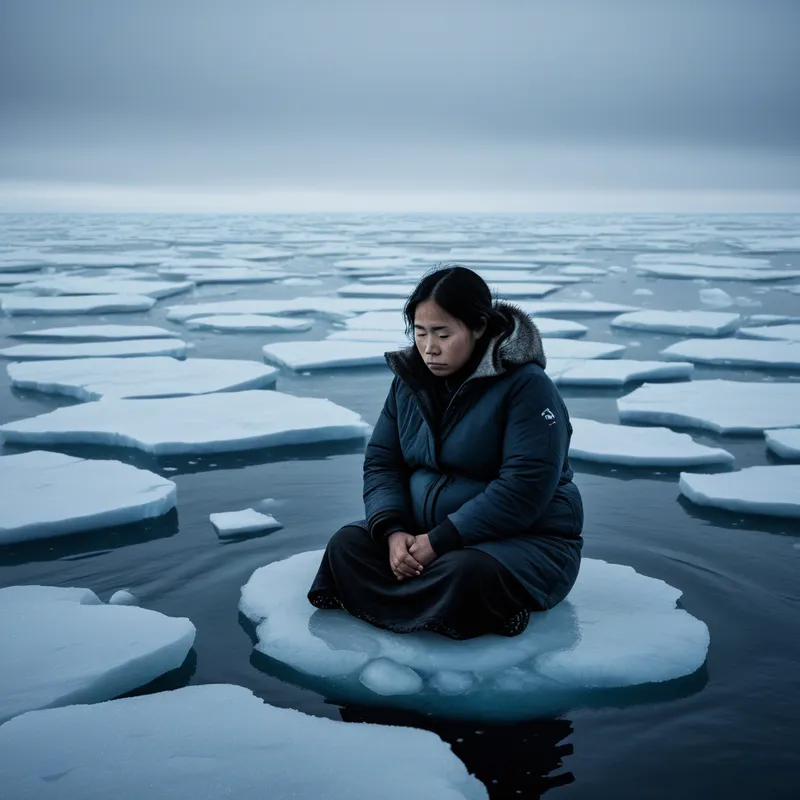
The woman’s grief was a blizzard inside her. It froze her laughter, buried her songs. She would walk to the edge of the land-fast ice, where the black water lapped, and call his name into the void. The wind stole her cries. The aurora danced, indifferent. Her sorrow was so vast, so heavy, it began to change the very shape of her being. She felt it pulling her down, toward the cold, dark home where her love now slept.
Days bled into nights. She refused to leave the shore. Her people begged her to come to the warmth of the sod house, to eat, to live. But her heart had already followed her husband into the deep. As she sat, her vigil eternal, her body began to answer the call of the sea. Her legs, numb from cold and sorrow, fused together, becoming a powerful, rudder-like tail. Her arms thickened, stretching into strong flippers meant for navigating the endless blue. Her skin, weathered by salt spray and tears, grew into a thick, wrinkled hide, a armor against the cold she now welcomed.
The final change came from within. From the core of her maternal love, now a cavern of loss, grew two long, ivory tusks. They were not weapons, but tools—to help her son, the child growing in her womb, whom she would now never bear into the world of sun and air. They were the last gift of a mother, the final anchor of her human care.
With a last, shuddering sigh that fogged the air, she slid from the ice into the water. The shock was not of cold, but of homecoming. She was heavy, yet buoyant; burdened, yet free. She dove, not to die, but to live in a new form. She became the first Aiviq, the Walrus. Her love for her lost husband transformed into a fierce devotion to her new herd, her children of the sea. Her grief became the immense, gentle bulk that now roams the ocean floor, remembering, always remembering, the touch of air and the sound of a human voice on the wind.
Cultural Origins & Context
This myth, in its many variations, belongs to the Inuit and Yupik peoples. It was not merely a story to explain an animal’s origin; it was a sacred narrative of reciprocity and identity. Told during the long winter nights by elders, the story served as a profound ethical and cosmological guide.
In the Inuit worldview, the boundary between human and animal is permeable. Animals possess inua—consciousness and personhood. The myth of the Walrus’s origin codifies this belief. It explains the walrus’s human-like eyes, its social nature, and its evident intelligence not as coincidence, but as testament to its ancestral humanity. The story functioned as a cornerstone of hunting respect. To hunt the walrus was not to kill a mere beast, but to engage with a transformed relative, requiring rituals of gratitude and respect to ensure the spirit would return to be reborn and allow itself to be taken again. It taught that profound loss could become a source of immense, enduring life for the entire community.
Symbolic Architecture
At its heart, this is a myth of alchemical grief. The woman’s sorrow does not destroy her; it reconstitutes her. Her transformation is not a punishment, but a profound adaptation of the soul to bear an unbearable weight.
The deepest grief is not an end, but a gestation. It reshapes the vessel so it can hold the ocean of loss without shattering.
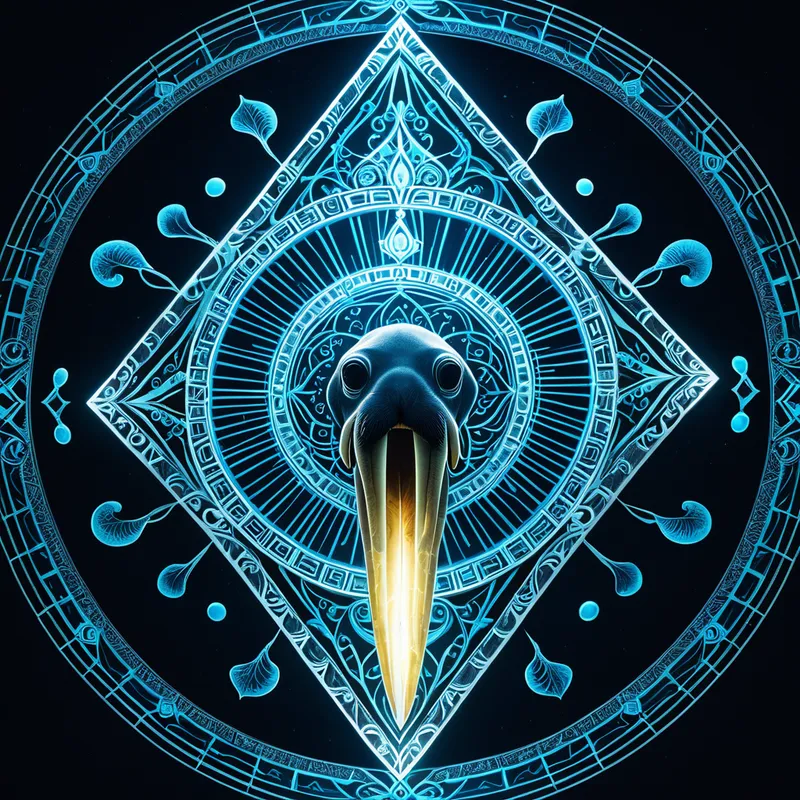
The walrus itself becomes a living symbol of the Caregiver archetype made eternal. Her tusks, grown from maternal love, symbolize tools for nurturing in a new, harsher environment—used to help her calf haul out onto ice, to defend the herd. Her immense bulk represents the weight of memory and responsibility that love leaves behind. She becomes the guardian of the sea floor, a bridge between the human world of loss and the animal world of sustenance.
The Dreamer's Resonance
When this myth pattern stirs in the modern dreamer, it often signals a profound somatic and psychological process of adaptation to a core loss. This is not the acute pain of fresh grief, but the slower, heavier process of becoming someone who can live with it.
Dreams may feature sensations of heaviness, of limbs becoming cumbersome, or of being drawn irresistibly into cold, dark water. One might dream of their own body morphing, not in terror, but with a strange, inevitable solemnity. This is the psyche’s workshop, where the ego-structure is being literally reformed to incorporate a massive change. The dreamer is not drowning; they are growing a new skin, a new way of moving through the world. The walrus in the dream is the emerging symbol of the resilient, enduring self that is being born from the dissolution of the old.
Alchemical Translation
For the individual on the path of individuation, this myth maps the transformation of a personal, cataclysmic emotion into a structural, enduring part of the personality—a complex that becomes a source of strength rather than paralysis.
The process begins with the Sacrifice of the known identity (the human woman). The conscious ego, attached to a specific form of life and love, must submit to being unmade. The Water—the unconscious—claims her. This is the nigredo, the dark night of the soul. But within that dissolution, the core archetype of the Caregiver does not die; it seeks a new vessel. The alchemical work is the slow, involuntary transmutation of the raw material of grief (lead) into the enduring, protective wisdom of the walrus (a kind of organic ivory).
The psyche’s genius is to take what is most burdensome and, through the mystery of symbolism, make it the very thing that allows you to navigate the depths.
The individual emerges not "healed" in the sense of returning to what was, but fundamentally reconfigured. They carry a new weight, a new perspective from the depths. They become a guardian of their own history, capable of nurturing others from a place of profound understanding. Their "tusks"—their unique tools for survival and care—are forged directly in the heart of their loss.
Associated Symbols
Explore related symbols from the CaleaDream lexicon:
- Water — The primordial element of the unconscious, emotion, and transformation; it is the medium that receives the woman's grief and from which her new form is born.
- Sacrifice — The voluntary surrender of one state of being to allow for the emergence of another, more necessary form of existence and service.
- Grief — The raw, transformative emotion that acts as the alchemical fire, burning away the old identity to make way for a new, more resilient structure of the soul.
- Mother — The archetypal force of nurturing and creation, which here is turned inward and transformed into a protective, enduring animal form for a child that will never be.
- Ocean — The vast, unknown realm of the deep psyche and eternal memory, which becomes the new home and domain of the transformed spirit.
- Transformation — The core process of the myth, the literal and psychic change of form in response to an unbearable psychic pressure.
- Shadow — The integrated aspect of profound sorrow and loss, which ceases to be a hidden weakness and becomes the visible, powerful body of the new self.
- Dream — The liminal state in which such profound metamorphosis is possible, and the ongoing realm where this mythic pattern continues to instruct the modern psyche.
- Spirit — The enduring consciousness or inua that persists through radical change, moving from human to animal form while retaining its essential core.
- Origin — The mythic moment of emergence that explains not just a species, but the very nature of deep, abiding connection and the sacred cause of form.