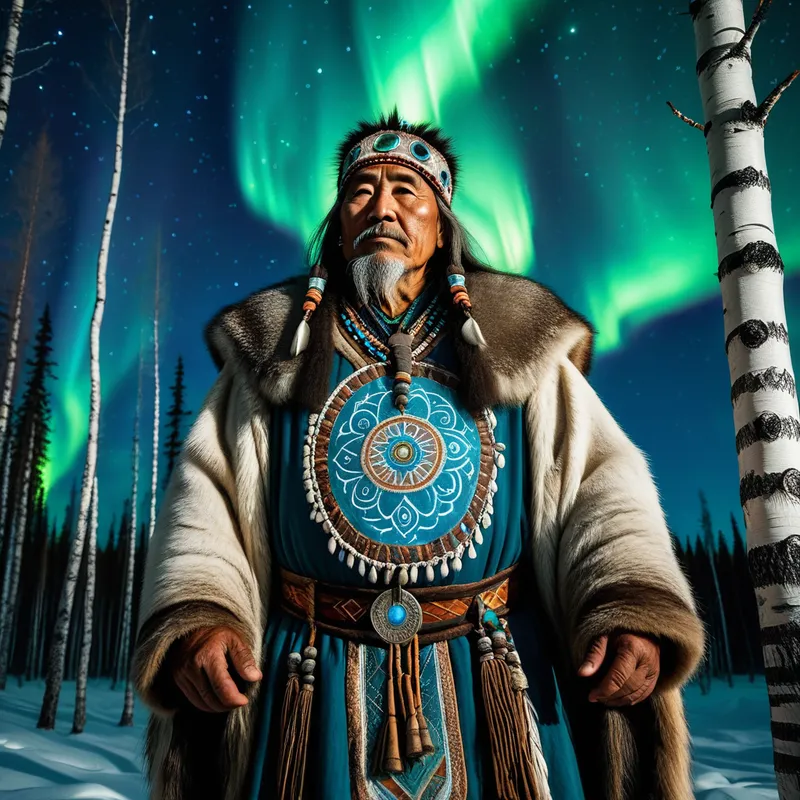
The Origin of the Shaman Myth Meaning & Symbolism
A myth where a divine being is torn apart and remade by celestial spirits, becoming the first conduit between the human world and the spirit realms.
The Tale of The Origin of the Shaman
Listen. In the time before time, when the world was young and the sky touched the earth, there was no bridge between the realms. Humans lived in the middle world, deaf to the songs of the spirits above and blind to the whispers of the ancestors below. They were alone, sick in body and spirit, with no one to plead their case to the great powers.
Then, from the people, a child was born under a strange star. This one was different. They heard the wind speak in the World Tree and saw faces in the flickering fire. The spirits noticed this sensitive soul. The great Tengri looked down from the blue eternity and saw the suffering of the people. A decision was made in the council of the gods. This human would be remade to serve as a messenger, a healer, a negotiator.
But the making of such a being is not a gentle act. It is a terrible unmaking.
One night, as the chosen one slept by a sacred fire, the sky cracked open. Not with violence, but with a silent, profound tearing of the veil. Spirits descended—not as gentle guides, but as divine surgeons. They were the Spirit-Helpers, taking the forms of mighty eagle, steadfast bear, and cunning wolf. They did not greet the sleeper. They took them.
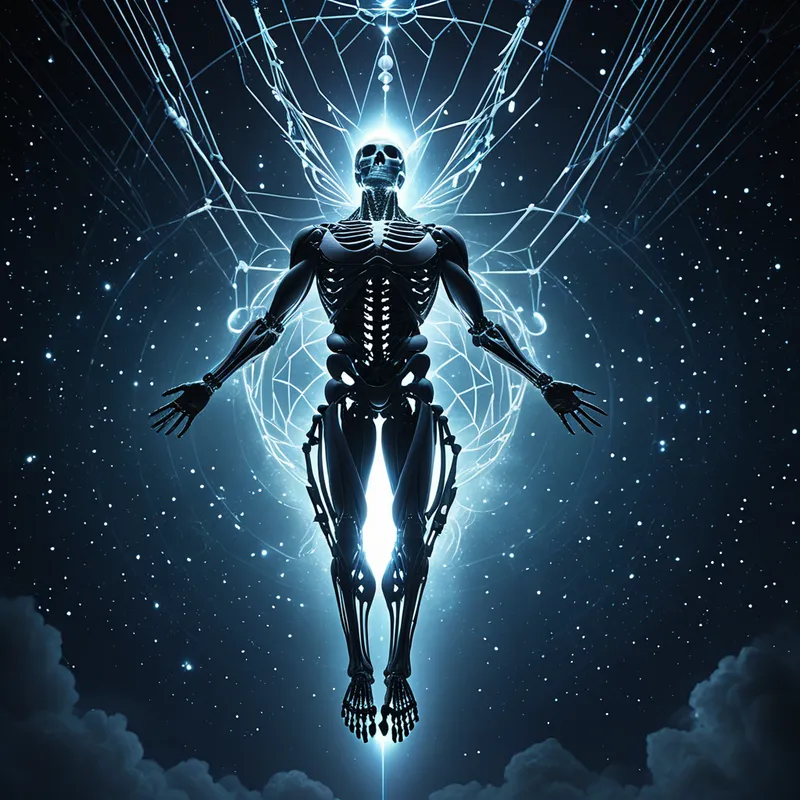
In a place that was not a place, a clearing at the root of the World Tree that exists in all worlds at once, the work began. It was a sacred dismemberment. With claws of light and beaks of intention, the spirits took the human apart. Bone was separated from bone, organ from organ. The flesh was stripped away, the blood offered to the earth, the eyes placed upon a stone altar to see in all directions. The sleeper was awake through it all, a consciousness floating in a sea of unimaginable sensation, witnessing their own dissolution.
This was not an end, but a preparation. The spirits cleansed each part. They scrubbed the bones with starlight, washed the organs in the milk of the celestial Umai, and tempered the sinews in the cold fire of the aurora. They removed the sickness of the ordinary world, the petty concerns and mortal blindness.
Then, with infinite care, they began the reassembly. But they did not simply put the human back together. They rebuilt the being. They placed quartz in the eyesockets to see the spirit world. They lined the ribs with iron to withstand the journey between realms. They placed the heart of the bear within the chest for strength, the cunning of the wolf in the mind, and the far-seeing vision of the eagle in the soul. When the last piece was set, the spirits breathed into the new form not just life, but purpose.
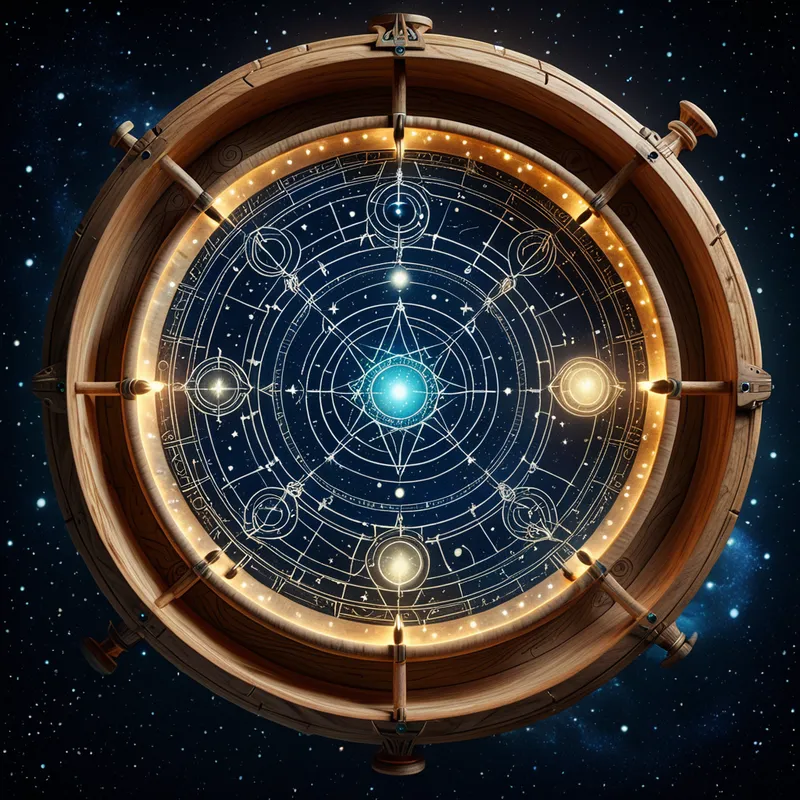
The being awoke on the cold earth of the middle world, whole and yet utterly changed. They remembered the tearing and the remaking. In their hands was a drum, fashioned from the wood of the World Tree and the skin of a sacred reindeer, given by the spirits as their tool and their steed. They were the first shaman. They were no longer solely human, but a bridge. Their first act was to rise, beat the drum, and begin the long work of healing the people they had been chosen from. The wound of their making became the source of their power.
Cultural Origins & Context
This foundational narrative, in its many variations, is central to the shamanic traditions across the vast Siberian expanse—from the Evenki and Buryat to the Nivkh and Khakas. It was not a story for entertainment, but an initiatory map, passed down orally from master to apprentice. It served a crucial societal function: it legitimized the shaman’s terrifying and often erratic power (their “madness”) by rooting it in a divine, sacrificial origin. It explained why the shaman was both of the community and painfully separate from it. The myth was recited during rituals and initiations, reinforcing that the shaman’s authority came not from human institutions, but from a direct, traumatic encounter with the cosmic order itself.
Symbolic Architecture
The myth is a profound [blueprint](/symbols/blueprint “Symbol: A blueprint represents the foundational plan or design for something, often symbolizing potential, structure, and the mapping of one’s inner self or future.”/) for the creation of a conscious intermediary between realms—not just of [spirit](/symbols/spirit “Symbol: Spirit symbolizes the essence of life, vitality, and the spiritual journey of the individual.”/) and matter, but of the conscious and unconscious psyche.
The shaman is not born, but unmade and remade. The original self must be sacrificed to create the vessel that can hold the whole.
The dismemberment is the ultimate deconstruction of the egoic [personality](/symbols/personality “Symbol: Personality in dreams often symbolizes the traits and characteristics of the dreamer, reflecting how they perceive themselves and how they believe they are perceived by others.”/). It represents the complete [breakdown](/symbols/breakdown “Symbol: A sudden failure or collapse of a system, structure, or mental state, often signaling a need for fundamental change or repair.”/) of old identities, assumptions, and the limited [perception](/symbols/perception “Symbol: The process of becoming aware of something through the senses. In dreams, it often represents how one interprets reality or internal states.”/) of the “normal” world. The spirit-helpers ([eagle](/symbols/eagle “Symbol: The eagle is a symbol of power, freedom, and transcendence, often representing a person’s aspirations and higher self.”/), bear, [wolf](/symbols/wolf “Symbol: Wolves in dreams symbolize instinct, intelligence, freedom, and a deep connection to the wilderness and primal instincts.”/)) are archetypal forces of the unconscious—instincts, strengths, and wisdom that are latent within the psyche but must be engaged consciously. Their surgical work signifies that transformation is not a random [accident](/symbols/accident “Symbol: An accident represents unforeseen events or mistakes that can lead to emotional turbulence or awakening.”/), but a purposeful, if brutal, restructuring by deeper aspects of the Self.
The reassembly with new parts (iron, [quartz](/symbols/quartz “Symbol: A crystalline mineral symbolizing clarity, amplification, and healing energy, often representing purity, transformation, and spiritual connection.”/), animal attributes) symbolizes the [integration](/symbols/integration “Symbol: The process of unifying disparate parts of the self or experience into a cohesive whole, often representing psychological wholeness or resolution of internal conflict.”/) of these archetypal powers into a new personality [structure](/symbols/structure “Symbol: Structure in dreams often symbolizes stability, organization, and the framework of one’s life, reflecting how one perceives their environment and personal life.”/). The [shaman](/symbols/shaman “Symbol: A spiritual mediator who bridges the human and spirit worlds, often through altered states, healing, and guidance.”/) is rebuilt with “spiritual organs”—enhanced capacities for perception (seeing spirits), [resilience](/symbols/resilience “Symbol: The capacity to recover quickly from difficulties, adapt to change, and maintain strength through adversity.”/) (iron ribs), and embodied instinct. The gift of the drum is the gift of method, the technology to navigate this new state of being. It is the [heartbeat](/symbols/heartbeat “Symbol: The heartbeat represents life, vitality, and the essence of being alive, symbolizing emotional connectivity and personal integrity.”/) that syncs the individual [rhythm](/symbols/rhythm “Symbol: A fundamental pattern of movement or sound in time, representing life’s cycles, emotional flow, and universal order.”/) with the rhythm of the [cosmos](/symbols/cosmos “Symbol: The entire universe as an ordered, harmonious system, often representing the totality of existence, spiritual connection, and the unknown.”/).
The Dreamer’s Resonance
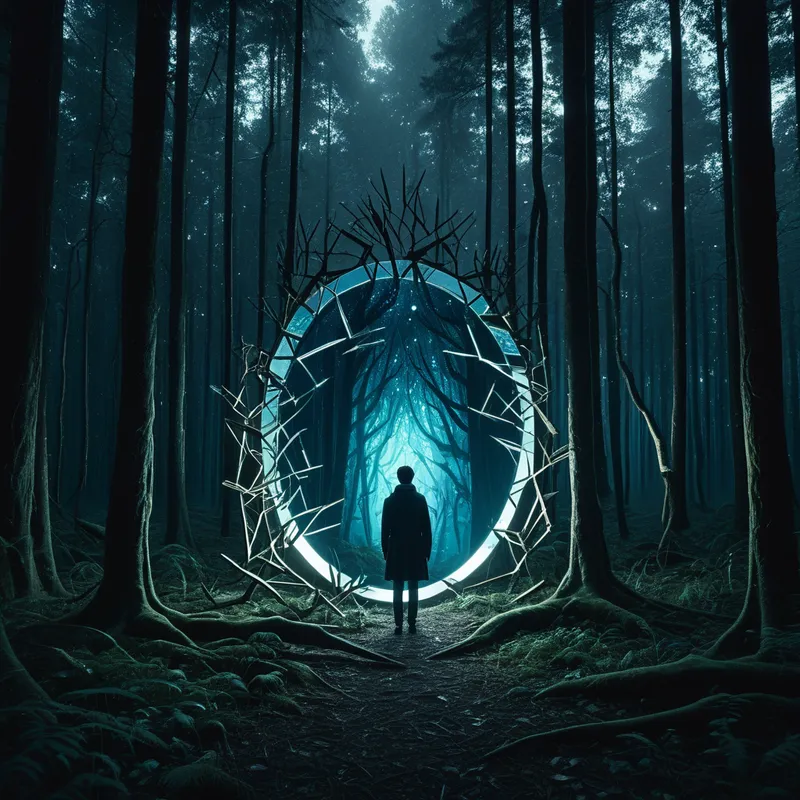
When this mythic pattern stirs in modern dreams, it rarely appears as a literal Siberian tale. Instead, it manifests as dreams of radical disintegration: the body falling apart, teeth crumbling, the house of the self collapsing. It appears as dreams of being operated on by shadowy figures or animals, of being lost in a forest that is also one’s own interior. There is often profound somatic terror—a feeling of annihilation.
This is the psyche signaling the necessity of a deep, structural change. The dreamer is not dying; they are undergoing the psychic equivalent of the shaman’s dismemberment. The old adaptation, the former personality structure that has served its purpose, is being taken apart by the autonomous, “spirit-helper” forces of the unconscious. The process feels like a crisis, a breakdown, because it is. The dreamer is in the liminal space between identities, and the psyche is dramatizing the painful but necessary dissolution that precedes rebirth into a more authentic, more capacious way of being.
Alchemical Translation
For the modern individual, the myth models the alchemical process of individuation—the journey toward psychological wholeness. We are all, in a sense, called to become shamans of our own inner worlds, to build a bridge between our conscious ego and the vast, often chaotic realm of the unconscious.
The first stage, the dismemberment, translates as a life crisis, a depression, a profound failure, or a loss that shatters our sense of who we are. It is the nigredo, the blackening, where everything falls apart. The key is to understand, as the myth teaches, that this is not a meaningless punishment, but the beginning of a sacred process initiated by the Self.
The spirit-helpers who perform the operation are the very aspects of our psyche we most fear or ignore: our rage, our grief, our primal instincts, our wild creativity. They are not the enemy; they are the surgeons.
The reassembly is the long, conscious work of integration. It is picking up the pieces—not to glue back the old vase, but to create a mosaic. We integrate our “iron” (endurance, boundaries), our “quartz sight” (intuition, insight), and our animal wisdom (body awareness, instinctual life). We receive our “drum”—our unique method of grounding and navigating this new consciousness, be it through art, relationship, therapy, or spiritual practice.
The reborn shaman does not return to the village as a normal citizen, but as a wounded healer. Similarly, the individuated person does not return to naive “normalcy.” They carry the memory of the dissolution and the wisdom of the reconstruction. Their wound—their sensitivity, their experience of darkness—becomes the very source of their depth, their empathy, and their ability to guide others through their own dark forests. They become a bridge within themselves, and thus, can become a bridge for others.
Associated Symbols
Explore related symbols from the CaleaDream lexicon:
- Shamanic Journey — The core action modeled by the myth, representing the deliberate voyage into non-ordinary states of consciousness to retrieve knowledge, power, or healing.
- Dismemberment — The central transformative ordeal, symbolizing the necessary deconstruction of the ego and old identity to make way for a new, more integrated self.
- Drum — The sacred technology gifted by the spirits, representing the heartbeat of the cosmos and the vehicle that carries the shaman between worlds.
- Spirit — The divine force that initiates the transformation and the essential connection the shaman mediates, representing the autonomous, numinous power of the unconscious.
- Bridge — The ultimate role of the shaman, created through their ordeal; they become a living connection between heaven, earth, and the underworld, or consciousness and the unconscious.
- Tree — The World Tree at which the dismemberment occurs, representing the cosmic axis, the structure of reality, and the path connecting all layers of existence.
- Bone — The purified, lasting framework of the shaman’s new body, symbolizing essential truth, ancestral lineage, and the indestructible core of the Self that survives transformation.
- Healing — The primary purpose bestowed upon the remade shaman, representing the ability to restore balance, which is only possible after one has been profoundly unbalanced and remade.
- Sacrifice — The voluntary or involuntary offering of the old self, representing the fundamental law that new life and great power require a profound surrender.
- Rebirth — The triumphant outcome of the ordeal, symbolizing the emergence of a new mode of being with enhanced capacities and a sacred purpose.
- Wound — The enduring mark of the transformation, which becomes the source of the shaman’s power and empathy, representing how our deepest injuries can become our greatest gifts.
- Vision — The clarified sight granted by the quartz eyes, representing the ability to perceive the hidden patterns, spirits, and truths of the world, beyond literal appearance.