
The Origin of the Boomerang Myth Meaning & Symbolism
A myth where a broken spear, thrown in grief, arcs back, teaching that loss and return are woven into the sacred law of the land itself.
The Tale of The Origin of the Boomerang
In the First Days, when the world was soft and the songs of the Ancestors still vibrated in the stones, there lived a hunter named Wirrun. His arm was strong, his eye was keen, and his spears flew true as the hawk’s dive. He provided for his people from the bounty of the land, a land shaped by the great journeys of the Dreamtime beings. His most prized possession was his spear, a shaft of hardened mulga wood, straight and sure.
One evening, as the sun bled into the western plains, Wirrun tracked a great kangaroo. He crept close, his breath still. With a powerful thrust of his woomera, he sent the spear singing through the air. It struck true—but against the trunk of a ghost gum, hidden behind the animal. The spear did not pierce; it shattered. The sound was a crack in the world, a snap that echoed Wirrun’s own heart. The kangaroo bounded away, and Wirrun was left with two broken pieces of wood in his hands.
A deep mourning fell upon him. This was not just a tool broken; it was a covenant severed. The straight path had failed. In a fit of grief and frustration, under the cold eye of the newly risen moon, he took the larger, curved fragment of the spear. Without aim, without hope, he hurled it away into the darkness, a final gesture of relinquishment.
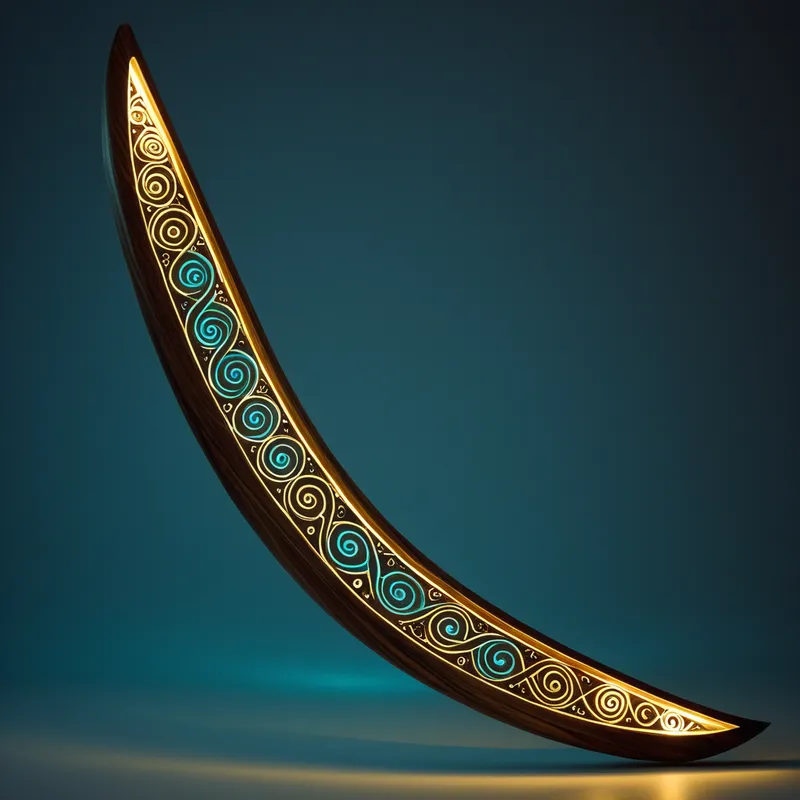
He watched it go, a dark slash against the star-dusted Milky Way. But it did not fall. To his awe, the piece of wood began to curve. It swept in a wide, impossible arc, whispering a new song as it cut the air—a song of woo-woo-woo. It flew out, around, and back, landing softly at his feet.
Wirrun stood frozen. He picked up the curved wood. The land itself seemed to hum. He understood then. The straight spear was a demand. This curved wood was an answer. It did not defy the law of the world; it revealed a deeper one. The Great Dreaming had not given him a weapon that failed, but a teaching that returned. He had thrown away his grief, and the world had given it back, transformed.

Cultural Origins & Context
This story, in its myriad local forms, is part of the vast, interconnected tapestry of The Dreaming. It is not a children’s fable but a mythic charter embedded in the land itself. Passed down through millennia via oral tradition, song, dance, and art, it was recounted by Elders and knowledge keepers around campfires, during ceremonies, and at sacred sites associated with the story’s events.
Its societal function was multifaceted. Practically, it encoded the invention and sacred significance of a vital tool. Spiritually and philosophically, it taught the profound Aboriginal principle of reciprocity and cyclicality. The boomerang’s return physically demonstrated the law that every action exists within a relationship, and what is sent out into the world—be it a hunt, a word, or a deed—will eventually circle back to its origin. It reinforced the concept of The Law, showing that innovation itself arises from within the sacred structure, not outside it.
Symbolic Architecture
At its [heart](/symbols/heart “Symbol: The heart symbolizes love, emotion, and the core of one’s existence, representing deep connections with others and self.”/), the myth symbolizes the transformation of [linear](/symbols/linear “Symbol: Represents order, predictability, and a direct, step-by-step progression. It symbolizes a clear path from cause to effect.”/) force into cyclical wisdom. The shattered [spear](/symbols/spear “Symbol: The spear often symbolizes power, aggression, and the drive to protect or conquer.”/) represents the failure of a direct, forceful, one-way approach to [life](/symbols/life “Symbol: The symbol of ‘Life’ represents a journey of growth, interconnectedness, and existential meaning, encompassing both the joys and challenges that define human experience.”/)’s challenges—be it hunting, [grief](/symbols/grief “Symbol: A profound emotional response to loss, often manifesting as deep sorrow, yearning, and a sense of emptiness.”/), or desire. Its breaking is a necessary [initiation](/symbols/initiation “Symbol: A symbolic beginning or transition into a new phase, status, or awareness, often involving tests, rituals, or profound personal change.”/), a defeat of the ego’s insistence on a straight [path](/symbols/path “Symbol: The ‘path’ symbolizes a journey, choices, and the direction one’s life is taking, often representing individual growth and exploration.”/) to its goal.
The broken tool is the first opening for sacred knowledge; the end of one world is the curvature that begins another.
The [boomerang](/symbols/boomerang “Symbol: A curved wooden tool that returns when thrown, symbolizing cyclical patterns, consequences, and the interconnectedness of actions and outcomes.”/) that emerges is the [archetype](/symbols/archetype “Symbol: A universal, primordial pattern or prototype in the collective unconscious that shapes human experience, behavior, and creative expression.”/) of the self-correcting [system](/symbols/system “Symbol: A system represents structure, organization, and interrelated components functioning together, often reflecting personal or social order.”/), [the law](/symbols/the-law “Symbol: Represents external rules, societal order, moral boundaries, and the tension between personal freedom and collective structure.”/) of return. Psychologically, it represents the [insight](/symbols/insight “Symbol: A sudden, deep understanding of a complex situation or truth, often arriving unexpectedly and illuminating hidden connections.”/) that our deepest losses, our thrown-away grief and rage, do not simply vanish. They travel on an unseen trajectory through the psyche and, if we are awake to the law, return to us as understanding. The [hero](/symbols/hero “Symbol: A hero embodies strength, courage, and the ability to overcome significant challenges.”/), Wirrun, transforms from a hunter who takes to a sage who receives—he learns to listen to the song of the curved air.
The Dreamer’s Resonance
When this mythic pattern stirs in the modern dreamtime, it often manifests as dreams of throwing something away—a letter, an object, a part of oneself—only to have it return, changed. One might dream of a key that flies from their hand and circles back as a bird, or of shouting into a canyon and having the echo return as harmonious music.
Somatically, this can correlate with a feeling of tension release followed by a surprising, gentle completion—a physical echo of the throw and return. Psychologically, the dreamer is likely at a point of frustrated effort, where a direct, willful approach to a problem (career, relationship, inner work) has “snapped.” The unconscious is presenting the possibility of a deeper, more resonant law: the need to engage in a process of release and attentive waiting, trusting that what is essential will not be lost but will be reconfigured and returned with new meaning.
Alchemical Translation
The individuation process modeled here is the alchemy of opus circulatorium. The first stage is Nigredo: the blackening, the grief and despair at the broken spear, the felt failure of one’s directed will. The throw is the active surrender, the mortificatio, where one consciously releases the broken pieces into the dark.
The flight of the boomerang through the unseen air is the Albedo—the whitening, the purification phase happening in the unconscious. It is the soul’s work, the curvature imposed by the Self’s deeper laws upon the ego’s raw material. The return is the Rubedo, the reddening, the return of the transformed substance. The hunter does not get his spear back; he receives the boomerang—a higher synthesis. He gains a tool that teaches law, that requires skill and respect, and that embodies the principle of relationship.
Individuation is not a straight path to a goal, but the cultivation of a skilled catch—the ability to recognize and receive what the psyche, governed by its own sacred laws, returns to you.
For the modern individual, this means learning to distinguish between forceful, willful pushing (the spear) and engaged, ritualized participation (the boomerang’s throw and catch). It is the shift from seeking to acquire to learning to participate in a cycle. True power lies not in the force of the throw, but in understanding the curve of the return and being present, with awe, to receive it.
Associated Symbols
Explore related symbols from the CaleaDream lexicon:
- Boomerang — The myth’s central artifact, symbolizing the sacred law of return, where actions and energies are not lost but transformed and brought back to their source.
- Spear — Represents the linear, forceful will of the ego, which must break or fail for a deeper, cyclical wisdom to be revealed.
- Dream — The dimension of the Dreaming where this transformative law originates and is communicated, the source of all creative and psychic patterning.
- Grief — The emotional catalyst that shatters the old form (the spear) and provides the raw, powerful energy for the transformative throw.
- Return — The core principle and action of the myth, the inevitable circling back of all things according to the deeper laws of the psyche and the cosmos.
- Law — The immutable, sacred structure of the Dreaming that governs all relationships and from which the boomerang’s behavior is a physical manifestation.
- Transformation — The alchemical process enacted by the myth, changing brokenness and loss into a tool of higher understanding and reciprocity.
- Hunter — The archetypal figure of focused pursuit and provision, who must undergo a crisis of method to become a receiver of wisdom.
- Sky — The vast, starry realm through which the boomerang flies, representing the domain of spirit, law, and the unseen trajectories of the soul.
- Wood — The primal, organic material of both spear and boomerang, symbolizing the raw substance of life and experience that can be shaped into different forms of consciousness.