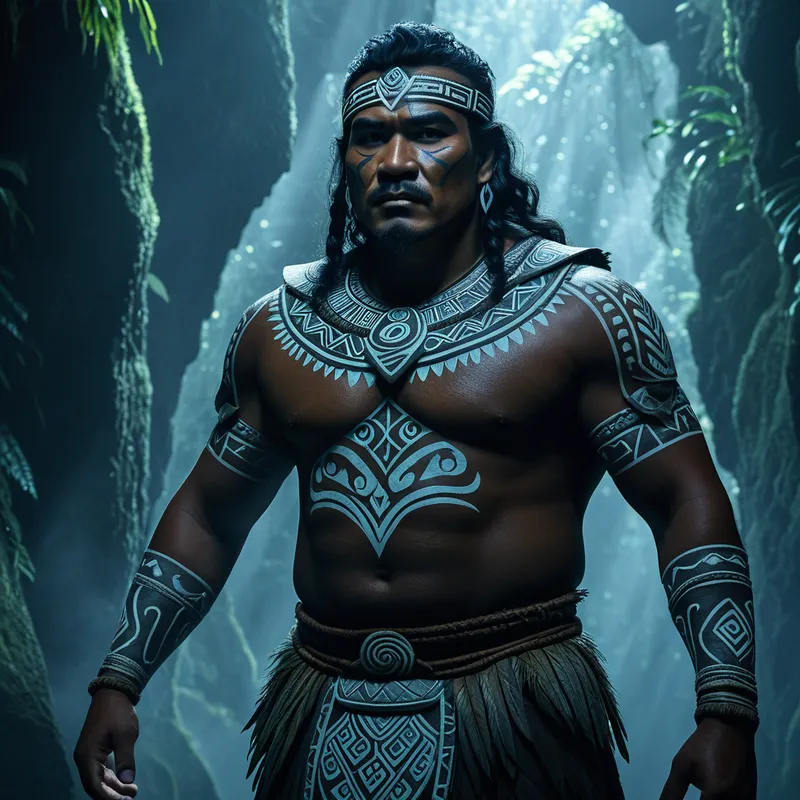
The Origin of Tattooing Myth Meaning & Symbolism
A mortal prince journeys to the underworld to reclaim his love, returning with the sacred art of tattoo as a mark of transformation and memory.
The Tale of The Origin of Tattooing
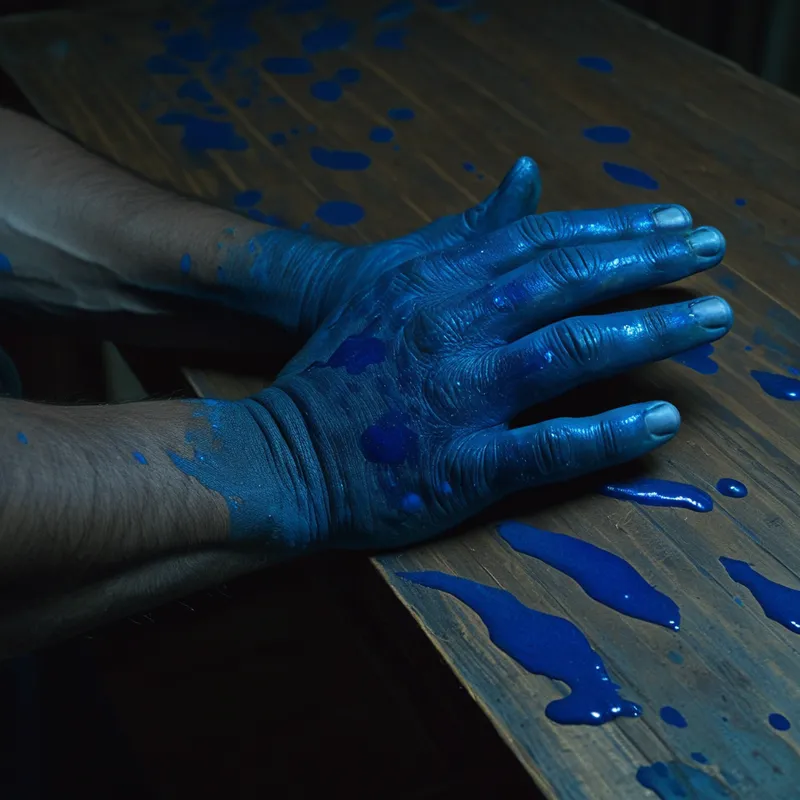
Listen. The world was younger then, and the veil between Te Ao Mārama and the underworld, Rarohenga, was thin as mist. In the world of light lived Mataora, a man of high rank, a prince among his people. He was skilled and proud, and upon his face, he wore not the deep-carved lines of his descendants, but designs painted with ochre and oil—beautiful, but fleeting. They washed away with rain and sweat, as impermanent as a mood.
Into his world came Niwareka. She was of Tūrehu, a people of Rarohenga, whose skin was clear and whose art was eternal. She moved with the grace of deep water, and her eyes held the stillness of stars seen from the ocean floor. Mataora loved her, and she, perhaps intrigued by the passionate, transient world of light, came to live with him as his wife.
But pride is a poison that seeps. In a fit of rage, shamed by some small thing, Mataora struck her. A single blow. In that moment, the warmth fled her eyes, replaced by a cold, ancient knowing. Without a word, Niwareka turned and was gone. She fled back through the hidden paths, down to the world of her father, Uetonga, where the air hums with the chant of chisels and the scent of sacred burning.
A cold emptiness filled the space where she had been. Mataora’s painted designs, once a source of pride, now seemed like childish smears. He saw their impermanence, their vanity, and in them, he saw his own failure. A fire of grief and shame ignited within him—a fire that would not let him rest. He had to follow. He had to descend.
The journey to Rarohenga was a stripping away. He passed through realms of whispering shadows and clinging fogs, his body growing weary, his painted marks smudging and fading until his face was a blur of regret. Finally, exhausted and stained, he entered the great dwelling of Uetonga. There sat Niwareka among her kin, her beauty now terrifying in its serene detachment. And there sat Uetonga, a figure of immense, quiet power, his own face a masterpiece of deep, black lines—a living topography of ancestry and law.
Mataora threw himself before Niwareka, his apologies pouring out, his love laid bare. He saw the permanent, awe-inspiring moko on the faces around him and understood his own poverty. Uetonga regarded the smeared, fading visitor from the world above. He saw the genuine remorse, the raw need. “You come seeking what is permanent,” Uetonga said, his voice like stone grinding stone. “You wear only the shadow of an image. Let us show you the substance.”
What followed was not a gift, but a forging. Mataora was given not a brush, but a uhi. Not pigment, but sacred āwheto. Uetonga and Niwareka worked upon him. The chisel bit deep, each tap a punctuation of pain, a hammer-stroke of truth driving the indelible ink beneath his skin. The patterns they carved were not merely decoration; they were a new skin, a testament written in blood and ash. Through the agony, Mataora did not flinch. He accepted each strike as the price for his folly, the toll for his passage back to love.
When the work was complete, Mataora stood transformed. The smeared paint was gone, replaced by the stark, beautiful truth of the moko. He wore his journey, his error, and his redemption on his very face. Seeing this permanent change, this willing sacrifice etched into his being, Niwareka’s heart softened. The bond was remade, not on the fragile ground of paint, but on the enduring bedrock of transformed flesh.
Together, they ascended back to Te Ao Mārama. And Mataora brought with him the great and solemn taonga: the art of tā moko, the tools, the chants, the sacred knowledge. He brought the bridge between the worlds, carved in skin, a memory of the underworld’ truth now living in the light.
Cultural Origins & Context
This myth of Mataora and Niwareka is a foundational waiata or narrative preserved within the oral traditions of the Maori. It was not mere entertainment but a whakapapa of the art itself—a sacred genealogy explaining the divine origin of tā moko. Told by tohunga (experts) and elders, it served multiple vital societal functions. It established the spiritual provenance of tattooing, elevating it from craft to a tapu (sacred) ritual received from the ancestors and deities of the underworld. It encoded the social and ethical laws surrounding the practice: moko was a rite of passage, a marker of rank, identity, and achievement. The story of Mataora’s transgression and arduous redemption underscored that the right to wear moko was earned through endurance, humility, and a transformation of character, mirroring the physical transformation of the tattoo ritual itself.
Symbolic Architecture
At its [heart](/symbols/heart “Symbol: The heart symbolizes love, emotion, and the core of one’s existence, representing deep connections with others and self.”/), this is a myth of the descent to reclaim a lost [soul](/symbols/soul “Symbol: The soul represents the essence of a person, encompassing their spirit, identity, and connection to the universe.”/)—both Niwareka, the [anima](/symbols/anima “Symbol: The feminine archetype within the male unconscious, representing soul, creativity, and connection to the inner world.”/) (the inner feminine [spirit](/symbols/spirit “Symbol: Spirit symbolizes the essence of life, vitality, and the spiritual journey of the individual.”/)), and Mataora’s own integrity. The painted face represents the [persona](/symbols/persona “Symbol: The social mask or outward identity one presents to the world, often concealing the true self.”/), the attractive but false self presented to the world, easily applied and easily lost. The blow that drives Niwareka away is the [moment](/symbols/moment “Symbol: The symbol of a ‘moment’ embodies the significance of transient experiences that encapsulate emotional depth or pivotal transformations in life.”/) the conscious ego, inflated by pride, severs its [connection](/symbols/connection “Symbol: Connection symbolizes relationships, communication, and bonds among individuals.”/) to the deeper, guiding [soul](/symbols/soul “Symbol: The soul represents the essence of a person, encompassing their spirit, identity, and connection to the universe.”/).
The underworld is not a place of punishment, but the realm of the unconscious, where the eternal patterns of the Self reside, waiting to be integrated.
The [journey](/symbols/journey “Symbol: A journey in dreams typically signifies adventure, growth, or a significant life transition.”/) to Rarohenga is the necessary katabasis, the [night](/symbols/night “Symbol: Night often symbolizes the unconscious, mystery, and the unknown, representing the realm of dreams and intuition.”/) sea [journey](/symbols/journey “Symbol: A journey in dreams typically signifies adventure, growth, or a significant life transition.”/). Mataora arrives “stained and faded”—his old [identity](/symbols/identity “Symbol: Identity represents the sense of self, encompassing personal beliefs, cultural background, and social roles.”/) is useless here. Uetonga, the master artisan, represents the archetypal [Senex](/symbols/senex “Symbol: The wise old man archetype representing spiritual authority, ancestral wisdom, and the integration of life experience into transcendent knowledge.”/) or spirit of [depth](/symbols/depth “Symbol: Represents profound layers of consciousness, hidden truths, or the unknown aspects of existence, often symbolizing introspection and existential exploration.”/), who administers the harsh but necessary [medicine](/symbols/medicine “Symbol: Medicine symbolizes healing, transformation, and the pursuit of knowledge, addressing both physical and spiritual health.”/) of [truth](/symbols/truth “Symbol: Truth represents authenticity, honesty, and the quest for knowledge beyond mere appearances.”/). The tattooing process is the alchemical nigredo, the blackening, where the old self is broken down through suffering to make way for the new. The permanent moko is the [symbol](/symbols/symbol “Symbol: A symbol can represent an idea, concept, or belief, serving as a powerful tool for communication and understanding.”/) of individuation achieved—a unique, enduring [pattern](/symbols/pattern “Symbol: A ‘Pattern’ in dreams often signifies the underlying structure of experiences and thoughts, representing both order and the repetitiveness of life’s situations.”/) of [identity](/symbols/identity “Symbol: Identity represents the sense of self, encompassing personal beliefs, cultural background, and social roles.”/) forged in the fires of conscious suffering, replacing the collective, temporary mask.
The Dreamer’s Resonance
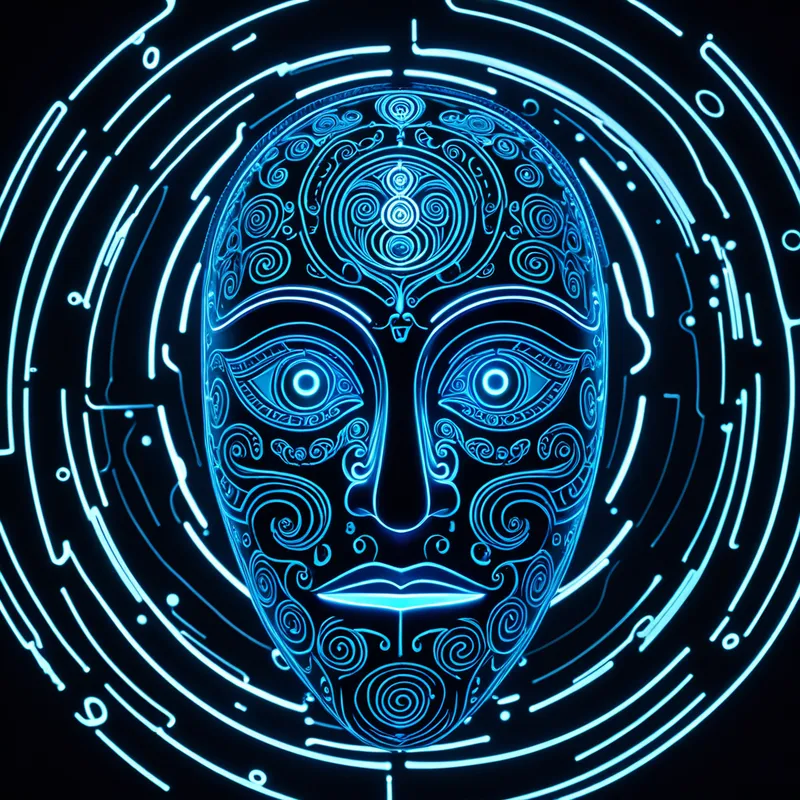
When this myth stirs in modern dreams, it often signals a profound psychological process of re-skinning—the need to shed a false or outgrown identity for one that is authentic and soul-deep. One might dream of washing away paint that will not come clean, or of feeling ashamed of superficial decorations. The dream may present a figure offering a painful but beautiful marking, or a journey downward into a creatively charged but intimidating workshop (the unconscious).
Somatically, this can manifest as a feeling of the skin being too thin, overly sensitive, or ill-fitting. Psychologically, it is the process of confronting a deep shame or moral failure (the “blow” to one’s inner values or relationships) that initiates a crisis. The dreamer is in the phase where the old ways of being (the painted persona) have failed, and the painful, meticulous work of etching a true identity from the raw material of experience must begin. It is a call to endure the necessary pain of authenticity.
Alchemical Translation
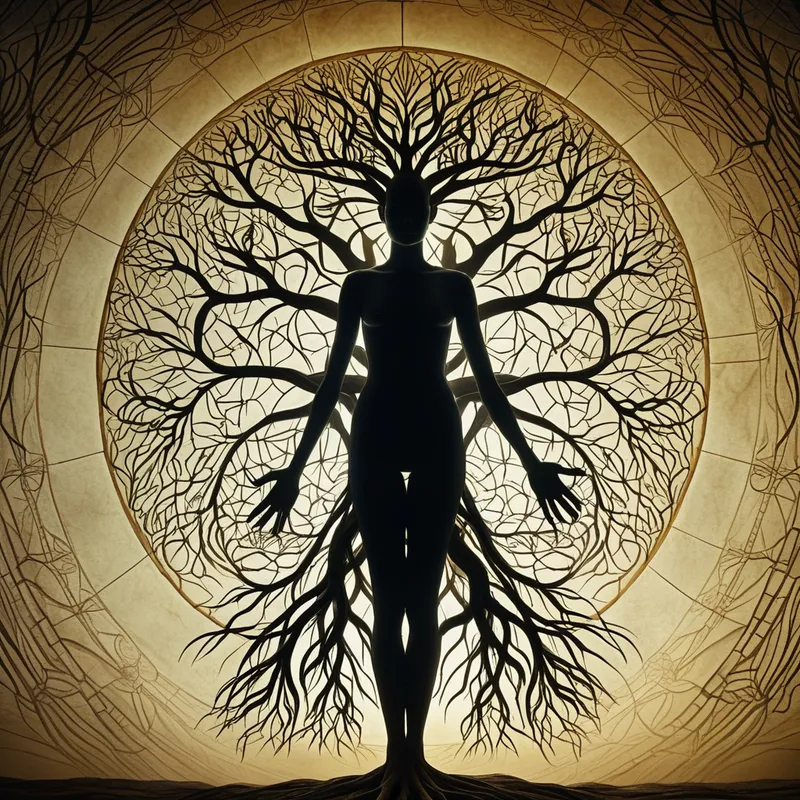
The myth models the complete arc of psychic transmutation. The base metal is Mataora’s prideful, persona-bound ego. The mortificatio (death) is his humiliation, loss, and the dissolving of his painted face. The descent is the conscious entry into the shadow realm of the unconscious (Rarohenga), where one must face the consequences of one’s actions and the awesome, demanding figures of deeper authority (Uetonga, the Self).
The chisel is the instrument of discrimination, and the pigment is the ash of what has been consciously burned away.
The tattooing itself is the albedo and rubedo—the whitening and reddening—the purification and integration. The pain is not meaningless punishment; it is the focused attention required to carve a new neural pathway, a new pattern of being. Each tap sets a memory, a lesson, a piece of reclaimed soul, into the permanent substrate of the psyche. The return to the upper world with Niwareka symbolizes the sacred marriage, the union of the transformed ego with the reclaimed anima/soul. The gift brought back—the art of tattoo—is the newfound ability to consciously shape one’s identity in alignment with ancestral truth (the patterns of the Self), turning one’s very life into a sacred text visible to the world.
Associated Symbols
Explore related symbols from the CaleaDream lexicon:
- Journey — The perilous descent into Rarohenga represents the essential psychological journey into the unconscious, a necessary voyage to retrieve lost parts of the self.
- Underworld — Symbolizes the unconscious mind, the realm of ancestors, shadow, and the eternal patterns that must be confronted for true growth.
- Tattoo — The permanent moko is the ultimate symbol of identity etched through sacrifice, a map of personal history and transformation worn on the skin, the boundary of self.
- Sacrifice — Mataora’s endurance of the painful tattooing ritual is a willing sacrifice of his old, superficial self to gain a true, enduring identity and reclaim love.
- Love — Niwareka represents the anima, the soul-guide whose loss initiates the transformative crisis and whose reconciliation marks the completion of the individuation process.
- Shame — Mataora’s act of violence and his subsequent faded paint are manifestations of deep shame, the catalytic emotion that destroys the false persona and forces the descent.
- Transformation — The core arc of the myth, moving from temporary paint to permanent carving, from prideful ignorance to humble wisdom, from a broken bond to a sacred union.
- Bridge — The art of tā moko itself becomes a bridge between the human and spirit worlds, and between the individual’s outer appearance and inner truth.
- Pain — The tattooing chisel’s bite represents the necessary, transformative suffering involved in achieving authenticity, the pain that etches wisdom into the soul.
- Memory — The permanent lines of the moko serve as an indelible memory of the journey, the error, and the covenant with the deeper self, ensuring the past informs the present.
- Pattern — The specific designs carved by Uetonga represent the archetypal blueprints of identity and order that exist within the collective unconscious, waiting to be personalized.
- Origin — The myth is fundamentally about the sacred origin of a defining cultural practice, explaining how a profound psychological truth became manifest as a physical art form.