The Origin of Coffee Arabian Myth Meaning & Symbolism
A myth where a weary shepherd discovers a sacred plant, awakening a nation from spiritual slumber through a dark, invigorating brew.
The Tale of The Origin of Coffee Arabian
Listen, and let the scent of roasted earth and distant mountains carry you back. To a time when the highlands of Abyssinia whispered secrets to the wind, and the line between the waking world and the realm of spirits was thin as a goat’s hair.
There was a shepherd named Kaldi. His days were a slow, sun-bleached circle: the climb to the high pastures, the watch over his flock, the descent under a blanket of stars. His life was the dust of the earth and the bleating of goats. But his spirit was weary, not from labor, but from a deep, unnameable slumber. The world felt heavy, draped in a veil he could not lift.
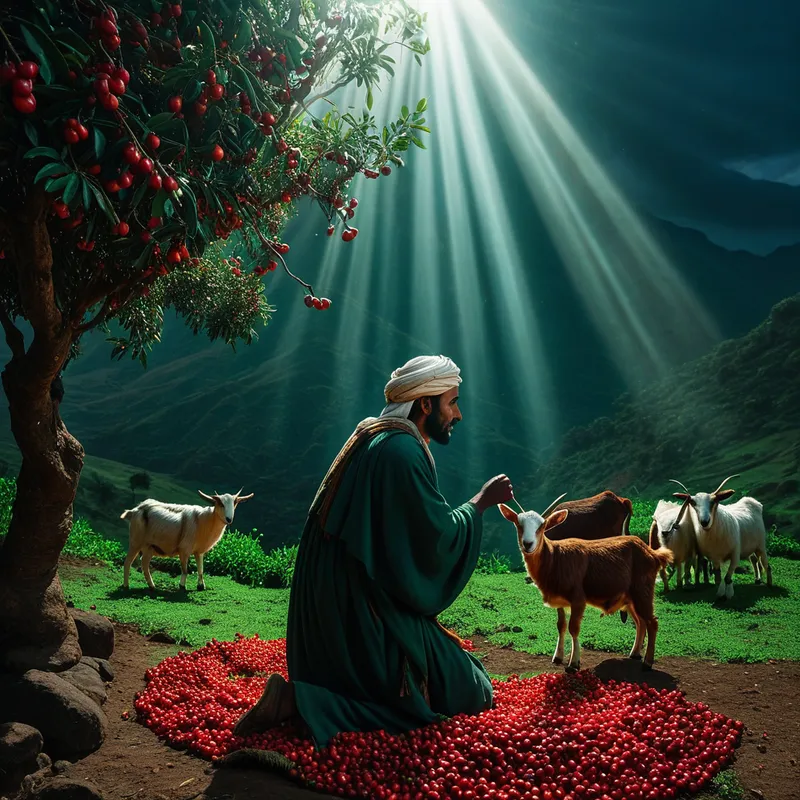
One evening, as the sun bled into the hills, Kaldi noticed a strange restlessness among his goats. They did not settle for the night. Instead, they danced—a frantic, joyous leaping around a particular bush he had passed a thousand times without seeing. Its leaves were dark and glossy, and upon its branches hung clusters of bright red berries, like tiny, forbidden suns. The goats nibbled these berries, and their eyes, usually placid pools, shone with an unnatural, vibrant light.
Cautious, yet pulled by a curiosity deeper than fear, Kaldi plucked a berry. He crushed it between his teeth. The pulp was bitter, the seeds within hard as stone. He felt nothing but the tartness on his tongue. Disappointed, he gathered a handful of the cherries and descended to his humble dwelling, the image of his dancing flock burning in his mind.
That night, sleep would not claim him. A strange energy hummed in his veins. His thoughts, usually slow and muddy, ran clear and swift like a mountain stream. The veil over the world began to thin. In the silence of his vigil, he heard it—not a sound, but a presence. A whisper from the very seeds he had discarded. It spoke of hidden fire, of a slumber that was not rest but death, and of a key to a door within the human soul.
Driven by this silent call, Kaldi took his discovery to the wise ones, the Sufi mystics in their remote monastery. He found an elder, his face a map of devotion, and poured the strange berries into his hands, stammering his tale of sleepless goats and sleepless nights. The elder, sensing a mystery, cast the berries into the fire, declaring them the work of a Shaytan, a trick to steal a man’s peace.
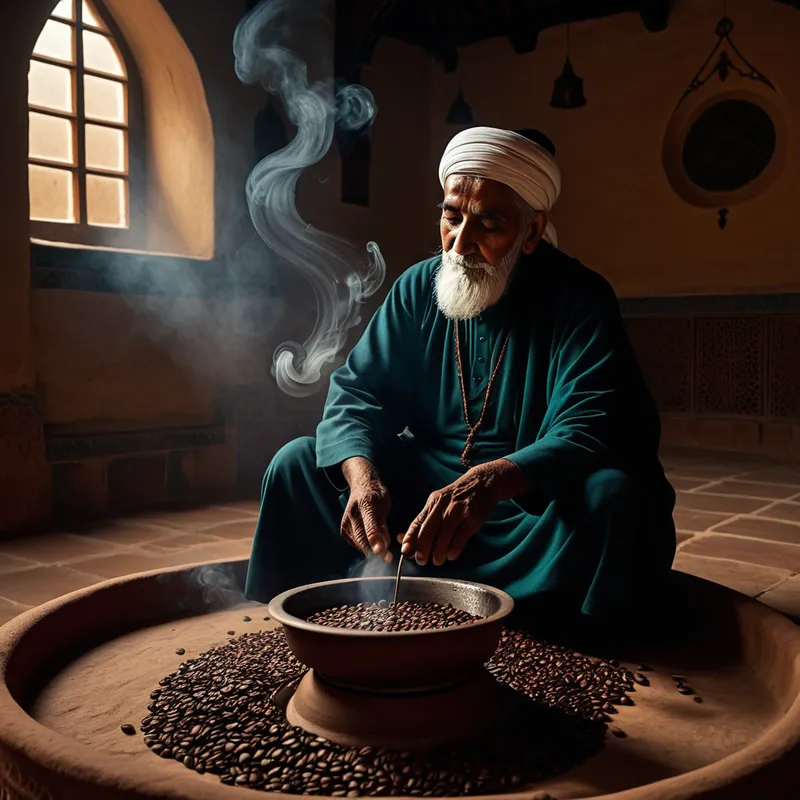
But then, a miracle. From the flames arose not the smell of burning, but a fragrance so profound it seemed to hold the very essence of memory and alertness—the rich, dark, comforting scent of roasted coffee. Intrigued, the monks raked the roasted beans from the embers, ground them into a fine powder, and steeped them in hot water.
They drank the black, bitter infusion. And as the liquid passed their lips, a different fire was kindled. Not in the hearth, but in the mind. The weight of spiritual fatigue lifted. The long nights of prayer were no longer a struggle against drooping eyelids, but a luminous journey into the heart of the divine. The veil tore asunder. They had found, in this humble bean, a sacred ally for their dhikr, a lantern for the soul’s dark night. The potion of sleeplessness had become the elixir of awakening.
Cultural Origins & Context
This origin story, while centered on the figure of Kaldi in Ethiopia, found its mythic home and deepest cultural integration in the Arabian world, particularly in Yemen. From the port of Mocha, the bean and its legend traveled on trade winds and caravan routes. It was not merely a commodity, but a narrative companion.
The tale was carried by merchants, refined by poets in the courts of the Caliphs, and sanctified by Sufi mystics in their zawiyas. For the Sufis, the myth was a lived reality. Coffee, or qahwa—a word originally denoting wine—became their “sober wine,” a tool to transcend bodily fatigue and achieve spiritual clarity during their nocturnal devotions. The story functioned as a sacred justification, transforming a potent stimulant from a suspect novelty into a gift for divine service. It was a folk etiology that answered a profound human need: to find the sacred in the everyday, to see grace in accidental discovery.
Symbolic Architecture
At its [heart](/symbols/heart “Symbol: The heart symbolizes love, emotion, and the core of one’s existence, representing deep connections with others and self.”/), this is not a [story](/symbols/story “Symbol: The symbol of ‘Story’ represents the narrative woven through our lives, embodying experiences, lessons, and emotions that shape our identities.”/) about a beverage, but about the awakening of [consciousness](/symbols/consciousness “Symbol: Consciousness represents the state of awareness and perception, encompassing thoughts, feelings, and experiences.”/) from its mundane slumber. Kaldi represents the innocent, pre-conscious [aspect](/symbols/aspect “Symbol: A distinct feature, quality, or perspective of something, often representing a partial view of a larger whole.”/) of the psyche, living in instinctual [harmony](/symbols/harmony “Symbol: A state of balance, agreement, and pleasing combination of elements, often associated with musical consonance and visual or social unity.”/) with [nature](/symbols/nature “Symbol: Nature symbolizes growth, connectivity, and the primal forces of existence.”/) but unaware of its deeper potentials. His goats, creatures of pure instinct, are the first to respond to the call of the new [spirit](/symbols/spirit “Symbol: Spirit symbolizes the essence of life, vitality, and the spiritual journey of the individual.”/)—the unconscious impulses that signal a change before the ego is aware.
The bitter bean is the hard, unprocessed truth of the psyche. It must pass through the fire of ordeal and be transformed by the vessel of culture to become nourishing.
The [bush](/symbols/bush “Symbol: The bush symbolizes hidden knowledge, nature’s beauty, and life cycles, often representing personal growth or challenges.”/) itself is a [Tree](/symbols/tree “Symbol: In dreams, the tree often symbolizes growth, stability, and the interconnectedness of life.”/) of [Knowledge](/symbols/knowledge “Symbol: Knowledge symbolizes learning, understanding, and wisdom, embodying the acquisition of information and enlightenment.”/) in the [wilderness](/symbols/wilderness “Symbol: Wilderness often symbolizes the untamed aspects of the self and the unconscious mind, representing a space for personal exploration and discovery.”/), offering not moral fall but cognitive [ascent](/symbols/ascent “Symbol: Symbolizes upward movement, progress, spiritual elevation, or striving toward higher goals, often representing personal growth or transcendence.”/). The fire of the monks is the alchemical calcinatio—the burning away of raw, chaotic nature to reveal its hidden essence. The resulting brew is the black Cup of the unknown, the liquid [shadow](/symbols/shadow “Symbol: The ‘shadow’ embodies the unconscious, repressed aspects of the self and often represents fears or hidden emotions.”/) one must drink to gain [illumination](/symbols/illumination “Symbol: A sudden clarity or revelation, often representing spiritual awakening, intellectual breakthrough, or the dispelling of ignorance.”/).

The Dreamer’s Resonance
When this myth stirs in the modern Dream, it often manifests as a somatic call to wake up. One might dream of finding a strange, potent plant in a familiar backyard, of animals behaving with uncanny intelligence, or of drinking a dark liquid that induces not intoxication, but hyper-lucidity.
Psychologically, this signals a process where latent psychic energy—repressed creativity, unused intellect, or spiritual longing—is becoming active. The “goats” are the body’s signals: restlessness, insomnia, a feeling of being “wired.” The dreamer is in the role of Kaldi, confronted with an anomaly that disrupts the sleepy consensus of their daily life. The challenge is to not dismiss this energy as demonic (a Shaytan of anxiety or distraction) but to courageously take it to the inner “monastery”—the place of contemplation and meaning-making—to be transformed.

Alchemical Translation
The myth perfectly models the early stages of individuation. First, the prima materia: the dull, suffering state of unconsciousness (Kaldi’s weary life). Then, the nigredo: the encounter with the shadowy, bitter, energizing content from the unconscious (the red berries, the sleeplessness). This is often experienced as a crisis.
The monk’s fire is the conscious engagement with this raw material. Without it, the berries remain merely disruptive; with it, they are transmuted.
The brewing is the solutio—dissolving the hardened seed into a drinkable essence, making the unconscious content assimilable to consciousness. The final stage is not a conclusion, but a new mode of being: the illuminatio. The sustained, clear-eyed engagement with one’s inner world and purpose. The modern individual’s “coffee” is any practice—therapy, art, meditation, study—that transforms restless psychic energy into focused consciousness, turning the poison of agitation into the medicine of awake presence.
Associated Symbols
Explore related symbols from the CaleaDream lexicon:
- Seed — The latent potential and hard truth contained within the coffee cherry, representing unawakened consciousness waiting for the catalyst of experience.
- Fire — The transformative ordeal of roasting, symbolizing the necessary suffering, passion, or intense focus required to reveal hidden value and essence.
- Cup — The vessel of reception and communion, representing the psyche or the ritual act of integrating the transformative “brew” of insight into one’s being.
- Awakening — The core promise of the myth, representing the shift from spiritual or psychological slumber into a state of vibrant, lucid consciousness.
- Mountain — The highland setting of the discovery, symbolizing the elevated, remote place within the psyche where profound revelations are often found.
- Goat — Instinct and untamed nature, acting as the first guide to the mysterious substance, representing the body’s wisdom preceding intellectual understanding.
- Spirit — The intangible essence invoked by the brew, representing the divine presence, heightened awareness, or the animating force of the unconscious.
- Shadow — The dark, bitter, initially rejected aspect (the bean, the sleeplessness) that holds the key to enlightenment and must be integrated, not feared.
- Tree — The coffee bush as the giver of knowledge and sustenance, a natural altar where the mundane world offers a gateway to the sacred.
- Dream — The state of heightened awareness and vision induced by the brew, mirroring the myth’s function as a map for navigating the unconscious.