The Orange Myth Meaning & Symbolism
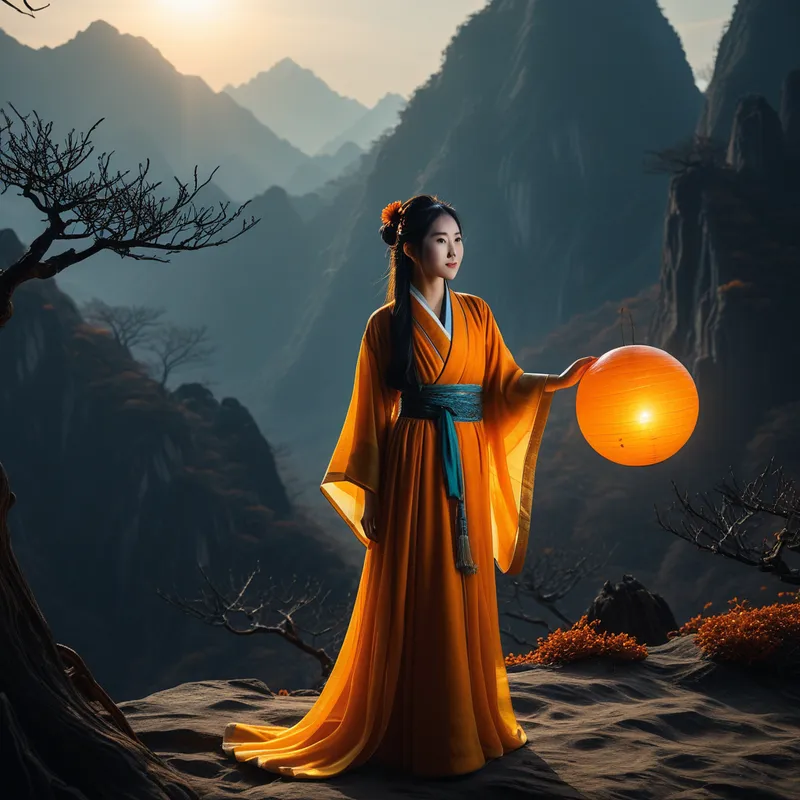
A celestial maiden descends, steals a sun-orange to save a dying land, and is transformed, seeding the world with golden light and bitter-sweet memory.
The Tale of The Orange
Listen, and hear the whisper that rides [the wind](/myths/the-wind “Myth from Various culture.”/) from the eastern peaks. In the time before time, when [the sky](/myths/the-sky “Myth from Persian culture.”/) was a tapestry freshly woven by the Nüwa, there existed a grove unseen by mortal eyes. This was the Jade Orchard of [Xi Wangmu](/myths/xi-wangmu “Myth from Chinese culture.”/), where trees bore fruit not of flesh, but of captured light. Their branches hung heavy with globes of condensed dawn, midday brilliance, and twilight ember—oranges that were not food, but frozen suns.
In the mortal realm below, a great shadow had fallen. A creeping cold, born not of season but of spirit, stole the warmth from the soil and the light from men’s hearts. Crops withered, rivers slowed to grey sludge, and a silence, thick as wool, smothered laughter. The people called to the heavens, but their prayers seemed to freeze and shatter before they could rise.
In the highest court of the [Jade Emperor](/myths/jade-emperor “Myth from Chinese culture.”/), a young celestial maiden, Si Chen, attended the stars. She was a weaver of subtle light, but the cries from below pierced her serene duty. Gazing down, she saw not just dying land, but dying hope—a shadow threatening to extinguish the inner flame of humanity itself. A forbidden thought took root: the Orchard’s fruit.
Her descent was a theft of silence. She slipped past the slumbering stone lions and into the grove. The air hummed with celestial power. There, she found it: a fruit burning with a core of pure, white-gold noon. To touch it was to hold a heartbeat of heaven. As her fingers closed around the warm peel, the entire orchard shuddered; a silent alarm rang through the pillars of heaven. The theft was known.
She fell not like a meteor, but like a leaf, cradling the stolen sun against her spirit. [The shadow](/myths/the-shadow “Myth from Jungian culture.”/) on earth recoiled at her approach. Landing in the dead heart of a valley, she did not feast upon the fruit. Instead, with a strength born of desperation, she plunged the orange into the frozen earth. Light erupted—a silent, expanding dome of gold that vaporized the shadow and thawed the stone. But [the law](/myths/the-law “Myth from Biblical culture.”/) of heaven is immutable. The energy required to ignite the barren world could not come from nothing. It came from her.
As the land bloomed in sudden, miraculous spring, Si Chen felt her celestial form unravel. Her essence dissolved, merging with the radiating light. Where she stood, a new, humble tree sprouted with impossible speed, its branches budding with fragrant white blossoms that then swelled into perfect, sun-gold oranges. But these fruits were different—their rind was dimpled like mortal skin, their scent both sweet and sharp with a hint of sorrow. They held light, yes, but now tempered by the experience of the soil, the shadow, and the cost.
Cultural Origins & Context
This tale is not found in the canonical classics like the Shan Hai Jing or Fengshen Yanyi, but lives in the oral traditions of southern China, particularly in regions like Hunan and Jiangxi where orange cultivation is ancient. It is a folk myth, a minjian gushi, passed down by grandmothers to grandchildren during the harvest, or shared by farmers resting in the shade of their groves. Its function was multifaceted: an etiological myth explaining the origin of the orange’s unique sweet-bitter taste, a piece of agricultural reverence for the fruit that sustained life, and a profound moral lesson.
It served as a narrative vessel for a central, yet often unspoken, Taoist and folk Buddhist principle: that true illumination is not merely a descent of grace from above, but requires a willing descent into [the world](/myths/the-world “Myth from Tarot culture.”/) of form, suffering, and limitation. The celestial bureaucracy of mainstream myth often feels distant; this tale brings the divine into intimate, sacrificial contact with the earthly. It was a story that validated struggle and framed sacrifice not as a loss, but as a necessary transmutation for generative change.
Symbolic Architecture
The myth is a perfect symbolic [vessel](/symbols/vessel “Symbol: A container or structure that holds, transports, or protects something essential, representing the self, emotions, or life journey.”/) for the [psyche](/myths/psyche “Myth from Greek culture.”/)’s confrontation with the [shadow](/symbols/shadow “Symbol: The ‘shadow’ embodies the unconscious, repressed aspects of the self and often represents fears or hidden emotions.”/) and the process of embodying [spirit](/symbols/spirit “Symbol: Spirit symbolizes the essence of life, vitality, and the spiritual journey of the individual.”/).
The <abbr title="The garden of the Queen Mother of the West, a paradise of immortality">[Jade](/symbols/jade "Symbol: A precious stone symbolizing purity, protection, and spiritual connection, often associated with wisdom, longevity, and harmony."/) Orchard</abbr> represents the undifferentiated, pristine state of [the Self](/myths/the-self “Myth from Jungian culture.”/)—perfect, whole, and eternal, but also [static](/symbols/static “Symbol: Static represents interference, disruption, and the breakdown of clear communication or signal, often evoking feelings of frustration and disconnection.”/) and disconnected from [life](/symbols/life “Symbol: The symbol of ‘Life’ represents a journey of growth, interconnectedness, and existential meaning, encompassing both the joys and challenges that define human experience.”/)’s complexity. The oranges are pure potential, latent [consciousness](/symbols/consciousness “Symbol: Consciousness represents the state of awareness and perception, encompassing thoughts, feelings, and experiences.”/), or spiritual [energy](/symbols/energy “Symbol: Energy symbolizes vitality, motivation, and the drive that fuels actions and ambitions.”/) in its raw, unused form.
The <abbr title="A creeping spiritual cold and silence">Great Shadow</abbr> is the collective and personal unconscious when it is denied, frozen, and toxic. It is depression, stagnation, and meaninglessness—not an active evil, but an [absence](/symbols/absence “Symbol: The state of something missing, void, or not present. Often signifies loss, potential, or existential questioning.”/) of the warming, illuminating energy of the psyche.
Si Chen is the archetypal rebel who heeds the call of the suffering world over the dictates of the established order (the celestial court). She represents the individual’s awakened conscience, the part of the [soul](/symbols/soul “Symbol: The soul represents the essence of a person, encompassing their spirit, identity, and connection to the universe.”/) that can no longer tolerate the [separation](/symbols/separation “Symbol: A spiritual or mythic division between realms, states of being, or consciousness, often marking a transition or loss of connection.”/) between spiritual ideal and earthly [reality](/symbols/reality “Symbol: Reality signifies the state of existence and perception, often reflecting one’s understanding of truth and life experiences.”/).
The theft is the first, necessary act of individuation: seizing one’s own inner light from the collective paradise to which it supposedly belongs.
Her sacrifice is the core [alchemy](/symbols/alchemy “Symbol: A transformative process of purification and creation, often symbolizing personal or spiritual evolution through difficult stages.”/). She does not simply deliver the light; she becomes the medium for its transformation. The pure celestial light, by passing through her and into the “corrupted” [earth](/symbols/earth “Symbol: The symbol of Earth often represents grounding, stability, and the physical realm, embodying a connection to nature and the innate support it provides.”/), is humanized. The resulting orange [tree](/symbols/tree “Symbol: In dreams, the tree often symbolizes growth, stability, and the interconnectedness of life.”/) produces [fruit](/symbols/fruit “Symbol: Fruit symbolizes abundance, nourishment, and the fruits of one’s labor in dreams.”/) that is both luminous and earthly, sweet and bitter. This is the [symbol](/symbols/symbol “Symbol: A symbol can represent an idea, concept, or belief, serving as a powerful tool for communication and understanding.”/) of the integrated psyche: wholeness that includes, rather than excludes, the shadows of experience, cost, and [mortality](/symbols/mortality “Symbol: The awareness of life’s finitude, often representing transitions, impermanence, or existential reflection in dreams.”/).
The Dreamer’s Resonance
When this myth stirs in the modern dreamer, it often manifests as dreams of finding or stealing a radiant object in a forbidden place—a glowing gem in an office building, a key of light in a parent’s locked drawer. The somatic feeling is one of thrilling dread and momentous purpose. Alternatively, one may dream of planting a light source—a lightbulb, a phone screen—into dark mud, and watching a strange, beautiful tree grow.
These dreams signal a critical phase in psychological development: the conscious decision to engage with one’s own “frozen” or shadowy aspects—a dormant creativity, a buried trauma, a denied need. The dreamer is the celestial maiden, and the “shadow land” is their own inner landscape of neglect. The dream affirms that the healing energy (the orange) must come from within one’s own spiritual resources (the celestial realm of the Self), but that its application will require a costly, transformative act of vulnerability and embodiment. There is a fear of punishment (the celestial law) which represents the superego’s resistance to this risky, individuating act.

Alchemical Translation
The myth of The Orange is a precise map for the Jungian process of individuation—the journey toward becoming an integrated, whole individual.
Stage 1: The Call from the Shadow (The Frozen Land). Life feels stagnant, cold, meaningless. The conscious attitude has become disconnected from the nourishing depths. This suffering is not a curse, but the call to begin the work.
Stage 2: The Theft from the Self (Stealing the Orange). This is the active, often rebellious, decision to seek renewal. It involves turning inward (ascending to the inner orchard) to claim one’s own innate potential, energy, or truth, often in defiance of internalized voices of authority or convention that say, “This is not yours to take.”
Stage 3: The Sacrificial Descent (Planting the Light). Here is the crucial, transformative phase that most spiritual bypass avoids. It is not enough to have the insight (the orange). One must invest it, at great personal cost, into the very fabric of one’s lived experience—the “dark earth” of relationships, work, body, and vulnerability. This is [the ego](/myths/the-ego “Myth from Jungian culture.”/)’s sacrifice to a larger process.
Individuation is not the preservation of the pure spirit, but the courageous contamination of that spirit with the raw stuff of life, thereby creating something entirely new.
Stage 4: The New Fruit (The Bitter-Sweet Harvest). The outcome is not a return to a pristine, celestial state. It is the creation of a new kind of life—symbolized by the earthly orange tree. The individual produces “fruit”: creative works, relationships, a way of being, that is nourishing and luminous, yet marked by the authenticity of having endured cost, limitation, and sorrow. The sweetness is earned; the bitterness gives it depth and reality. The rebel spirit (Si Chen) is gone as a separate entity, because she has become the entire, generative system. The light is now inherent in the world, not just above it.
Thus, the myth teaches that our deepest healing and creativity are alchemical. They require us to steal fire from our own divinity and bravely plant it in the darkest, most neglected soil of our souls, trusting that the death of an old form gives birth to a living, fruit-bearing truth.
Associated Symbols
Explore related symbols from the CaleaDream lexicon: