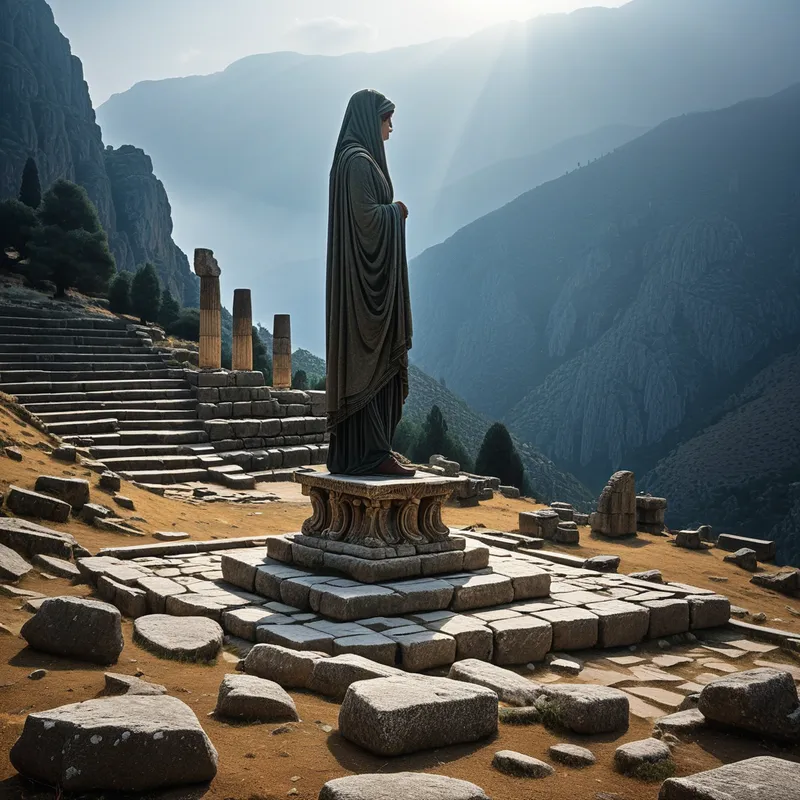
The Oracle's Tripod Myth Meaning & Symbolism
A myth of Apollo's theft of the prophetic tripod from Gaia, establishing the Delphic Oracle and the cost of divine wisdom.
The Tale of The Oracle’s Tripod
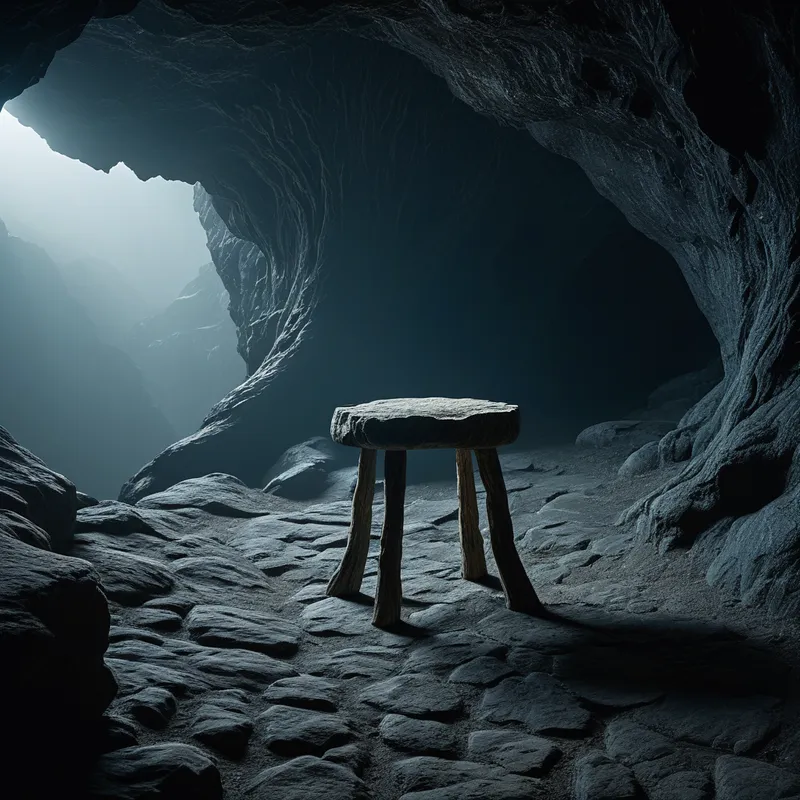
Before the gleaming columns of Delphi pierced the mountain air, the voice of the earth herself spoke from the darkness. In the deep, shadowed cleft of Pytho, where the bones of the great serpent Python would one day lie, there was only the primordial silence of Gaia. From a crack in the living rock, a strange and drowsy vapor rose, a breath as ancient as time. And beside this chasm sat a simple, three-legged stool—a tripod of gnarled wood, dark with the moisture of the deep earth.
This was the first oracle. No priestess sat upon it yet. The tripod was the seat of the earth’s own dreaming. Those brave or desperate enough to descend into that sacred gloom would sit upon the stool, breathe the intoxicating pneuma, and in their trance, the goddess would speak through them. Her words were not clear verses, but raw, guttural sounds—the groan of tectonic plates, the whisper of roots in the soil. It was a wisdom that was chaotic, fertile, and utterly inseparable from the body of the world.
Then came the one who shines from afar. Apollo, the new god, golden and terrible in his youth, descended from the bright heights of Olympus. He had slain Python, the serpent-dragon that guarded the place, claiming the site by conquest. But the power of prophecy was not his. It remained in the earth, in that humble stool beside the vaporous cleft. To speak the will of Zeus, to channel the clear, piercing light of divine law, he needed the vessel.
So, under a moonless sky, the god of light became a thief in the dark. He entered the cave, a place antithetical to his nature. The earthy scent of decay, the damp chill, the overwhelming presence of the Mother—it was a realm of a different order. There, in the silent heart of the world, he laid his hands upon the tripod. The wood, infused with millennia of chthonic power, felt alive, resistant. This was not a trophy of war, but a kidnapping. He wrenched it from its home, carrying the very seat of the earth’s voice up into the open air, into the realm of sun and reason.
He placed the tripod over the same sacred fissure, but now within a temple built by hands, ordered by geometry. He appointed a priestess, the Pythia, to sit upon it. She would breathe the same vapors, but now they were filtered through laurel leaves and ritual. The raw, earthly moans were translated into hexameter verse by priests. The chaotic wisdom of the body was formalized into the intellectual prophecy of the mind. The Oracle of Delphi was born, not from creation, but from a sacred theft—a forced marriage between the old, deep power of the earth and the new, structuring light of the sky.
Cultural Origins & Context
The myth of the tripod’s theft is not a single, canonical tale from a text like Hesiod’s Theogony, but a foundational layer of lore embedded in the very identity of the Delphic sanctuary. It represents the historical and theological shift in Greek religion from the veneration of chthonic (earth) deities to the Olympian pantheon. The story was likely part of the hieros logos, the sacred narrative told by the Delphic priests themselves to explain and legitimize Apollo’s presence at a site so obviously rooted in the power of Gaia and her daughter, Themis.
Its societal function was profound. It acknowledged the antiquity and potency of the site while asserting the new Olympian order. The myth served as a charter, explaining why prophecy at Delphi came through a process that involved both ecstatic, altered states (the legacy of Gaia’s vapors) and meticulous, rational interpretation (the domain of Apollo and his priests). It told every supplicant, from peasant to king, that the wisdom they sought was born from a primal tension—a stolen, yet necessary, fusion of opposites.
Symbolic Architecture
The tripod is the central, multifaceted symbol. As a three-legged stool, it is the ultimate symbol of stability on uneven ground—a physical manifestation of the temenos, or sacred precinct, that creates order out of chaos. Its three legs can be seen as the three realms: the chthonic (underworld), the terrestrial (mortal world), and the celestial (Olympian world). The seat itself is the point of intersection, the place where these realms meet and a human vessel becomes a conduit.
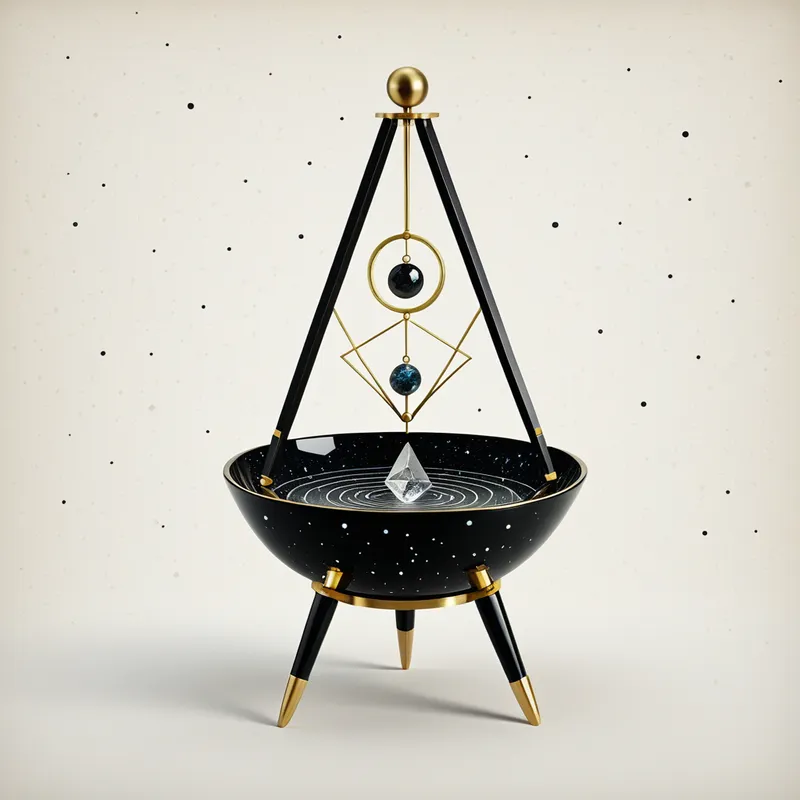
The tripod is the alchemical vessel where the raw prima materia of the unconscious (Gaia’s breath) is distilled into the conscious logos (Apollo’s prophecy).
Apollo’s theft is not merely an act of violence, but a necessary differentiation. It represents the psychic process where the emerging conscious ego (the solar principle) must separate itself from, and assert control over, the undifferentiated, all-encompassing power of the unconscious (the earth mother). This is a foundational trauma of consciousness itself—a “sacred crime” that enables culture, language, and individual identity to form, yet forever creates a longing for the lost, primal unity.
The Pythia becomes the living symbol of this reconciliation. She is the human body that must hold the tension between the deep, somatic trance and the structured, intellectual output. Her personhood is sacrificed to the role; she is the tripod made flesh.
The Dreamer’s Resonance
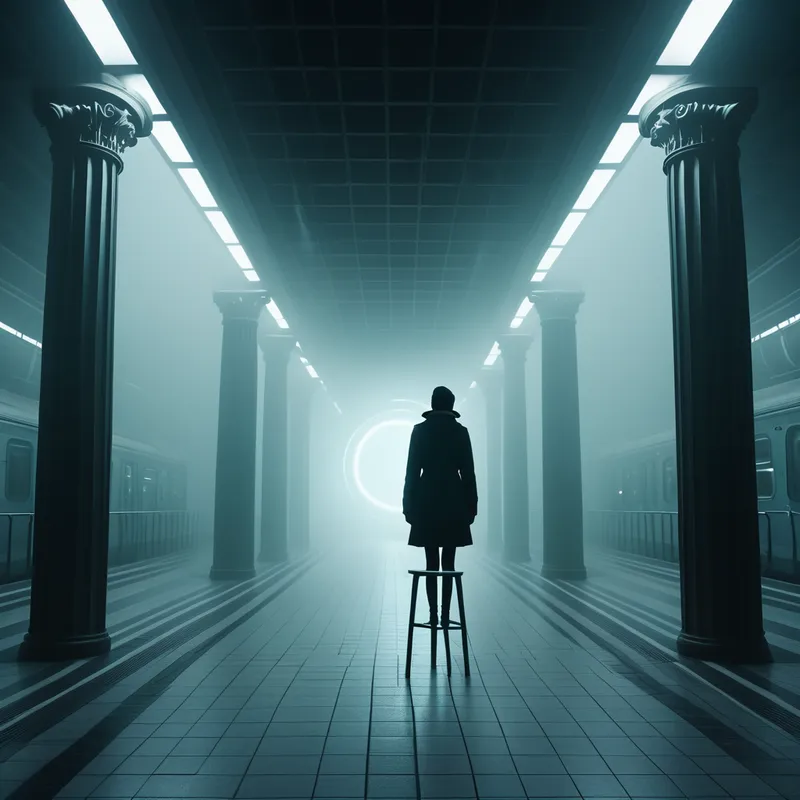
To dream of a tripod, a three-legged stool, or a sacred seat in an unexpected place is to encounter this mythic pattern in the personal psyche. It often surfaces during life transitions where one’s foundational “ground”—their career, identity, or beliefs—feels unstable or is being forcibly changed.
The dream may feature an attempt to steal or move a simple, powerful object from a dark, earthy place (a basement, a cave, a childhood home) into a brighter, more formal setting. This somaticizes the inner conflict between an old, instinctual way of knowing (a gut feeling, a deep but inarticulate passion) and the pressure to formalize, rationalize, or “make presentable” that knowledge to the world or to one’s own critical mind. The dreamer may feel like both the thief and the one being robbed, experiencing the anxiety of Apollo (am I a fraud taking what isn’t mine?) and the grief of Gaia (something deep and true has been taken from me).
Alchemical Translation
For the modern individual, the myth maps the arduous path of individuation—the process of becoming a coherent, conscious self. We all begin in a state akin to the primal cave: our early consciousness is embedded in the somatic, emotional matrix of the family and the body (Gaia). The development of a strong ego (Apollo) requires a kind of “theft.” We must take the raw, chaotic material of our innate potential, our instincts, and our deep emotions away from their purely unconscious state and bring them into the light of conscious examination and discipline.
The prophecy—your authentic voice and purpose—only emerges after the sacred crime of separating from the mother-world and enduring the guilt of that separation.
This is the alchemical separatio. The tripod is the enduring structure of the Self that can hold this tension. The initial act feels like a violation, a betrayal of what is natural and given. We may feel we are “faking it” or building our identity on borrowed power. The myth assures us this rupture is intrinsic to the process. The goal is not to return to the cave, but to become like the temple at Delphi: a constructed, sacred space where the deep vapors of the unconscious can be safely inhaled, honored, and translated into a language that can guide our journey in the sunlit world. We must, in essence, become both the thief-god and the seated priestess, mastering the art of stealing from our own depths to speak our own truth.
Associated Symbols
Explore related symbols from the CaleaDream lexicon: