The Oracle at Delphi in Greek Myth Meaning & Symbolism
A priestess, possessed by a god, breathes prophetic vapors from the world's navel, channeling divine truth for kings and commoners alike.
The Tale of The Oracle at Delphi in Greek
Listen. Before history was written on papyrus, it was breathed from a crack in the world. High on the shuddering slopes of Mount Parnassus, where eagles carve circles in the thin, clear air, there lies a place of terrible power. The earth itself is wounded here, exhaling a sweet, intoxicating breath—a pneuma—from a deep and hidden chasm. This is Delphi.
It was not always sacred to the Far-Shooter, Apollo. In the deep time of the world, the primeval serpent Python, child of the Earth Mother Gaia, coiled around the vent, its scales drinking the vapors, its hiss the only prophecy. But the young god Apollo, golden and ruthless, descended. The clash shook the mountains. His silver arrows found their mark, and Python fell, its dark blood soaking into the sacred soil. To purify himself of the miasma of slaughter, Apollo fled to the Vale of Tempe, a god in exile, and returned as a god of order. He claimed the chasm, this omphalos—the navel of the world—and built his temple upon it.
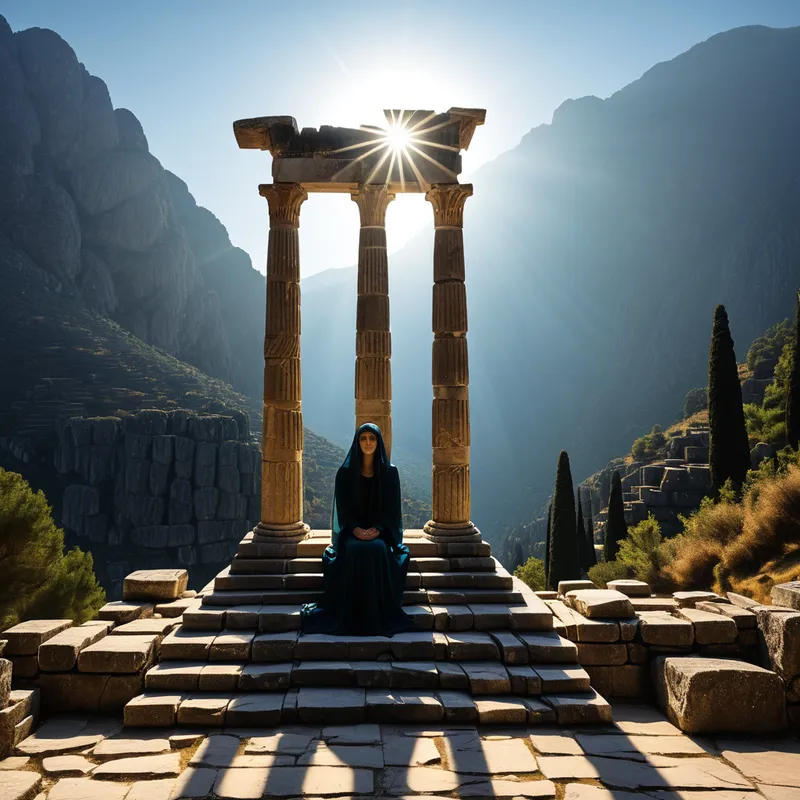
Now, the ritual begins. Far below, in the temple’s heart, the adyton, the air is thick with the smell of burnt laurel and damp stone. The Pythia has prepared. She has bathed in the Castalian Spring, chewed sacred laurel leaves, and perhaps inhaled the smoke of burning barley and hemp. She takes her seat on a three-legged stool—the tripod—placed directly over the chasm. The sweet, cloying pneuma rises, enveloping her.
A change comes over her. Her body stiffens, then trembles. Her eyes, once clear, roll back. Her breathing becomes ragged, a rasp that is not entirely her own. The god has entered. The priests, ears attuned to the divine, lean close as her mouth opens. What emerges is not the clear speech of mortals, but a torrent of guttural cries, fragmented words, and ecstatic moans. It is the raw voice of the god, untamed and chaotic.
The supplicant, a king perhaps, or a common farmer, waits in terrified hope. He has brought his rich gift, purified himself, and asked his question of the priests. Now, he hears the cacophony from the sacred chamber. The priests, the prophetai, translate the divine frenzy into hexameter verse, a riddle wrapped in the ambiguity of fate. “You will go you will return not in war you will perish,” they might chant. A life, an empire, hangs on the placement of a comma never spoken. The answer is given. It is perfect, final, and utterly opaque. The seeker departs, carrying a piece of the divine chaos, a splinter of fate he must now decipher in the world of sun and consequence.
Cultural Origins & Context
The Oracle at Delphi was not merely a story; it was a geopolitical and spiritual institution for over a millennium. Its origins are shrouded in the Mycenaean past, likely rooted in a prehistoric earth-goddess cult centered on the chasm’s intoxicating gases. The myth of Apollo’s conquest represents a historical and theological shift—the imposition of a patriarchal, Olympian order over an older, chthonic, and matriarchal power structure. This transition was never complete; the Pythia remained a woman, the vessel, and the chasm belonged to Gaia.
The oracle functioned as the central nervous system of the Hellenic world. City-states, from Athens to Sparta, and individuals like Croesus of Lydia, sought its guidance on matters of war, colonization, law, and personal guilt. The priests were savvy political operators, with networks of informants across the Mediterranean, which allowed their often-ambiguous pronouncements to be interpreted with startling worldly acumen. The myth was lived daily in ritual, reinforcing a worldview where human action was forever in dialogue with a mysterious, often inscrutable, divine will. The oracle’s authority stemmed from this very inscrutability; truth was not a simple datum, but a relationship to be navigated.
Symbolic Architecture
At its core, the Oracle represents the terrifying and necessary interface between the conscious ego and the unconscious Self. Delphi is a map of the psyche.
The Omphalos stone marks the central point, the axis mundi where the personal psyche touches the transpersonal. It is the point of connection to the deep, archetypal patterns that govern human life. The tripod of the Pythia is the unstable, mediating structure—the ritual, the therapy, the disciplined practice—that allows one to hover over the abyss without falling in.
The divine breath from the chasm is the raw, undifferentiated content of the unconscious—powerful, creative, prophetic, and potentially poisonous if approached without structure or respect.
The Pythia herself is the ultimate symbol of the anima, the inner feminine mediating principle. She is the vessel who must be possessed by the archetypal masculine spirit (Apollo) to translate the chthonic feminine whispers (Gaia’s vapors) into a form the conscious mind can apprehend. Her frenzied state is the somatic cost of this mediation; true insight from the depths disrupts the body and shatters ordinary consciousness. The priests who interpret her ravings represent the necessary function of the ego—to take the raw, symbolic material from the unconscious and attempt to give it coherent, if ambiguous, form suitable for life in the world.

The Dreamer’s Resonance
When this mythic pattern stirs in the modern dreamer, it signals a profound confrontation with inner authority and hidden knowledge. To dream of seeking an oracle is to feel a critical life question pressing from within, one that logic and external advice cannot answer.
The dream landscape may feature a mysterious, authoritative figure (often shadowy or androgynous) in a liminal space—a basement office, a cave-like room, the back of a familiar shop. This is the dream’s Pythia. The dreamer may present a question, but the answer comes in a distorted form: written in fading ink, spoken in a foreign language, or shown in a confusing symbol. The somatic resonance is key: a feeling of awe, dread, or disorientation upon receiving the message. This is the pneuma at work—the autonomic nervous system responding to the eruption of unconscious content. The dreamer is experiencing the first, raw, often chaotic revelation of a truth their psyche has been preparing. The struggle is not to get a clear answer, but to tolerate the ambiguity and begin the work of interpretation.

Alchemical Translation
The journey to Delphi models the alchemical process of solutio—dissolution—followed by the arduous work of coagulatio—re-formation. The seeker’s voyage to the temple is a conscious decision to seek wisdom beyond the ego. The purification in the Castalian Spring is the solutio, the washing away of old, rigid identities and defenses. One must become clean, empty, and humble to approach the sacred.
Entering the adyton and confronting the possessed Pythia is the plunge into the nigredo, the blackening. Here, the ego’s certainty is dissolved in the chaotic vapors of the unconscious. The clear, linear question meets a non-linear, symbolic, and terrifying response. This is the critical alchemical moment.
The oracle does not solve your problem; it shatters your understanding of the problem, forcing a psychic reorganization at a deeper level.
The return journey, wrestling with the ambiguous verse, is the coagulatio. The individual must now become their own priest, interpreting the divine fragment through the lens of their own life, experiences, and actions. The prophecy is not a fixed fate, but a field of potential. The individuation achieved is not the receiving of a simple answer, but the development of a lasting relationship with the inner oracle—the capacity to consult one’s own depths, tolerate the anxiety of not-knowing, and courageously enact the interpreted truth in the world. One does not become a passive recipient of fate, but an active co-creator with the mysterious Self. The tripod, in the end, must be built within.
Associated Symbols
Explore related symbols from the CaleaDream lexicon: