The Opening of the Mouth Ceremony Myth Meaning & Symbolism
A sacred ritual to reanimate the dead, restoring senses and spirit so the soul may eat, drink, and speak in the eternal afterlife.
The Tale of The Opening of the Mouth Ceremony
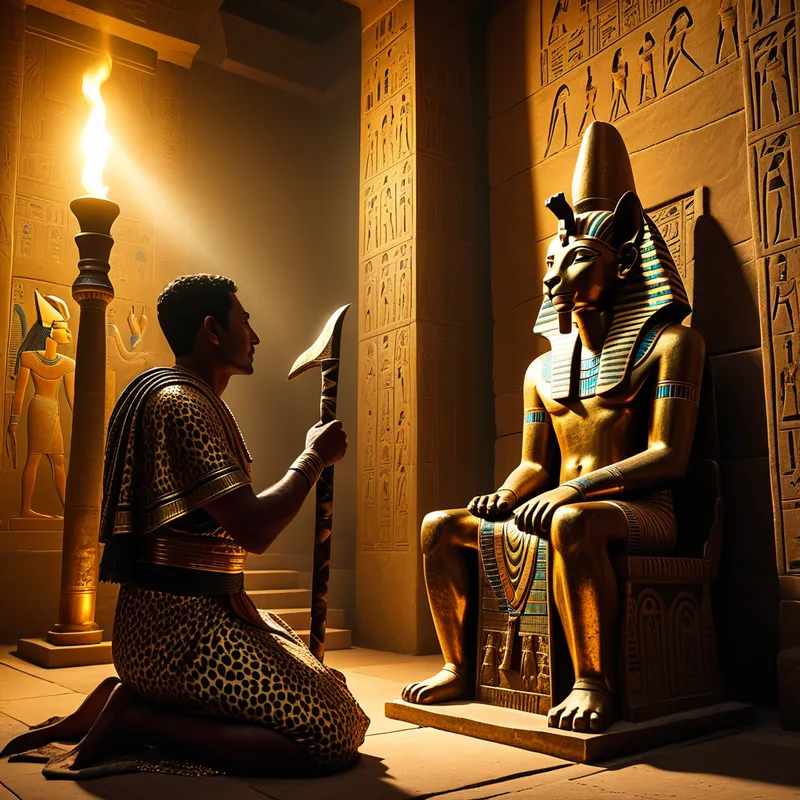
The air in the tomb is still as death, thick with the scent of kyphi incense and the memory of life. Before the silent, seated form—a statue of perfect limestone, the ka’s eternal home—a drama older than [the pyramids](/myths/the-pyramids “Myth from Egyptian culture.”/) begins to unfold. This is not a place of endings, but of a most perilous beginning.
The sem priest, draped in the spotted hide of the leopard, steps forward. His is the role of [Horus](/myths/horus “Myth from Egyptian culture.”/), the avenging son. Arrayed behind him are the kherep-heket, their voices a low hum waiting to become a spell. And presiding in the shadows, though unseen, is the weight of Anubis, he who balances the heart.
The conflict is absolute: the dead one’s senses are sealed. The mouth cannot taste the bread of [the Field of Reeds](/myths/the-field-of-reeds “Myth from Egyptian culture.”/). The eyes cannot behold the light of Ra. The ears are deaf to the hymns of the gods. The statue is perfect, yet it is a prison of silence.
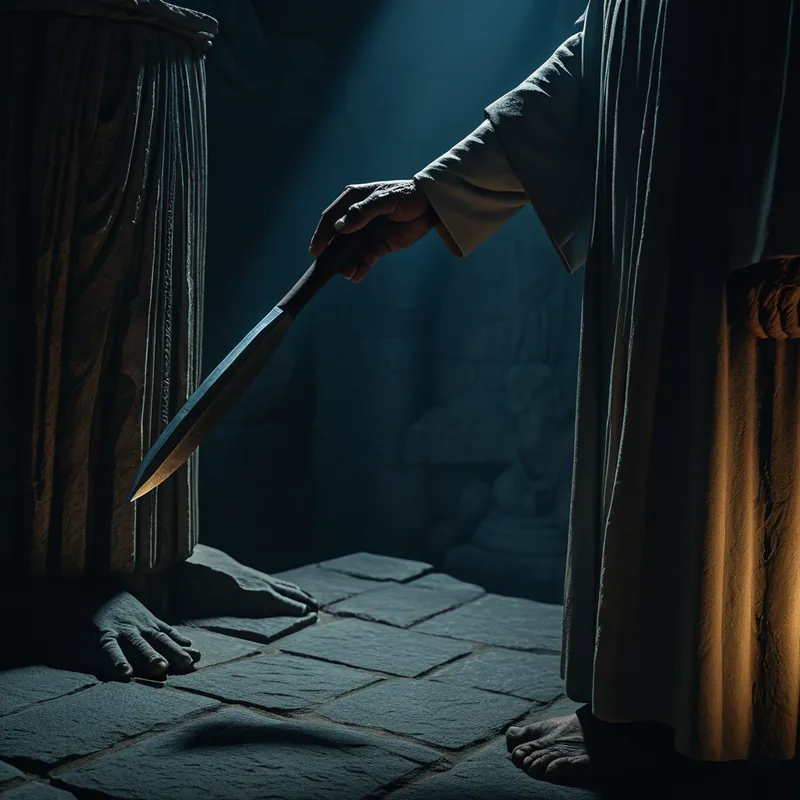
The priest raises the pesesh-kef, its blade of dark iron catching the flicker of oil lamps. It is not a weapon, but a key. He touches it to the statue’s lips—once, twice. A cold click of metal on stone echoes in the chamber. Then, he brings forth the foreleg of a sacrificed bull, still warm with the vitality so recently departed. This limb of power is pressed to the mouth. The chant rises now, a weaving of sound and intent: “Your mouth is opened! Your mouth is split open by Horus with that iron finger of his, with which he opened the mouth of the gods!”
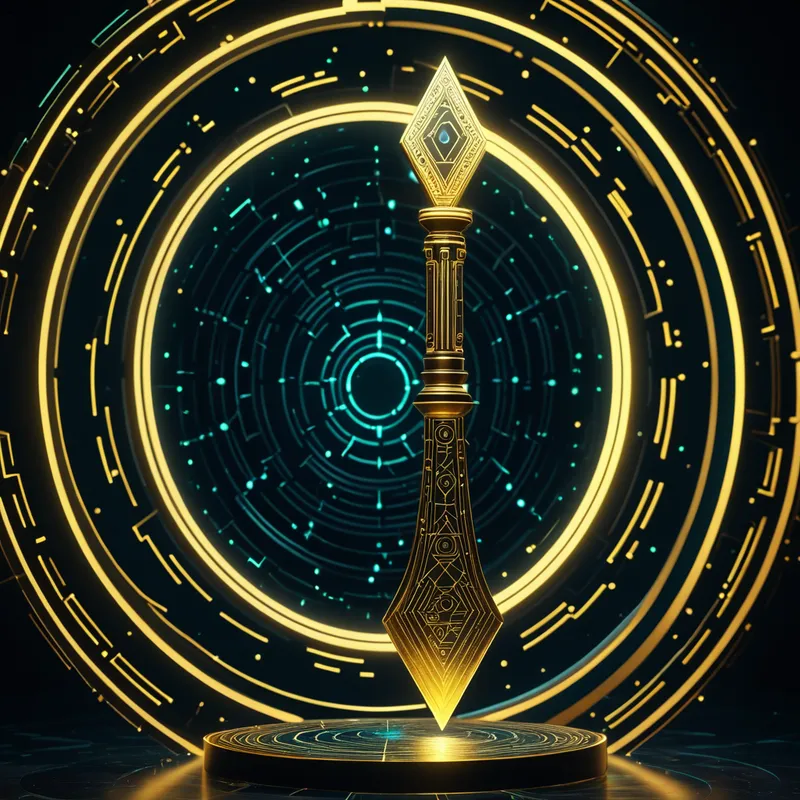
The ritual is a symphony of restoration. A serpent-shaped blade of obsidian touches the eyes. A feather brushes the ears. Each touch is an invocation, a transfer of essence. The final, sacred act approaches. The priest takes a rod of precious cedar, tipped with a hand of gold. This instrument, the ur-hekau, the “Great of Magic,” is placed between the statue’s newly opened lips. It is the conduit for the heka that will flow like [water](/myths/water “Myth from Chinese culture.”/), like breath.
And then, the resolution—a silence deeper than before, but now pregnant with potential. The statue has not moved, yet everything has changed. The incense smoke seems to curl toward it with new purpose. The bread and water laid before it are no longer mere offerings, but sustenance awaiting a recipient. The mouth is open. The senses are restored. The ba can now descend from the day sky, find its home, and live. The [journey to the west](/myths/journey-to-the-west “Myth from Chinese culture.”/) can truly begin.
Cultural Origins & Context
This was no mere myth to be told, but a vital, performed reality. The Opening of the Mouth ceremony was the indispensable climax of the Egyptian funerary process, documented in tomb walls from the Old Kingdom onward and detailed in papyri like the Book of the Dead. Its function was starkly practical in a metaphysical sense: to transfigure the inert corpse or its statue substitute into a viable vessel for the soul’s eternal life.
It was enacted by specialized priests for royalty and elite officials, though its principles filtered down through all strata of society. The ceremony was believed to have divine precedent, originating when Horus performed these rites for his murdered father, [Osiris](/myths/osiris “Myth from Global/Universal culture.”/), thus enabling his resurrection as Lord of [the Duat](/myths/the-duat “Myth from Egyptian culture.”/). By re-enacting this primordial event, the priests were not just mimicking magic; they were aligning the deceased with the ultimate template of death and rebirth, securing their place in the cosmic order ([ma’at](/myths/maat “Myth from Egyptian culture.”/)). It was society’s most profound duty to the dead, ensuring they became an akh, a “glorified one,” rather than a restless, hungry ghost.
Symbolic Architecture
At its core, the [ceremony](/symbols/ceremony “Symbol: Ceremonies in dreams often symbolize transitions, rituals of passage, or significant life events.”/) is a profound [metaphor](/symbols/metaphor “Symbol: A figure of speech where one thing represents another, often revealing hidden connections and deeper truths through symbolic comparison.”/) for the activation of potential. The mouth is the primary [gateway](/symbols/gateway “Symbol: A threshold between states, representing transition, opportunity, or initiation into new phases of life or consciousness.”/) of the [soul](/symbols/soul “Symbol: The soul represents the essence of a person, encompassing their spirit, identity, and connection to the universe.”/)—through it, one consumes [the world](/myths/the-world “Myth from Tarot culture.”/) ([food](/symbols/food “Symbol: Food in dreams often symbolizes nourishment, both physical and emotional, representing the fulfillment of basic needs as well as deeper desires for connection or growth.”/), air) and projects oneself back into it (speech, [breath](/symbols/breath “Symbol: Breath symbolizes life, vitality, and the connection between the physical and spiritual realms.”/), [spirit](/symbols/spirit “Symbol: Spirit symbolizes the essence of life, vitality, and the spiritual journey of the individual.”/)). To seal it is the finality of [death](/symbols/death “Symbol: Symbolizes transformation, endings, and new beginnings; often associated with fear of the unknown.”/). To open it is the first act of a new kind of [life](/symbols/life “Symbol: The symbol of ‘Life’ represents a journey of growth, interconnectedness, and existential meaning, encompassing both the joys and challenges that define human experience.”/).
The ritual declares that the form must be made ready to receive the spirit, that the vessel must be consecrated before it can hold the sacred.
The tools are deeply symbolic. The adze, a carpenter’s tool, frames death not as an end but as a crafting, a shaping of the spiritual [body](/symbols/body “Symbol: The body in dreams often symbolizes the dreamer’s self-identity, personal health, and the relationship they have with their physical existence.”/). The [bull](/symbols/bull “Symbol: The bull often symbolizes strength, power, and determination in many cultures.”/)’s leg represents brute life force, transferred through sacrifice. The golden rod is the ultimate [symbol](/symbols/symbol “Symbol: A symbol can represent an idea, concept, or belief, serving as a powerful tool for communication and understanding.”/) of transmitted divine power and speech. Each [action](/symbols/action “Symbol: Action in dreams represents the drive for agency, motivation, and the ability to take control of situations in waking life.”/) moves the deceased from a state of passive objecthood to active subjecthood. Psychologically, it represents the crucial [moment](/symbols/moment “Symbol: The symbol of a ‘moment’ embodies the significance of transient experiences that encapsulate emotional depth or pivotal transformations in life.”/) when an internal [structure](/symbols/structure “Symbol: Structure in dreams often symbolizes stability, organization, and the framework of one’s life, reflecting how one perceives their environment and personal life.”/)—a belief, a talent, a recovered [memory](/symbols/memory “Symbol: Memory symbolizes the past, lessons learned, and the narratives we construct about our identities.”/)—is finally “plugged in” and energized, moving from dormant [idea](/symbols/idea “Symbol: An ‘Idea’ represents a spark of creativity, innovation, or realization, often emerging as a solution to a problem or a new outlook on life.”/) to living [reality](/symbols/reality “Symbol: Reality signifies the state of existence and perception, often reflecting one’s understanding of truth and life experiences.”/).
The Dreamer’s Resonance
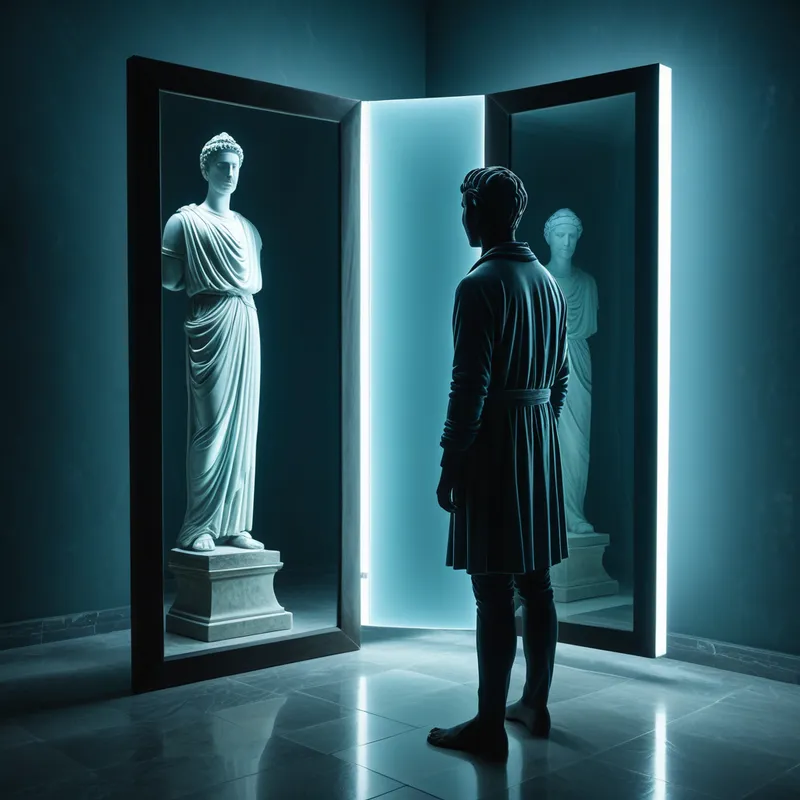
When this mythic pattern stirs in the modern unconscious, it often manifests in dreams of profound somatic or communicative frustration. You may dream of trying to scream in a crisis but emitting no sound. You may see your own face in a mirror, but your mouth is sewn shut or made of stone. You may be offered a feast but find your jaws locked tight.
These are not nightmares of mere anxiety, but of unlived potential. They signal a part of the [psyche](/myths/psyche “Myth from Greek culture.”/)—a feeling, a truth, a creative impulse—that has been “mummified,” preserved but de-animated. The psychological process is one of deep self-confrontation: what within me have I declared dead and silent? What voice have I entombed? The frustration in the dream is the soul’s protest against this state of suspended animation. It is the ka knocking from inside the statue, demanding the ritual that will set it free to partake in the world again.
Alchemical Translation
For the individual on the path of individuation, the Opening of the Mouth is the archetypal model for psychic transmutation. Our lives are littered with inner “deaths”—traumas, abandoned dreams, aspects of personality we silenced to survive. These become our inner tombs, holding statues of who we might have been.
The alchemical work is [the self](/myths/the-self “Myth from Jungian culture.”/)-performed ritual. The sem priest is the conscious ego, taking up the responsibility of healing. The adze is the tool of honest self-analysis, the careful, sometimes painful chipping away of the stony defenses we’ve built. The sacrifice of the bull is the surrender of an old, brute identity—the killing of what we thought we were to make way for what we are.
The gold-tipped rod is the authentic word, the true name we finally speak to our own soul. It is the moment of self-blessing.
The culmination is not a loud explosion, but a quiet, fundamental restoration of connection. The opened mouth allows the individual to “eat” and digest new experiences, to “drink” inspiration, and most importantly, to “speak” their own truth into existence. The integrated self is not a corpse revived, but a statue fully inhabited—a perfect, enduring vessel now animated by the full breath of the spirit. The ceremony thus maps the journey from being a passive object of fate to becoming an active subject, an akh of one’s own psyche, capable of sustaining oneself in the eternal present of a conscious life.
Associated Symbols
Explore related symbols from the CaleaDream lexicon: