The Omphalos Stone Myth Meaning & Symbolism
The sacred stone marking the world's center, dropped by Zeus to end a divine quarrel, establishing Delphi as the axis of cosmos and consciousness.
The Tale of The Omphalos Stone
Listen, and hear of the time when the world was young and unanchored, when the winds blew from no fixed quarter and the paths of gods and men were tangled and unclear. In the high halls of Olympus, a great question hung in the air, thick as incense: Where lies the very heart of the world? The navel of Gaia, the point from which all things radiate and to which all things return?
The mighty Zeus, whose will is law, sought to settle the matter. From his throne, he loosed two golden eagles, creatures of his own sovereign sight. “Fly!” he commanded. “One to the rising sun, the other to the dying light. Fly to the very ends of the earth, then turn and seek its center. Where your paths cross, there we shall mark the middle of all things.”
And so they flew. One beat its wings towards the crimson dawn, over the wine-dark sea and the lands of the rising sun. The other sped into the purple twilight, past the pillars of Atlas and into the unknown west. For days and nights uncounted they journeyed, until the curve of the world brought them back upon themselves. The air grew thin and crisp, scented with pine and rock-dust. Over the rugged, twin-peaked mass of Mount Parnassus, their shadows met and merged upon the stony ground.
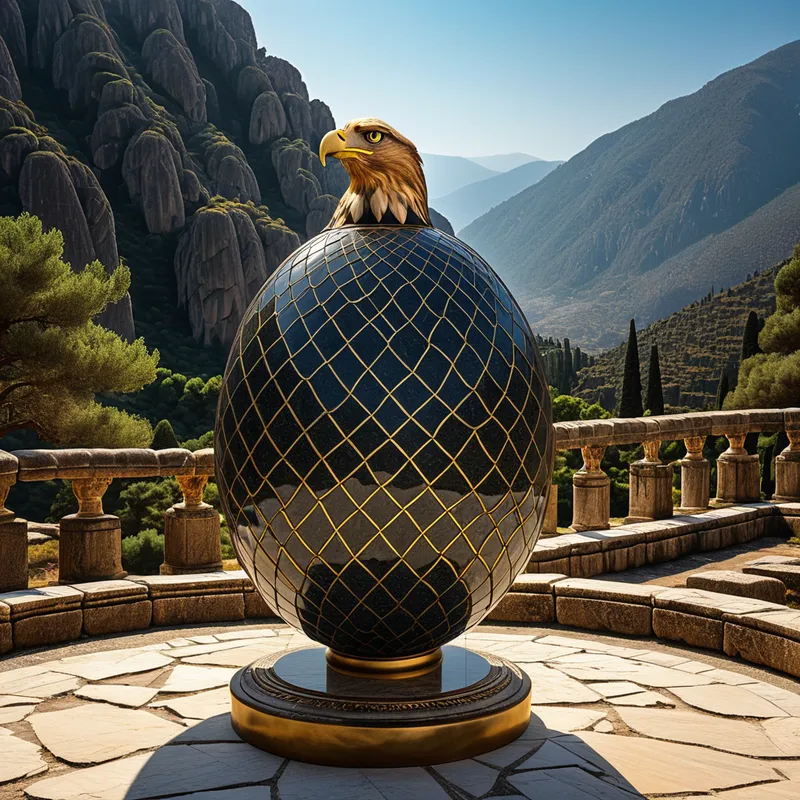
Zeus saw. And from the vault of heaven, he cast down his marker. Not a thunderbolt, but a stone. It fell not with destructive fury, but with the deliberate, final weight of a decree. It struck the earth where the eagles’ paths had crossed, on the slope of Parnassus, and there it remained. A simple, powerful thing: an egg-shaped stone, bound about with a carved woollen net, the agrenon. This was the Omphalos.
Around this stone, the very air hummed with a new potential. The wild, chthonic power of the place, once guarded by the serpent Python, was now tethered, given a axis. Here, Apollo would slay the serpent and establish his oracle. Here, upon a tripod placed beside the sacred stone, the Pythia would sit, breathing the vapors that rose from a crack in the earth beside the Omphalos. Her riddling words, inspired by the god, flowed from this very center, this fixed point in the turning world. The stone was the proof: this was no ordinary place. This was the belly-button of creation, where heaven and earth, the known and the unknown, were stitched together by divine will.

Cultural Origins & Context
The myth of the Omphalos is inextricably woven into the identity of Delphi. For over a millennium, from at least the 8th century BCE, Delphi functioned as the spiritual and geopolitical center of the Hellenic world. The stone itself was a tangible cult object within the Temple of Apollo, a physical anchor for the site’s staggering claim.
This story was not mere folklore; it was sacred geography and political theology. It was told by priests, referenced by poets like Homer and Hesiod, and understood by every city-state that sent emissaries to consult the Oracle. The myth served a critical societal function: it provided a cosmic justification for Delphi’s unparalleled authority. In a world of competing polities, having the “center” on your territory (or under your shared Hellenic stewardship) meant possessing the ultimate reference point. It transformed Delphi from a powerful shrine into the axis mundi, the place where communication with the divine was most direct because it was, quite literally, at the source.
Symbolic Architecture
The Omphalos is a master symbol of centering. It represents the establishment of order (cosmos) out of potential chaos. Before the stone falls, the world is without a definitive center—a psychologically terrifying state of pure relativity and disorientation. Zeus’s act is one of cosmic orientation.
The center is not found by searching; it is declared into being by an act of sovereign consciousness. It is the point from which all measurement begins, and thus, the point where meaning is made.
The stone’s egg-shape speaks of latent potential, the world egg from which creation emerges. The carved net that binds it is equally potent. It is the web of fate, the interconnectedness of all things, held together and contained by this central anchor. The two eagles represent the polarities of existence—east and west, dawn and dusk, beginning and end—whose reconciliation defines the center. The center, therefore, is not a place of bland averaging, but the dynamic, living point of tension where opposites are held in relationship.
Psychologically, the Omphalos symbolizes the Self in Jungian terms—the archetype of wholeness and the regulating center of the psyche. It is the internal “place” around which the complexities of personality (the ego, the persona, the shadow, the anima/animus) orbit. Without contact with this inner Omphalos, the psyche is adrift, blown by the winds of external circumstance and internal conflict.
The Dreamer’s Resonance
When the Omphalos pattern stirs in the modern unconscious, it often manifests in dreams of searching for or discovering a central object in a vast, undefined space. A dreamer might find a uniquely textured stone in the middle of an endless plain, at the heart of a labyrinth, or in the center of an empty room. There is a profound somatic sense of “coming home,” of grounding, of a deep, gravitational pull towards this object.
This dream motif signals a critical psychological process: the need for orientation during a period of disintegration or expansion. Perhaps the dreamer’s life has lost its familiar structure (a job loss, a move, a relationship ending), or perhaps consciousness has expanded through new insights, leaving the old ego-center feeling inadequate. The psyche is instinctively seeking to re-establish a new, more authentic center of gravity. The dream Omphalos is the psyche’s own declaration of a new foundational principle, a core truth around which a renewed identity can coalesce. The anxiety of the search gives way to the profound relief of finding—not a final answer, but a stable point from which to navigate.
Alchemical Translation
The individuation journey is, at its core, the process of locating and building a relationship with one’s inner Omphalos. We begin in a state of psychic diffusion, identifying with various roles, expectations, and fragments of ourselves (the uncentered world). The “eagles” of our own psyche—our conscious striving and our unconscious depths, our logical mind and our intuitive body—fly out on their separate, often conflicting, paths.
The alchemical coniunctio oppositorum occurs not by blending, but by finding the still point around which opposites revolve.
The crisis that prompts the search for meaning is the equivalent of Zeus’s decisive act. It is the moment the ego, in service to a greater totality (the Self), surrenders its claim to be the sole center and allows for the discovery of a deeper, transpersonal anchor. This is the “falling of the stone”: the often-sudden, grounding realization of a core value, a vocation, or an unshakable aspect of one’s being that had been latent.
Establishing this inner center is the work of a lifetime. We “carve the net” upon it through the work of integration—weaving our experiences, our shadows, our talents into a cohesive whole that is bound to this central truth. Like the Pythia at the tripod, when we speak from this centered place, we access a different kind of knowledge: not the ego’s opinion, but the oracle of the Self. We become conduits for insight that comes from the intersection of the personal and the universal, from the very navel of our own world. The Omphalos myth, therefore, is a timeless map for the most sacred of human journeys: the return to one’s own essential, unshakeable center.
Associated Symbols
Explore related symbols from the CaleaDream lexicon: