
The Omer Ritual Myth Myth Meaning & Symbolism
A sacred 49-day count between Passover and Shavuot, the Omer ritual mythos charts the soul's perilous ascent from the slavery of impulse to the freedom of received wisdom.
The Tale of The Omer Ritual Myth
Listen. The story begins not with a bang, but with a breath held in the throat of the world. It begins in the mud-brick dust of a broken kingdom, with the taste of bitter herbs still on the tongue and the ghost-chains of Mitzrayim still ringing in the ears. Freedom had been torn from the fist of a tyrant, a miracle of shattered water and a path through the sea. But the people stood on the far shore, not in a promised land, but in a vast and howling emptiness. They were free from, but not yet free for.
They had the memory of slavery and the shock of escape. They had manna, a bread of angels that fell with the dew. But they had no law, no shape, no name for this terrifying new breath in their lungs. The Divine Voice had promised a meeting at a mountain, a receiving. But between the miracle of the Exodus and the revelation at the mountain lay a wilderness of forty-nine days—a desert within the desert.
This is the time of the Omer. Each day became a step. Each sunset, a priest would stand before the people and, with a solemnity that hushed the camp, would count: “Today is the first day of the Omer.” “Today is the second day.” The count was not towards a battle or a harvest they could see. It was towards a mystery: the giving of the Torah at Har Sinai.
The wilderness was not empty. It was filled with the murmuring of their own souls. The ghosts of the onion pots of Egypt whispered of a simpler, fuller bondage. The vast sky accused them of smallness. Each day of the count was a struggle to shed an old skin—the skin of the slave mentality, of dependency, of chaos. They journeyed through landscapes of doubt and thirst, through the valleys of Rephidim and the shadows of Amalek. The rising action was not of armies clashing, but of a people slowly, painfully, preparing a vessel within themselves capable of holding infinite light without shattering.
On the forty-ninth day, a profound silence fell over the camp. A stillness of perfect anticipation. They had climbed, day by day, a ladder of time. And then, on the fiftieth day, the world cracked open. Not with the gentle giving of a scroll, but with a cataclysm of perception: thunder that was also a voice, lightning that was also a script, a mountain trembling like a leaf, and the unutterable Name etched into the very fabric of reality. The Omer was complete. The raw, liberated potential of the Exodus had been refined, through the fire of the count, into a vessel ready to receive its purpose. The breath held was finally released as a divine word.
Cultural Origins & Context
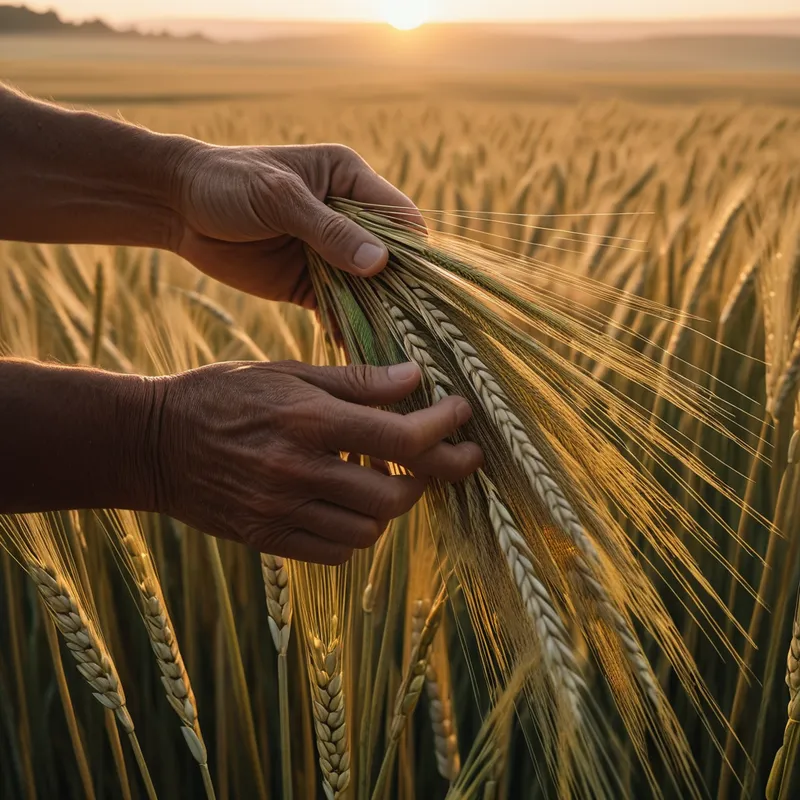
The mythos of the Omer is not a single narrative but a ritual rhythm woven into the agricultural and liturgical calendar of ancient Israel. Its origins are explicitly commanded in the Torah (Leviticus 23:9-16): from the day after the Sabbath of Passover, a sheaf (omer) of the first barley harvest is waved before the altar, and seven full weeks are counted until the festival of Shavuot. This was a deeply somatic practice for an agrarian society—tying their most basic sustenance (bread from the grain) to their most profound spiritual event (the revelation at Sinai).
It was passed down not merely by storytellers but by the entire community’s ritual body. Every individual was obligated in the count, recited nightly. The Rabbis of the Talmudic era deepened its psychological dimensions, framing it as a period of semi-mourning and intense self-refinement, linking it to the historical tragedy of a plague that struck the students of the sage Rabbi Akiva. Thus, its societal function was dual: it synchronized the community with the earth’s cycles, ensuring divine blessing on the harvest, and it synchronized each soul with a collective memory of a transformative psychic journey from degradation to dignity, from chaos to cosmos.
Symbolic Architecture
The Omer [ritual](/symbols/ritual “Symbol: Rituals signify structured, meaningful actions carried out regularly, reflecting cultural beliefs and emotional needs.”/) is a masterclass in symbolic [alchemy](/symbols/alchemy “Symbol: A transformative process of purification and creation, often symbolizing personal or spiritual evolution through difficult stages.”/). The omer of barley represents the initial, raw state of the [soul](/symbols/soul “Symbol: The soul represents the essence of a person, encompassing their spirit, identity, and connection to the universe.”/)—the first, humble harvest of freedom. Barley was often animal fodder, symbolizing our base, instinctual [nature](/symbols/nature “Symbol: Nature symbolizes growth, connectivity, and the primal forces of existence.”/) just liberated from slavery.
The journey from liberation to revelation is not a sprint but a meticulous count, where each day is a bead on the rosary of becoming.
The forty-nine days represent the exhaustive process of refinement. In Jewish mysticism ([Kabbalah](/symbols/kabbalah “Symbol: A Jewish mystical tradition focused on understanding the divine, the universe’s structure, and the soul’s journey through esoteric teachings and symbolic texts.”/)), the forty-nine days are mapped onto the seven lower [Sefirot](/symbols/sefirot “Symbol: The ten divine emanations in Kabbalah representing aspects of God and the structure of creation.”/), each interacting with the other, creating a [matrix](/symbols/matrix “Symbol: A dream symbol representing the fundamental structure of reality, consciousness, or the self. It often signifies feelings of being trapped, controlled, or questioning the nature of existence.”/) of forty-nine emotional and spiritual qualities (e.g., loving-kindness within discipline, endurance within [compassion](/symbols/compassion “Symbol: A deep feeling of empathy and concern for others’ suffering, often involving a desire to help or alleviate their pain.”/)) that must be examined and purified. The [wilderness](/symbols/wilderness “Symbol: Wilderness often symbolizes the untamed aspects of the self and the unconscious mind, representing a space for personal exploration and discovery.”/) is the psyche itself—the uncharted territory between an old, broken [identity](/symbols/identity “Symbol: Identity represents the sense of self, encompassing personal beliefs, cultural background, and social roles.”/) and a new, integrated one. Sinai is not a geographic [location](/symbols/location “Symbol: The symbol of ‘Location’ signifies a sense of place, context, and the environment in which experiences unfold.”/) but the state of conscious receptivity, the peak of [human](/symbols/human “Symbol: The symbol of a human represents individuality, complexity of emotions, and social relationships.”/) potential where the individual soul can interface with the transcendent [pattern](/symbols/pattern “Symbol: A ‘Pattern’ in dreams often signifies the underlying structure of experiences and thoughts, representing both order and the repetitiveness of life’s situations.”/).
The Dreamer’s Resonance
When this mythic pattern stirs in the modern dreamer, it often manifests as dreams of arduous, meticulous journeys. Dreaming of counting steps on an endless staircase, crossing a vast desert with a specific destination in mind, or preparing oneself meticulously for a great test or meeting. There is a somatic sense of anticipatory tension—a feeling of being in-between.
Psychologically, this signals a process of integration following a major life rupture or liberation (leaving a toxic relationship, a career change, a spiritual awakening). The initial euphoria of escape has faded, and the hard work of building a new internal structure has begun. The dreamer is in the “wilderness of the Omer,” facing the murmuring voices of old dependencies (the “onions of Egypt”) and the terrifying freedom of an unmapped future. Each day of the count in the myth corresponds to the daily, often tedious, work of therapy, mindfulness, or habit change—the slow shaping of the vessel.

Alchemical Translation
The Omer ritual is a precise map of individuation. The Exodus represents the crucial, often traumatic, break with the collective unconscious (the slavery of undifferentiated existence, of acting solely on complexes and impulses). This is the separatio.
The offering of the first, crude barley is the sacrifice of the ego’s insistence on its old, familiar form, however limiting.
The forty-nine days are the nigredo and albedo—the dark night of the soul and the washing clean. It is the conscious, deliberate scrutiny of all aspects of the personality (the Kabbalistic forty-nine gates). Each quality—our anger, our love, our judgment, our pity—must be lifted from its chaotic, reactive state and brought into a conscious, ethical relationship with its opposite. This is the hard, unglamorous work of self-knowledge.
Shavuot, the receiving of the Torah, is the rubedo and coniunctio—the reddening and sacred marriage. It is the moment when the fully prepared individual consciousness (the refined vessel) is able to receive and integrate a transpersonal, ordering principle (the Self, the archetype of meaning). The law is not received as restriction, but as the deep, inherent pattern of a now-coherent psyche. The individual is no longer a slave to inner Pharaohs or a wanderer in chaos, but a conscious participant in a cosmic order. The raw potential of liberation has been transmuted into the gold of authentic, responsible being.
Associated Symbols
Explore related symbols from the CaleaDream lexicon:
- Journey — The central motif of the Omer myth is the perilous, intentional trek through the wilderness, representing the soul’s mandatory passage from one state of being to a higher one.
- Mountain — Symbolizing Har Sinai, the mountain represents the aspirational peak of consciousness, the difficult ascent towards revelation and the encounter with the divine.
- Order — The meticulous, daily count of the Omer imposes a sacred structure on chaotic time, mirroring the imposition of cosmic law (Torah) onto the chaotic potential of a newly freed people.
- Ritual — The act of counting the Omer itself is the foundational ritual, a prescribed, repetitive practice that shapes consciousness and creates a container for transformation.
- Sacrifice — The waving of the first barley Omer is an offering of one’s initial, unrefined state, a sacred surrender of the old self to make way for the new.
- Seed — The barley sheaf is the seed of the harvest, paralleling the liberated soul as the seed of a future, mature being, requiring the gestation period of the count to sprout.
- Light — The revelation at Sinai is described in terms of overwhelming light and fire, symbolizing the illuminating, consciousness-expanding power of integrated wisdom.
- Wilderness — The essential setting of the journey, representing the liminal, undefined, and challenging psychic space where old identities dissolve and new ones are forged.
- Stone — The tablets of the law, hewn from the mountain, symbolize the permanent, enduring structure that is received once the transformative journey is complete.
- Bridge — The 49 days themselves act as a fragile but necessary bridge spanning the chasm between the slavery of the unconscious and the freedom of conscious, law-bound existence.