The Olympian Council Myth Meaning & Symbolism
The story of the twelve gods who rule from Mount Olympus, a cosmic drama of power, order, and the eternal negotiation between chaos and civilization.
The Tale of The Olympian Council
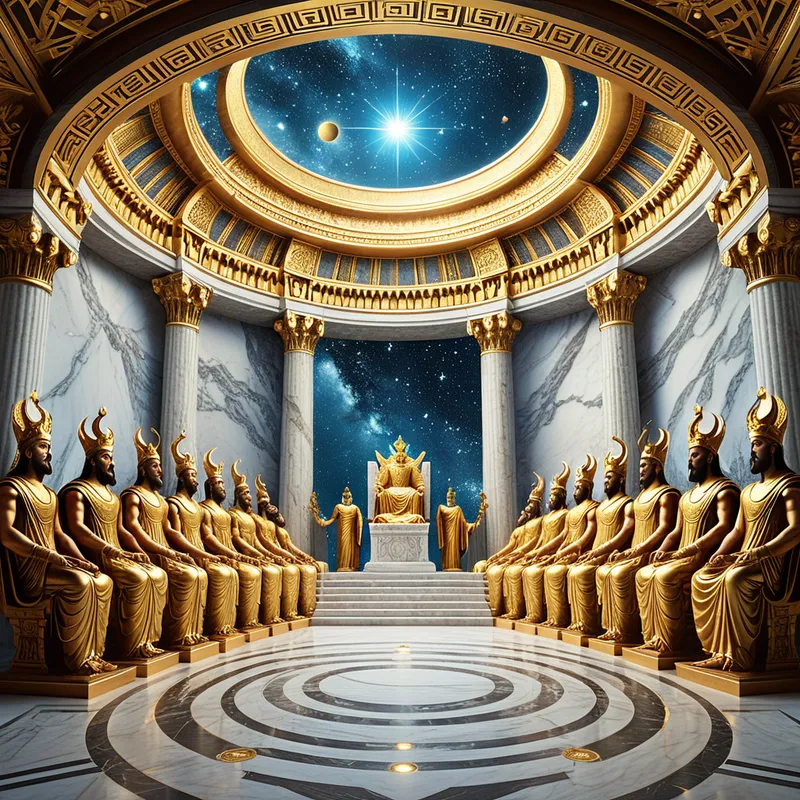
Hear now the tale of the unshakable peak, the cloud-veiled home where the air is not air but the breath of eternity. This is Mount Olympus, not of stone and soil as men know it, but a realm of shimmering ether, its foundations rooted in the world yet its spires lost in the pure idea of heaven. Here, in a hall that has no walls but the horizon itself, they gather.
They are twelve. Not a number of chance, but of completion. The air hums with the presence of the first: Zeus, whose brow is crowned with the potential of the storm, his gaze the blue of a sky moments before the crack of lightning. Beside him sits Hera, her posture regal, her eyes holding the deep, complicated love of a thousand binding oaths. There is Poseidon, who smells of salt and the abyss, his trident tapping a rhythm like distant, restless tides. And Hestia, whose presence is a silent, warming flame at the heart of the hall, the center that holds.
The others bring their domains with them. Athena enters with the scent of olive wood and the cool logic of strategy. Ares clanks in, the air growing metallic and hot. Apollo fills the space with the clear, piercing light of reason and the unseen tension of a drawn bow. Artemis moves with the silence of the forest, moonlight glinting on her silver bow. Aphrodite arrives, and the very ether seems to soften, to yearn. Hephaestus’s steady, limping gait is the sound of creation hammered into form. Hermes, wings on his sandals, is already everywhere at once, a blur of potential messages. And Demeter carries the quiet, profound patience of the turning earth.
They do not gather for petty counsel. They assemble when the fabric of the cosmos is tugged. A city below prays for victory, and the pleas pull at both Athena’s shrewd mind and Ares’ lust for tumult. A mortal king breaks a sacred oath, and the violation vibrates in Hera’s being and Zeus’s sense of justice. A new invention of fire emerges, and Hephaestus feels its spark while Hestia gauges its threat to the sacred hearth.
The council is not a vote. It is a convergence of cosmic forces. Voices rise not in shouts, but in the manifestation of their essence. Poseidon’s argument is a sudden pressure, the phantom roar of a wave crashing against the mountain’s root. Zeus’s will is the gathering charge in the air, the ozone scent of absolute authority. Aphrodite’s persuasion is a sudden, disarming memory of first love that softens a hardened heart. Through this divine parliament, the world’s fate is not decided, but negotiated—a tense, glorious, and eternal balancing act between the wild, raw powers of nature and the fragile, beautiful dream of order. Here, on the unshakable peak, the universe holds its breath.
Cultural Origins & Context
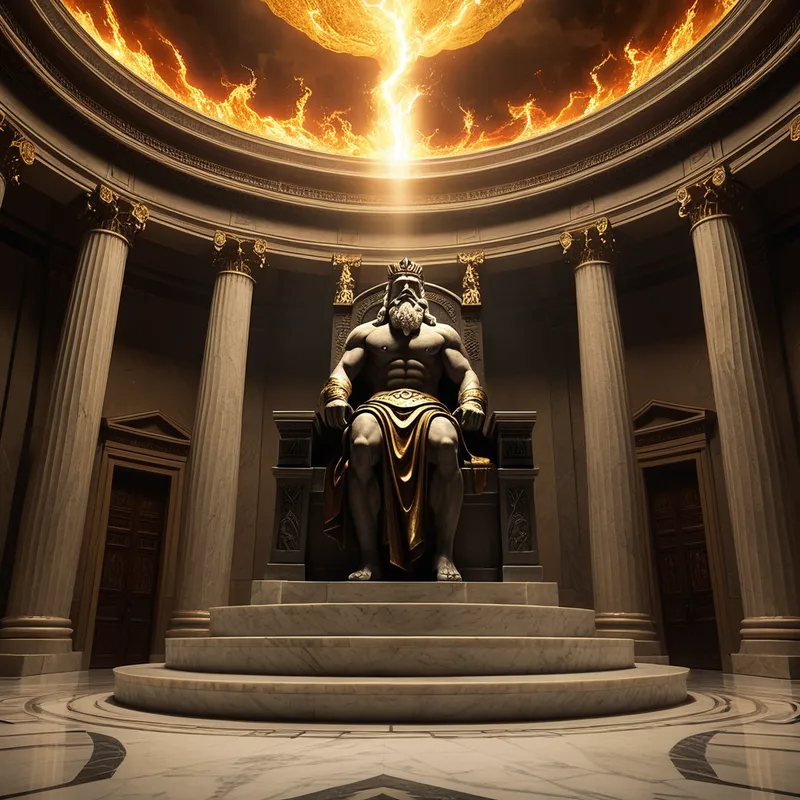
The pantheon of the twelve Olympians was not a static theological decree, but a living, breathing constellation that coalesced over centuries. Its primary sources are the epic poetry of Homer and the Hesiodic corpus, particularly the Theogony, which provided a divine genealogy and a narrative of cosmic order emerging from chaos. These stories were not scripture in a monastic sense; they were the foundational software of Hellenic culture, performed by bards at festivals, enacted in rituals, and visualized in the sculpture and pottery that filled public and private life.
The Council’s societal function was multifaceted. It modeled a polis—a city-state—in celestial form, with Zeus as its basileus (king) and the other gods as a contentious, powerful aristocracy. For the Greeks, this mirrored their own political reality, teaching that order, even divine order, was maintained through debate, alliance, conflict, and compromise. The myths explained the complexity of the world: why the sea was both nourishing and treacherous (Poseidon’s mood), why love could lead to ruin (Aphrodite’s caprice), and why wisdom was needed in war (Athena’s domain). The Olympians were the ultimate patrons, ancestors, and psychological mirrors for a people navigating a world filled with both brilliant civilization and unforgiving natural force.
Symbolic Architecture
The Olympian Council is not merely a pantheon of gods; it is a profound map of the complete human psyche, elevated to a cosmic scale. Each deity represents a sovereign, autonomous complex—a bundle of instincts, drives, and capacities—within the totality of the Self.
The Council is the psyche’s attempt to govern itself, to bring the raw, titanic forces of the unconscious into a chamber of conscious negotiation.
Zeus symbolizes the organizing principle of consciousness itself, the ego’s struggle to impose logos (order/word) on the chaos of inner and outer experience. His thunderbolt is the flash of insight, the decisive act of will that attempts to settle internal civil wars. Hera is the archetype of the committed container, the urge for lasting partnership and social structure, perpetually in tension with Zeus’s wandering, generative impulses. The conflict between them is the eternal human struggle between the desire for stable form and the urge for new experience.
The other gods represent specialized faculties: Athena (strategic intellect), Apollo (aesthetic and prophetic clarity), Aphrodite (eros and relational magnetism), Ares (raw aggression), Hephaestus (creative transformation through suffering). The Council’s drama shows that wholeness is not a state of peace, but of dynamic, often fraught, interaction between these powerful, sometimes contradictory, inner rulers.
The Dreamer’s Resonance
To dream of an Olympian Council is to experience one’s own inner parliament in session. The setting is rarely a glorious mountaintop; it may be a stark conference room, a grand but empty theater, or a circular chamber with high, unreachable windows. The dreamer is often an observer, a petitioner, or strangely, the one seated in Zeus’s empty throne, feeling utterly unprepared.
The somatic experience is key: a pressure in the chest (Hera’s justified grievance), a buzzing tension in the air (Zeus’s unresolved decision), a cold, analytical clarity (Athena’s presence), or a destabilizing wave of attraction or repulsion (Aphrodite’s influence). The dream signifies a critical point of internal conflict where major life decisions—career, relationship, creative direction—are being “ruled on” by autonomous parts of the self. You are not making a choice; you are witnessing the factions of your own soul debate it. The anxiety of the dream is the ego’s fear of being overthrown or rendered irrelevant by these more powerful, archetypal forces.

Alchemical Translation
The individuation process, the journey toward psychological wholeness, is mirrored precisely in the myth of the Olympian ascent. It begins with the overthrow of the Titans—the chaotic, undifferentiated, and often overwhelming drives of the primal psyche. The establishment of the Council represents the heroic, ongoing work of building a conscious structure capable of housing these immense powers.
Individuation is not the victory of one god over the others, but the construction of a viable Olympus within—a psychic space where all inner deities can be acknowledged, heard, and integrated into a functioning whole.
The modern seeker’s task is not to worship these archetypes externally, but to host them internally. This is the alchemical translation: to recognize the Ares within when rage flares, and to give it a voice in the council rather than letting it sack the city of the self. To honor the Hephaestus when creative labor feels like a limping, sweaty ordeal that transforms raw material into something of worth. To consult the Athena before strategic moves, and to acknowledge the Demeter during periods of fallow waiting and grief. The goal is to move from being a pawn of these forces (a mortal toyed with by the gods) to becoming the steward of the council itself—a Zeus-consciousness that does not tyrannize the other gods, but provides a space for their necessary, tumultuous, and creative governance. The ultimate triumph is not a static peace, but the capacity to hold the divine debate, to bear the lightning, and to rule the inner cosmos with a blend of authority, justice, and humility.
Associated Symbols
Explore related symbols from the CaleaDream lexicon: