
The Ogham Trees Myth Meaning & Symbolism
A myth where the first druid, wounded by poetry, carves a sacred alphabet from the names of trees, weaving language, nature, and soul into one.
The Tale of The Ogham Trees
Listen. In the time before memory, when the world was a song still being sung, there was a silence in the heart of the great forest. The trees, the Dair, the Beith, the Fearn, all stood in deep communion, their roots woven with the secrets of the earth, their crowns holding conversations with the stars. But humankind, newly come and trembling, heard only the wind.
Among them was a man named Ogma, whose mind was a clear pool reflecting the patterns of hawk-flight and river-current. He was a seeker, a listener in the green gloom. Yet, for all his listening, the speech of the world remained a beautiful, frustrating murmur. He yearned not just to hear, but to know, to fix the flowing wisdom into a form that could be held, shared, and remembered.
One evening, as the sun bled into the west, Ogma walked the forest edge, his spirit heavy with this longing. From the nemeton came a sound—not bird, nor beast, nor breeze. It was the sound of the forest’s own soul, a poetry so pure and piercing it was a physical force. It struck Ogma not in the ear, but in the breastbone. He fell to the moss, breathless, as visions of root-tendrils seeking dark water and sap rising like star-milk flooded his mind. The poem was a gift, but also a wound—a sublime burden.
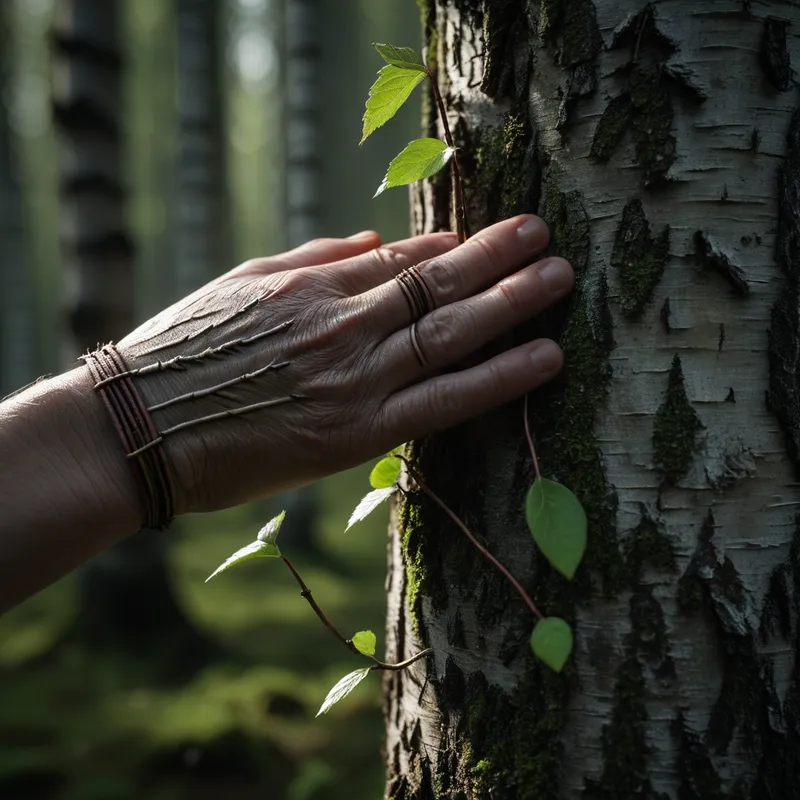
For three days and nights, he lay in a fever-dream, the unspoken poem burning within him. On the fourth dawn, weak but lucid, he understood. The poem could not be spoken with a human tongue. It needed a body of its own. Stumbling to a young Huath, he took his knife. Not to harm, but to midwife. Thinking of the first tree, the pioneer Beith, he carved a single straight line along the sapling’s edge. The mark felt true. He named it for the tree.
And so he journeyed, guided by the lingering echo of the forest’s song. To the Saille by the water, he gave a mark of curves, for flexibility. To the steadfast Dair, he gave a strong, central stave. For each tree, he listened, felt its essence—its medicine, its character, its place in the great turning—and found a shape to match. He carved on wood and stone, his hand moving with a rhythm older than his own heartbeat. He was not inventing, but translating; revealing an alphabet that had always been there, waiting in the grain and the growth.
When the last mark, for the Ioho, was carved into the dark, eternal wood, a great sigh passed through the forest. The silence was gone, replaced by a new, resonant hum. The trees now had a voice in the world of men. Ogma, his life-force spent in the giving of this gift, smiled. He had taken the wound of inspiration and transformed it into a key. The song was now a script. The secret was now a seed, ready to be planted in the soul of any who would learn to read the living world.
Cultural Origins & Context
The myth of the Ogham Trees springs from the rich, oral tapestry of the early Irish and broader Celtic world. It is not a single, standardized narrative from one text, but a coalescence of lore surrounding the origin of the Ogham script. Our primary sources are later medieval manuscripts, like the Lebor Báile an Mhóta and the Auraicept na n-Éces, which sought to preserve and systemize a tradition already ancient and mystical.
This myth was the domain of the fili (poet-seers) and the druids. For them, it was not merely an etiological story about writing. It was a sacred charter that rooted human language, law, and knowledge directly in the animate landscape. The society that cherished this myth saw no firm boundary between culture and nature. Every tree was a repository of specific wisdom—legal (the ash for law), protective (the hazel for wisdom), funerary (the yew for eternity). To learn the Ogham was to learn the forest, and thus to learn the hidden structure of reality itself. The myth functioned as a mnemonic map, a pedagogical tool, and a profound philosophical statement: true knowledge is ecological, emerging from relationship with the living world.
Symbolic Architecture
At its core, the myth presents language not as a human invention, but as a revelation from the more-than-human world. Ogma’s role is that of the mediator, the one who can withstand the overwhelming influx of the numinous (the “wound”) and labor to give it a tangible form. This is the archetypal act of the culture-bringer.
The first alphabet was not a tool for domination, but a bridge for communion. Each letter is a pact with a living entity.
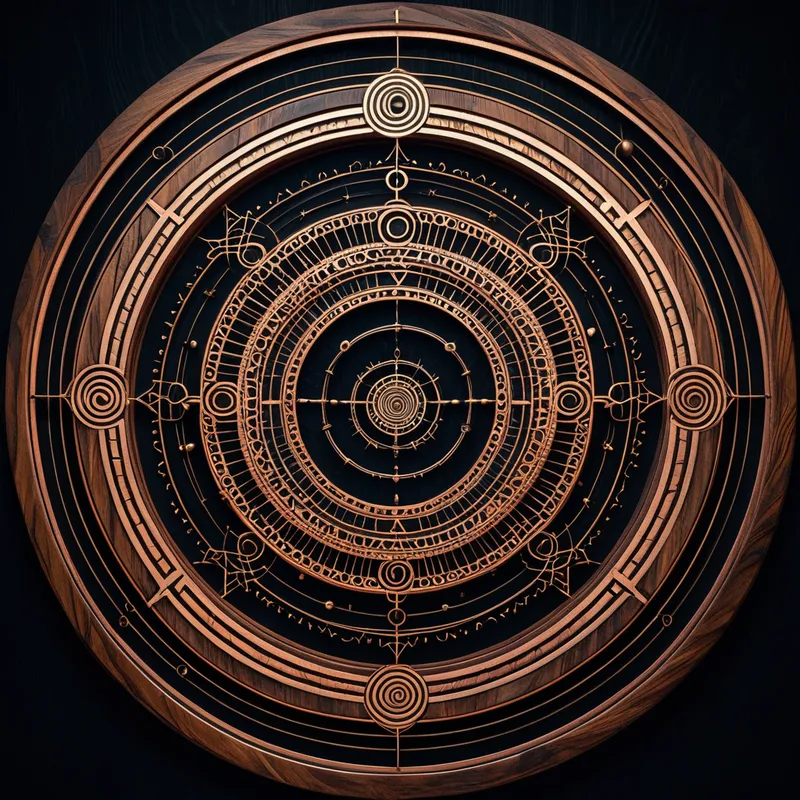
The trees represent the fundamental archetypes of existence. The Beith is the archetype of beginnings, purification, and potential. The Dair is the archetype of strength, sovereignty, and endurance. The Coll is the archetype of wisdom, inspiration, and poetic insight. Together, the twenty (or more) feda form a complete symbolic cosmology. The act of carving is crucial—it is a sacrifice. Ogma invests his own vitality into the inert material to awaken its latent voice. This mirrors the psychological process of making the unconscious conscious: it requires effort, focus, and a portion of one’s own psychic energy to bring a hidden content into the light of awareness.
The Dreamer’s Resonance
When this myth stirs in the modern psyche, it often manifests in dreams of forests where trees communicate, of finding mysterious inscriptions on natural objects, or of a pressing, beautiful sound that one struggles to articulate. Such dreams signal a profound turning point: the unconscious is ripe with a new form of understanding that seeks expression.
The somatic feeling is often one of pressure in the chest or throat—the “unspoken poem” of Ogma. This is the psyche’s innate knowledge, its organic wisdom, pushing against the confines of habitual thought and language. The dreamer may be on the cusp of formulating a personal philosophy, discovering a creative voice, or integrating a deep intuitive knowing that defies everyday logic. The dream-forest represents the lush, complex, and often chaotic totality of the inner self. The search for the “right tree” or the “correct mark” symbolizes the search for the precise inner archetype or emotional truth that can accurately carry this new consciousness into the world.

Alchemical Translation
The journey of Ogma is a perfect model for the alchemical process of individuation. The initial state is one of longing and separation—the conscious mind aware of a greater wisdom but unable to grasp it. The “wounding by poetry” is the nigredo, the dark night of the soul, where the ego is overwhelmed by the contents of the unconscious. This is a necessary dissolution.
The long pilgrimage to each tree is the albedo, the whitening, the laborious work of distillation and discrimination. Here, the psyche must differentiate its components. Which inner “tree”—which complex, which archetypal energy—holds the shape for this feeling? Is this current challenge one of resilient Dair or adaptable Saille? The carving is the citrinitas, the yellowing, the application of will and craft to give form to the insights.
Individuation is the carving of one’s own Ogham. Each life experience becomes a stroke on the stave of the soul, spelling out a unique name known only to the Self and the world that inspired it.
Finally, the completed alphabet and its resonant hum signify the rubedo, the reddening, the creation of the philosopher’s stone. This stone is the integrated Self, a psyche that has built a living language to navigate between the inner wilderness and the outer world. The myth teaches that our deepest wisdom is not self-generated; it is received from the animate universe, from the body, from the ancestral layers of the mind. Our task, like Ogma’s, is the sacred craft of listening, suffering the inspiration, and then undertaking the patient, loving work of translation—carving our own unique script from the names of the inner trees that guide us home.
Associated Symbols
Explore related symbols from the CaleaDream lexicon: