The Ogham Script Myth Meaning & Symbolism
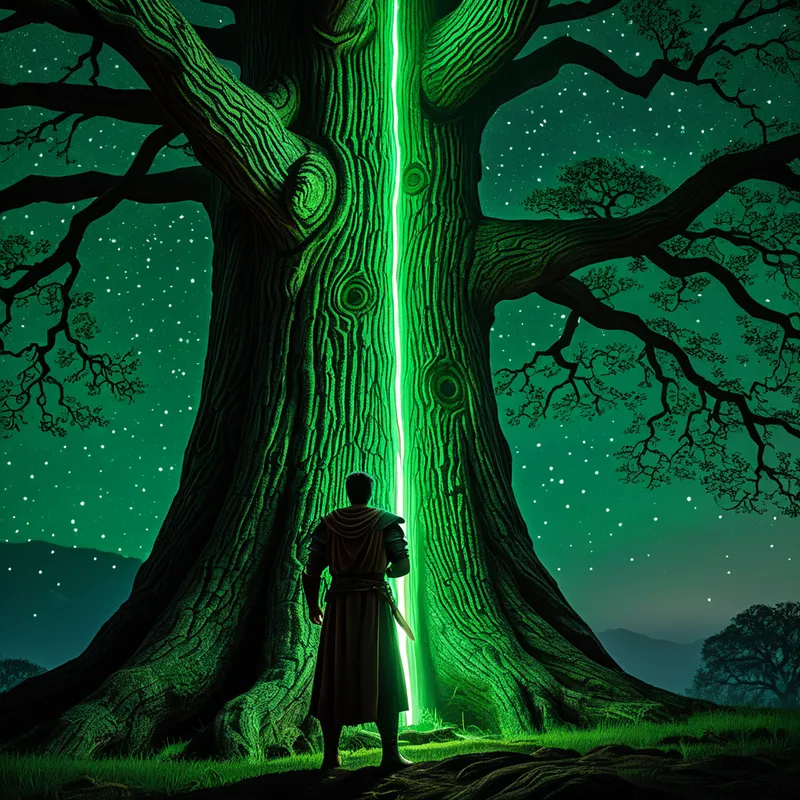
The god Ogma carves a secret script into the world tree, creating a language of memory that bridges the human and divine realms.
The Tale of The Ogham Script
Listen now, and let the fire’s crackle become the rustle of leaves in a sacred grove. In the time before memory hardened into history, when the world was a conversation between the seen and the unseen, there lived a god whose strength was in his arm and whose wisdom was on his tongue. His name was Ogma, Sun-Face, champion of the Tuatha Dé Danann.
Yet a shadow had fallen upon the land. The old ways of knowing—the songs sung from heart to heart, the lore whispered from elder to child—were fading like mist under a rising sun. The great Fir Bolg and the mighty Fomorians spoke in grunts and threats, a language of possession and power, not of meaning. The divine truths, the names of the winds, the secret histories of the stones, risked being lost to the relentless tide of forgetting. Ogma felt this loss as a physical ache, a silence where there should be a symphony.
He withdrew from the halls of his kin and walked the wild edges of the world. He stood on cliffs where the sea’s roar was the only speech, and in deep forests where the trees seemed to hold their breath, waiting. The answer did not come as a voice, but as a vision in the grain of the world itself. One evening, as the setting sun caught the edge of a standing stone, he saw it: a stark, beautiful line against the granite. A single notch. It was not a picture. It was a mark. A thought made permanent.
His heart hammered a new rhythm. He sought the Bile, the World Tree at the center of all things, whose roots drank from the underworld and whose branches cradled the stars. Placing his palm upon its ancient bark, he felt the hum of all life passing through it. Here, at this axis, he would make his stand against oblivion.
With the focused might he once used to wield a sword, Ogma extended his forefinger. He did not cut with a blade, but with intention itself. He pressed into the living wood, and a line of emerald light followed his touch, searing a clean, vertical stroke into the oak. This was the stem-line, the spine of a new reality. Then, with precise, decisive gestures, he carved short, perpendicular marks—one, two, three, four, five—across and through that spine. Each combination, each grouping on the left, the right, or across, was not arbitrary. It was the shape of a sound, the contour of a concept. He named each set for a tree, for the birch that heralds new beginnings, the alder that guards the mysteries of the waters, the oak that is the king of the forest.
As he carved the final Iodho, the symbol of the yew, eternity itself, the grove erupted in a silent song. The script upon the tree blazed, and its light did not fade but sank deep into the grain, becoming part of its memory. Ogma had not merely invented a tool. He had midwifed a covenant. He had given the land a tongue, and in doing so, gave his people a way to listen to the land forevermore. The secret was no longer whispered; it was written in the soul of the world, waiting to be read.
Cultural Origins & Context
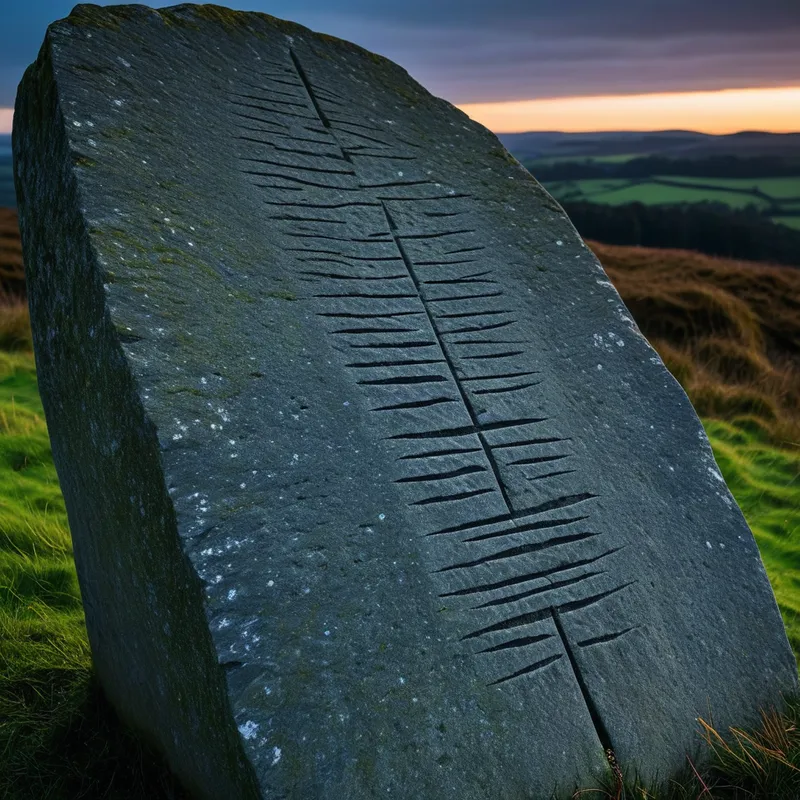
The Ogham script, as a historical reality, is an early medieval alphabet used primarily to write the early Irish language, and later Old Irish, on stone monuments. The mythological origin story, however, belongs to a much older, oral stratum of Celtic consciousness. It is preserved in the Lebor Gabála Érenn (The Book of Invasions) and other later manuscripts, where it is presented not as a human invention but as a divine revelation.
This myth was the domain of the fili, the poet-seers who were the keepers of history, law, and sacred knowledge. For them, Ogham was far more than a practical alphabet. It was a druidic tool of memory, divination, and connection. The story of Ogma’s creation served a crucial societal function: it sacralized knowledge itself. It framed literacy and memory as gifts from the gods, aligning the poet’s craft with a cosmic order. To know Ogham was to participate in that original, revelatory act, to hold a key to the hidden language of nature and the ancestors.
Symbolic Architecture
At its core, the myth of Ogham is about the birth of conscious articulation from the womb of primal, undifferentiated experience. The “shadow of forgetting” represents the terror of the unconscious, where all experiences and truths dissolve back into chaos. Ogma, as the archetypal Sage, embodies the human (and divine) impulse to rescue meaning from this flux.
The first word is not spoken; it is carved. It is the moment the fluid thought encounters the resistance of the world and chooses to leave a mark.
The Bile, the World Tree, is the ultimate symbol of the axis mundi. By inscribing the script upon it, Ogma does not create an external tool but reveals an internal structure. The Ogham becomes the neurological system of the world-soul, a visible pattern of the invisible connections that bind all things. Each letter, named for a tree or a natural concept (like “honeysuckle” or “lake”), insists that language is not abstract but rooted in the living, sensory reality of the world. The script is a map of a psyche that is ecological, where the self is a grove and every thought a specific tree with its own properties, shadows, and medicine.
The Dreamer’s Resonance
When the Ogham script appears in modern dreams, it rarely manifests as legible text. Instead, one might dream of finding strange, angular grooves in the bedpost, seeing bark peel away to reveal geometric patterns, or trying desperately to read a message carved into one’s own skin that remains just beyond comprehension.
This dream imagery signals a profound somatic and psychological process: the psyche’s attempt to encode a new, hard-won understanding. The dreamer is likely integrating a raw, overwhelming, or deeply intuitive experience into a structured form of self-knowledge. The frustration of not being able to “read” it reflects the tension between unconscious knowing and conscious articulation. The body (the bedpost, the skin) as the medium indicates that this knowledge is not intellectual but embodied—a truth felt in the bones, the nerves, the pulse, now seeking its own alphabet to become communicable, even if only to the self.

Alchemical Translation
The alchemical journey modeled by the Ogham myth is the transmutation of prima materia—the chaotic, mute substance of our unlived life and unprocessed experience—into the lapis philosophorum, the philosopher’s stone of coherent identity. Ogma’s withdrawal from society mirrors the necessary nigredo, the descent into the solitary dark night where old forms of communication fail us.
The act of carving is the albedo, the whitening. It is the conscious, disciplined work of differentiation. The dreamer, as their own Ogma, must take the vague feelings, the synesthetic impressions, the “knowing without words,” and impose a stem-line of intention upon them. Then, they must make the precise cuts: naming the emotion (the birch of new pain), identifying the complex (the alder of hidden grief), acknowledging the archetype (the oak of inner authority).
Individuation is the process of learning your own Ogham. It is carving the unique, angular glyphs of your experience onto the world-tree of your being, creating a legible scripture of the self.
The final stage, the script blazing and then sinking into the tree, is the rubedo, the reddening or completion. The newly formed knowledge does not remain a superficial tool; it becomes memory itself, woven into the very grain of the personality. The struggle is resolved not by shouting the truth, but by inscribing it so deeply into one’s foundation that it becomes the silent, supporting structure of all future thought and speech. One becomes a living monument, a standing stone upon which the story of the self is written, waiting for the right light—or the right question—to make it legible once more.
Associated Symbols
Explore related symbols from the CaleaDream lexicon: