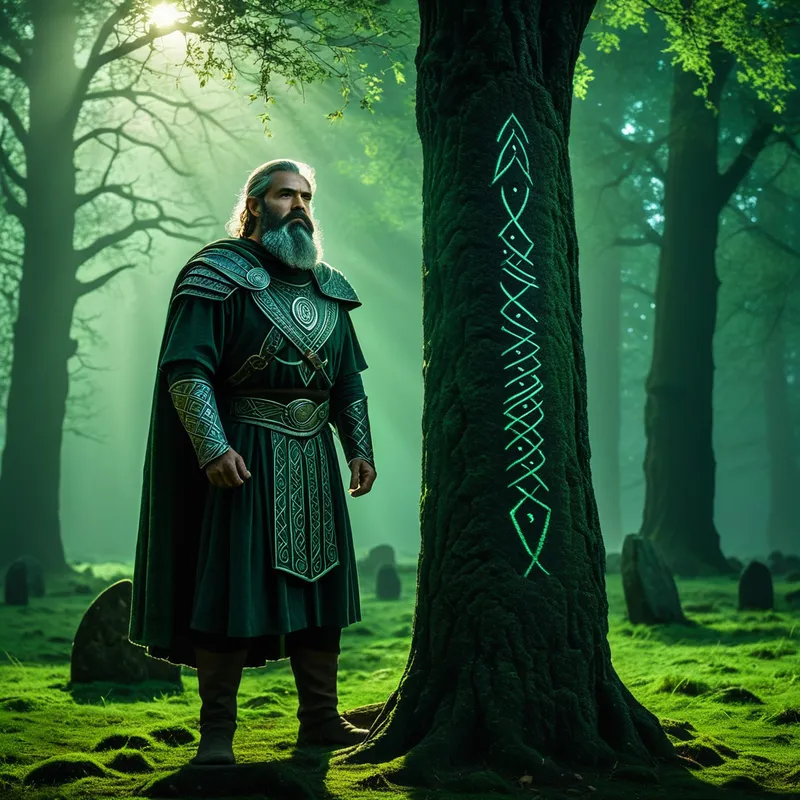
The Ogham Alphabet Myth Meaning & Symbolism
The myth of Ogma inventing the Ogham script as a secret, sacred language born from the soul of the forest and the mind of a god.
The Tale of The Ogham Alphabet
Listen now, and hear the whisper in [the wind](/myths/the-wind “Myth from Various culture.”/) through the elder branches. In the time before memory solidified into history, when [the world](/myths/the-world “Myth from Tarot culture.”/) was a conversation between gods and the green, there lived Ogma, Sun-Faced, Champion of the Tuatha Dé Danann. He was a giant of thought and muscle, whose tongue could weave spells of binding truth and whose arm could lift mountains. Yet, a silence troubled him—a silence in the space between minds.
The great king [Nuada](/myths/nuada “Myth from Celtic culture.”/) of the Silver Hand ruled from his hall, but his judgments, his laws, his glorious deeds, were at the mercy of breath and memory. They could be twisted, forgotten, lost like leaves in an autumn gale. Ogma watched [the druids](/myths/the-druids “Myth from Celtic culture.”/) commune with the spirits of oak and ash, saw the secret knowledge pass from elder to initiate in hushed tones beside [sacred wells](/myths/sacred-wells “Myth from Celtic culture.”/). This knowledge was alive, but it was fragile. It needed a vessel stronger than air, a pattern that could hold the soul of a [thing](/myths/thing “Myth from Norse culture.”/).
Driven by this need, Ogma walked away from the forts and fires of his people. He entered the [Sídhe](/myths/sdhe “Myth from Celtic / Irish culture.”/)-mounds and the deep, uncut forests where the oldest trees kept council. For nine days and nights, he fasted, leaning his brow against the trunk of a great Bile, the primal oak. He listened not with his ears, but with his bones. He heard the slow, deep song of roots drinking from the dark earth. He felt the upward rush of sap, the secret language of growth. He saw in his mind’s eye [the way](/myths/the-way “Myth from Taoist culture.”/) a branch forked in decision, the way bark cracked in patterns, the way a single, straight sapling reached for the sun.
On the tenth morning, as the first light pierced the canopy and caught the dewdrops on a [spider](/myths/spider “Myth from Native American culture.”/)’s web, the vision crystallized. The world was already writing itself. The edge of a reed against clay, the notch of a knife on a branch, the very spine of a leaf—these were the first letters. He took his dagger, its hilt carved with the faces of wisdom, and found a straight, pale stave of ashwood. Upon its edge, he began to carve.
He did not draw pictures. He made marks that were the bones of speech. A single stroke across the stave’s edge for “B,” Beith, the birch, the pioneer. Two strokes for “L,” Luis, the quicken tree of guarding flame. Three, four, five—a whole family of lines, branching left and right, climbing the vertical line like steps on a ladder or leaves on a stem. Twenty letters he carved, each one married to a tree, a plant, a elemental force. Dair the oak. Saille [the willow](/myths/the-willow “Myth from Celtic culture.”/). Ioho the yew.
As he carved the final stave, a wind swept through the grove that was not a wind. It was the sigh of the forest recognizing its own true name. [The Ogham](/myths/the-ogham “Myth from Celtic culture.”/) was born—not invented, but revealed. A secret language for the land itself, for the kings to mark their boundaries in stone, for the poets to encode their sagies, for the seers to cast their cryptic lots. Ogma returned to Nuada’s hall and laid the staves before the assembly. He spoke not a word, but simply pointed to the first stave, Beith. And in the minds of all present, the image of a slender birch in a clearing sprang forth, bright with the promise of a new start. The silence between minds was broken. The forest now had a tongue, and the gods had given it to mortals to learn.
Cultural Origins & Context
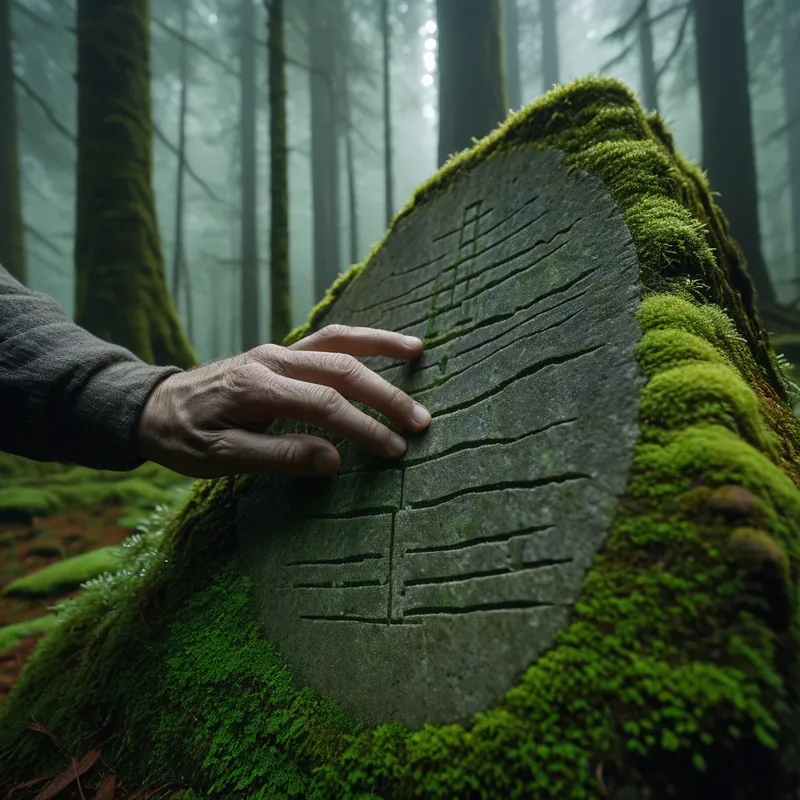
[The Ogham script](/myths/the-ogham-script “Myth from Celtic culture.”/) is a historical reality, an early medieval alphabet used primarily to write Primitive Irish on stone memorials, most famously in Ireland and western Britain. The myth of its invention, however, comes from later medieval Irish manuscripts, like the Book of Ballymote and the Book of Leinster, where scholars and scribes, steeped in both native tradition and Christian learning, sought to provide a divine or heroic origin for this enigmatic writing system.
By attributing its creation to Ogma, the myth brilliantly synthesizes several key Celtic cultural values. It ties the script to the Tuatha Dé Danann, the god-like ancestors, granting it immense prestige and antiquity. More importantly, it roots writing not in abstract geometry, but in the living, sacred landscape. In a culture where druids held trees as sacred, where every forest and hill was inhabited by spirits, the idea that the alphabet emerged from the forest was the ultimate validation. It was a “green language,” making it a fitting tool for a literate class—the Filid (poets) and Brehons (judges)—whose power derived from memorized lore and whose wisdom was seen as drawn from nature. The myth served to sacralize the act of inscription, transforming boundary markers and memorial stones into conversations with the animate land.
Symbolic Architecture
At its core, the myth of [Ogham](/myths/ogham “Myth from Celtic culture.”/)’s creation is about the [birth](/symbols/birth “Symbol: Birth symbolizes new beginnings, transformation, and the potential for growth and development.”/) of [consciousness](/symbols/consciousness “Symbol: Consciousness represents the state of awareness and perception, encompassing thoughts, feelings, and experiences.”/) from the [womb](/symbols/womb “Symbol: A symbol of origin, potential, and profound transformation, representing the beginning of life’s journey and the unconscious source of creation.”/) of the unconscious. The vertical stave is the [Axis](/symbols/axis “Symbol: A central line or principle around which things revolve, representing stability, orientation, and the fundamental structure of reality or consciousness.”/) Mundi, the individual’s [spine](/symbols/spine “Symbol: The spine symbolizes strength, support, and the foundational structure of one’s life and identity.”/) and lifeline, the [connection](/symbols/connection “Symbol: Connection symbolizes relationships, communication, and bonds among individuals.”/) between the deep [earth](/symbols/earth “Symbol: The symbol of Earth often represents grounding, stability, and the physical realm, embodying a connection to nature and the innate support it provides.”/) (the unconscious, the ancestral) and the expansive sky (conscious thought, [spirit](/symbols/spirit “Symbol: Spirit symbolizes the essence of life, vitality, and the spiritual journey of the individual.”/)). The notches are the distinct perceptions, memories, and articulations that branch off from this central core of being.
The alphabet is the first map of a differentiated world, a net of meaning cast over the formless continuum of experience.
Ogma represents the archetypal force that mediates between the undifferentiated “all” of [nature](/symbols/nature “Symbol: Nature symbolizes growth, connectivity, and the primal forces of existence.”/) and the [human](/symbols/human “Symbol: The symbol of a human represents individuality, complexity of emotions, and social relationships.”/) need for order and [expression](/symbols/expression “Symbol: Expression represents the act of conveying thoughts, emotions, and individuality, emphasizing personal communication and creativity.”/). He is [strength](/symbols/strength “Symbol: ‘Strength’ symbolizes resilience, courage, and the ability to overcome challenges.”/) (physical [effort](/symbols/effort “Symbol: Effort signifies the physical, mental, and emotional energy invested toward achieving goals and personal growth.”/) to carve) wedded to eloquence (mental effort to perceive the [pattern](/symbols/pattern “Symbol: A ‘Pattern’ in dreams often signifies the underlying structure of experiences and thoughts, representing both order and the repetitiveness of life’s situations.”/)). The [forest](/symbols/forest “Symbol: The forest symbolizes a complex domain of the unconscious mind, representing both mystery and potential for personal growth.”/) is the unconscious [pleroma](/symbols/pleroma “Symbol: In Gnostic cosmology, the Pleroma is the divine fullness or totality of spiritual powers, representing the realm of perfection beyond the material world.”/)—teeming with [life](/symbols/life “Symbol: The symbol of ‘Life’ represents a journey of growth, interconnectedness, and existential meaning, encompassing both the joys and challenges that define human experience.”/), intelligence, and potential, but without distinct form. Ogham is the act of naming, which in psychological terms is the act of making the unconscious conscious. Each [tree](/symbols/tree “Symbol: In dreams, the tree often symbolizes growth, stability, and the interconnectedness of life.”/)-[letter](/symbols/letter “Symbol: A letter symbolizes communication, messages, and the sharing of thoughts and feelings.”/) is a complex [symbol](/symbols/symbol “Symbol: A symbol can represent an idea, concept, or belief, serving as a powerful tool for communication and understanding.”/), a bundle of associations (protection for rowan, transformation for yew), providing a psychic taxonomy for navigating the inner and outer worlds.
The Dreamer’s Resonance
To dream of Ogham is to dream of a nascent self trying to inscribe its own existence. Dreaming of finding or carving Ogham letters on stone or wood often coincides with a life phase where one is seeking to define personal boundaries, articulate a long-held but inchoate feeling, or “mark one’s territory” psychologically. The vertical line may appear as a spine, a tower, a ladder, or a tree trunk—the dreamer’s essential axis.
Conversely, dreaming of unreadable or fading Ogham suggests a disconnect from one’s innate wisdom or ancestral voice. The somatic sensation is often one of a “knot” in the throat or chest—knowledge or emotion that cannot find its channel of expression. The dream may present the [Ogham staves](/myths/ogham-staves “Myth from Celtic culture.”/) as living saplings pushing through the dreamer’s skin, indicating that unconscious contents (the “forest”) are forcefully seeking conscious recognition and formulation, a potentially painful but growth-oriented process.

Alchemical Translation
The individuation journey modeled here is the transmutation of lived experience into authentic personal language. The “[prima materia](/myths/prima-materia “Myth from Alchemical culture.”/)” is the raw, overwhelming, and often silent experience of being alive—the “forest” of our emotions, memories, and instincts. The “opus” is the disciplined, meditative withdrawal (Ogma’s retreat) to listen to the deep, non-verbal intelligence of the body and the [psyche](/myths/psyche “Myth from Greek culture.”/).
The goal is not to leave the forest, but to learn its grammar and become a fluent translator between its wild wisdom and the world of human relation.
The carving of the stave is the act of commitment to this translation. Each “letter” one discovers and claims—be it a core value, a healed trauma, a creative impulse—becomes a [talisman](/myths/talisman “Myth from Global culture.”/) of self-knowledge. One builds, notch by notch, one’s own “Ogham,” a personal symbolic system that makes sense of one’s unique journey. The final stage is not mastery, but return and communication: using this hard-won personal language to engage with the “hall” of one’s community and relationships from a place of grounded integrity. One becomes, like Ogma, a champion of their own truth, able to hold the strength of their convictions and the eloquence of their lived experience. The myth assures us that our authentic voice is not a foreign invention, but a revelation waiting to be heard in [the sacred grove](/myths/the-sacred-grove “Myth from Celtic culture.”/) of our own being.
Associated Symbols
Explore related symbols from the CaleaDream lexicon: