The Odyssey Myth Meaning & Symbolism
A warrior's decade-long voyage home becomes the ultimate map of the soul, charting a course through monsters, gods, and the self to find true belonging.
The Tale of The Odyssey
Hear now, a tale not of a war’s beginning, but of its endless echo. It is the story of a man cleaved in two: a king without a kingdom, a husband across a chasm of years, a father who is a ghost in his own son’s life. His name is Odysseus, and his home is a memory etched on a heart scarred by ten years of bronze and blood at Troy.
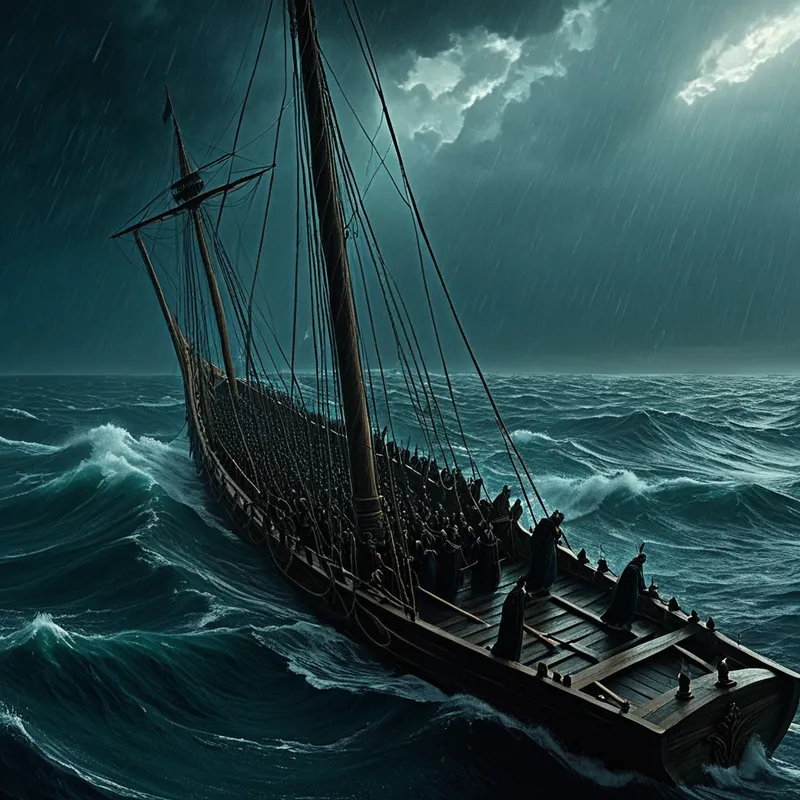
The war is won by guile, by the hollow belly of a wooden horse. But the victory is ash. The gods, capricious and wrathful, decree that the journey home shall be the true trial. Poseidon stirs the wine-dark sea into a fury, while Athena watches from afar, a weaver of subtle threads.
His fleet is dashed upon strange shores. In the land of the Cyclopes, Odysseus’s cunning saves his men from being devoured in the cave of the monstrous Polyphemus, but his pride rings out—“I am Odysseus!”—a boast that earns Poseidon’s undying wrath. They linger in the languid, lotus-induced forgetfulness of the Lotus-Eaters. They navigate the fatal strait between the ravenous, six-headed Scylla and the sucking whirlpool of Charybdis, a choice between certain death and grievous loss.
They walk into the underworld itself, where the shade of the blind prophet Tiresias whispers of the path ahead and the ghosts of his past—his mother, his comrades—cling to him with silent accusations. He resists the soul-dissolving song of the Sirens, bound to his ship’s mast, a man choosing conscious agony over blissful oblivion. For seven years, he is held captive by the nymph Calypso, offered immortality and eternal youth in a gilded cage of paradise, his heart aching for a mortal, aging wife and a rocky island kingdom.
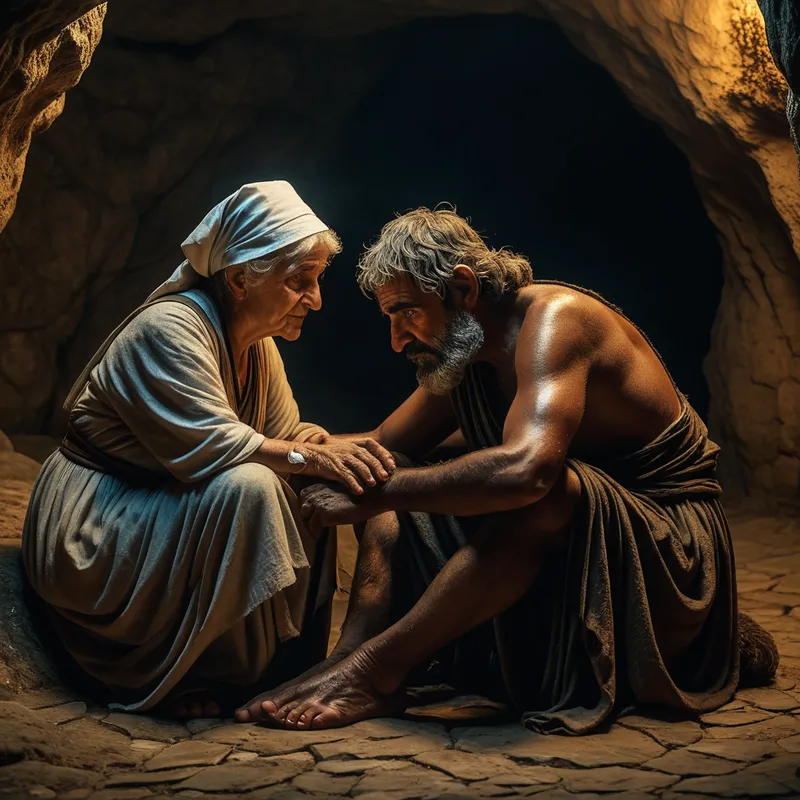
When he is finally released, shipwrecked and alone on the shores of Ithaca, he is no longer the man who left. He is a stranger in his own skin, a beggar in his own hall. The great hall is choked with arrogant suitors, devouring his wealth and courting his faithful queen, Penelope, who weaves and unravels a shroud in a silent war of attrition. With the guidance of Athena, now manifest, he steps into the role of the nameless wanderer. He is taunted, abused, and tested. In the flickering firelight, an old nurse washes the feet of this beggar and feels the scar of a boar’s tusk—a memory from his youth—and knows. The recognition is silent, seismic.
Then comes the final trial. Penelope, in a move of desperate cunning, declares she will marry the man who can string her husband’s great bow and shoot an arrow through the aligned sockets of twelve axe heads. The suitors fail, their soft hands unable to bend the weapon of the warrior-king. The beggar steps forward. He takes the bow. It sings in his hands, familiar as his own breath. He strings it effortlessly. In that moment, the disguise falls away not from his body, but from the room’s perception. The king is revealed. And with cold, precise fury, the explorer of the wide world becomes the purger of his own house, reclaiming his throne, his wife, and his very identity in a storm of blood and justice.
Cultural Origins & Context
This epic emerged from the oral tradition of the Greek Dark Ages, a time when memory was the only library. It is attributed to the blind poet Homer, likely a name that crystallized a centuries-long tradition of bardic performance. These aoidoi (singers) would have performed at the courts of chieftains, weaving the tales of the nostoi (the returns from Troy) into the fabric of aristocratic identity.
The Odyssey functioned as more than entertainment; it was a cultural compass. It explored the tension between kleos (glory, the public fame won in war) and nostos (homecoming, the private return to identity and order). For a culture of seafarers and colonists, it mapped the psychological perils of wandering—the loss of self, the allure of oblivion, the confrontation with the “other.” It also reinforced the sacred Greek concepts of xenia (the ritualized bond of hospitality between host and guest) and the proper order of the household (oikos), showing the chaos that ensues when these are violated by the suitors. It was a foundational text for Greek education, teaching values of cunning (metis), endurance, and the ultimate priority of home and family.
Symbolic Architecture
The Odyssey is not a geographical chart, but a psychic one. Ithaca is not merely a place, but a state of being—the integrated Self. The decade-long voyage is the necessary detour the conscious ego must take to shed its inflated identity (the conquering hero of Troy) and become capable of ruling its own inner kingdom.
The true monster is not the Cyclops, but the un-blinded ego that shouts its name to the heavens, inviting the wrath of the unconscious.
Each island is a state of consciousness or a complex. The Land of the Lotus-Eaters represents the temptation of numbing pleasure, of spiritual amnesia. Circe’s island is the realm of animal instinct and sensual enchantment, where men are reduced to their base drives until the “herb of moly” (symbolizing divine insight or consciousness) allows for negotiation and integration. The descent to the Underworld is the quintessential nekyia, a confrontation with the personal and ancestral past, where one must listen to the ghosts to proceed. Calypso’s offer is perhaps the most insidious: immortal stasis, the end of struggle and becoming, which is a deeper death than physical demise.
Penelope is the anima figure, the soul-connection that holds the center. Her act of weaving and unweaving is the creative, sustaining, and patient power of the unconscious psyche that maintains the possibility of wholeness against the predatory forces of disintegration (the suitors).
The Dreamer’s Resonance
When the Odyssey pattern stirs in the modern dreamer, it signals a profound process of psychic re-orientation. This is not the hero’s call to outward adventure, but the explorer’s mandate for an inward voyage.
Dreams of being perpetually lost in airports, of missing trains, or of navigating endless, unfamiliar corridors mirror Odysseus’s wanderings. They speak to a disorientation in life’s direction, a feeling of being blown off course by external forces (a Poseidon-like boss, a stormy relationship). Dreams of being held captive in a beautiful, luxurious place—a resort you cannot leave—echo the Calypso complex: a comfortable life that has become a gilded cage, stifling growth. Encounters with monstrous, single-minded figures (a Cyclops) in dreams may represent a overwhelming, “one-eyed” perspective dominating the dreamer’s life, be it an obsession, a addiction, or a tyrannical aspect of their own personality.
Somatically, this process may feel like a deep fatigue that isn’t cured by sleep—the exhaustion of the long-distance voyager. There can be a literal or metaphorical sea-sickness, a nausea from life’s constant turbulence and lack of solid ground. The resolution phase often begins with dreams of arriving on a stark, rocky shore (Ithaca), feeling like a stranger, or of performing a simple, telling task—like stringing a bow—that reveals one’s true capacity.

Alchemical Translation
The alchemy of The Odyssey is the transmutation of the wandering persona (the hero, the beggar) into the embodied sovereign. The entire journey is the nigredo, the necessary dissolution of the old, rigid identity forged in the fires of Troy (our past battles, traumas, and triumphs). Being dashed upon rocks, losing all companions, and descending to the underworld are the brutal but essential processes of breaking down the ego’s armor.
The mast is the spine of consciousness; the Sirens’ song is the pull of the unconscious to dissolve back into its waters. To be bound to the mast is to choose the agony of awareness over the bliss of oblivion.
The years with Circe and Calypso represent a prolonged albedo, a washing and a tempting stagnation in intermediate states of refinement. The final return, the disguise, and the contest of the bow embody the rubedo. Here, the reclaimed powers (cunning, endurance, skill) are not used for conquest abroad, but for the precise, surgical restoration of inner order. The beggar’s rags are the humilitas of the alchemical process; the bow is the lapis philosophorum, the philosopher’s stone—the unique, indestructible essence of the individual that has been tempered by the long journey.
For the modern individual, the odyssey is the path of individuation. It is the recognition that our longest, most arduous journey is not toward achievement in the world, but toward the authentic home of the Self. It demands we navigate our personal sirens (addictions, distractions), confront our cyclopean shames and rages, and endure the calypso-comforts that would have us abandon our mortal, imperfect, but true destiny. The goal is not to return to who we were, but to return with all we have become, and to wield that hard-won wisdom to reclaim our rightful inner throne.
Associated Symbols
Explore related symbols from the CaleaDream lexicon: