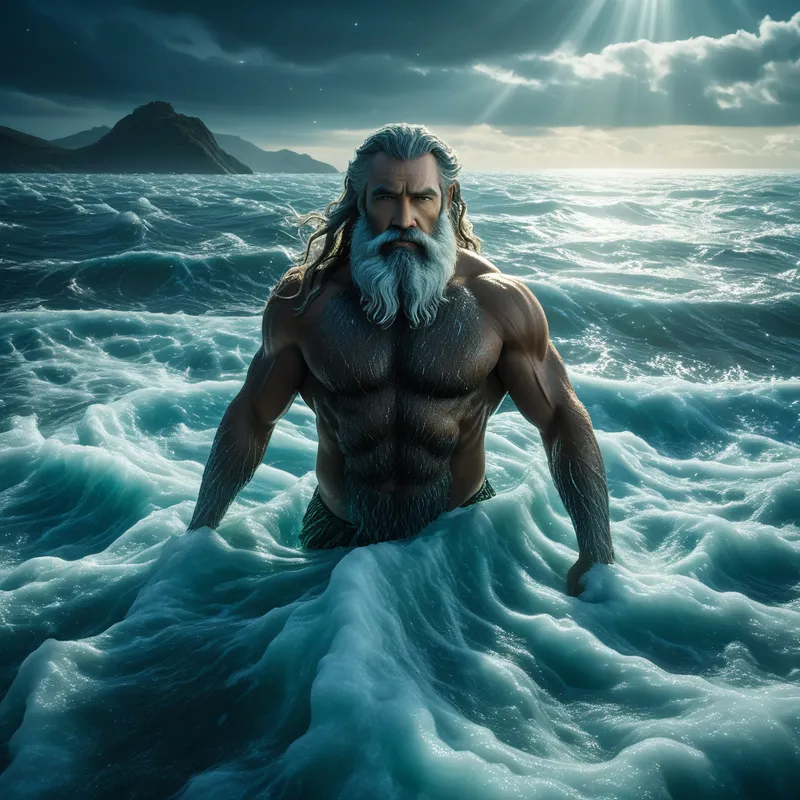
The Oceanids Myth Meaning & Symbolism
The 3000 daughters of Oceanus and Tethys, nymphs of every freshwater source, embody the primal, nurturing, and boundless flow of the unconscious psyche.
The Tale of The Oceanids
Before the first ship cut the wine-dark sea, before the first city thirsted for a well’s cool gift, the world was embraced by a river. Not a river you could ford, but a titanic, silver coil of fresh water that circled all lands like a serpent biting its own tail. This was Oceanus, eldest of the Titans, whose being was the source of all streams. And with his sister-wife Tethys, the deep-breasted nourisher, he begot not a handful of children, but a legion. Three thousand daughters. Three thousand sons.
Listen now to the whisper of the daughters, the Oceanids. They were born not of conflict, but of abundance. Where their brother Potamoi were the roaring, named rivers—the Nile, the Alpheus—the sisters were the essence of water itself in its gentle, giving forms. They were the soul of every spring that bubbles secretly from mossy stone, every mountain stream that chatters down a slope, every cloud-fed lake sleeping in a crater, every hidden well in a dusty courtyard. They did not rule from high thrones, but inhabited. A naiad was her spring; if it dried, she faded.
Their world was one of endless connection. The great river of their father connected all things, and they were its countless emissaries. They danced in the spray where river met sea, tended the hanging gardens of mist in hidden valleys, and sang lullabies to the roots of great oaks. They were the nurses of the young gods; Hera herself was raised in their care by Dike. Their lives were a hymn to nurture, to the silent, ceaseless giving that asks for no name.
Yet, the age of the Titans waned. Thunder shook the cosmos. Their cousin Zeus led a war that reshaped the heavens. And the Oceanids, caught in the tide of this new order, found their destinies weaving into the tapestry of the Olympian world. Some became consorts and mothers to the new gods, vessels of ancient wisdom passing into a changed era. Metis, wisest of all, would become the first wife of Zeus, her counsel his strength—until prophecy foretold her child would surpass him, and he swallowed her whole, making her wisdom part of his very being. Others, like Pheme, became the personified whispers of the new world. Nemesis ensured balance was kept. And the steadfast Asia wept unceasing tears for her husband, bound and tormented on a distant crag, her sorrow becoming the salt of the earth.
Through it all, the majority remained unnamed, countless, their essence unchanged. They continued to be the pulse of the world’s freshwater, the hidden network of life that sustains all things. When the hero Prometheus was bound, it was the Oceanids who first came to comfort him, their presence a cool balm against the scorching sun and the eagle’s beak. They witnessed suffering, they participated in epic tales, yet their core nature—to flow, to connect, to nourish—remained as constant as their father’s encircling stream, a primordial truth beneath the dramas of gods and men.
Cultural Origins & Context
The myth of the Oceanids flows from the deepest wellsprings of Greek cosmogony, found primarily in the Theogony of Hesiod (c. 700 BCE). Hesiod’s work is not mere storytelling; it is a sacred genealogy, a map of cosmic order. In listing the three thousand Oceanids, he performs a profound cultural act: he systematizes and sanctifies the entire hydrological landscape of the known and imagined world. Every spring, every river had a divine consciousness, a nymph, making the natural world inherently sacred and alive.
This myth functioned as an explanatory and relational framework. For a Greek farmer drawing water, that well was not an inert resource but the home of a being—a daughter of the great, ancient Oceanus. This fostered a relationship of respect, propitiation, and awe. The myth was passed down through oral poetry and later written texts, serving as the foundational “science” of hydrology and a theology of immanence. The Oceanids represented the benign, nurturing face of nature, distinct from the unpredictable and often dangerous gods of the sea (Poseidon) or the wild (Artemis). They were the divine in the local, the global network of life-giving moisture made personal.
Symbolic Architecture
Psychologically, the Oceanids represent the collective, nurturing matrix of the unconscious itself. They are not a single archetype, but the very medium in which archetypes swim.
The unconscious is not a dark pit, but a world-encircling river of potential, from which all forms of life and consciousness emerge.
Oceanus, the father, symbolizes the source—the boundless, primordial psyche from which all differentiated contents (the individual nymphs, or conscious thoughts and complexes) arise. Tethys is the receptacle, the deep, containing function that allows this psyche to take form. Their three thousand daughters, then, are the myriad potentials, insights, emotions, and nurturing impulses within us. They are the “fresh water” of the soul—what is vital, cleansing, and sustaining, as opposed to the salty, chaotic waters of the repressed or traumatic unconscious (often symbolized by the sea).
Their connection to every spring and stream maps onto the neural networks of the brain and the associative pathways of the mind. Each “nymph” is a node of psychic energy tied to a specific memory, talent, or capacity for care. The myth of Metis being swallowed by Zeus is a powerful image of the ego (Zeus) integrating a profound piece of unconscious wisdom (Metis) so completely that it becomes a part of its operational intelligence.
The Dreamer’s Resonance
When the pattern of the Oceanids surfaces in modern dreams, it often signals a process of reconnection to the inner wellsprings of life. To dream of countless women near or as water, of a hidden network of streams, or of finding a pure, forgotten spring, is to encounter the psyche’s own nurturing, connective matrix.
Somatically, this may correlate with a release of held tension, a feeling of fluidity returning to stiff joints, or even tears—the body’s own “fresh water” breaking through a drought. Psychologically, the dreamer is likely experiencing a need for emotional nourishment, a longing for authentic connection (to self or others), or a rediscovery of forgotten talents and gentle aspects of the self that have been neglected in a goal-oriented, “heroic” conscious life. It is the unconscious advocating for care over conquest, for network over hierarchy, for the slow, sustaining seep of insight over the lightning bolt of revelation.

Alchemical Translation
The alchemical process mirrored in the Oceanid myth is not the fiery solve et coagula of dramatic transformation, but the gentle, pervasive work of solutio—dissolution in the waters of the unconscious. It is the process of softening rigid ego boundaries to allow the nourishing, connective waters of the deeper Self to permeate one’s being.
Individuation is not only about forging a singular hero; it is equally about remembering that one is a tributary of a vast, ancient river.
For the modern individual, the “core struggle” is often one of isolation, burnout, and disconnection from the vital, sustaining elements of one’s own soul. The triumph modeled by the Oceanids is one of re-membering. It is the act of tracing one’s own exhaustion back to its source—not to a single trauma, but to a disconnection from the three thousand inner “nymphs”: the capacity for rest, for quiet creativity, for unconditional self-care, for empathy.
The alchemical translation involves becoming like Oceanus—recognizing oneself as part of a boundless, circulating system—and like Tethys—developing the depth to contain and nurture one’s own potentials. It means listening for the whispers of one’s personal “Metis” (innate wisdom) and integrating it, not through force, but through receptive understanding. Ultimately, it is about transmuting a life of arid striving into one of fluid being, where consciousness learns to honor and flow with the countless, nameless, life-giving streams within.
Associated Symbols
Explore related symbols from the CaleaDream lexicon: