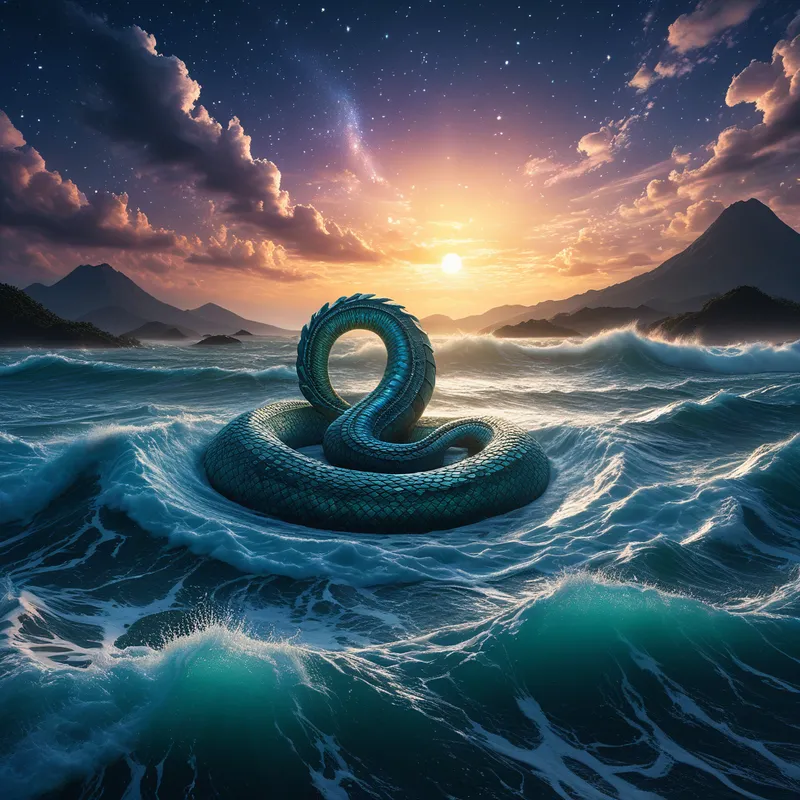
The Ocean of Milk Myth Meaning & Symbolism
Gods and demons churn the primordial ocean for the nectar of immortality, a cosmic struggle revealing the necessity of tension for profound transformation.
The Tale of The Ocean of Milk
In the time between times, when the universe lay exhausted from the endless cycles of creation and dissolution, a profound weariness settled upon the devas. Their radiance dimmed, their strength sapped by the relentless might of the asuras. Cursed with mortality, they faced the slow decay of their celestial forms. In their despair, they sought the counsel of Vishnu, who rested upon the coils of the world-serpent Ananta Shesha in the milky depths of the causal ocean.
Vishnu spoke, his voice the sound of deep waters: “There is a remedy, but it is born of a terrible cooperation. You must unite with your enemies. You must churn the Ocean of Milk itself. From its depths will arise amrita. But you cannot do this alone. You must enlist the asuras. The labor will require both your light and their might.”
Thus, a fragile, momentous pact was struck. The devas and asuras gathered on the shore of the boundless, placid ocean of pure potential. For a churning staff, they uprooted the mighty Mount Mandara. For a churning rope, they persuaded the king of serpents, Vasuki, to wind himself around the mountain. The devas took hold of Vasuki’s tail. The asuras, suspecting trickery, grasped his head. And they began to pull.
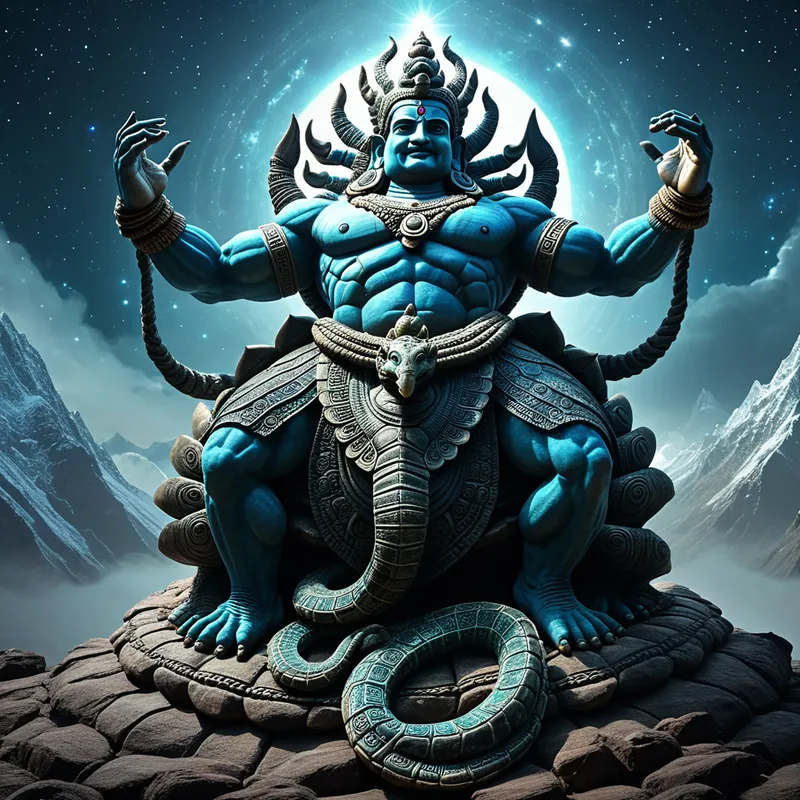
Back and forth, in a cosmic tug-of-war, they strained. The mountain began to spin, churning the ocean’s depths. But the great weight of Mandara had no foundation; it started to sink into the soft ocean bed, threatening to vanish forever. In that crisis, Vishnu took the form of Kurma, a tortoise of immeasurable size, and dove to the bottom. Upon his adamantine shell, the mountain found its pivot, its stable axis in the chaos.
The churning resumed, a grueling, epoch-spanning labor. The first product was not nectar, but a deadly poison, Halahala, so virulent it threatened to consume all creation. To save the worlds, the great god Shiva drank the poison, holding it in his throat, which turned blue, earning him the name Neelakantha.
Then, from the churned depths, wonders began to emerge: the celestial cow Kamadhenu, the goddess of wine Lakshmi seated on a lotus, the divine white horse Uchchaihshravas, the precious jewel Kaustubha, the parijata tree, and finally, the physician of the gods, Dhanvantari, emerged holding the radiant pot of amrita.
Seeing the prize, the fragile alliance shattered. The asuras seized the pot. Chaos erupted. Once more, Vishnu intervened, taking the form of the enchanting Mohini. Distracting the asuras with divine allure, Mohini retrieved the amrita and served it only to the devas, restoring their immortality and the balance of the cosmos. The churning ceased. The ocean grew still once more, forever changed by what it had yielded.
Cultural Origins & Context
The myth of the Samudra Manthan is a cornerstone of Puranic literature, most elaborately detailed in texts like the Vishnu Purana and the Mahabharata. It was not a mere story for entertainment, but a cosmological and ethical narrative device. Recited by priests and storytellers, it served to illustrate profound philosophical principles: the interdependence of opposites, the inevitability of suffering before reward, and the cyclical nature of cosmic maintenance (dharma).
Its societal function was multifaceted. It explained the origin of various celestial beings and objects within the Hindu worldview. More importantly, it modeled the ideal of divine intervention (avatara) and presented a metaphor for the human condition—our eternal struggle between higher aspirations (devas) and base instincts (asuras), with the hope of divine grace providing the stability (Kurma) and the discernment (Mohini) needed to attain liberation (moksha), the true amrita.
Symbolic Architecture
The myth is a masterclass in symbolic psychology. The Ocean of Milk is the primordial unconscious, the undifferentiated state of potential from which all forms of consciousness and life emerge. It is the pleroma, the unmanifest source containing both poison and nectar.
The nectar of immortality is always found at the bottom of the cup of poison. One cannot be summoned without the other.
The churning itself is the central act of consciousness. It represents the necessary friction required to bring latent psychic contents—treasures and terrors alike—into the light of awareness. The devas and asuras are not merely external gods and demons; they are the internal forces of our psyche: order and chaos, spirit and matter, altruism and selfishness, transcendence and embodiment. Their forced cooperation signifies that profound transformation cannot be achieved by the “good” parts of ourselves alone; we must engage with our shadow, our raw power, our ambition—the “asuric” within.
Kurma, the foundation, symbolizes the Self—the central, stabilizing archetype of the psyche (in Jungian terms) that provides the axis for the turbulent work of individuation. Vasuki, the serpent, is the vital, ambivalent life force; it is the energy of kundalini that must be harnessed, a power that can be destructive (poison from its mouth) when approached from the wrong end (ego/head), but can lead to enlightenment when approached from the base (spirit/tail). The emergence of Lakshmi signifies that true prosperity and beauty are born from this arduous inner work.
The Dreamer’s Resonance
When this myth stirs in the modern dreamer, it signals a profound somatic and psychological process of integration. To dream of a vast, milky sea is to sense the boundless potential of the unconscious self. To dream of a great, laborious churning—perhaps a repetitive task, a turning wheel, or a struggle between two groups—is the psyche’s representation of an inner conflict being actively worked upon.
The somatic feeling is often one of immense strain, of a pivotal effort. The dreamer may feel they are holding the weight of a mountain or pulling a great rope. This mirrors the real, bodily tension that accompanies deep psychological work—the anxiety before a breakthrough, the fatigue of confronting a repressed trauma (the poison), or the sustained effort required to develop a new skill or aspect of personality (a treasure). The dream is an affirmation: you are in the midst of the churn. The treasures—symbolized by a sudden gift, a guiding figure (Dhanvantari), or a beautiful presence (Lakshmi)—are the nascent psychic formations awaiting birth from this labor.
Alchemical Translation
For the individual, the Samudra Manthan is a precise model of psychic alchemy—the Magnum Opus of the soul. The process begins with the nigredo: the recognition of mortality, weakness, and despair (the devas’ plight). This necessitates a pact with the shadow (the alliance with the asuras), the first brave step toward wholeness.
The churning is the albedo, the purification. Here, the ego (the mountain) must be grounded on the Self (the tortoise) to prevent dissolution. The first yield is the poison—the repressed wounds, toxic patterns, and shame (Halahala). This must be fully acknowledged and contained (held in the throat, not swallowed) by a transformative, accepting consciousness (Shiva). Only by facing this shadow can the process continue.
Individuation is not about becoming perfect, but about becoming whole. It requires making peace with the serpent that is both rope and poison.
The emergence of the treasures represents the citrinitas, the integration of various psychic functions: creativity (Kamadhenu), inner value (Lakshmi), vitality (Uchchaihshravas). Finally, the retrieval of the amrita by Mohini is the rubedo. This is the culmination—not a destruction of the asuric/instinctual side, but a wise, discerning re-integration. Mohini represents the transcendent function, the psychic ability to hold opposites in tension and guide energy toward the nourishment of the conscious self. The amrita is the achieved state of psychic equilibrium, a taste of the immortal Self, born from the courageous, complete churning of one’s own ocean.
Associated Symbols
Explore related symbols from the CaleaDream lexicon: