The Nüwa Myth Meaning & Symbolism
The creator goddess Nüwa forms humanity, then sacrifices herself to mend a shattered cosmos, embodying the ultimate act of reparative love.
The Tale of The Nüwa
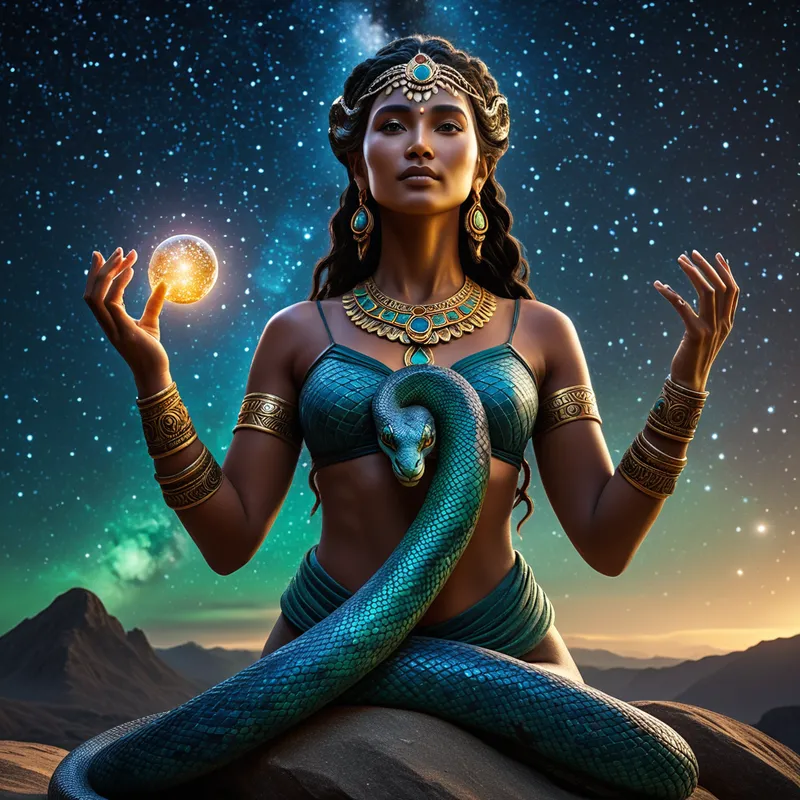
In the time before time, when [the world](/myths/the-world “Myth from Tarot culture.”/) was a formless broth of mist and potential, there was a loneliness so vast it echoed through [the void](/myths/the-void “Myth from Buddhist culture.”/). From this primordial silence emerged Nüwa, her being a perfect union of serpent and woman. Her coiled body held the wisdom of the deep earth, and her human heart held the compassion of the heavens yet unborn. She wandered the silent, beautiful desolation, her spirit aching for a sound other than [the wind](/myths/the-wind “Myth from Various culture.”/).
One day, beside the [Yellow River](/myths/yellow-river “Myth from Chinese culture.”/), she knelt in the rich, yellow clay. A profound impulse stirred within her. Dipping her divine hands into the mud, she began to shape. With infinite care, she fashioned a small figure in her own image, but with legs instead of a tail. She breathed upon it, and the clay figure stirred, stretched, and let out a cry—the first human voice. Joy blossomed in Nüwa’s heart. She shaped another, and another, until a chorus of life filled the quiet land. But her hands grew weary. So, she took a length of vine, dipped it into the thick mud, and flicked it. Where each droplet fell, a new human sprang up, simpler than the hand-shaped ones, but alive with the same spark.
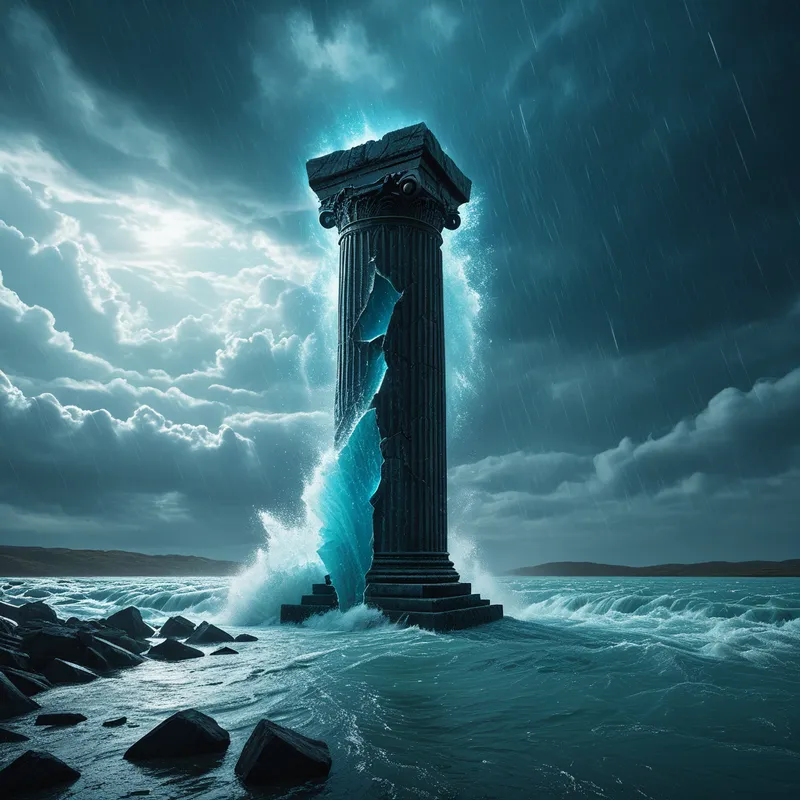
For an age, her children thrived under her watchful gaze. Then, catastrophe. In a cosmic battle, the Gonggong, in a rage of defeat, smashed his head against the Mount Buzhou, the pillar that held up [the sky](/myths/the-sky “Myth from Persian culture.”/). The pillar shattered with a sound that broke the world. The heavens tore open above the northwest, and [the earth](/myths/the-earth “Myth from Hindu culture.”/) cracked open in the southeast. A bitter cold wind and a torrent of celestial fire poured from the rent in the firmament. The earth’s axis tilted, rivers reversed their courses, and fierce beasts emerged from the deep cracks to prey upon her terrified children.
Nüwa’s heart broke at the sight. The harmony she had birthed was unraveling into chaos. She acted not with rage, but with a sorrowful, determined love. She journeyed to the farthest rivers, gathering stones of five sacred colors: azure, crimson, yellow, white, and black. She built a mighty furnace and, with a fire stoked by her own divine will, melted the stones into a luminous, molten paste. Then, rising on her serpent coils against the howling gale, she began to patch the broken sky. With her bare hands, she daubed the shimmering substance over the terrible wound, stitch by celestial stitch, until the heavens were whole again.
But the earth still trembled. The pillar was gone. So, Nüwa slew a giant turtle, cut off its four legs, and set them as new pillars at the four corners of the world, steadying the sky. She then subdued the black dragon and other beasts of chaos, and used the ashes of the reeds to choke the flooding waters, saving the lands for humanity. The cosmos was repaired, but the cost was immense. The work exhausted her primordial essence. Some say she rested, her form becoming the very landscape. Others whisper she dissolved into the mended world, her breath in the wind, her love in the soil that nourishes her children. She did not rule from a throne, but remained within the fabric of the reality she saved.
Cultural Origins & Context
The myth of Nüwa is one of the most ancient and enduring narratives in Chinese cosmology, with roots stretching back to the Warring States period and fragments found in texts like the Classic of Mountains and Seas and the Huainanzi. Unlike the later, more patriarchal celestial bureaucracies, Nüwa’s story belongs to an older stratum of myth—a matriarchal, primal world where creation and repair are acts of direct, embodied divinity, not administrative decree.
She was not merely a subject for imperial scribes; her story was the foundational “why” for the people. It explained the tilt of the heavens, the course of rivers, and, most importantly, the flawed yet sacred nature of humanity itself. The tale was passed down through oral tradition, likely by shamans and storytellers who served as the living memory of the tribe. Its societal function was profound: it established a cosmology of care, where the world is not perfect but is actively mended. It positioned humanity as the beloved, if fragile, creation of a compassionate mother, setting a cultural template for resilience, reparative action, and the sacred duty to maintain harmony.
Symbolic Architecture
Nüwa is the [archetype](/symbols/archetype “Symbol: A universal, primordial pattern or prototype in the collective unconscious that shapes human experience, behavior, and creative expression.”/) of the [Creator](/symbols/creator “Symbol: A figure representing ultimate origin, divine power, or profound authorship. Often embodies the source of existence, innovation, or personal destiny.”/) in its most profound, alchemical sense. Her serpentine [body](/symbols/body “Symbol: The body in dreams often symbolizes the dreamer’s self-identity, personal health, and the relationship they have with their physical existence.”/) symbolizes the chthonic, instinctual wisdom of the unconscious and the cyclical, renewing power of [nature](/symbols/nature “Symbol: Nature symbolizes growth, connectivity, and the primal forces of existence.”/). Her [human](/symbols/human “Symbol: The symbol of a human represents individuality, complexity of emotions, and social relationships.”/) torso represents conscious [intention](/symbols/intention “Symbol: Intention represents the clarity of purpose and direction in one’s life and can symbolize motivation and commitment within a dream context.”/), [compassion](/symbols/compassion “Symbol: A deep feeling of empathy and concern for others’ suffering, often involving a desire to help or alleviate their pain.”/), and culture. She is the ultimate [symbol](/symbols/symbol “Symbol: A symbol can represent an idea, concept, or belief, serving as a powerful tool for communication and understanding.”/) of the coniunctio oppositorum—the sacred [marriage](/symbols/marriage “Symbol: Marriage symbolizes commitment, partnership, and the merging of two identities, often reflecting one’s feelings about relationships and social obligations.”/) of opposites ([earth](/symbols/earth “Symbol: The symbol of Earth often represents grounding, stability, and the physical realm, embodying a connection to nature and the innate support it provides.”/)/[heaven](/symbols/heaven “Symbol: A symbolic journey toward ultimate fulfillment, spiritual transcendence, or connection with the divine, often representing life’s highest aspirations.”/), instinct/care, [chaos](/symbols/chaos “Symbol: In Arts & Music, chaos represents raw creative potential, uncontrolled expression, and the breakdown of order to forge new artistic forms.”/)/order) necessary for creation.
The act of creation is first an act of loneliness seeking communion, and then an act of love assuming responsibility for its creation.
The shattered pillar of heaven represents a catastrophic [rupture](/symbols/rupture “Symbol: A sudden break or tear in continuity, often representing abrupt change, separation, or the shattering of established patterns.”/) in the psychic [structure](/symbols/structure “Symbol: Structure in dreams often symbolizes stability, organization, and the framework of one’s life, reflecting how one perceives their environment and personal life.”/)—a [trauma](/symbols/trauma “Symbol: A deeply distressing or disturbing experience that overwhelms the psyche, often manifesting in dreams as unresolved emotional wounds or psychological injury.”/), a [paradigm](/symbols/paradigm “Symbol: A fundamental model or framework in arts and music that shapes creative expression, perception, and cultural understanding.”/)-shattering [insight](/symbols/insight “Symbol: A sudden, deep understanding of a complex situation or truth, often arriving unexpectedly and illuminating hidden connections.”/), or a collapse of meaning that floods the conscious world with the chaotic contents of the unconscious (the beasts, the floods). Nüwa’s [response](/symbols/response “Symbol: Response in dreams symbolizes how one reacts to situations, often reflecting the subconscious mind’s processing of events.”/) is not to destroy or to start over, but to mend. The five-colored stones are the quintessential symbols of psychic [integration](/symbols/integration “Symbol: The process of unifying disparate parts of the self or experience into a cohesive whole, often representing psychological wholeness or resolution of internal conflict.”/). They represent the diverse, fragmented aspects of [the self](/myths/the-self “Myth from Jungian culture.”/) (emotions, instincts, thoughts, [spirit](/symbols/spirit “Symbol: Spirit symbolizes the essence of life, vitality, and the spiritual journey of the individual.”/), body) that must be gathered, “melted” in the [furnace](/symbols/furnace “Symbol: A furnace represents transformation through intense heat, purification, and the containment of powerful energy. It symbolizes both creative potential and destructive force.”/) of intense conscious [effort](/symbols/effort “Symbol: Effort signifies the physical, mental, and emotional energy invested toward achieving goals and personal growth.”/) (the [opus](/symbols/opus “Symbol: A spiritual or alchemical term for a great work of creation, often representing the culmination of a life’s purpose or a transformative process.”/)), and forged into a new, cohesive substance to repair the breached [boundary](/symbols/boundary “Symbol: A conceptual or physical limit defining separation, protection, or identity between entities, spaces, or states of being.”/) between the conscious and unconscious realms.
The Dreamer’s Resonance
When this myth stirs in the modern dreamer, it often manifests as dreams of profound rupture and subsequent, painstaking repair. You may dream of your home—the symbol of the [psyche](/myths/psyche “Myth from Greek culture.”/)—with a cracked foundation or a hole in the roof, with dark [water](/myths/water “Myth from Chinese culture.”/) or a cold wind pouring in. You may see yourself holding shattered pieces of a precious vase or a mirror, feeling an urgent, sorrowful need to glue them back together.
Somatically, this can feel like a deep fatigue paired with a relentless, compassionate drive—the exhaustion of Nüwa after her labors, coupled with her unwavering focus. Psychologically, you are in the process of what James Hillman called “soul-making.” A foundational aspect of your identity or worldview has been damaged, perhaps by betrayal, loss, or the unavoidable confrontation with your own shadow. The dream is not presenting an easy fix, but the archetypal pattern for the long, careful work of re-collecting your scattered self, facing the inner “beasts” of fear and chaos, and weaving a new, more resilient psychic structure that acknowledges the cracks but holds firm.
Alchemical Translation
The journey of Nüwa is a perfect map for the individuation process, specifically the stage following a painful [nigredo](/myths/nigredo “Myth from Alchemical culture.”/) (the blackening, the shattering of the pillar). It models the albedo and citrinitas—the whitening and yellowing, the stages of purification and integration.
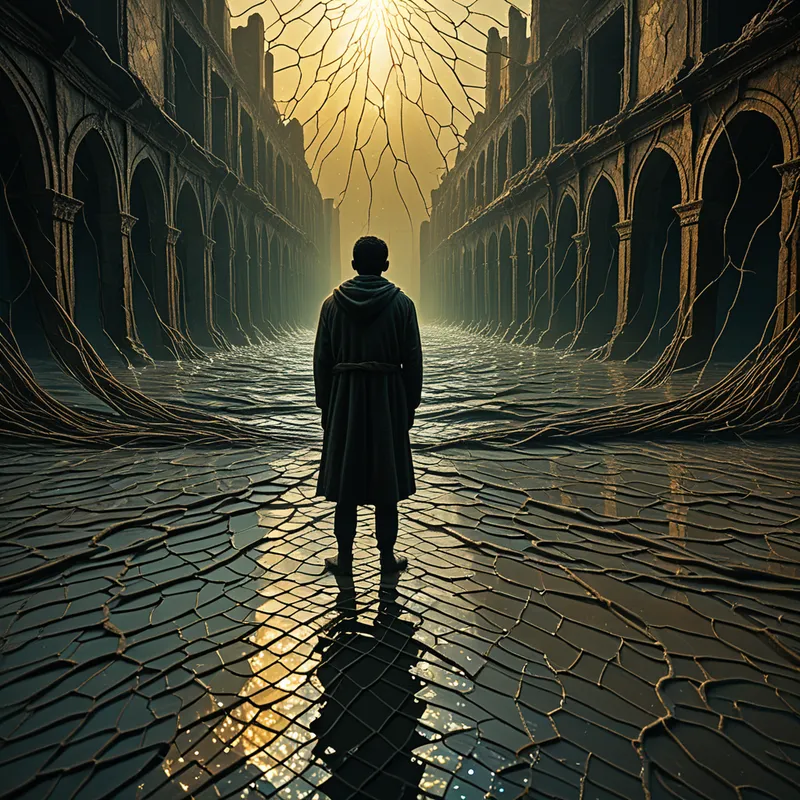
First, we must acknowledge the Rupture. The conscious [persona](/myths/persona “Myth from Greek culture.”/) or ego-structure has been catastrophically challenged. We feel exposed, flooded, and tilted off our axis. The Nüwa process begins with the courageous, sorrowful acceptance of this damage, without resorting to blame or escapism.
Second, we Gather the Colored Stones. This is the conscious work of therapy, reflection, art, or dialogue—gathering the disparate, often conflicting parts of our experience: our anger (crimson), our sorrow (azure), our hope (yellow), our clarity (white), and our shadowy instincts (black). We cannot use just one; wholeness requires all the colors of our being.
Individuation is not about building a perfect, unblemished self. It is about becoming a skilled and loving repairer of the inevitable rents in the fabric of the soul.
Third, we Melt and Mend. This is the transformative fire of sustained attention and emotional processing. We hold these gathered aspects in [the vessel](/myths/the-vessel “Myth from Alchemical culture.”/) of our awareness until their rigid, separate forms dissolve into a new understanding. Then, we apply this newfound “stone paste”—this integrated perspective—to the specific wound. We mend our relationship patterns, our self-image, our connection to meaning, stitch by conscious stitch.
Finally, we Reset the Pillars. We establish new, sustainable structures for our lives—healthier boundaries ([the turtle](/myths/the-turtle “Myth from Chinese culture.”/)’s legs), disciplined containment of chaotic impulses (subduing [the dragon](/myths/the-dragon “Myth from Chinese culture.”/)), and practical actions to channel overwhelming emotions (damming the floods with ash). The goal is not to return to a naive, pre-shattered state, but to achieve a repaired wholeness, one that contains the history of its own breaking and healing. In doing so, we incarnate the Nüwa within: not as a distant goddess, but as the active, compassionate mender of our own world.
Associated Symbols
Explore related symbols from the CaleaDream lexicon: