
The North Starin na Myth Meaning & Symbolism
A myth of a celestial guide who becomes fixed in the sky, offering direction to all who are lost in the vastness of the world or the self.
The Tale of The North Starin na
Listen. In the time before time, when the sky was a restless, churning sea of darkness and the earth was a formless plain of shadow, there was no way to know where you were. The great lights of the heavens danced in a wild, unpredictable whirl. One night they would cluster in the east, singing songs of dawn; the next, they would flee to the west, weeping tales of endings. Travelers on the land would set out with hope and return, if they returned at all, broken and directionless, having walked in vast, despairing circles. The world was adrift. The soul was adrift.
Among the celestial host was a being of pure, curious light named Starin na. While its kin reveled in their chaotic dance, Starin na felt a profound sorrow for the creatures below. It watched the tiny, flickering campfires of humanity, saw them lift confused faces to the riotous sky, and it knew their longing. It was a longing for a single, true thing in a universe of flux.
One night, as the great Uranos churned particularly violently, threatening to swallow the lesser lights, Starin na made a choice. It swam against the celestial current, pushing through the swirling ether until it reached the highest, coldest, most silent point in the northern vault. There, it spoke a word that was not a sound but a vow, a vow that echoed in the bones of the world.
"I will be the question that finds its own answer," it declared. "I will be the journey that has found its home."
And then, Starin na did what no star had ever dared. It reached out its luminous arms and grasped the very fabric of the night. With a sound like a mountain settling into its roots for eternity, it fixed itself. It drove its essence deep into the axis of the turning world. The other stars screamed in protest, a symphony of terror and awe, as they felt the universe gain a pivot. A stillness was born within the motion.
A great tearing happened within Starin na—not a death, but a transformation. The agony of becoming eternal, of sacrificing forever the wild joy of the dance for the solemn duty of the watch. Its light, once warm and golden like its kin, cooled into a piercing, silver-blue beacon. It did not flicker. It did not wander. It simply was. And in that moment, the first traveler on the shadowed plain below stopped, looked up, and felt a strange certainty unknot in their chest. They pointed a trembling finger north. And they knew the way home.

Cultural Origins & Context
The myth of the North Starin na is not the property of any single culture, but a universal story-pattern that has emerged independently across continents and epochs. It is the human psyche mapping its deepest need for orientation onto the cosmos. From the Phoenician sailors navigating by the star they called the "Phoenice," to the Polynesian wayfinders for whom Hōkūpa'a (the fixed star) was the pivot of the heavenly canoe, to the countless inland tribes who saw in the northern light the eye of a watchful ancestor or spirit—the narrative core remains.
It was passed down not in formal epics, but in practical lore: the elder showing the child the one star that "never lies," the chant sung before a long journey, the story told around the fire when someone was lost in life, not just in land. Its societal function was profoundly pragmatic and profoundly spiritual. It taught navigation, yes, but more importantly, it taught the concept of a true bearing—an external correlate for an internal moral and psychological compass. It was a myth that served as both map and metaphor.
Symbolic Architecture
Psychologically, the North Starin na represents the archetype of the Self, as defined by Carl Jung. It is not the ego, which is the traveler, but the central, unchanging point around which the psyche revolves. Its symbolism is rich and multi-layered:
- The Sacrifice of Potential for Purpose: Starin na gives up the "dance" of endless potential, of being everything everywhere, to become one specific, essential thing. This mirrors the individuation process where we sacrifice the diffuse fantasy of infinite possible selves to commit to the singular, authentic self we are meant to become.
To find your direction, you must first become still. The fixed point is not a prison, but the center from which all true motion is measured.
- The Unwavering Witness: It is the part of the psyche that observes without judgment, the inner consciousness that remains constant amidst the storms of emotion, the chaos of thought, and the shifting roles we play (the persona). It does not intervene; it simply is, providing a reference point of pure awareness.
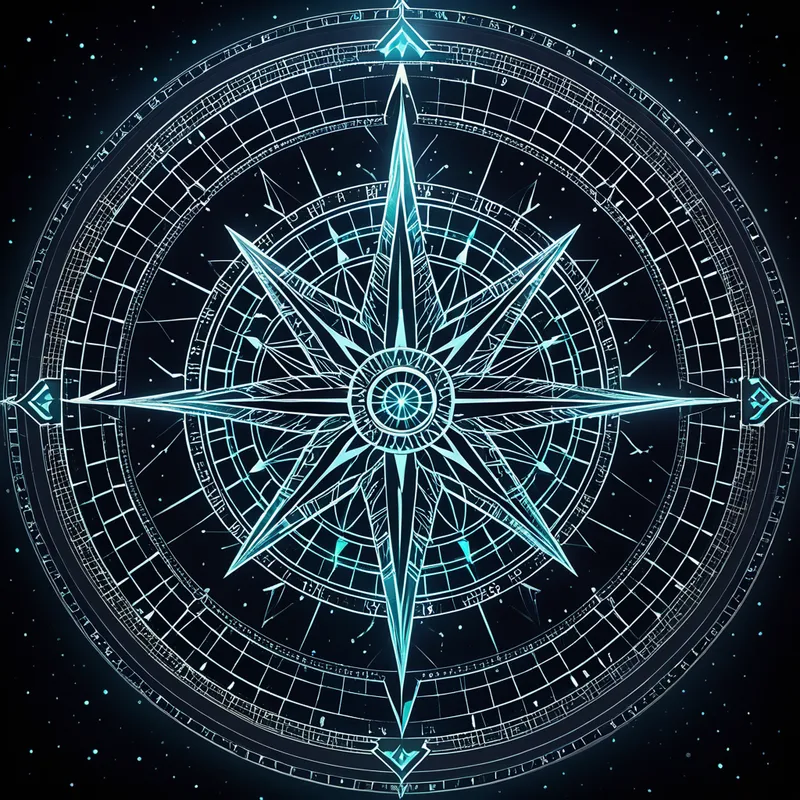
- The Axis Mundi: In mythological terms, it is the axis mundi of the personal cosmos. It connects the mundane (the lost traveler on earth) with the transcendent (the eternal, celestial order), offering a pathway between the confused ego and the transpersonal Self.
The Dreamer's Resonance
When this myth pattern surfaces in modern dreams, it often manifests during periods of profound disorientation or existential crisis. The dreamer may be wandering in a featureless landscape, driving on a highway that leads nowhere, or floating in a dark sea. The somatic feeling is one of vertigo, groundlessness, and deep anxiety—the psychological equivalent of being spiritually lost.
The appearance of the North Starin na in the dream is the psyche's innate corrective. It might appear as a singular, impossibly bright streetlight in a deserted city, a lone candle flame in a vast dark room, or a specific, resonant word or note that repeats with unwavering clarity. The dream shift is palpable: the anxiety does not necessarily vanish, but it is joined by a new somatic signature—a subtle sense of alignment, a relaxation in the shoulders, a deepening of breath. The dream-ego is not yet "saved," but it has been given a coordinate. The process is one of re-establishing inner orientation, of the unconscious compensating for the conscious mind's loss of way by activating the archetype of the guiding Self.

Alchemical Translation
The alchemical journey mirrored in this myth is the opus of finding the prima materia within one's own chaotic life and "fixing" it into the lapis philosophorum. The initial "chaotic dance" of the stars represents the nigredo stage—the dark, confused, and fragmented state of the unexamined life.
Starin na's agonizing act of self-fixation is the albedo, the whitening. It is the conscious, often painful, act of commitment and discernment. It requires asking: "Amidst all that I could be, what is the one, true, unwavering thing that I am?" This is not a limitation, but a distillation. The cooling of its light from gold to silver-blue symbolizes the transition from the solar, ego-driven passions to the lunar light of reflective consciousness.
The guide you seek is not ahead of you on the path, but above you, at the still point of your own turning world.
For the modern individual, the alchemical translation is this: Our "north" is not a pre-ordained destiny or a societal goal. It is the internal axis of values, integrity, and authentic purpose we choose to fix within ourselves, often at the cost of more fleeting pleasures or identities. The triumph is not in reaching a destination, but in achieving such inner constancy that, no matter how lost the traveler (the ego) feels, it can always look up, re-orient, and remember the direction home—which is always, ultimately, toward the center of one's own being. We do not follow the North Starin na; by embodying its principle of fixed purpose, we become it for our own journey.
Associated Symbols
Explore related symbols from the CaleaDream lexicon: