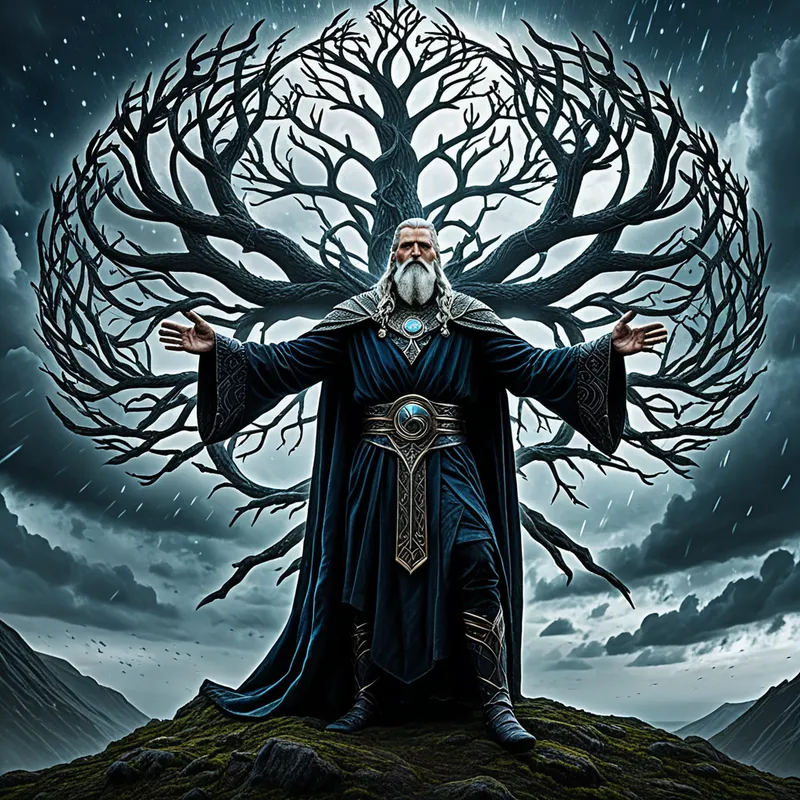
The Norse myth of Odin hanging Myth Meaning & Symbolism
The Allfather hangs himself on the World Tree, pierced by a spear, to gain the ultimate wisdom of the runes through a voluntary ordeal of suffering.
The Tale of The Norse myth of Odin hanging
Listen. In the time before time, when the worlds were young and the great tree [Yggdrasil](/myths/yggdrasil “Myth from Global/Universal culture.”/) held all things in its embrace, there was a hunger. It was not a hunger of the belly, but of the soul. It gnawed at the very heart of the Allfather, Odin. He who was lord of the slain, master of magic, father of gods and men, knew that his wisdom was but a candle against the coming dark. He sought the source, the root of all things, the secret language of the cosmos itself: [the runes](/myths/the-runes “Myth from Norse culture.”/).
He went to the place where the three roots of [the World Tree](/myths/the-world-tree “Myth from Celtic culture.”/) drink from three wells. To the deepest root, which delves into the [Ginnungagap](/myths/ginnungagap “Myth from Norse culture.”/) of memory, to the Well of Urd. The air was thick with the breath of the [Norns](/myths/norns “Myth from Nordic culture.”/) and cold with [the mist](/myths/the-mist “Myth from Celtic culture.”/) of ages. There, beneath that root, he made his choice.
He took his own spear, [Gungnir](/myths/gungnir “Myth from Norse culture.”/), the oath-swearer, and with a cry that was both a surrender and a command, he drove it into his own side. He offered himself to himself. Then, with the last of his strength, he hung himself upon the gnarled limb of Yggdrasil. No friend held him, no foe bound him. He was both the sacrifice and the sacrificer, suspended between the worlds.
For nine nights and nine days, a number sacred and complete, he hung. The winds of Asgard, [Jotunheim](/myths/jotunheim “Myth from Norse culture.”/), and Hel tore at him. His blood, dark and godly, dripped into the well below. Hunger clawed at his insides. Thirst parched his throat. The cold of [the void](/myths/the-void “Myth from Buddhist culture.”/) seeped into his bones. He stared, with his one remaining eye, into [the abyss](/myths/the-abyss “Myth from Kabbalistic culture.”/) of the well, and the abyss stared back. He died to himself, to his kingship, to his power. He descended into [the underworld](/myths/the-underworld “Myth from Greek culture.”/) of his own being.
And in the deepest dark of the ninth night, when the pain had burned away everything but pure awareness, he saw. A shimmering in the depths. A pattern in the chaos. A whisper in the silence. He saw the [runes](/myths/runes “Myth from Norse culture.”/). They did not float to him; he fell into them. With a final, gasping reach of his spirit, he seized them. The knowledge roared into him—the secrets of binding and unbinding, of healing and harming, of life and death and what lies beyond. The tree shuddered. He fell from the branch, no longer a hanging corpse, but a god reborn, filled with a terrible, silent knowing.
Cultural Origins & Context
This myth is preserved primarily in the Old Norse poem Hávamál (“The Sayings of the High One”), part of the Poetic Edda. It was not a story for children or a simple moral tale. It was a core mystery, passed down by skalds (poets) and possibly within initiatory contexts. In the harsh, fatalistic worldview of the Norse, wisdom was not a gentle gift but a hard-won prize, often paid for with suffering. Odin, the patron of poets, warriors, and seekers of hidden knowledge, models the ultimate pursuit. The myth functioned as a paradigm for the shamanic ordeal—the seidr practitioner’s journey between worlds—and as a theological explanation for the origin of the runic alphabet, a system of writing imbued with magical power. It taught that the highest authority, even for a god, comes not from dominion over others, but from a harrowing journey into [the self](/myths/the-self “Myth from Jungian culture.”/).
Symbolic Architecture
The myth is a perfect symbolic engine of [initiation](/symbols/initiation “Symbol: A symbolic beginning or transition into a new phase, status, or awareness, often involving tests, rituals, or profound personal change.”/). The Yggdrasil is the [axis](/symbols/axis “Symbol: A central line or principle around which things revolve, representing stability, orientation, and the fundamental structure of reality or consciousness.”/) of [reality](/symbols/reality “Symbol: Reality signifies the state of existence and perception, often reflecting one’s understanding of truth and life experiences.”/), the [structure](/symbols/structure “Symbol: Structure in dreams often symbolizes stability, organization, and the framework of one’s life, reflecting how one perceives their environment and personal life.”/) of the [psyche](/myths/psyche “Myth from Greek culture.”/) itself, connecting the conscious (Asgard), the ancestral/unconscious (Well of Urd), and the chthonic [depths](/symbols/depths “Symbol: Represents the subconscious, hidden emotions, or foundational aspects of the self, often linked to primal fears or profound truths.”/) (Hel). To hang upon it is to be crucified upon the structure of one’s own existence.
The sacrifice must be whole: one gives not a part, but the entirety of the old self. The spear is the wound that makes the opening for the new knowledge to enter.
The nine nights represent a full cycle of [gestation](/symbols/gestation “Symbol: A period of development and preparation before a significant birth or emergence, symbolizing potential, transformation, and the journey toward manifestation.”/) and [death](/symbols/death “Symbol: Symbolizes transformation, endings, and new beginnings; often associated with fear of the unknown.”/), the time needed for a psychic seed to germinate in darkness. Odin’s [auto](/symbols/auto “Symbol: An auto symbolizes autonomy, freedom, and the journey of life, reflecting personal control over one’s direction.”/)-sacrifice—offering himself to himself—is the ultimate act of self-[responsibility](/symbols/responsibility “Symbol: Responsibility in dreams often signifies the weight of duties and the expectations placed upon the dreamer.”/). He does not petition an external god; he becomes both the question and the answer. The runes are more than letters; they are the archetypal patterns of reality, the DNA of the [cosmos](/symbols/cosmos “Symbol: The entire universe as an ordered, harmonious system, often representing the totality of existence, spiritual connection, and the unknown.”/). Gaining them signifies achieving a [consciousness](/symbols/consciousness “Symbol: Consciousness represents the state of awareness and perception, encompassing thoughts, feelings, and experiences.”/) that can perceive and interact with the fundamental laws of existence, both psychological and [material](/symbols/material “Symbol: Material signifies the tangible aspects of life, often representing physical resources, desires, and the physical world’s influence on our existence.”/).
The Dreamer’s Resonance
When this myth stirs in the modern dreamer, it often manifests as dreams of suspension, paralysis, or voluntary ordeal. You may dream of hanging from a great tree or a cliff edge, not in terror, but in a state of intense, painful waiting. You may dream of a profound wound—a spear or blade entering your side—that does not kill but opens you. The somatic experience is one of piercing clarity born of exhaustion, of hitting a bottom where the only direction is inward.
Psychologically, this signals a critical point of [nigredo](/myths/nigredo “Myth from Alchemical culture.”/) in the alchemical process—the blackening, the dissolution of [the ego](/myths/the-ego “Myth from Jungian culture.”/)’s familiar structures. The dreamer is undergoing a necessary “hanging” of their old identity, career, relationship, or belief system. It is a state of liminality, where one is no longer what they were but not yet what they will become. The hunger and thirst in the dream are the soul’s craving for authentic meaning, a nourishment that ordinary life cannot provide. This dream pattern asks: What knowledge is so crucial that you would willingly endure this disintegration to obtain it?
Alchemical Translation
The myth of Odin’s hanging is a master blueprint for the alchemical process of individuation—the forging of the integrated Self. The first step is the voluntaria vulneratio, the willing wounding. In life, this is the conscious decision to confront a deep trauma, a shadow aspect, or a calling that requires abandoning security.
The tree is the process; the hanging is the submission to it. One does not conquer the unconscious; one surrenders to its transformative grip.
The nine nights of suffering correspond to the necessary period of incubation, where the ego’s noise must fade so the whispers of the Self can be heard. This is active suffering, not passive victimhood; it is the pain of holding the tension of opposites until a new synthesis emerges.
The final grasp of the runes is the illuminatio, the dawn of a new consciousness. The runes represent the acquired “toolkit” of the integrated psyche: the ability to “spell” (assemble) one’s reality with greater wisdom, to “read” the hidden patterns in events, and to “carve” one’s destiny with intention. The god who climbs down from the tree is not the same god who climbed up. He is wiser, heavier with knowledge, and forever marked by his ordeal. For the modern individual, the alchemical translation is clear: our greatest wisdom and authentic power are born not from what we acquire externally, but from what we are willing to lose—and find—within the sacred, terrifying depths of our own being.
Associated Symbols
Explore related symbols from the CaleaDream lexicon: