
The Norse god Odin's cloak tha Myth Meaning & Symbolism
A myth of the Allfather's cloak, woven from shadow and sky, concealing his quest for wisdom and the price of true knowing.
The Tale of The Norse god Odin’s cloak tha
Hear now, a tale not of thunder, but of silence. Not of the spear’s bright charge, but of the shadow that moves before it. In the high halls of Asgard, where the mead flows golden and boasts echo from rafters, the Allfather is often absent. For Odin walks other paths.
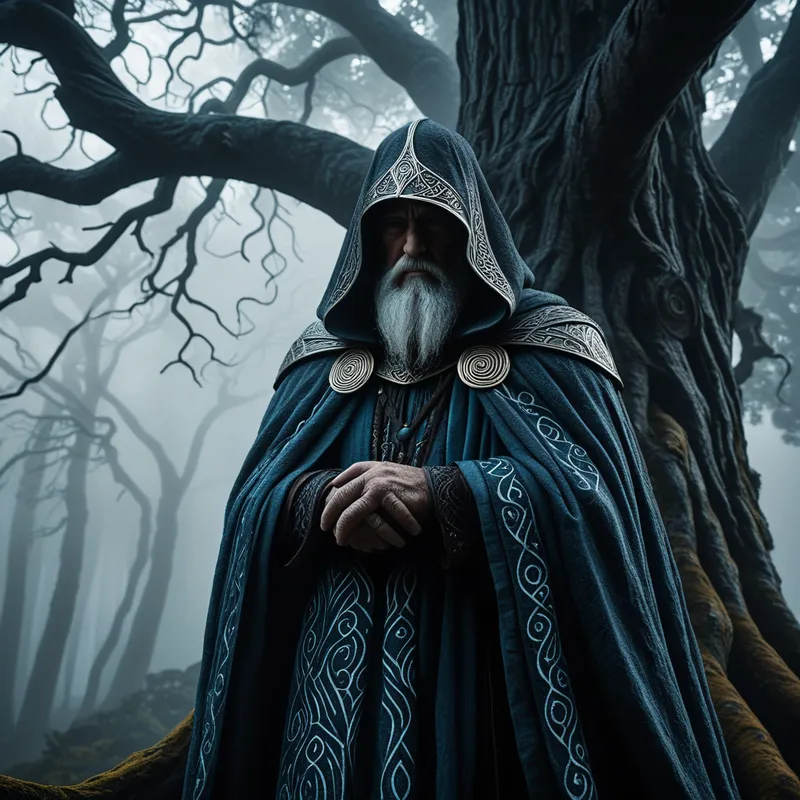
He walks where the roots of Yggdrasil gnaw at the stones of forgotten worlds. He walks the mist-shrouded borders between what is known and what must never be found. And for these walks, he dons not the glittering war-gear of a king, but a cloak. It is a garment without a single name, for to name it would be to pin down a cloud. It is the color of a raven’s wing at midnight, of deep water under ice, of the space between stars. To look upon it is to feel the chill of a secret kept too long.
They say it was not woven on any loom of Asgard or Svartalfheim. It was gathered. A thread from the sigh of a dying giant, forgotten at the dawn of time. A strand from the shadow cast by Gungnir when first it was forged. The frayed edges of a dream dreamt by the Norns. And the down of his own thought-birds, Huginn and Muninn, plucked not in cruelty, but in an exchange of essence. The cloak drinks the light around it and breathes out a deeper darkness, a living twilight that swallows sound and scent and sight.
Wrapped in this mantle, Odin becomes a whisper in the world. The eagle perched on Yggdrasil’s highest branch does not mark his passage. The serpent coiled at the root feels no tremor. He is the unseen question, the hidden cost. In this form, he journeyed to the Well of Mimir. The guardian, the severed head of wisdom itself, demanded a price for a drink: an eye. And there, in the silent gloom, the cloak witnessed its master’s hand rise, not in violence, but in offering. It caught the falling, sight-filled orb, absorbing its sacrifice into its fabric, the first great truth sewn into its weave.
Again, cloaked in this living shadow, he hung for nine nights on the windswept tree, a spear-gash in his side, a sacrifice to himself. The cloak was his only shroud against the elements, soaking not with rain, but with the agony of revelation, the runes carving themselves not just into his mind, but into the very threads that wrapped his suspended form. It learned the taste of wisdom born from torment.
And when he walks now, a grey wanderer among men, the cloak is his true face. It hides the fury of the god of battles and reveals only the weary hunger of the seeker. It is the space between the question and the answer, the long, lonely road that must be traveled alone. It is the silence that holds all sagas, waiting to be unfurled.
Cultural Origins & Context
The figure of Odin, and by extension the nature of his iconic attributes, emerges from the rich, stark tapestry of the Norse worldview, recorded primarily in the medieval Icelandic texts known as the Poetic Edda and the Prose Edda. These myths were not mere stories but a complex symbolic language for understanding a universe perceived as fundamentally dynamic, hostile, and charged with hidden meaning.
The cloak, as a specific artifact, is often implied rather than explicitly detailed. It is the essential tool of the god in his guises as the wanderer, the necromancer, the seeker of secrets. This reflects a culture that valued both the open, communal glory of the feast and the solitary, perilous quest for ørlög (fate) and knowledge. The myths were passed down by skalds (poets) and storytellers, often in hall settings, serving to explain the nature of authority (wisdom over brute force), the cost of consciousness, and the importance of strategy and foresight—qualities embodied by the cloaked wanderer who knows more than he reveals.
Symbolic Architecture
Odin’s cloak is the ultimate symbol of the veil. It does not represent mere hiding, but the necessary container for the transformative process. It is the psychological space of incubation.
The cloak is the darkness of the womb where the self is unmade and remade; it is the silence that must envelop the scream of sacrifice before it can become a word of power.
First, it symbolizes Concealed Sovereignty. The king disguises himself as the beggar. The ego’s need for recognition is surrendered to the Self’s need for understanding. The cloak contains the totality—the warrior, the poet, the shaman, the king—allowing only the aspect required for the current ordeal to emerge.
Second, it represents the Vessel of Sacrifice. The cloak receives Odin’s eye at Mimir’s well and endures his agony on the tree. It does not protect him from pain but holds the pain, allowing it to be metabolized into wisdom. Psychologically, it is the part of us that can contain unbearable insight—trauma, grief, or profound realization—without being utterly shattered, allowing for alchemical change.
Finally, it is the Garment of the Unseen World. It facilitates travel to the roots of Yggdrasil, to the lands of the dead. It is the symbol of the permeable boundary between the conscious and unconscious mind. To don the cloak is to engage in active imagination, to enter the interior landscape where the raw archetypes dwell, protected from the harsh glare of literal thinking.
The Dreamer’s Resonance
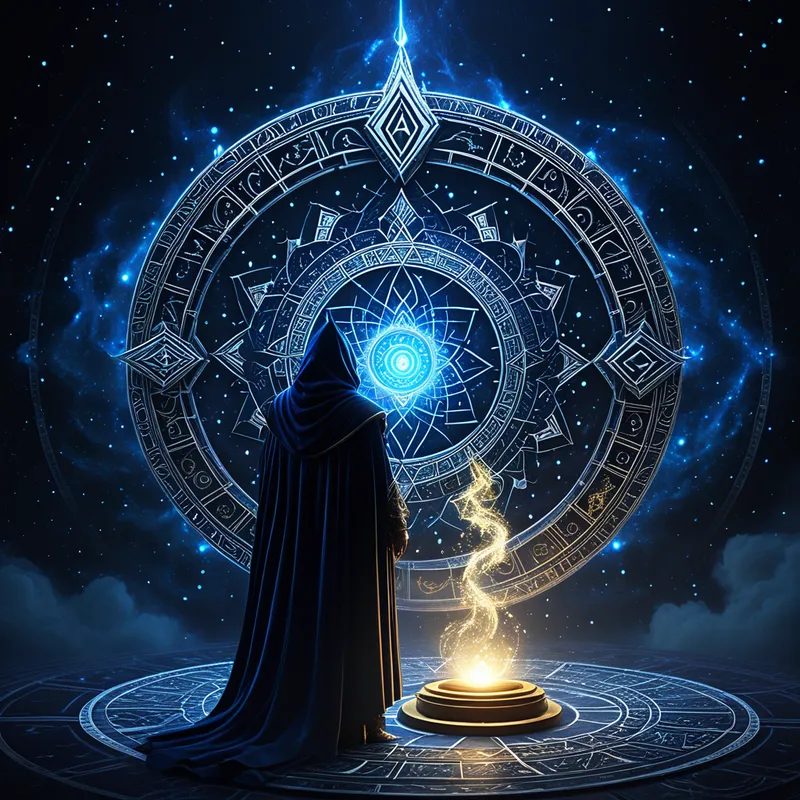
When the motif of Odin’s cloak surfaces in a modern dream, it often signals a profound encounter with the archetype of the Self. The dreamer may find themselves wearing a heavy, dark, or starry cloak that feels both alien and intimately familiar. They may be searching for something in a vast, lonely landscape, the cloak their only comfort.
Somatically, this can correlate with a feeling of being “wrapped” in introspection, a weighted blanket of deep thought, or a sense of protective isolation. Psychologically, it marks a stage where one is “incubating.” Conscious efforts have been surrendered; the ego is in retreat. The dreamer is in the cloak—the hidden, transformative process where old identities are shed, and new wisdom is being forged in darkness. There may be a concurrent feeling of loneliness (the wanderer’s path) but also of immense, quiet potency. The cloak in the dream is the psyche’s own holding environment, allowing a necessary dying and birthing to occur away from the public eye.
Alchemical Translation
The myth of Odin’s cloak provides a masterful map for the process of individuation—the alchemical journey of becoming whole. It models the stages of psychic transmutation not as a glorious battle, but as a shrouded, solitary work.
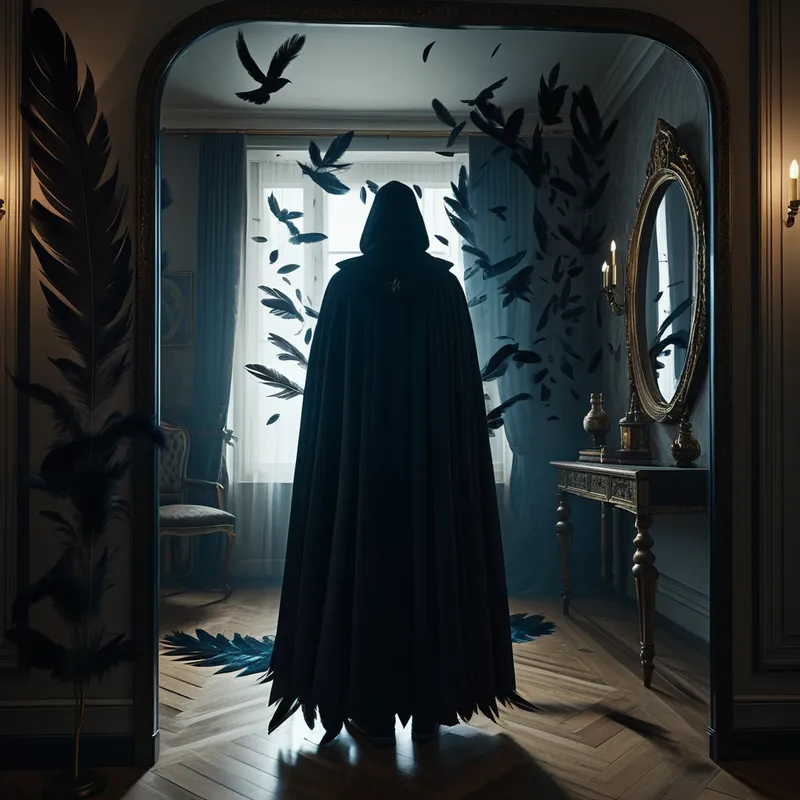
The first operation is Nigredo, the blackening. This is the donning of the cloak itself: the conscious decision to enter a period of darkness, confusion, or depression. It is the voluntary withdrawal from the brightly lit “hall” of collective values and persona to face the shadowy roots of one’s own being. The ego’s certainties are dissolved in this darkness.
The sacrifice at Mimir’s well is the Separatio: the willing plucking out of the “eye” of habitual perception. One must surrender the way one has always seen the world to gain a deeper, more painful, and more truthful vision.
The hanging on Yggdrasil is the Mortificatio, the symbolic death. Here, in the cloak’s embrace, the old self is suspended in agony. This is the crucible where the runes—the fundamental structuring principles of the new consciousness—are seared into the soul. The cloak ensures this death is not annihilation but a contained dissolution.
Finally, the return as the wanderer is the Albedo, the whitening, and the beginning of integration. The wisdom gained is not worn as a crown but carried within the humble, enduring cloak. The transformed individual moves through the world differently: quieter, seeing more, known less. They have integrated the cloak’s function. They can hold paradox, contain suffering, and wield knowledge with compassionate stealth. They have learned that true power lies not in what is displayed, but in what is wisely concealed and patiently nurtured in the fertile dark.
Associated Symbols
Explore related symbols from the CaleaDream lexicon: