The Nile Sedge Basket Myth Meaning & Symbolism
A tale of a child, hidden in a basket of river reeds, whose survival against cosmic odds reveals a hidden king and the power of fate.
The Tale of The Nile Sedge Basket
Hear now a whisper from the time when gods walked with the breath of [the river](/myths/the-river “Myth from Buddhist culture.”/). In the black land of Kemet, a shadow fell upon the house of the Hebrews. A [pharaoh](/myths/pharaoh “Myth from Egyptian culture.”/), his heart hardened like flint, feared their numbers and decreed a horror: every newborn son was to be cast into the life-giving, life-taking Nile.
In a humble dwelling of mudbrick, a Levite woman held her third-born son, her heart a drum of terror. For three moons, she hid his cries in the swaddling darkness. But as he grew, his voice could no longer be contained by walls. A desperate cunning, born of a love deeper than the Nun, took hold of her.
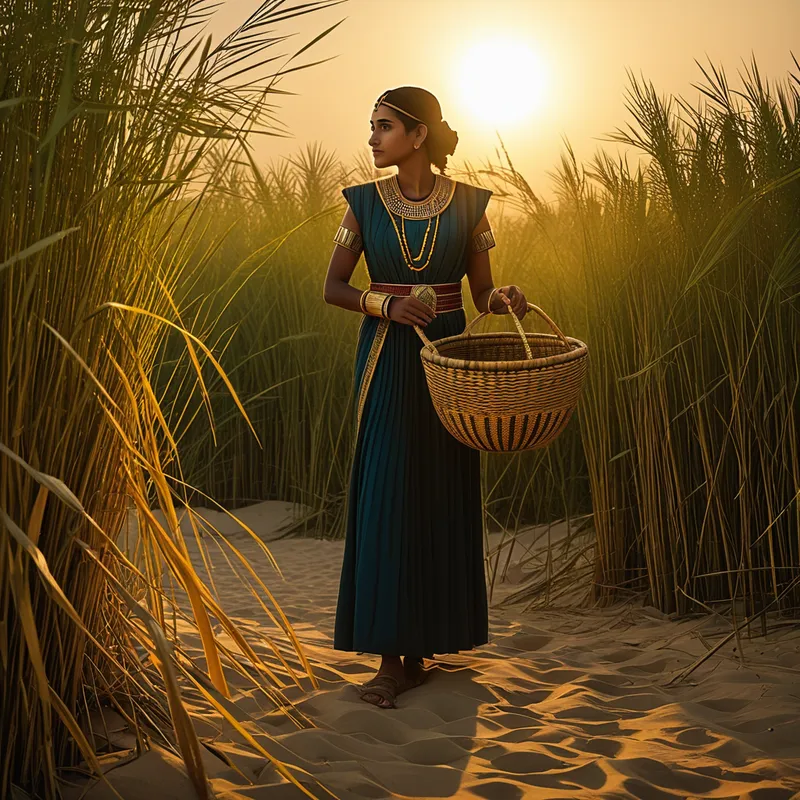
She went to the river’s edge, where the [papyrus](/myths/papyrus “Myth from Egyptian culture.”/) reeds whispered secrets to the [water](/myths/water “Myth from Chinese culture.”/). With skilled hands, she wove a basket—a tiny ark of sedge and reed. She caulked it with bitumen and pitch, making it watertight, a womb of earth and river. She placed her sleeping child within, this boy with eyes like pools of night, and laid the basket among the reeds at the river’s brink. His sister, [Miriam](/myths/miriam “Myth from Biblical culture.”/), stood sentinel afar, her breath held tight in her chest.
The river Hapi carried [the vessel](/myths/the-vessel “Myth from Alchemical culture.”/) gently. It did not sink into [the abyss](/myths/the-abyss “Myth from Kabbalistic culture.”/) but floated, cradled by the current, until it came to rest where the royal women bathed. The daughter of Pharaoh, surrounded by her handmaidens, came down to the water’s cool embrace. She saw the strange basket among the reeds and sent a slave to fetch it.
Upon opening it, the infant wept. The princess’s heart, untouched by her father’s decree, melted. “This is one of the Hebrew children,” she said, knowing yet defying. At that moment, Miriam emerged from her hiding place, a spirit of the reeds made flesh. “Shall I go and call a nurse from the Hebrew women to nurse [the child](/myths/the-child “Myth from Alchemy culture.”/) for you?” she asked, her voice steady despite the thunder in her veins.
The princess agreed. Thus, the child was returned to the arms of his very mother, his life paid for by the palace’s silver. He was named [Moses](/myths/moses “Myth from Biblical culture.”/), “the one who is drawn out.” The basket that was meant for death became the vessel of his destiny, carrying him from the decree of the river of death to the lap of royal power, setting his feet upon the path that would split a sea and shape a people.
Cultural Origins & Context
This narrative, central to the foundation myth of Israel, is preserved in the second chapter of the biblical Book of Exodus. While its primary custodians were the Hebrew scribes, its setting is deeply embedded in the Egyptian cosmological and physical landscape. The Nile was not just a river; it was the arterial pulse of Kemet, a divine entity. To place a child upon it was to place him directly in the hands of the gods—a potent act of surrender and fate-trusting that resonated with Egyptian understandings of divine judgment and royal destiny.
The story functioned as a powerful origin myth for a prophet and liberator, establishing his paradoxical identity: a Hebrew raised as Egyptian, an outsider within the palace, a condemned child saved by the very power that sought to destroy him. In the ancient Near Eastern context, such stories of exposed infants who survive to become great leaders (like Sargon of Akkad) were a common literary trope, signifying an individual marked by the divine for an extraordinary fate from the moment of their perilous beginning.
Symbolic Architecture
The [basket](/symbols/basket “Symbol: A basket in dreams often symbolizes a container for emotions, responsibilities, or resources.”/) is the myth’s central [symbol](/symbols/symbol “Symbol: A symbol can represent an idea, concept, or belief, serving as a powerful tool for communication and understanding.”/), a [microcosm](/symbols/microcosm “Symbol: A small, self-contained system that mirrors or represents a larger, more complex whole, often reflecting the universe within an individual.”/) containing multitudes. Woven from the reeds of the Nile, it is fashioned from the very substance of the [threat](/symbols/threat “Symbol: A threat in dreams often reflects feelings of vulnerability, anxiety, or fear regarding one’s safety or well-being. It can indicate unresolved conflicts or the presence of external pressures.”/). It represents the cunning of the [human](/symbols/human “Symbol: The symbol of a human represents individuality, complexity of emotions, and social relationships.”/) [spirit](/symbols/spirit “Symbol: Spirit symbolizes the essence of life, vitality, and the spiritual journey of the individual.”/) to use the tools of oppression to create a [vessel](/symbols/vessel “Symbol: A container or structure that holds, transports, or protects something essential, representing the self, emotions, or life journey.”/) of salvation.
The vessel of destiny is always woven from the reeds of our deepest peril.
The bitumen and [pitch](/symbols/pitch “Symbol: Pitch symbolizes a rough, sticky substance often associated with barriers and obstacles, reflecting the idea of struggle and the effort required to achieve goals.”/) that seal it symbolize the [mother](/symbols/mother “Symbol: The symbol of ‘Mother’ represents nurturing, protection, and the foundational aspect of one’s emotional being, often associated with comfort and unconditional love.”/)’s love and desperation—a dark, protective coating that makes the fragile vessel watertight against the chaotic waters of Nun and the cruel decree of the state. The [child](/symbols/child “Symbol: The child symbolizes innocence, vulnerability, and potential growth, often representing the dreamer’s inner child or unresolved issues from childhood.”/) within is the nascent self, the potential [king](/symbols/king “Symbol: A symbol of ultimate authority, leadership, and societal order, often representing the dreamer’s inner power or external control figures.”/) or [prophet](/symbols/prophet “Symbol: A messenger or seer who receives divine revelations, often warning of future events or guiding moral direction.”/), utterly vulnerable yet containing an unspoken [destiny](/symbols/destiny “Symbol: A predetermined course of events or ultimate purpose, often linked to spiritual forces or cosmic order, representing life’s inherent direction.”/). The [river](/symbols/river “Symbol: A river often symbolizes the flow of emotions, the passage of time, and life’s journey, reflecting transitions and movement in one’s life.”/) is the flow of [fate](/symbols/fate “Symbol: Fate represents the belief in predetermined outcomes, suggesting that some aspects of life are beyond human control.”/), time, and the unconscious—it can drown or carry, destroy or deliver to an unexpected shore.
The [princess](/symbols/princess “Symbol: The symbol of a princess embodies themes of power, privilege, and feminine grace, often entailing a journey of self-discovery.”/) represents the intervention of grace or unexpected [fortune](/symbols/fortune “Symbol: Fortune symbolizes luck, wealth, and opportunities that may be present or sought in one’s life.”/), the [aspect](/symbols/aspect “Symbol: A distinct feature, quality, or perspective of something, often representing a partial view of a larger whole.”/) of the ruling power that can recognize and spare hidden value. Her act of drawing the child from the [water](/symbols/water “Symbol: Water symbolizes the subconscious mind, emotions, and the flow of life, representing both cleansing and creation.”/) is a second [birth](/symbols/birth “Symbol: Birth symbolizes new beginnings, transformation, and the potential for growth and development.”/), a royal adoption that changes his entire ontological [status](/symbols/status “Symbol: Represents one’s social position, rank, or standing within a group, often tied to achievement, power, or recognition.”/). The entire [sequence](/symbols/sequence “Symbol: The symbol of ‘sequence’ often signifies the order of events and the progression towards a desired outcome or goal.”/) models a profound [truth](/symbols/truth “Symbol: Truth represents authenticity, honesty, and the quest for knowledge beyond mere appearances.”/): what is hidden in fear must be exposed to fate to be found by destiny.
The Dreamer’s Resonance
To dream of a basket floating on dark water speaks to a profound psychological process underway. The dreamer may be in a state of feeling exposed, vulnerable, and adrift on the currents of a life situation that feels overwhelming or threatening—a “Nile decree” of anxiety, loss, or transition.
The basket is the dream-ego’s temporary vessel, a fragile but intentional structure of self-protection the [psyche](/myths/psyche “Myth from Greek culture.”/) has woven. The act of placing something precious (a child, a symbol of the nascent self, a creative project, a new feeling) into this basket and setting it afloat indicates a necessary surrender. It is the somatic recognition that one cannot control the current, only the integrity of the vessel and the faith in the process. The dream may evoke deep anxiety (the fear of drowning) coupled with a strange, quiet hope (the possibility of being found). This is the psyche working through the orphan archetype’s core dilemma: how to protect and deliver the vulnerable self into a new, authentic identity when the old environment has become hostile.

Alchemical Translation
The myth of the sedge basket is a perfect allegory for the alchemical stage of the [nigredo](/myths/nigredo “Myth from Alchemical culture.”/) and the beginning of albedo. The oppressive decree is the crushing pressure that forces a hidden, precious content (the filius philosophorum, or philosophical child) into manifestation. The mother’s act of weaving and sealing is the conscious work of [the ego](/myths/the-ego “Myth from Jungian culture.”/), constructing a vessel—a ritual, a therapy, a creative practice—to contain the unconscious material.
To be drawn from the water is to be claimed by a destiny larger than the self that cast you adrift.
Placing it in the river is the critical act of submitting this contained self to the unconscious (the river). One must let go of direct control. The basket’s journey is the transformative process itself, guided by unseen currents. The finding by the princess is the albedo—the washing white, the unexpected recognition and valuation of this once-rejected self by a new, authoritative complex within the psyche (perhaps the anima/animus, or [the Self](/myths/the-self “Myth from Jungian culture.”/)). The child is saved, nurtured, and given a new name and station. Psychically, this models the individuation process where a rejected or hidden aspect of the personality is retrieved from the depths, brought into the light of consciousness, and integrated, granting the individual a new sense of purpose and royal authority over their own life. The orphan finds he was a king all along.
Associated Symbols
Explore related symbols from the CaleaDream lexicon: