The Nigredo to Albedo Process Myth Meaning & Symbolism
The soul's descent into chaotic blackness, where dissolution becomes the crucible for a rebirth into a state of purified, lunar whiteness.
The Tale of The Nigredo to Albedo Process
Listen. In the silent hour before memory, when the world was a single, heavy sigh, the Materia Prima slept. It was not gold, nor silver, nor any named thing. It was potential, pregnant and dark, dreaming of form. This is where our tale begins, not with a bang, but with a groan.
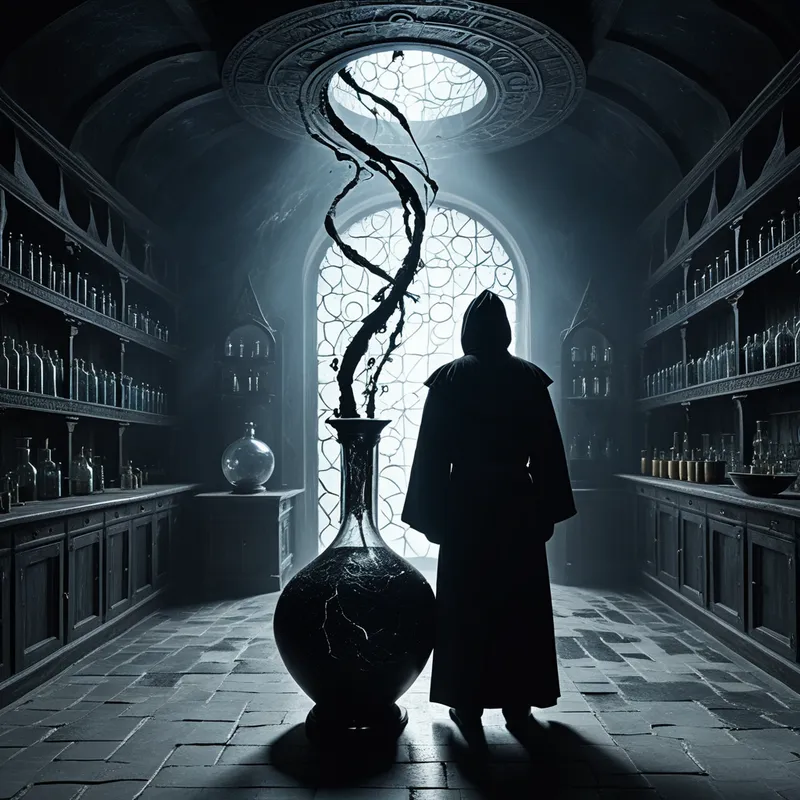
The Alchemist, who is not a man but a state of being—a concentrated will—entered the vas Hermeticum. This vessel was the world, the workshop, the very body of the seeker. With intention as his only tool, he gathered the raw stuff of existence: his passions, his failures, his unspoken shames, his brightest hopes. All were cast into the alembic. Then, he applied the fire. Not a flame of wood or coal, but the Igneus Naturae, the hidden fire of nature that burns without light.
And so began the Nigredo.
The mixture did not glow. It curdled. It soured. A profound blackness, deeper than any night, welled up from within the vessel. It was the black of rotting leaves, of forgotten tombs, of a starless void. Foul vapors rose—the stench of decay, of psychic corruption. The unified Materia Prima shattered into a chaos of conflicting elements. The Alchemist, mirrored in his work, felt his own soul fragment. All order dissolved. This was the coniunctio of shadow with shadow, a marriage in the grave. He saw visions of the Sol Niger, a sun that gave no warmth, only a desolate, absorbing dark. In this blackness, the Alchemist was utterly orphaned, a stranger to himself. The work was a failure. The fire had only made a tomb.
He was tempted to quench the flame, to flee the stinking darkness. But a whisper, older than time, held him: Solve et Coagula. Dissolve and Coagulate. The blackness was not an end, but a necessary womb.
He tended the fire. He watched. He waited in the perfect black. And then, after an aeon of despair, a change. A single, silver tear fell from the soot-blackened ceiling of the vessel onto the pitch below. Where it struck, the blackness did not sizzle, but stillened. A point of clarity emerged. Then another. Like frost forming on a windowpane at midnight, a delicate, crystalline whiteness began to spread across the surface of the chaos. The foul vapors ceased. The oppressive heat cooled to a gentle, lunar chill.
This was the dawning of the Albedo.
The black mass did not vanish; it was washed. It was bleached by a light that came from within itself, a cold, silent luminescence. The formless matter began to coalesce into something pure, white, and hard—like salt, like moonstone, like bleached bone cleansed of all flesh. The Alchemist, gazing upon this white stone, felt a corresponding clarity in his own mind. The passions were not gone, but stilled; the conflicts were not resolved, but ordered. A profound peace, empty and bright, filled the vessel. The black sun had set. In its place rose the Luna Alba, casting a light that did not dazzle, but revealed the true, stark contours of what remained. The orphan had found a home in austerity. The putrefaction was complete. The soul had been washed in its own darkness and had emerged, not joyful, but clean. The work was not finished, but it had passed through the first, most terrible gate.
Cultural Origins & Context
This is not a myth from a single culture, but a process-myth born from the underground river of Hermetic Alchemy that flowed through Alexandria, the Islamic Golden Age, and Medieval Europe. It was never a single story told around a fire, but a coded narrative embedded in cryptic texts, enigmatic woodcuts, and the oral teachings of adepts. Its tellers were not bards, but philosophers, physicians, and mystics like Zosimos of Panopolis, who recorded visions of dismemberment and renewal in his Visions, or the anonymous authors of the Rosarium Philosophorum.
Its societal function was dual. Exoterically, it provided a framework for early chemistry and metallurgy, a guide for transforming base lead. Esoterically, and more profoundly, it was a map for individuation. It served a culture of seekers operating under persecution, requiring its truths to be hidden in allegory. The myth of Nigredo to Albedo was a lifeline for the soul in an age of plague, inquisition, and spiritual crisis, offering a template where personal despair and confusion were not signs of damnation, but the essential first steps of a divine craft.
Symbolic Architecture
The myth’s power lies in its uncompromising mapping of a psychic death and rebirth cycle. The vas Hermeticus is the total psyche—the conscious ego and the unconscious—sealed under the pressure of intentional suffering or crisis. The Nigredo symbolizes the inevitable confrontation with the Shadow. It is the experience of depression, of meaninglessness, of seeing one’s cherished ideals and self-image rot into contradiction.
The Nigredo is the truth that one must lose one’s soul to find it. It is the annihilation of the persona, the comfortable lie of who we think we are.
The blackness is not evil, but prima materia—the fertile, chaotic source of all potential. The Luna Alba of the Albedo represents the birth of a new conscious attitude from this chaos. It is not solar, hot, or heroic, but reflective, cool, and discerning. It is the ego, having survived its dissolution, now capable of observing the contents of the psyche without immediate identification or panic. The white stone is the nascent, integrated self—hard-won, fragile, and purified of naive inflation.
The Dreamer’s Resonance
When this myth stirs in modern dreams, it announces a profound somatic and psychological initiation. The dreamer may find themselves in a decaying house (the personal psyche), trapped in a dark, flooding basement (the unconscious). They may handle black, sticky substances like tar or oil, or witness beloved objects corrode and turn black. These are somatic signals of the Nigredo—the body feeling the weight of unprocessed emotional matter.
The transition to Albedo in dreams is often marked by the appearance of white, clean, or cold symbols: walking into a sudden, silent snowfall; finding a room painted stark white; washing oneself in a clear, icy spring; or discovering a perfectly white stone or bone. The emotional tone shifts from claustrophobic dread to a spacious, if lonely, calm. The dream ego is not celebrating, but quietly observing this new, stark landscape of the self. This dream sequence signals that a period of intense psychological deconstruction is giving way to a phase of clarity, sobriety, and re-formation.

Alchemical Translation
For the modern individual, the Nigredo to Albedo process models the non-negotiable first half of any genuine transformation. We cannot think, positive-affirm, or consume our way from lead to gold. The culture of the “hero’s journey” often skips the putrefaction, but alchemy insists upon it. The modern seeker must consent to their own Nigredo—to enter the depression, the relationship ending, the career collapse, the identity crisis, and not immediately seek to fix it, but to let it cook. To allow the old, outworn structures of the personality to dissolve in the heat of suffering.
The fire is not the enemy, but the agent of truth. It burns away everything that is not essential, leaving only the blackened, authentic residue of the self.
The subsequent Albedo is not happiness, but lucidity. It is the ability to see oneself and one’s life without the filters of ambition, shame, or persona. It is a “washing” by the light of honest self-reflection. This white stage is often mistaken for the goal, but in the full Magnum Opus, it is merely the preparation of the soul to receive the true colors of life (the Citrinitas) and the integrated, golden wholeness of the Rubedo. To be “whitened” is to become capable of bearing reality, having been scoured clean in the dark night of the soul. It is the creation of an inner vessel strong enough to contain the final, glorious, and terrifying union of opposites.
Associated Symbols
Explore related symbols from the CaleaDream lexicon: