
The Nigredo Phase Myth Meaning & Symbolism
The myth of the Nigredo Phase describes the alchemist's terrifying descent into primal chaos, where all identity dissolves in the black womb of the prima materia.
The Tale of The Nigredo Phase
Listen. The story does not begin with light, but with a shattering.
In the silent heart of the oratorium, the Adept stands before the [vas Hermeticum](/myths/vas-hermeticum “Myth from Alchemical culture.”/). The air is thick with the scent of salt and slow decay. For months, years, a lifetime, they have gathered the [prima materia](/myths/prima-materia “Myth from Alchemical culture.”/)—not just lead and sulphur, but their own pride, their knowledge, their cherished self-image. All is placed within [the vessel](/myths/the-vessel “Myth from Alchemical culture.”/), sealed with the sign of the [Ouroboros](/myths/ouroboros “Myth from Global/Universal culture.”/).
The fire is lit. Not a roaring blaze, but a slow, insistent, secret heat—the heat of concentrated attention, of unflinching introspection. At first, nothing. Then, a stirring. The composite matter begins to sweat, to weep a bitter dew. Colors swirl and clash—the red of passion, the white of purity—then they muddy, darken.
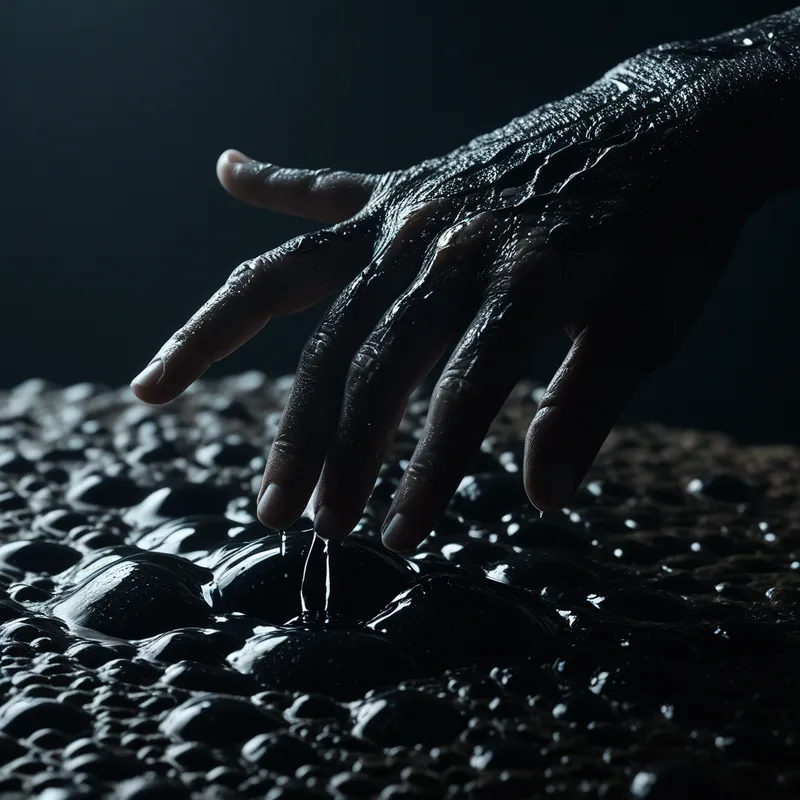
A groaning rises from the vessel, a sound felt in the bones, not heard by the ears. The matter convulses. It blackens. Not the black of soot or night, but the absolute black of [the abyss](/myths/the-abyss “Myth from Kabbalistic culture.”/), a black that drinks all light and gives nothing back. This is the [Nigredo](/myths/nigredo “Myth from Alchemical culture.”/). The vessel becomes a window into a private chaos. [The Adept](/myths/the-adept “Myth from Alchemical culture.”/) sees faces form and melt in the seething pitch—the face of a scorned lover, a dead parent, a childhood fear, their own face twisted in unrecognizable rage and despair. The coniunctio they sought has become a monstrous, fighting union of all they have denied.
[The laboratory](/myths/the-laboratory “Myth from Alchemical culture.”/) itself seems to dissolve. The stone walls weep the same black tears. The fire dims, choked by the emanating gloom. The Adept is alone with the rot of [the world](/myths/the-world “Myth from Tarot culture.”/), the rot of their soul. This is the melancholia. Every virtue feels like a lie, every structure a prison. The king—the conscious ego—is dead, drowned in the black sea within the glass.
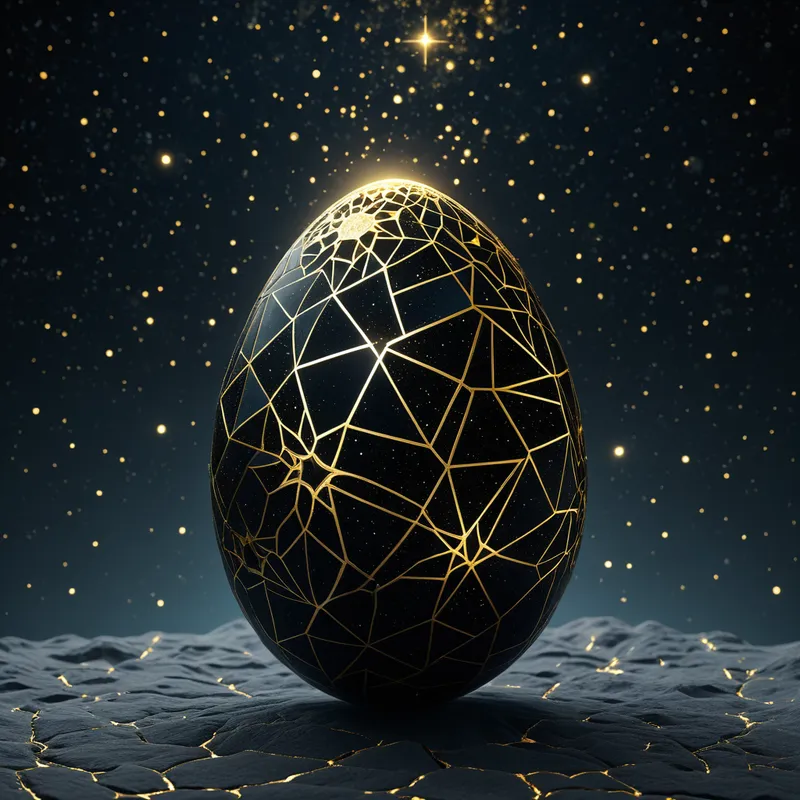
There is no action to take, no spell to recite. The only task is to witness. To not look away as the beloved self putrefies. To hold the vessel, and the fire beneath it, steady. The night is long. Centuries pass in a single watch. Just as the silence and the blackness become absolute, as if the universe has swallowed itself, a change occurs. Not a dramatic light, but a subtle shift in the quality of the darkness. From the very center of the pitch, a single, impossible star winks into being. A point of unassailable density. The blackness is no longer mere chaos, but a fertile womb. The groaning ceases. In the profound stillness, the Adept understands: the putrefaction is complete. The black sun has risen. The work can now begin.
Cultural Origins & Context
The mythos of [the Nigredo](/myths/the-nigredo “Myth from Alchemical culture.”/) is not a single, codified story from a lost civilization, but the central, recurring nightmare and revelation of the European Hermetic tradition, spanning from late antiquity through the Renaissance. It was passed down not by bards in halls, but by adepts in coded manuscripts, cryptic woodcuts, and whispered oral teachings within clandestine circles.
Its societal function was deeply subversive. In a world ordered by Church doctrine and feudal hierarchy, the Nigredo described a sacred, individual apocalypse. It was a map for the outlawed journey of the soul, a process that had to be experienced, not merely believed. [The alchemist](/myths/the-alchemist “Myth from Various culture.”/)-physicians like Paracelsus saw it as the necessary first medicine—the solve (dissolve) that must precede the coagula (recoagulate). To culture at large, it was heresy or madness. To the practitioner, it was the only truth that could lead to the [Lapis Philosophorum](/myths/lapis-philosophorum “Myth from Alchemical culture.”/).
Symbolic Architecture
The Nigredo is the archetypal [drama](/symbols/drama “Symbol: Drama signifies narratives, emotional expression, and the exploration of human experiences.”/) of unmaking. It symbolizes the voluntary or involuntary [dissolution](/symbols/dissolution “Symbol: The process of breaking down, dispersing, or losing form, often representing transformation, release, or the end of a state of being.”/) of the conscious [personality](/symbols/personality “Symbol: Personality in dreams often symbolizes the traits and characteristics of the dreamer, reflecting how they perceive themselves and how they believe they are perceived by others.”/)—[the ego](/myths/the-ego “Myth from Jungian culture.”/)—when confronted with the contents of the personal [shadow](/symbols/shadow “Symbol: The ‘shadow’ embodies the unconscious, repressed aspects of the self and often represents fears or hidden emotions.”/) and the [collective unconscious](/symbols/collective-unconscious “Symbol: The Collective Unconscious refers to the part of the unconscious mind shared among beings of the same species, embodying universal experiences and archetypes.”/).
The seed cannot know the tree until it consents to its own cracking open. So too, the soul knows no greater light than that which is born from its consent to absolute darkness.
The vas Hermeticum is the total [psyche](/myths/psyche “Myth from Greek culture.”/), the container of the transformational process. The [athanor](/symbols/athanor “Symbol: An alchemical furnace representing spiritual transformation, purification, and the sustained process of creating the Philosopher’s Stone.”/)‘s fire is the heat of conscious [attention](/symbols/attention “Symbol: Attention in dreams signifies focus, awareness, and the priorities in one’s life, often indicating where the dreamer’s energy is invested.”/) and suffering, without which the matter remains inert. The blackening itself is not evil, but the visible [symptom](/symbols/symptom “Symbol: A physical or emotional sign indicating an underlying imbalance, distress, or message from the unconscious mind.”/) of confrontation. All that was solid—identifications, personas, moral certainties—liquefies into the massa confusa. The [death](/symbols/death “Symbol: Symbolizes transformation, endings, and new beginnings; often associated with fear of the unknown.”/) of the “[king](/symbols/king “Symbol: A symbol of ultimate authority, leadership, and societal order, often representing the dreamer’s inner power or external control figures.”/)” (the old ruling [consciousness](/symbols/consciousness “Symbol: Consciousness represents the state of awareness and perception, encompassing thoughts, feelings, and experiences.”/)) is not a failure, but the prerequisite for any genuine renewal.
The Dreamer’s Resonance
When this myth stirs in the modern dreamer, it announces a profound somatic and psychological initiation. Dreams become landscapes of the Nigredo: being trapped in collapsing buildings (the dissolution of psychic structure), wandering through endless sewers or basements (descent into [the underworld](/myths/the-underworld “Myth from Greek culture.”/) of the psyche), being pursued by a faceless or shadowy figure (the approaching shadow), or witnessing one’s own body decay or transform into something monstrous.
The somatic experience is one of weight and viscosity. One may feel literally bogged down, sluggish, depressed (from deprimere, “to press down”). There is a sense of carrying a black, tarry substance within. Emotionally, it is the season of Saturnine melancholy—feelings of isolation, meaninglessness, and a crushing awareness of one’s own flaws and mortality. The dreamer is not “going crazy”; they are being immersed in [the prima materia](/myths/the-prima-materia “Myth from Alchemical culture.”/) of their own being. The ego is being humbled, forced to relinquish control so a deeper, more central Self can begin to organize the chaos.

Alchemical Translation
For the modern individual seeking wholeness, the Nigredo models the non-negotiable first step of individuation. Our culture prizes growth, light, and positivity, viewing depression, stagnation, and “negative” emotions as errors to be fixed. The alchemical myth reframes this “dark night” as the sacred ground of all transformation.
The gold is not found by polishing the surface of the lead, but by descending into the lead’s secret, black heart, where it dreams of being sun.
The process translates as a conscious engagement with one’s own fragmentation. This is the “shadow work” of depth psychology: to stop projecting one’s darkness onto others and to instead “contain” it within the vessel of self-reflection (the therapy chamber, the journal, the mindful pause). It is to apply the slow fire of honest attention to one’s failures, rages, shames, and fears—not to be consumed by them, but to cook them, to subject them to the transformative pressure of consciousness.
The [triumph](/myths/triumph “Myth from Roman culture.”/) of the myth is not an escape from the blackness, but the discovery of its purpose. The putrefaction reveals itself as fermentation. The sense of death becomes the precondition for rebirth. The individual who endures this phase without fleeing into distraction or false consolation emerges not “fixed,” but fundamentally altered. They have met [the dragon](/myths/the-dragon “Myth from Chinese culture.”/) of chaos and found it to be the guardian of their own hidden treasure. The ego, once the solitary king, becomes a servant to the greater, more mysterious Self that begins to coalesce from the central, starry point in the dark. The work of albedo—the washing clean—can then begin, but it is a washing born from the depths, not a superficial whitewashing. The Nigredo teaches that to become who we are, we must first cease to be who we thought we were.
Associated Symbols
Explore related symbols from the CaleaDream lexicon: