
The Nigredo Myth Meaning & Symbolism
The myth of the Nigredo, the first stage of alchemy, where dissolution into blackness is the necessary crucible for all true psychic rebirth.
The Tale of The Nigredo
Listen. Before the white, before the red, before the gold, there is the Black. This is not a story of ascent, but of descent. It begins not in a palace, but in a cellar; not with a shout, but with a sigh.
The Artifex stands in the Oratorium, a chamber of stone and silence. The air is thick with the smell of salt and sorrow. Before them lies the Massa Confusa—a lump of dull lead, a vial of bitter tears, a handful of dust from a forgotten road. This is the substance of their life, the sum of all they have gathered: their pride, their failures, their unspoken shames, their brightest hopes now tarnished.
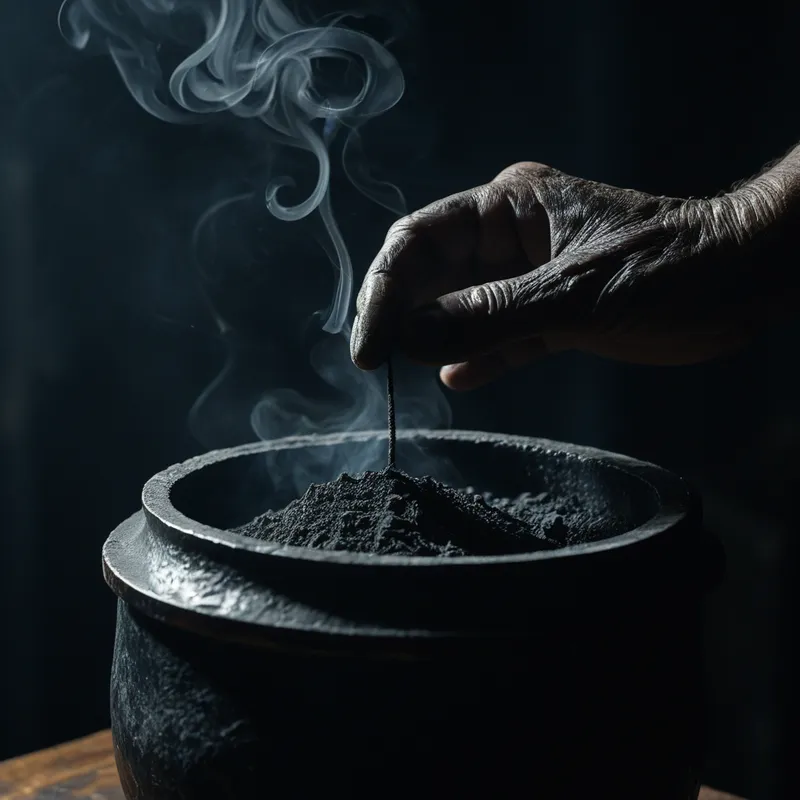
The furnace is lit. Not with a roaring blaze, but with a low, persistent heat, the heat of a fevered brow. The Artifex places the Massa Confusa into the Vas Hermeticum, the sealed vessel. They close the lid. The world goes dark.
This is the incubation. In the absolute blackness of the vessel, a terrible marriage occurs. The dry and the moist, the fixed and the volatile, the king and the queen—all the opposed forces within the soul are forced together. They do not embrace; they strangle one another. A slow rot sets in. The lead sweats a cold, metallic dew. The dust putrefies. The tears ferment into a sharp vinegar. The once-distinct elements dissolve into a single, seething, black soup—the Sol Niger.
The Artifex watches, their heart a cold stone in their chest. This is the death. The death of certainty, the death of the old form, the death of the persona they showed the world. A stench of decay fills the Oratorium. The blackness in the vessel becomes absolute, a void that swallows all light. It is the midnight of the spirit. Here, in this blackness, the Scintilla, the tiny spark of soul, is utterly extinguished. Or so it seems.
For in the absolute depth of this nigredo, when all is corruption and despair, a miracle of putrefaction occurs. The blackness does not solidify; it becomes fertile. It becomes a womb. And if the Artifex can endure the stench, the despair, the terrifying formlessness, they will see it—not with their eyes, but with the eye of the spirit. A single, almost imperceptible star, white and cold, glimmers in the heart of the black ocean. The first sign of the Albedo. The death was not an end, but a gestation. The tale of the Black is the tale of the necessary night.
Cultural Origins & Context
The mythos of the Nigredo is not from a single culture, but from the underground river of Western esotericism that flowed through Alexandria, the Islamic Golden Age, and into Medieval and Renaissance Europe. It was passed down in cryptic, illustrated manuscripts like the Rosarium Philosophorum and the writings of figures such as Hermes Trismegistus. These texts were not mere recipes; they were spiritual diaries encoded in the language of chemistry.
The myth was told in whispers between adepts, in the shadows of monasteries and royal courts. Its societal function was subversive. In a world ordered by Church dogma and feudal hierarchy, alchemy proposed a radical interior democracy: the divine is not only out there in heaven, but in here, trapped in the basest matter of the self and the world. The Nigredo was the essential, terrifying first step in liberating it. It modeled a process of radical self-honesty and deconstruction that was too dangerous for public doctrine, finding its home in symbol, allegory, and the silent work of the furnace.
Symbolic Architecture
Psychologically, the Nigredo represents the conscious confrontation with the Shadow. It is the moment when the carefully constructed persona—the “lead” of our adaptive self—is subjected to the heat of honest self-reflection and life crisis. This heat forces a dissolution.
The gold cannot be extracted; it must be born from the decay of what you once believed was yourself.
The Vas Hermeticum is the total commitment to the process, the sealed container of the therapeutic space, the analytic hour, or the solitary ordeal where one cannot escape one’s own material. The Sol Niger symbolizes the dark, creative power of the unconscious now unleashed, a sun that gives not light but the heat of fermentation. The putrefaction is not meaningless suffering; it is the breakdown of outworn complexes, rigid identities, and naive ideals, reducing them to their psychic components so they may be reconstituted.

The Dreamer’s Resonance
When this myth stirs in the modern dreamer, it announces a profound somatic and psychological initiation. Dreams become landscapes of decay: teeth falling out, houses crumbling, navigating endless basements or sewers. The dream ego may find itself covered in black oil, trapped in a dark room, or watching a loved one transform into a rotting figure.
These are not portents of literal doom, but somatic metaphors of the Nigredo at work. The body in the dream registers the dissolution happening in the psyche. The feeling is one of profound disorientation, loss, and “stuckness.” The dreamer is in the Vas, experiencing the necessary death of an old attitude. The psyche is performing its own alchemy, reducing a conscious position to black, fertile mush so that a new, more authentic structure—hinted at by those fleeting images of white birds or morning stars in the dream—may eventually arise.
Alchemical Translation
For the modern individual, the Nigredo myth models the non-negotiable first phase of individuation. Our culture prizes positivity, growth, and light, but alchemy insists we must first become well-acquainted with our inner night.
The process begins when life itself becomes the furnace: a job loss, a betrayal, a depression, a failure that “heats” our identity to the breaking point. The conscious task is not to fix it, or to seek premature light, but to seal the vessel—to commit to staying with the feeling, however black. This means allowing the grief, the rage, the shame to putrefy, to break down their simplistic stories into raw, emotional truth.
The lead of your resentment must rot before it can become the silver of understanding.
This is the cultivation of the Capacitas Negativa, the negative capability to endure uncertainty and darkness. The triumph of the Nigredo is not an escape from blackness, but the realization that one can survive it, that within it lies a strange, fecund emptiness. The first glimmer of the white star is not a solution, but the birth of a new question from the ruins of the old answers. One does not solve the Nigredo; one gestates within it, until the psyche itself, from its own depths, signals the dawn of the next stage.
Associated Symbols
Explore related symbols from the CaleaDream lexicon: