The Nightingale and the Rose Myth Meaning & Symbolism
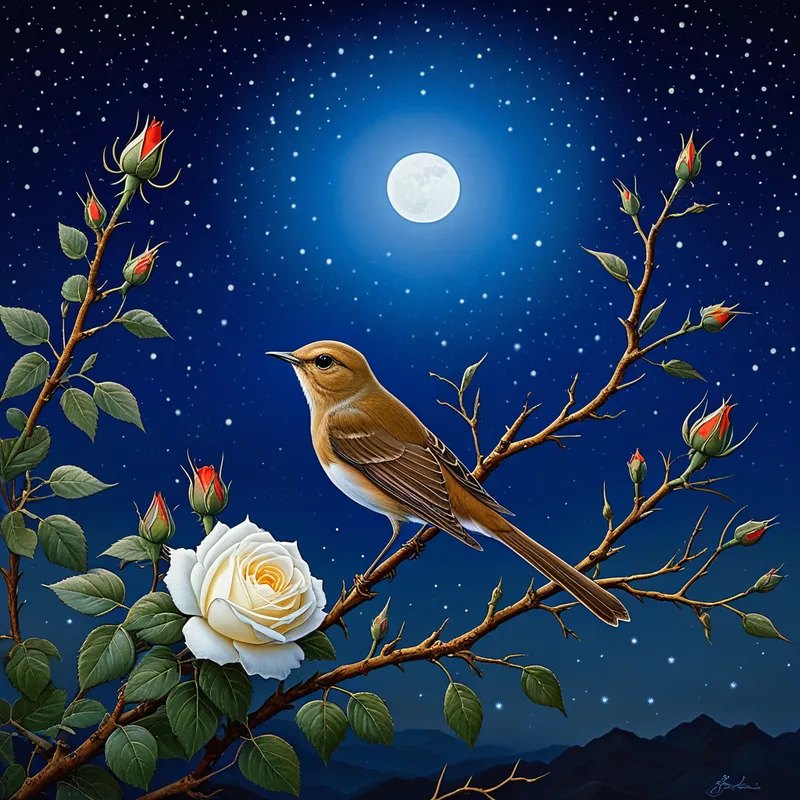
A nightingale, pierced by a thorn, sings its life into a white rose, dyeing it crimson with its heart's blood—a testament to love's ultimate sacrifice.
The Tale of The Nightingale and the Rose
Listen, and let the scent of [jasmine](/myths/jasmine “Myth from Persian culture.”/) and old parchment carry you back. In the time when [the moon](/myths/the-moon “Myth from Tarot culture.”/) was a silver bowl and the stars were the scattered thoughts of the first poet, there lived a nightingale. This was no ordinary bird. Its song was a thread of pure longing, a melody woven from the very fabric of the unseen world. It lived in the garden of a poet-king, a place where every leaf whispered a verse and every fountain played [the music of the spheres](/myths/the-music-of-the-spheres “Myth from Greek culture.”/).
One evening, as the last ember of the sun faded, the nightingale beheld a sight that stilled its song. A single rosebush, proud and lonely, bore one bud of the purest white—a [pearl](/myths/pearl “Myth from Chinese culture.”/) clasped in a fist of thorns. The nightingale’s heart, a tiny drum of fierce passion, beat a new rhythm. It saw in that unopened flower the perfect beauty, the ultimate beloved, the answer to a question its song had always asked but never formed.
But [the rose](/myths/the-rose “Myth from Persian culture.”/) was cold. It was white as snow, silent as stone. It did not open. The nightingale circled it, singing sweeter and sweeter, pouring every secret of dawn and dusk into its plea. The bud remained closed. Despair, a dark wine, filled the bird’s small being. Then, from the ancient earth itself, a voice—perhaps the spirit of the garden, perhaps the nightingale’s own soul—spoke: “The rose is the beloved. To awaken it, to make it bloom, requires a sacrifice. [The white rose](/myths/the-white-rose “Myth from Alchemical culture.”/) becomes red only with a lover’s heart-blood, warmed by a final song.”
The nightingale did not hesitate. Love had already decided. It flew to the rosebush, pressed its tender breast against the longest, sharpest thorn, and began to sing. Not a song of sorrow, but of ecstatic surrender. As the thorn pierced its heart, the song grew stronger, clearer, more luminous. Each note was a drop of life, a ruby tear, flowing down the thorn and into the stem of the sleeping bud.
The white petals trembled. A blush, faint as a dawn yet unseen, touched their edges. The nightingale sang on, its life becoming its song, its song becoming the rose’s color. The blush deepened to crimson, to scarlet, to the deep, living red of a beating heart exposed to the moon. The rose unfurled, petal by glorious petal, until it stood fully open, radiant, perfuming the night with a fragrance of passion and loss.
The song ended. The nightingale, its small body light now as a fallen leaf, dropped from the thorn. In the morning, the poet-king found the most magnificent red rose he had ever seen, and at its foot, a silent, gray-feathered bird. He never knew the cost of the beauty he held. But the garden remembered. And on certain still nights, when a red rose blooms, you can almost hear, carried on [the wind](/myths/the-wind “Myth from Various culture.”/), the echo of a perfect, sacrificed song.
Cultural Origins & Context
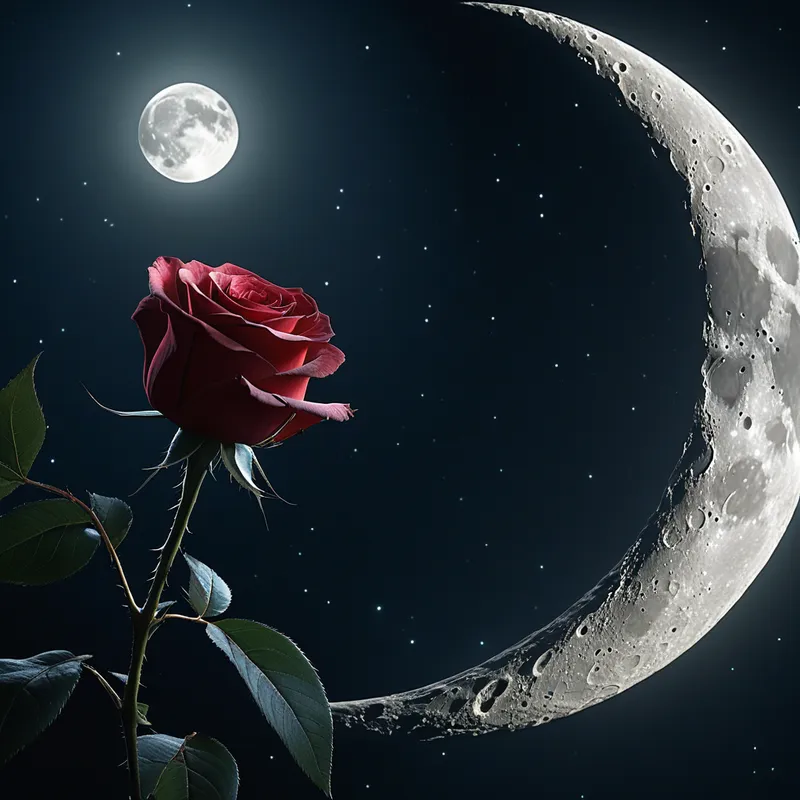
This poignant myth, while immortalized in the West by Oscar Wilde’s Victorian parable, finds its deepest roots in the rich soil of Persian literature and mystical thought. It is not a single, codified myth from a sacred text, but a fluid, pervasive motif that flows through the works of poets like Omar Khayyám and, most significantly, the towering figure of Rumi. In the Sufi tradition, which profoundly shaped Persian culture, the nightingale (Bulbul) and the rose (Gol) are archetypal lovers in an eternal spiritual drama.
The tale was passed down not by historians, but by dervishes in khaniqahs, by poets in royal courts, and by storytellers in bazaars. Its societal function was multifaceted: as a metaphor for the soul’s (Bulbul) desperate, beautiful longing for God (Gol); as a model of idealized, self-obliterating love in the Persian romantic tradition; and as a profound teaching on the nature of true beauty, which is always born of a costly, interior process. It encoded a core cultural truth: that the most exquisite outcomes—art, love, wisdom—are often forged in [the crucible](/myths/the-crucible “Myth from Alchemical culture.”/) of profound personal sacrifice.
Symbolic Architecture
The myth’s power lies in its stark, perfect [symbolism](/symbols/symbolism “Symbol: The use of symbols to represent ideas or qualities, often conveying deeper meanings beyond literal interpretation. In dreams, it’s the language of the unconscious.”/). The Nightingale represents the [psyche](/myths/psyche “Myth from Greek culture.”/) in its [aspect](/symbols/aspect “Symbol: A distinct feature, quality, or perspective of something, often representing a partial view of a larger whole.”/) as the [Lover](/symbols/lover “Symbol: A lover in dreams often represents intimacy, connection, and the emotional aspects of relationships.”/). It is pure desire, yearning, and creative [expression](/symbols/expression “Symbol: Expression represents the act of conveying thoughts, emotions, and individuality, emphasizing personal communication and creativity.”/). Its song is the voice of the [soul](/symbols/soul “Symbol: The soul represents the essence of a person, encompassing their spirit, identity, and connection to the universe.”/)’s longing, beautiful but, by itself, insufficient to enact transformation.
The White [Rose](/symbols/rose “Symbol: A rose often symbolizes love, beauty, and passion, embodying both the joys and sorrows of romantic relationships.”/) is the unmanifest potential, the cold [archetype](/symbols/archetype “Symbol: A universal, primordial pattern or prototype in the collective unconscious that shapes human experience, behavior, and creative expression.”/), the idealized but unreachable Other. It is perfection in [stasis](/symbols/stasis “Symbol: A state of inactivity, equilibrium, or suspension where no change or progress occurs, often representing psychological or existential paralysis.”/)—beautiful but sterile. It symbolizes the beloved, the divine, the goal of the artistic endeavor, or the integrated Self, in its dormant state.
The [Thorn](/symbols/thorn “Symbol: A symbol of pain, protection, and hidden beauty, representing obstacles that guard growth or cause suffering.”/) is the necessary [instrument](/symbols/instrument “Symbol: An instrument symbolizes creativity, communication, and the means by which one expresses oneself or influences the world.”/) of suffering and [connection](/symbols/connection “Symbol: Connection symbolizes relationships, communication, and bonds among individuals.”/). It is the painful point of contact between the yearning soul and the hard [reality](/symbols/reality “Symbol: Reality signifies the state of existence and perception, often reflecting one’s understanding of truth and life experiences.”/) of [the world](/myths/the-world “Myth from Tarot culture.”/) or the beloved’s otherness. It represents sacrifice, ordeal, and the piercing [truth](/symbols/truth “Symbol: Truth represents authenticity, honesty, and the quest for knowledge beyond mere appearances.”/) that awakens.
The crimson rose does not replace the white one; it is the white rose, transformed by the alchemy of suffering and song. The goal is not abandoned but fulfilled through the lover’s dissolution.
The central [alchemy](/symbols/alchemy “Symbol: A transformative process of purification and creation, often symbolizing personal or spiritual evolution through difficult stages.”/) is clear: the Song (creative [life](/symbols/life “Symbol: The symbol of ‘Life’ represents a journey of growth, interconnectedness, and existential meaning, encompassing both the joys and challenges that define human experience.”/)-force, [spirit](/symbols/spirit “Symbol: Spirit symbolizes the essence of life, vitality, and the spiritual journey of the individual.”/)) and the [Heart](/symbols/heart “Symbol: The heart symbolizes love, emotion, and the core of one’s existence, representing deep connections with others and self.”/)-[Blood](/symbols/blood “Symbol: Blood often symbolizes life force, vitality, and deep emotional connections, but it can also evoke themes of sacrifice, trauma, and mortality.”/) (vitality, embodied suffering, [life](/symbols/life “Symbol: The symbol of ‘Life’ represents a journey of growth, interconnectedness, and existential meaning, encompassing both the joys and challenges that define human experience.”/) essence) must merge. [Spirit](/symbols/spirit “Symbol: Spirit symbolizes the essence of life, vitality, and the spiritual journey of the individual.”/) alone is just sound; [blood](/symbols/blood “Symbol: Blood often symbolizes life force, vitality, and deep emotional connections, but it can also evoke themes of sacrifice, trauma, and mortality.”/) alone is just pain. Together, channeled through the focused point of the thorn (conscious sacrifice), they become the transformative agent that dyes potential into actuality, turning the white [idea](/symbols/idea “Symbol: An ‘Idea’ represents a spark of creativity, innovation, or realization, often emerging as a solution to a problem or a new outlook on life.”/) into the red reality.
The Dreamer’s Resonance
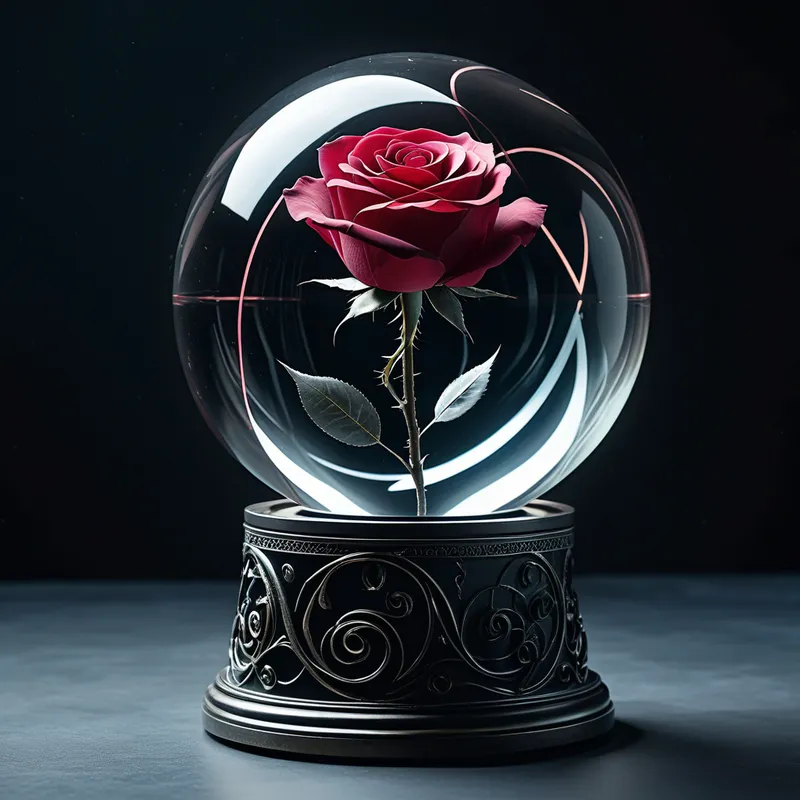
When this myth stirs in the modern unconscious, it often surfaces in dreams of poignant, beautiful suffering. To dream of being a nightingale singing desperately to an unresponsive flower is to experience the somatic feeling of creative or emotional labor that feels unseen, of love offered but not reciprocated. The thorn’s piercing is the dream-body registering the acute pain of vulnerability, of putting one’s “heart on the line.”
Conversely, to dream of being the white rose, cold and closed, may signal a psychological process of defensive withdrawal. The dreamer is the beloved who cannot open, perhaps for fear of the cost to the “nightingale” (another person or their own passionate nature), or because they feel trapped in a perfectionistic, sterile state. The blooming of the rose in a dream, especially if accompanied by a sense of sorrowful beauty, often marks a moment of profound emotional or psychic release—a heart-opening paid for by a prior, perhaps forgotten, sacrifice. These dreams ask the dreamer: What in you is singing its life out? What in you remains frozen, beautiful but unopened? And what thorn of truth must you embrace to connect the two?
Alchemical Translation
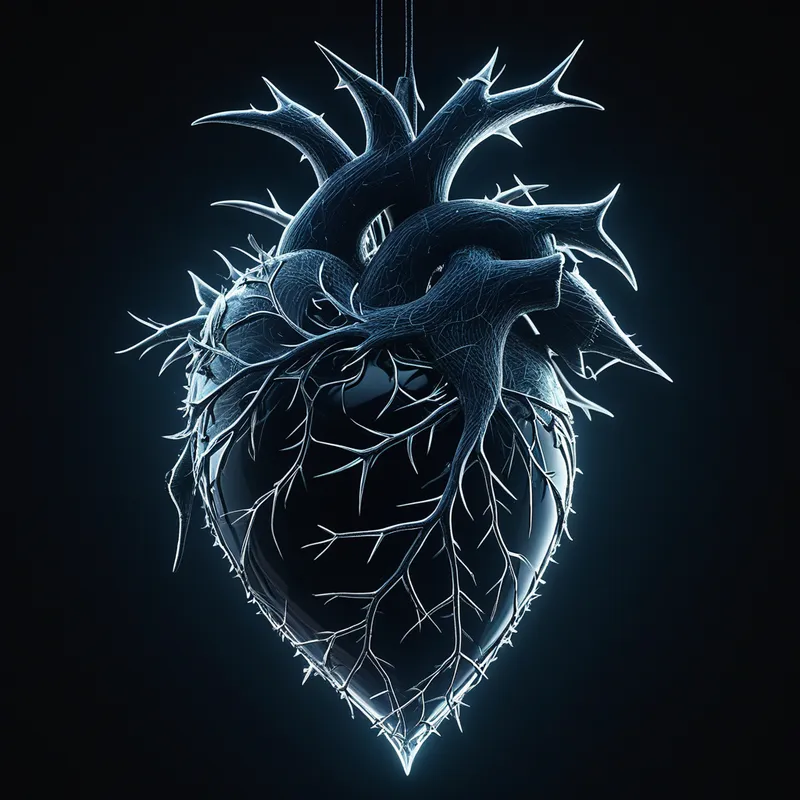
For the individual on the path of individuation, the myth of the Nightingale and the Rose is a precise map of psychic transmutation. The process begins with the recognition of the White Rose—an idealized self-image, a perfect but lifeless goal (the perfect job, the flawless relationship, total enlightenment). We sing at it, decorate it with affirmations, but it remains inert.
The alchemical shift occurs when the psyche turns its song inward, toward its own shadow, its own embodied reality—the thorn. This is the painful, precise work of self-confrontation: acknowledging one’s wounds, dependencies, angers, and fears (the heart-blood). The sacrifice is not of something external, but of the illusion that one can achieve the red rose without being pierced by one’s own truth.
Individuation is the crimsoning of the soul. We do not attain a new self; we dye the latent self with the blood of our own lived experience, warmed by the fire of conscious attention.
The nightingale’s final, ecstatic song is the act of holding that tension consciously—the pain of the thorn and the vision of the rose—without fleeing into cynicism or fantasy. In that sustained note, the opposites merge. The blood of the complex (the thorn’s wound) becomes the pigment of the symbol (the rose’s color). [The ego](/myths/the-ego “Myth from Jungian culture.”/)-driven desire of the nightingale dies, but in that death, it gives life to [the Self](/myths/the-self “Myth from Jungian culture.”/), the now-blood-red rose that blooms in the garden of the integrated personality. The rose that blooms is not the nightingale’s possession, but its masterpiece and its monument. We, as modern individuals, are both the sacrifice and the resulting beauty, the singer and the song made manifest. The myth teaches that our deepest fulfillment is found not in reaching for a static ideal, but in the courageous, costly act of pouring our authentic, suffering, singing life into the heart of our own becoming.
Associated Symbols
Explore related symbols from the CaleaDream lexicon: