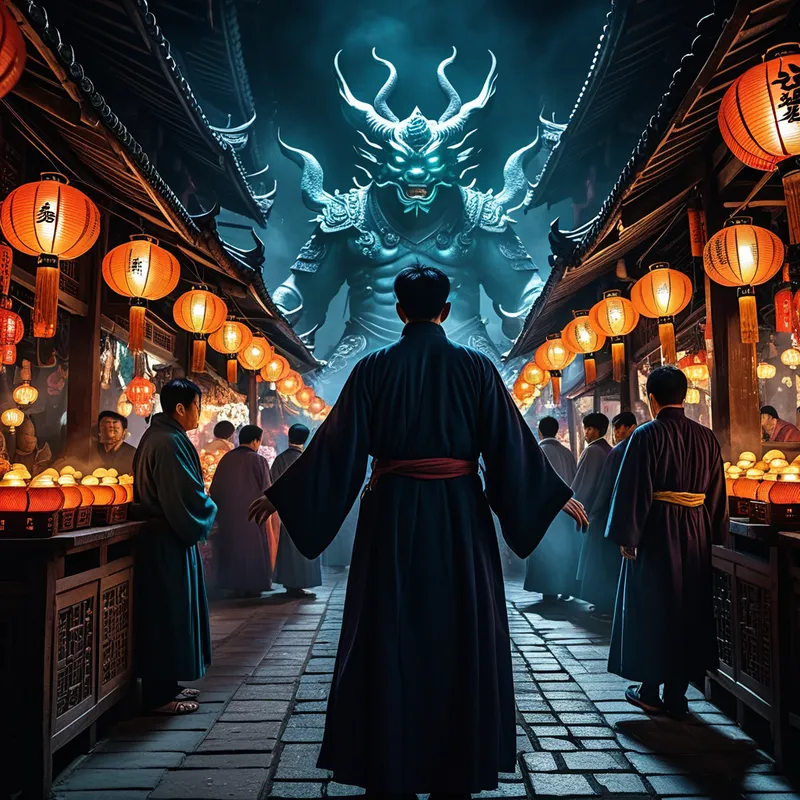
The Night Market of Zhong Kui Myth Meaning & Symbolism
A myth where the demon-queller Zhong Kui presides over a spectral market, a liminal space where the living and the dead, order and chaos, meet.
The Tale of The Night Market of Zhong Kui
Listen, and let the mists of time part. In the deep hours, when [the world](/myths/the-world “Myth from Tarot culture.”/) of men is hushed in slumber and [the veil](/myths/the-veil “Myth from Various culture.”/) between realms grows thin, a different commerce begins. This is not a market for the living. It is the Ye Shi, the Night Market, and its sovereign is none other than [Zhong Kui](/myths/zhong-kui “Myth from Chinese culture.”/).
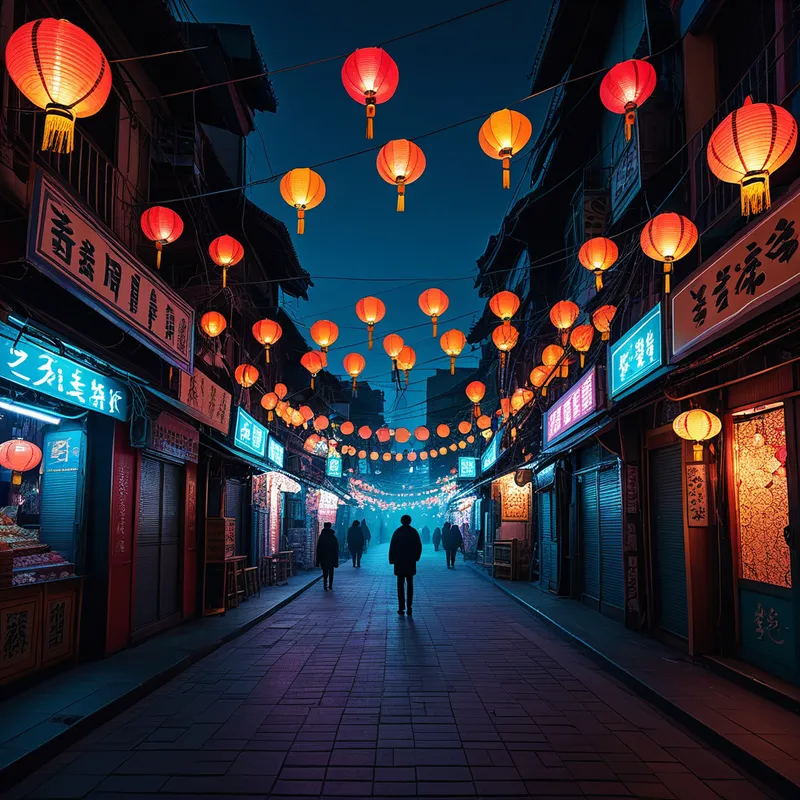
Picture a winding alley that exists only on the breath of midnight, materializing from the convergence of forgotten crossroads and the echoes of unfulfilled desires. Paper lanterns, burning with a cold, blue-green flame, cast long, dancing shadows that have a life of their own. The air is thick with the scent of old incense, damp earth, and a metallic tang—the smell of the spirit world.
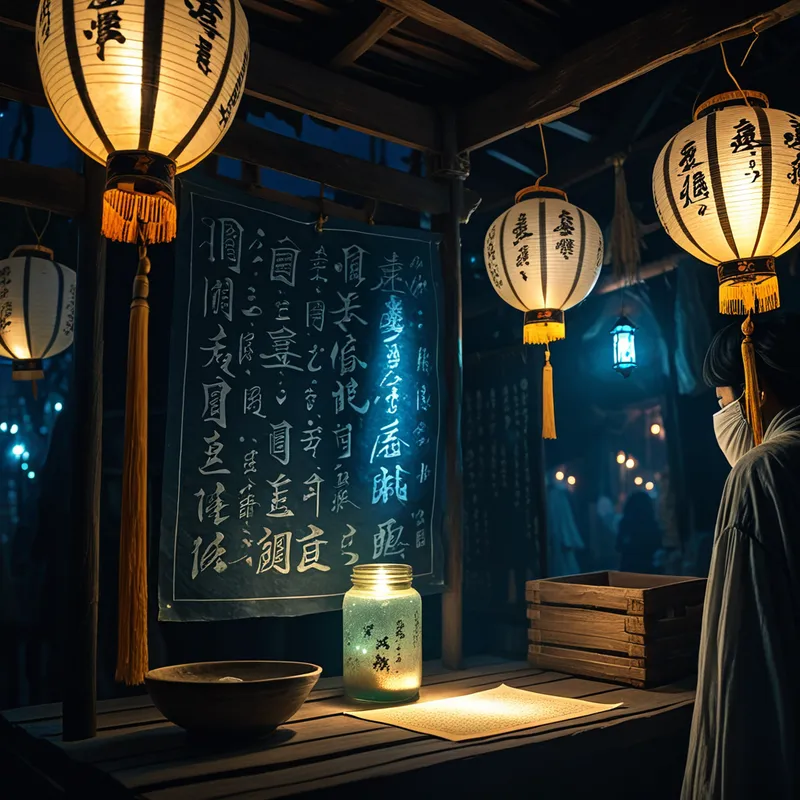
Here, the vendors are shades and specters. A river-drowned maiden sells pearls of condensed sorrow. A headless scholar offers scrolls inscribed with the wisdom he never published in life. Fox spirits peddle charms of illusion, and [hungry ghosts](/myths/hungry-ghosts “Myth from Buddhist culture.”/) trade in whispers and regrets. It is a cacophony of silent pleas and rustling silks, a economy of the intangible.
But chaos does not reign. For at [the market](/myths/the-market “Myth from Various culture.”/)‘s heart, seated upon a rough-hewn stone that serves as his throne, is the Master. Zhong Kui is a mountain of a presence. His face is a fearsome visage, a scholar’s fierce brow set in a permanent scowl, his beard wild like ink spilled upon silk. He wears the robes of a Tang dynasty official, now tattered and stained from eternal vigil. In one hand, he holds a mighty sword, not to attack, but planted point-down—a pillar of order. In the other, he might clutch a scroll or a gourd to capture wayward spirits. His eyes, like burning coals, miss nothing.
The drama unfolds not in battle, but in governance. A pair of quarrelsome ghosts, their forms flickering with residual anger, begin to disrupt a stall, their conflict threatening to unravel the market’s fragile peace. Shadows deepen. The lantern flames gutter. A ripple of panic passes through the spectral crowd. All eyes turn to the stone throne.
Zhong Kui does not rise. He merely turns his gaze upon the disruptors. It is a look that contains the weight of imperial edicts and the finality of [the underworld](/myths/the-underworld “Myth from Greek culture.”/)‘s judgment. The quarreling ghosts freeze, their fury dissolving into cold terror. With a gesture—a slight lift of his chin, a low, rumbling word that is more vibration than sound—he directs two of his lesser ghostly attendants. The conflict is contained, the offenders led away to some silent arbitration. Balance is restored. The market’s eerie hum resumes. The lanterns burn steadily once more. Under his unwavering gaze, the chaotic realm of the dead learns to mimic the order of the living, if only for the night. As dawn’s first light threatens the eastern sky, the market fades, stall by stall, ghost by ghost, until only the memory of his imposing silhouette remains, guarding [the threshold](/myths/the-threshold “Myth from Folklore culture.”/) back to the world of day.
Cultural Origins & Context
The myth of Zhong Kui and his nocturnal dominion springs from the rich, syncretic soil of Chinese folk religion, Daoist cosmology, and ancestor veneration. Zhong Kui himself is a fascinating figure: a brilliant scholar who, wronged by the imperial system (often said to have been denied the top honors in the palace examinations due to his ugly appearance), committed suicide, only to be posthumously recognized and appointed by the [underworld](/myths/underworld “Myth from Greek culture.”/) bureaucracy as the Yanluo Wang’s foremost marshal against demons.
The concept of the Ye Shi is a widespread folk motif, a liminal space where the rules of the day are suspended. It served a profound societal function. In a culture with deep reverence for ancestors and a complex understanding of the spirit world, the Night Market myth provided a narrative container for the unknown and the feared. It acknowledged the presence of restless spirits and unresolved earthly attachments (hungry ghosts, wronged souls) but placed them within a framework of ultimate order. Zhong Kui’s rule over this space was a comfort. It told people that even the chaotic realm of ghosts had a ruler, a scholar-official no less, who maintained a celestial mandate. The myth was passed down through oral storytelling, folk operas, and especially through paintings and prints of Zhong Kui, which were (and still are) displayed to ward off evil and protect the household.
Symbolic Architecture
At its core, this myth is a profound map of the [psyche](/myths/psyche “Myth from Greek culture.”/)‘s [relationship](/symbols/relationship “Symbol: A representation of connections we have with others in our lives, often reflecting our emotional state.”/) with [chaos](/symbols/chaos “Symbol: In Arts & Music, chaos represents raw creative potential, uncontrolled expression, and the breakdown of order to forge new artistic forms.”/). The [Night](/symbols/night “Symbol: Night often symbolizes the unconscious, mystery, and the unknown, representing the realm of dreams and intuition.”/) Market represents the untamed, shadowy contents of the personal and [collective unconscious](/symbols/collective-unconscious “Symbol: The Collective Unconscious refers to the part of the unconscious mind shared among beings of the same species, embodying universal experiences and archetypes.”/)—the repressed memories, unexpressed emotions, forgotten traumas, and instinctual drives that we banish from the light of day.
The shadow is not evil; it is merely unintegrated. The Night Market is not a hell, but a marketplace. Everything there was once a currency of the soul.
Zhong Kui is the [archetype](/symbols/archetype “Symbol: A universal, primordial pattern or prototype in the collective unconscious that shapes human experience, behavior, and creative expression.”/) of the Ego in its most mature and authoritative form. He is not the innocent [hero](/symbols/hero “Symbol: A hero embodies strength, courage, and the ability to overcome significant challenges.”/) who slays monsters, but the established ruler who administers them. His fearsome [appearance](/symbols/appearance “Symbol: Appearance in dreams relates to self-image, perception, and how you present yourself to the world.”/) symbolizes the necessary [strength](/symbols/strength “Symbol: ‘Strength’ symbolizes resilience, courage, and the ability to overcome challenges.”/) and resolve one must muster to face the contents of the [shadow](/symbols/shadow “Symbol: The ‘shadow’ embodies the unconscious, repressed aspects of the self and often represents fears or hidden emotions.”/). His scholar’s [background](/symbols/background “Symbol: The background in a dream can reflect context, environment, and underlying influences in the dreamer’s life.”/) is crucial: it is [consciousness](/symbols/consciousness “Symbol: Consciousness represents the state of awareness and perception, encompassing thoughts, feelings, and experiences.”/), [knowledge](/symbols/knowledge “Symbol: Knowledge symbolizes learning, understanding, and wisdom, embodying the acquisition of information and enlightenment.”/), and discernment (the sword of discrimination) that ultimately govern the unconscious, not brute force. The market’s [operation](/symbols/operation “Symbol: An operation signifies a process of change or transformation that often requires deliberate effort and planning.”/) under his watchful eye symbolizes the possibility of integrating these [shadow](/symbols/shadow “Symbol: The ‘shadow’ embodies the unconscious, repressed aspects of the self and often represents fears or hidden emotions.”/) elements into a larger, more complete Self. The ghosts are not destroyed; their chaotic [energy](/symbols/energy “Symbol: Energy symbolizes vitality, motivation, and the drive that fuels actions and ambitions.”/) is managed, their “trade” observed and given a structured [outlet](/symbols/outlet “Symbol: A point of connection, release, or transfer for energy, ideas, or emotions. Often represents a need for grounding, expression, or a source of power.”/).
The Dreamer’s Resonance
When the imagery of the Night Market of Zhong Kui arises in modern dreams, it signals a critical phase of shadow-work. The dreamer is not necessarily being haunted by external ghosts, but is being called to the marketplace of their own interior.
Somatically, this might manifest as restlessness at night, a feeling of being “visited” by thoughts or anxieties as one tries to sleep. Psychologically, the dreamer may be grappling with repressed aspects of their personality—a long-ignored anger, a creative impulse treated as frivolous, a grief that hasn’t been processed. To dream of wandering the market as a fearful observer suggests feeling overwhelmed by these unconscious contents. To dream of standing with Zhong Kui, or even as Zhong Kui, observing the scene with authority, indicates [the ego](/myths/the-ego “Myth from Jungian culture.”/) is successfully engaging in the difficult work of recognition and management. The dream is an invitation to stop fearing the “ghosts” and to begin the slow, firm work of bringing them under the jurisdiction of conscious awareness.
Alchemical Translation
The alchemical process modeled here is not the dramatic [solve et coagula](/myths/solve-et-coagula “Myth from Alchemical culture.”/) (dissolve and coagulate) of destruction and rebirth, but the slower, more meticulous work of [separatio](/myths/separatio “Myth from Alchemical culture.”/) and administratio—separation and administration. The modern individual’s journey of individuation is rarely about killing off parts of oneself. It is about learning to rule the inner kingdom.
Individuation is the process by which the scholar, wronged by life, becomes the king of his own haunted psyche.
First, one must venture into the personal Night Market—through therapy, active imagination, or honest self-reflection—and acknowledge the spectral vendors: the ghost of a failed ambition, [the hungry ghost](/myths/the-hungry-ghost “Myth from Buddhist culture.”/) of unmet need, the fox-spirit of seductive illusion. The initial encounter is often terrifying; the ego feels small and vulnerable. The alchemical translation occurs when the individual cultivates their inner Zhong Kui. This means developing the “fierce scholar” within: the part that can study these shadows with discernment, name them, and understand their origin. It means planting the sword of conscious values and boundaries as an unwavering pillar. One does not necessarily befriend every ghost, but one learns to govern the space in which they exist. The [triumph](/myths/triumph “Myth from Roman culture.”/) is not a silent, empty psyche, but a vibrant, orderly inner world where all aspects of [the self](/myths/the-self “Myth from Jungian culture.”/), even the dark and disreputable ones, are acknowledged and given their place under the sovereign light of consciousness. The chaos is not banished; it is transformed into a complex, managed, and ultimately creative economy of the soul.
Associated Symbols
Explore related symbols from the CaleaDream lexicon: