The Nemeton Myth Meaning & Symbolism
A tale of a sacred grove where the boundaries between worlds thin, demanding sacrifice and offering profound communion with the wild, untamed soul.
The Tale of The Nemeton
Listen. [The wind](/myths/the-wind “Myth from Various culture.”/) does not blow here; it breathes. The light does not fall; it pools. This is the place where the map ends and [the world](/myths/the-world “Myth from Tarot culture.”/) begins anew. This is the [Nemeton](/myths/nemeton “Myth from Celtic culture.”/).
Do not seek it with your feet alone. You must seek it with a hunger in your chest, a hollow where certainty once lived. You will walk beyond the tilled fields, past the last shepherd’s hut, into the land where the paths are made by boar and wolf. The air grows thick, sweet with the rot of last year’s leaves and the sharp scent of living sap. The chatter of your people fades, replaced by a silence so deep it has its own sound—the creak of ancient wood, the whisper of moss drinking shadow.
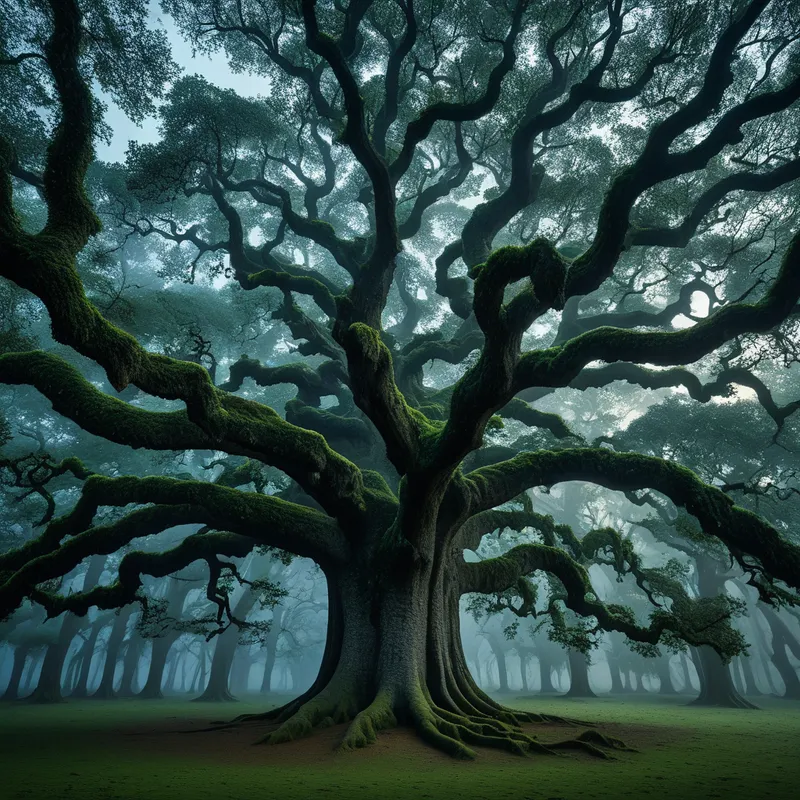
Here, the oaks are pillars holding up [the sky](/myths/the-sky “Myth from Persian culture.”/). Their bark is seamed like the faces of forgotten kings. In the center, a clearing opens, not empty, but full—full of presence. This is the heart. The boundary stone, slick with dew and lichen, marks not a border, but a threshold. To cross it is to shed your name, your rank, the weight of your deeds. The Druid knows this. They do not enter as a lord, but as a supplicant, barefoot on the cold earth.
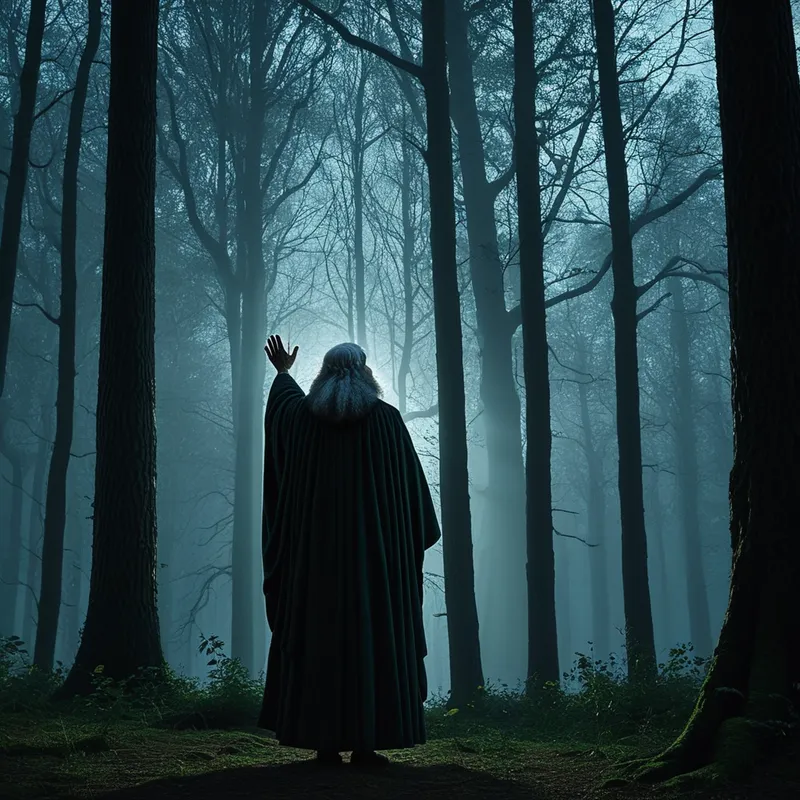
The ritual begins not with a chant, but with a listening. The Druid stills their own breath to hear the breath of the grove. They pour libation—not fine wine, but fresh [water](/myths/water “Myth from Chinese culture.”/), milk, or the dark richness of mead—onto the roots. This is not a gift to the gods; it is a sharing with them, with the Genii Locorum who are the grove itself. The air shimmers. The shadows between the trees deepen, and from them, a sense of watchful, ancient intelligence gathers. It is the spirit of the place, the Sovereignty of the wild world, made manifest not in a form, but in a feeling—a crushing awe, a terrifying belonging.
The sacrifice is made. Perhaps a simple offering of grain, perhaps something more. The key is the intent: a piece of one’s own order given over to the chaos of life. In that moment of surrender, [the veil](/myths/the-veil “Myth from Various culture.”/) thins. Time braids upon itself. The Druid may see visions of herds long dead, of battles yet to come, or hear [the true name](/myths/the-true-name “Myth from Various culture.”/) of the wind. Knowledge flows not as words, but as a raw, green understanding rooted in the very soil. The conflict is the human soul meeting the un-human world, and the resolution is not conquest, but communion. The Druid leaves not with a trophy, but with a charge—a piece of the grove’s wild wisdom to carry back to the world of people. They are remade, a walking threshold themselves.
Cultural Origins & Context
The concept of the Nemeton is not a single, codified myth from a sacred text, but a pervasive and fundamental reality woven into the fabric of pre-Christian Celtic societies across Gaul, Britain, and Ireland. Our understanding comes from archaeological sites, place-name studies (like Vernemetum, “the great grove”), and the often disapproving accounts of Roman commentators like Lucan, who described druidic rites in shadowy groves.
These groves were not merely pretty natural cathedrals; they were the primary temples. The Celts did not, as a rule, build massive stone structures to house their gods. They recognized the divine in situ—in that specific cluster of oaks, by that particular spring, on that lone hill. The Nemeton was a consecrated space, a [temenos](/myths/temenos “Myth from Greek culture.”/) (a cut-off place) where the cosmic order and the chaotic, generative power of nature met. It was a court of law, a site for seasonal festivals like [Lughnasadh](/myths/lughnasadh “Myth from Celtic culture.”/), and a sanctuary where even enemies might temporarily lay down arms.
The myths were not “told” about the Nemeton in a narrative sense; the Nemeton was the stage upon which the mythic drama of life was perpetually enacted. The stories of the gods and heroes were imbued with its essence. It functioned as the psychic and societal anchor, the wild, untamed core around which the cultivated world of the tribe was organized—a constant reminder that all human order springs from and must answer to a deeper, older law.
Symbolic Architecture
Psychologically, the Nemeton represents the temenos of [the Self](/myths/the-self “Myth from Jungian culture.”/)—the sacred, protected inner [space](/symbols/space “Symbol: Dreaming of ‘Space’ often symbolizes the vastness of potential, personal freedom, or feelings of isolation and exploration in one’s life.”/) where individuation occurs. It is the wild, uncultivated ground of the [psyche](/myths/psyche “Myth from Greek culture.”/), the primal [matrix](/symbols/matrix “Symbol: A dream symbol representing the fundamental structure of reality, consciousness, or the self. It often signifies feelings of being trapped, controlled, or questioning the nature of existence.”/) from which [consciousness](/symbols/consciousness “Symbol: Consciousness represents the state of awareness and perception, encompassing thoughts, feelings, and experiences.”/) grows.
The grove is not a retreat from the world, but a deeper engagement with the world’s soul. To enter it is to consent to be unmade, so that you may be remade according to a more ancient pattern.
The towering oaks symbolize the axial [structure](/symbols/structure “Symbol: Structure in dreams often symbolizes stability, organization, and the framework of one’s life, reflecting how one perceives their environment and personal life.”/) of the psyche, connecting the [underworld](/symbols/underworld “Symbol: A symbolic journey into the unconscious, representing exploration of hidden aspects of self, transformation, or confronting repressed material.”/) of the personal and [collective unconscious](/symbols/collective-unconscious “Symbol: The Collective Unconscious refers to the part of the unconscious mind shared among beings of the same species, embodying universal experiences and archetypes.”/) (the roots) with the conscious mind (the [trunk](/symbols/trunk “Symbol: The trunk in dreams typically denotes the core structure or foundation of one’s identity, values, or beliefs.”/)) and the transpersonal, spiritual [realm](/symbols/realm “Symbol: The symbol of ‘Realm’ often signifies the boundaries of one’s consciousness, experiences, or emotional states, suggesting aspects of reality that are either explored or ignored.”/) (the canopy). The clearing at the center is the transcendent function, the paradoxical space where opposites—order and [chaos](/symbols/chaos “Symbol: In Arts & Music, chaos represents raw creative potential, uncontrolled expression, and the breakdown of order to forge new artistic forms.”/), [human](/symbols/human “Symbol: The symbol of a human represents individuality, complexity of emotions, and social relationships.”/) and [nature](/symbols/nature “Symbol: Nature symbolizes growth, connectivity, and the primal forces of existence.”/), known and unknown—can meet and generate new meaning. The [ritual](/symbols/ritual “Symbol: Rituals signify structured, meaningful actions carried out regularly, reflecting cultural beliefs and emotional needs.”/) sacrifice is the essential act of relinquishing [the ego](/myths/the-ego “Myth from Jungian culture.”/)’s rigid control, offering up a cherished [identity](/symbols/identity “Symbol: Identity represents the sense of self, encompassing personal beliefs, cultural background, and social roles.”/) or certainty to the larger, more mysterious process of the Self. The Genii Locorum are the archetypal guardians of this inner space, the autonomous complexes and instinctual patterns that must be acknowledged and respected, not conquered.
The Dreamer’s Resonance
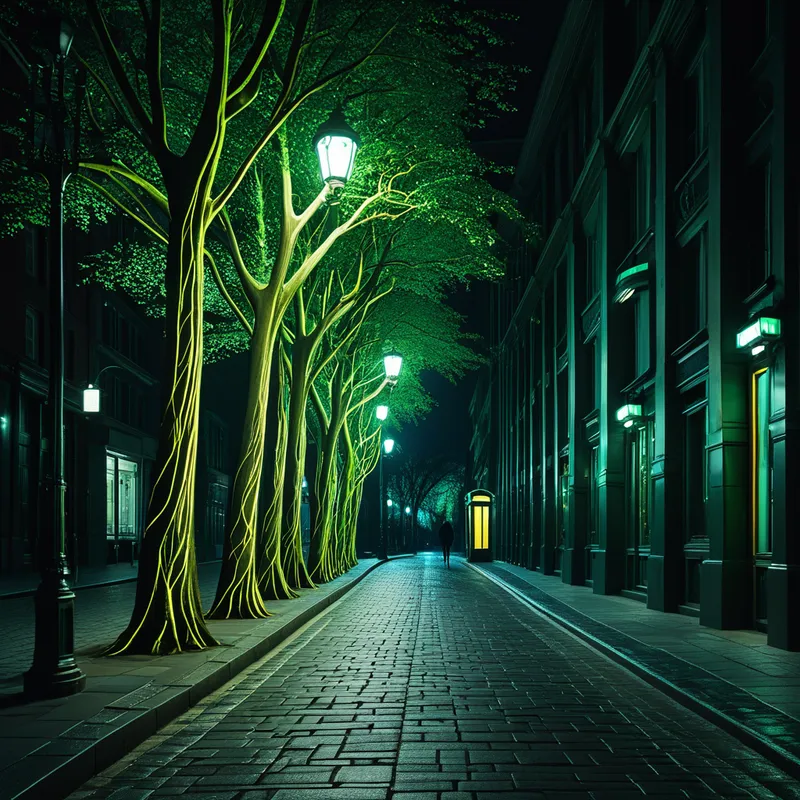
When the Nemeton appears in modern dreams, it rarely manifests as a pristine forest. It may be a forgotten corner of a city park that feels eerily alive, a basement overgrown with roots, or a room in one’s own house that has a door previously unnoticed, leading to a wild, interior garden.
Dreaming of this pattern signals a profound somatic and psychological process: the call to engage with the wild foundation of one’s own being. The dreamer is often at a life threshold, feeling overly civilized, cut off from instinct, or trapped in sterile patterns. The grove-dream is an invitation—and a demand—from the deep psyche to re-establish communion with the untamed Self. There is often anxiety (the fear of the dark woods) mixed with awe (the beauty of the light in the clearing). This is the somatic signal of the ego confronting the numinous power of the unconscious. The process underway is one of re-wilding the psyche, of daring to step off the well-trodden path of [persona](/myths/persona “Myth from Greek culture.”/) and into the fertile, shadowy ground where true transformation germinates.
Alchemical Translation
The myth of the Nemeton is a perfect allegory for the alchemical opus, the work of psychic transmutation. The journey to the grove is the [nigredo](/myths/nigredo “Myth from Alchemical culture.”/)—the blackening, the descent into the unknown, the confrontation with the primal massa confusa of one’s nature. The grove itself, with its interplay of profound darkness and dappled light, is the albedo and citrinitas—the whitening and yellowing, the separating and purifying of elements within that chaos.
The sacrifice at the stone altar is the crucial moment of mortificatio—the death of the old, outmoded attitude of the ego. One does not kill a part of the self, but offers it up to be dissolved in the waters of the unconscious, so it may be reconstituted at a higher level.
The communion with the spirit of the place is the coniunctio oppositorum—[the sacred marriage](/myths/the-sacred-marriage “Myth from Various culture.”/) of conscious awareness with unconscious wisdom. The Druid does not “learn” facts; they are impregnated with insight. Finally, returning to the tribe with a charge represents the [rubedo](/myths/rubedo “Myth from Alchemical culture.”/)—the reddening, the return of the transformed individual to the world, now able to embody and impart the integrated wisdom. The individuated Self becomes a living Nemeton, a sacred space where the divine and the human, the wild and the ordered, are in constant, creative dialogue. For the modern individual, the myth teaches that wholeness is not found through further cultivation of the persona, but through a courageous, ritualized return to the sacred wild within.
Associated Symbols
Explore related symbols from the CaleaDream lexicon: