The Nemean Lion from Greek myt Myth Meaning & Symbolism
Heracles' first labor: to slay a lion with an impenetrable hide, a beast born of cosmic chaos, forcing a confrontation with the impossible.
The Tale of The Nemean Lion from Greek myt
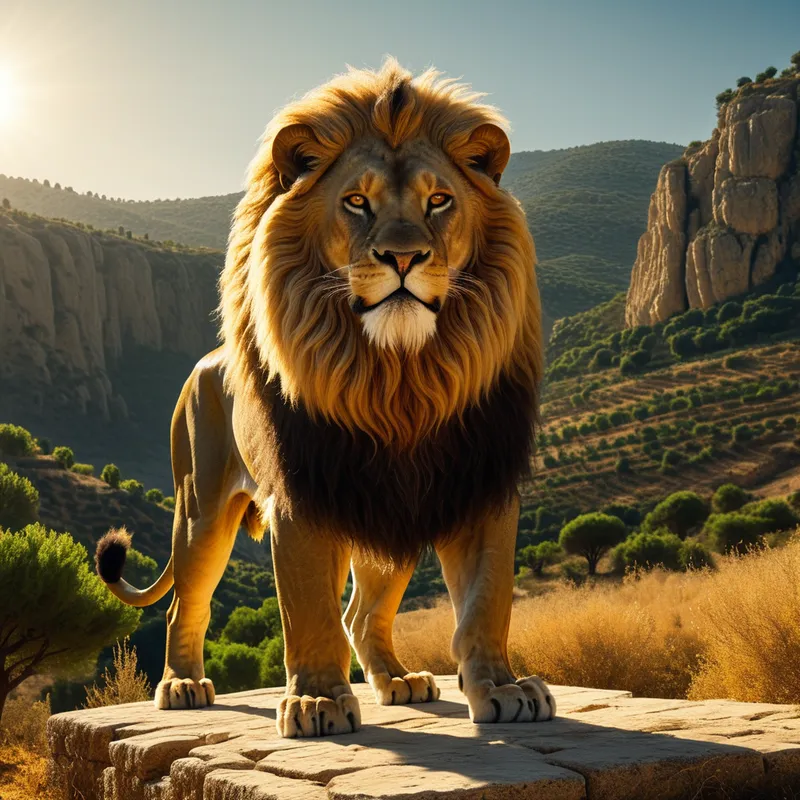
Hear now of the first and most terrible of the labors. The air in the valley of Nemea was thick, not with mist, but with a dread that had settled into the soil. The people had fled, their homes silent, for a terror walked the land. It was no ordinary beast, but the Nemean Lion, a creature whose origin was whispered to be of the dark moon itself, or sprung from the blood of the primordial [Typhon](/myths/typhon “Myth from Greek culture.”/). Its hide was not of flesh and fur, but of a substance like adamant, harder than any bronze forged by man or god. No spear could pierce it, no arrow find purchase. Its claws sheared through shield and bone alike. The very earth trembled when it roared, a sound that stole the courage from the bravest heart.
Into this blighted valley came [Heracles](/myths/heracles “Myth from Greek culture.”/), son of Zeus, his shoulders already broad with a fate not of his choosing. His first labor, set by the jealous King Eurystheus, was this: slay the unslayable. For days, [Heracles](/myths/heracles “Myth from Greek culture.”/) tracked the beast, finding only the remnants of its feasts. Then, as the sun hung heavy, he found it at the mouth of its twin-mouthed cave, a place where light feared to enter. The lion saw him, and its golden eyes held no fear, only a bottomless, predatory hunger.
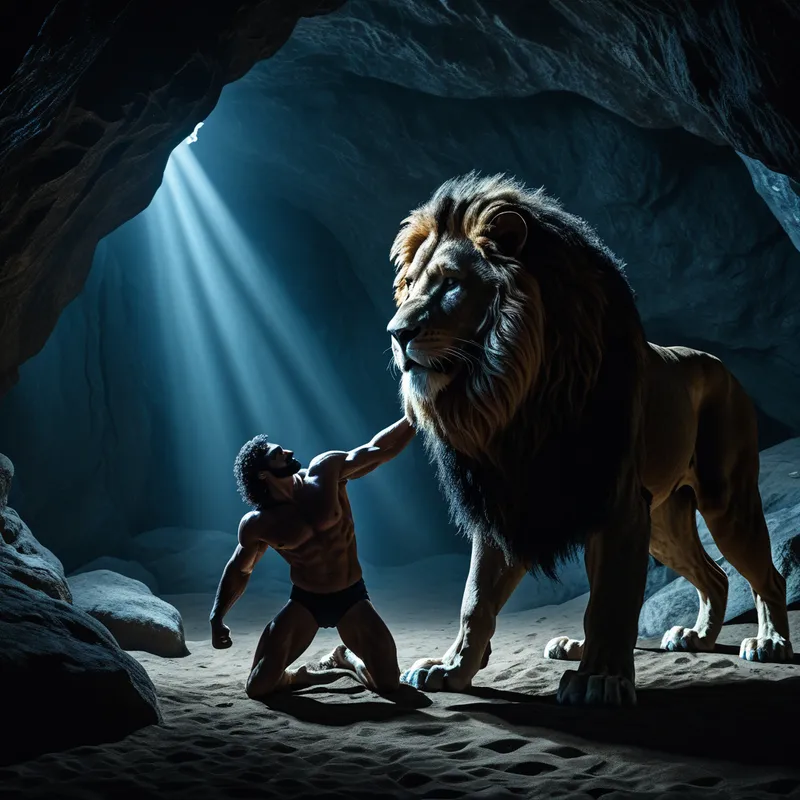
Heracles loosed his arrows. They sang through the air and struck the beast’s flank—only to shatter into splinters, falling uselessly to the ground. His mighty club, swung with all his strength, landed with a thunderous crack, but the lion shook its great mane, unharmed. The invulnerability of the beast was absolute. Realizing the futility of his weapons, Heracles did the only [thing](/myths/thing “Myth from Norse culture.”/) left: he closed the distance. The lion lunged, and the hero met it with his bare hands.
What followed was a struggle of pure, raw essence. Man and monster became a single, heaving mass of force at [the cave](/myths/the-cave “Myth from Platonic culture.”/)‘s entrance. The scent of dust, of hot breath, of iron-like fur filled Heracles’ senses. He could feel the impossible strength of the creature, a power that seemed to flow from the bedrock of [the world](/myths/the-world “Myth from Tarot culture.”/) itself. Locking his arms around its neck, he applied a grip that could choke the life from a river god. The lion thrashed, its claws scoring deep grooves in [the earth](/myths/the-earth “Myth from Hindu culture.”/), but Heracles held on, his own breath burning in his lungs, his muscles screaming in protest against the cosmic strength he contained.
Slowly, imperceptibly at first, the beast’s struggles weakened. The divine strength of Zeus’s son met the primordial invulnerability of chaos, and for a moment, the latter yielded. The great lion went limp. But the labor was not complete. The hide, his prize and proof, could not be cut. Puzzled, Heracles looked at his broken tools. Then, a spark of divine insight, or perhaps the brutal logic of the wild itself, came to him. He used the lion’s own claws—the only thing sharp enough in all the world to cut its own skin. With a grim and sacred practicality, he flayed the beast, claiming its pelt as his armor and its gaping maw as his helmet.
He returned to Tiryns, a figure transformed. No longer just a strong man, but a being clad in the very essence of his conquest. When he flung the carcass before King Eurystheus, the king’s terror was so profound he fled and ordered a great bronze jar to be buried in the earth, a womb of fear to hide him from the hero’s awful, newfound majesty.
Cultural Origins & Context
This myth originates from the rich tapestry of ancient Greek oral tradition, crystallized in texts like the Bibliotheca of Pseudo-Apollodorus and referenced in the works of poets like Hesiod. It functioned as a foundational episode in the cycle of the Twelve Labors of Heracles, a narrative framework that served multiple societal purposes. Told by bards and depicted on pottery, it was a story of national identity, showcasing the archetypal Greek hero whose virtues—arete (excellence) and [metis](/myths/metis “Myth from Greek culture.”/) (cunning intelligence)—could overcome even supernatural adversity.
The labor was set in Nemea, a site later famous for its athletic games, subtly linking heroic conquest with the origins of cultural institutions. The myth also served a theological function, illustrating the Olympian order (represented by Heracles, agent of Hera’s will and son of Zeus) triumphing over chthonic, primordial chaos (the lion, offspring of monstrous beings). It was a tale that reinforced the cultural belief that civilization, through heroic effort, could master the wild, untamed, and seemingly invincible forces of nature and fate.
Symbolic Architecture
The Nemean [Lion](/symbols/lion “Symbol: The lion symbolizes strength, courage, and authority, often representing one’s inner power or identity.”/) is not merely a [monster](/symbols/monster “Symbol: Monsters in dreams often symbolize fears, anxieties, or challenges that feel overwhelming.”/); it is the embodiment of the invulnerable [shadow](/symbols/shadow “Symbol: The ‘shadow’ embodies the unconscious, repressed aspects of the self and often represents fears or hidden emotions.”/). Its impervious hide represents those aspects of [the self](/myths/the-self “Myth from Jungian culture.”/)—or of a [situation](/symbols/situation “Symbol: The ‘situation’ symbolizes the junction between the subconscious and conscious realms, often reflecting the current challenges or dynamics in the dreamer’s waking life.”/)—that seem utterly resistant to change, negotiation, or direct assault. These are the entrenched patterns, the core wounds, the primal fears that we believe cannot be touched, let alone transformed.
The first great labor is always an encounter with one’s own apparent invincibility—not of the ego, but of the problem that defines it.
Heracles’ initial failure with conventional weapons symbolizes the futility of applying known, logical, or forceful solutions to a profound psychological block. The shattering arrows represent broken intentions; the useless club, frustrated willpower. The [hero](/symbols/hero “Symbol: A hero embodies strength, courage, and the ability to overcome significant challenges.”/)’s ultimate victory through wrestling and [strangulation](/symbols/strangulation “Symbol: A dream symbol representing extreme suppression, loss of voice, or life-threatening constriction. Often signifies being overwhelmed by external forces or internal emotions.”/) points to the necessity of direct engagement and [assimilation](/symbols/assimilation “Symbol: The process of integrating new experiences, identities, or knowledge into one’s existing self, often involving adaptation and transformation.”/). One must get close enough to the [problem](/symbols/problem “Symbol: Dreams featuring a ‘problem’ often symbolize internal conflicts or challenging situations that require resolution and self-reflection.”/) to be changed by it, to embrace it, and to find the [solution](/symbols/solution “Symbol: A solution symbolizes resolution, clarity, and the overcoming of obstacles, often representing a sense of accomplishment.”/) within the [nature](/symbols/nature “Symbol: Nature symbolizes growth, connectivity, and the primal forces of existence.”/) of the [problem](/symbols/problem “Symbol: Dreams featuring a ‘problem’ often symbolize internal conflicts or challenging situations that require resolution and self-reflection.”/) itself. The use of the lion’s own claws to [skin](/symbols/skin “Symbol: Skin symbolizes the boundary between the self and the world, representing identity, protection, and vulnerability.”/) it is the masterstroke of symbolic [integration](/symbols/integration “Symbol: The process of unifying disparate parts of the self or experience into a cohesive whole, often representing psychological wholeness or resolution of internal conflict.”/): the power to transform [the shadow](/myths/the-shadow “Myth from Jungian culture.”/) lies hidden within the shadow’s own [structure](/symbols/structure “Symbol: Structure in dreams often symbolizes stability, organization, and the framework of one’s life, reflecting how one perceives their environment and personal life.”/).
The Dreamer’s Resonance
When this myth pattern emerges in modern dreams, it often manifests as confronting an adversary, obstacle, or creature that is impervious to all attempts to defeat it. The dreamer may fire weapons that have no effect, shout arguments that go unheard, or run from a pursuer they cannot outpace. Somatically, this can feel like a profound helplessness or a frustrating stagnation.
Psychologically, this signals a confrontation with a core complex—a deeply rooted cluster of thoughts, feelings, and memories that possesses a kind of psychic autonomy and resistance. The dream is highlighting a part of the self that has been rendered “invulnerable” to conscious influence, often through years of repression or trauma. The process underway is the unconscious forcing an acknowledgment that current strategies are insufficient. The dreamer is being prepared, like Heracles, to drop their tools and engage the problem on a more intimate, instinctual, and potentially transformative level.
Alchemical Translation
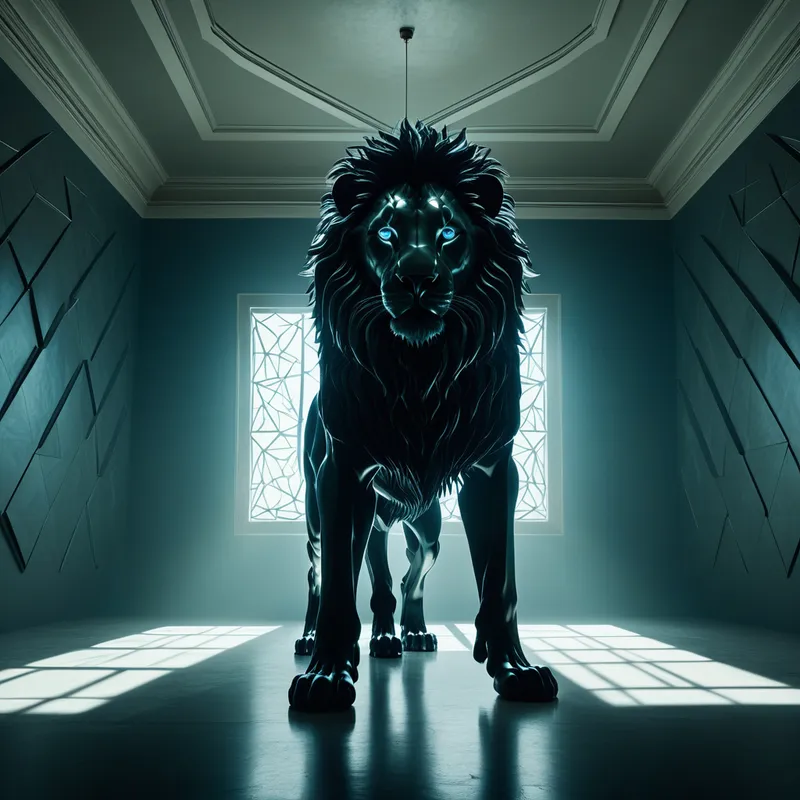
The alchemy of this myth models the first, crucial stage of psychic transmutation: the [nigredo](/myths/nigredo “Myth from Alchemical culture.”/), or blackening. This is the confrontation with [the prima materia](/myths/the-prima-materia “Myth from Alchemical culture.”/), the chaotic, heavy, and seemingly indestructible base matter of the soul. The lion is that raw, unintegrated power of the instinctual self, ferocious and shining with a dark, golden autonomy.
The labor is not to destroy the beast, but to discover that its invulnerability is the very material required for the new skin of consciousness.
Heracles’ journey is one of individuation. His ego, armed with its gifts (strength, skill), is humbled. He must surrender his identity as “the one who conquers with weapons” and become “the one who endures and contains.” By wrestling the lion into submission, he integrates its raw power. By wearing its pelt, he performs the ultimate alchemical act: he makes the former enemy his defining attribute. The shadow is not eliminated; it becomes a source of protection and identity. For the modern individual, this translates to the process of facing a seemingly insurmountable inner flaw or life challenge, not to annihilate it, but to understand its nature so completely that its essential energy can be reclaimed and repurposed as a foundational strength. The lion’s skin becomes the hero’s cloak—what was once our greatest vulnerability becomes the emblem of our hard-won, authentic power.
Associated Symbols
Explore related symbols from the CaleaDream lexicon: