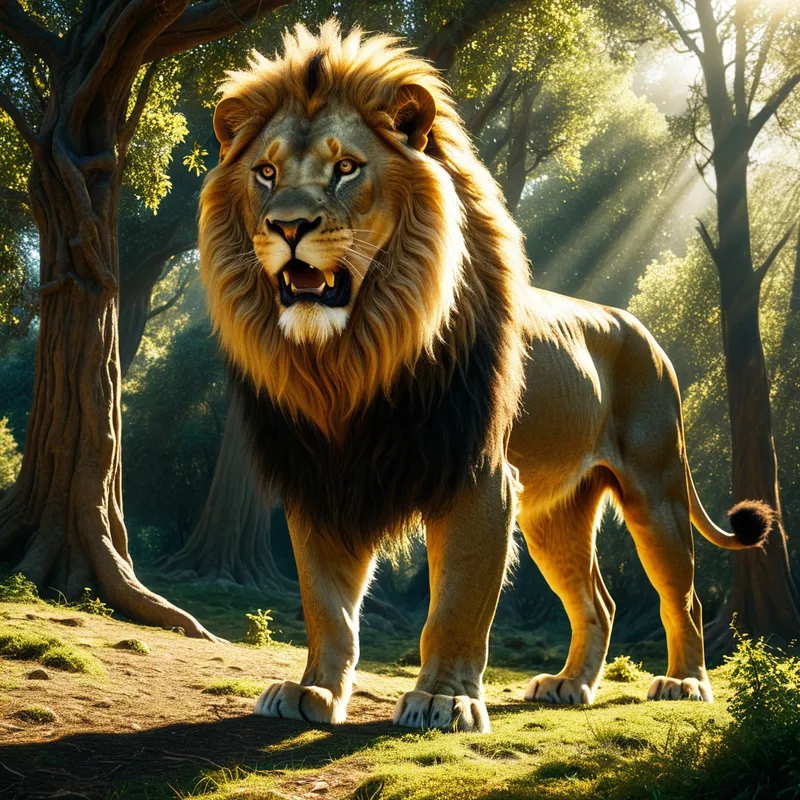
The Nemean Lion Myth Meaning & Symbolism
Hercules' first labor: to slay a lion with an impenetrable hide, a primal confrontation with the invulnerable, monstrous aspect of the self.
The Tale of The Nemean Lion
Hear now of the first and most terrible of the labors, a task born not of glory, but of atonement. In the wake of a madness sent by Hera, the son of Zeus stood before his cousin, King Eurystheus, a man whose heart was a shriveled fig. The command was given: go to the valley of Nemea. There, a horror walks.
The air in Nemea is thick with the silence of the tomb. No shepherd’s song echoes here; no child’s laughter. The very earth is scarred. The cause is a lion, but no ordinary beast of the forest. It is a child of monstrous lineage, some say of [Typhon](/myths/typhon “Myth from Greek culture.”/) and Echidna, others claim a fell moon-beast sent by [Selene](/myths/selene “Myth from Global/Universal culture.”/). Its hide is not flesh, but a living armor, harder than any bronze forged by [Hephaestus](/myths/hephaestus “Myth from Global/Universal culture.”/), proof against the point of spear and the edge of sword. Its roar shakes the leaves from the oaks and stills the hearts of men in distant villages.
The hero, [Hercules](/myths/hercules “Myth from Greek culture.”/), enters this blighted land. His mighty bow is useless; his arrows, tipped with poison, shatter like twigs against the golden pelt. His club, which felled giants, strikes with a thunderous crack but only serves to enrage the creature. The lion turns, eyes like molten bronze, and attacks. Man and beast become a whirlwind of dust and fury, a primal dance of survival. [Hercules](/myths/hercules “Myth from Greek culture.”/) is forced to discard his tools, the extensions of his will. There, in the dust, he understands: to conquer this invulnerable [thing](/myths/thing “Myth from Norse culture.”/), he must meet it on its own terms. Raw strength against raw strength. Spirit against spirit.
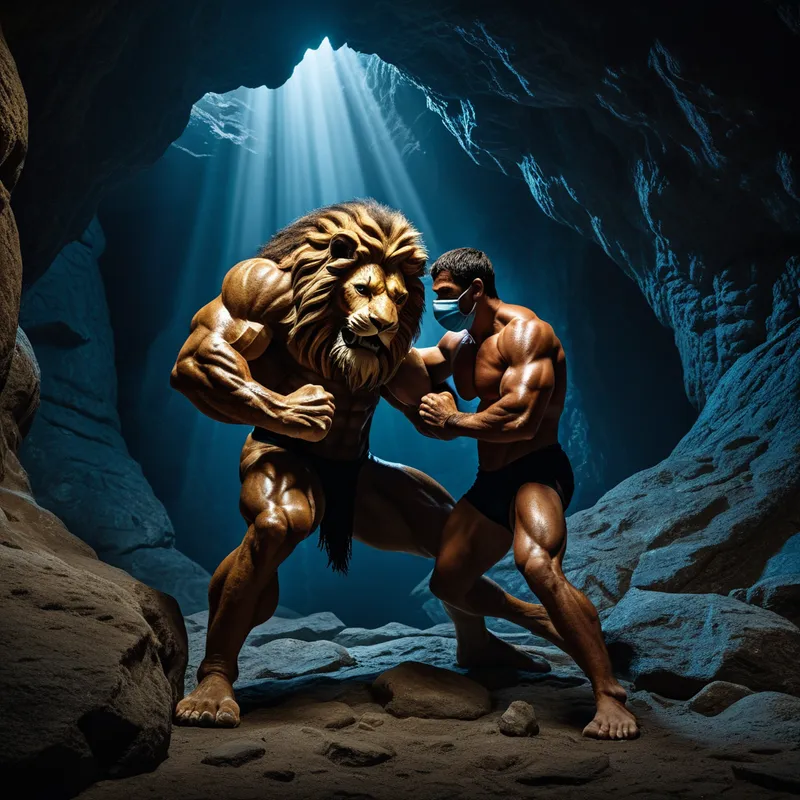
He follows the beast to its lair, a cave with two mouths, dark as a forgotten memory. Inside, [the world](/myths/the-world “Myth from Tarot culture.”/) narrows to heat, breath, and the stench of blood. In that absolute darkness, where sight is stolen, the other senses awaken. He hears the low growl, feels the displacement of air. He grapples the monster. There is no technique now, only the immense, cracking strain of muscle and sinew, the desperate search for a purchase on the slick, impossible hide. His hands find the great neck. He locks his arms, his own breath burning in his lungs, and squeezes. The struggle is eternal, a contest against the very concept of invulnerability. Finally, with a shudder that seems to pass through [the earth](/myths/the-earth “Myth from Hindu culture.”/) itself, the lion goes limp.
But the labor is not complete. The pelt must be claimed. Knives fail. Swords bend. In a [flash of insight](/myths/flash-of-insight “Myth from Alchemical culture.”/), Hercules uses the lion’s own claws—the only thing sharp enough to pierce its divine hide—to skin the creature. He emerges from the twin-mouthed cave, not just a victor, but transformed. He drapes the monstrous pelt over his broad shoulders, the head becoming a helmet. [The thing](/myths/the-thing “Myth from Norse culture.”/) that was invulnerable to him now becomes his protection. [The hunter](/myths/the-hunter “Myth from African culture.”/) wears the skin of the hunted, and a new legend is born from the silence of Nemea.
Cultural Origins & Context
This myth forms the foundational episode of the canonical Twelve Labors of [Heracles](/myths/heracles “Myth from Greek culture.”/), a cycle that solidified in the Archaic period of Greece (c. 800-500 BCE). It was not merely an adventure story but a core narrative of cultural identity. Bards recited it in aristocratic halls, and it was depicted on temple metopes and countless vases, serving as a ubiquitous symbol of heroic aretē (excellence).
The myth functioned on multiple societal levels. For [the polis](/myths/the-polis “Myth from Greek culture.”/), it narrated the establishment of order over chaos, the civilizing hero subduing the untamed wilderness that threatened community. The Nemean Games, one of the great Panhellenic festivals, were said to have been founded by Hercules in honor of the slain lion, thus ritualizing the victory into a recurring celebration of physical and spiritual prowess. The story was a pedagogical tool, teaching about divine will (the labor as penance), human limitation (the failure of weapons), and ingenious resilience. It passed from Hesiod’s Theogony to the libraries of Alexandrian scholars, remaining a cornerstone of the Greek heroic imagination, a necessary first step in the arduous path to apotheosis.
Symbolic Architecture
The Nemean [Lion](/symbols/lion “Symbol: The lion symbolizes strength, courage, and authority, often representing one’s inner power or identity.”/) is not merely a [monster](/symbols/monster “Symbol: Monsters in dreams often symbolize fears, anxieties, or challenges that feel overwhelming.”/); it is the archetypal [Shadow](/symbols/shadow “Symbol: The ‘shadow’ embodies the unconscious, repressed aspects of the self and often represents fears or hidden emotions.”/) made manifest. Its invulnerability is the central [symbol](/symbols/symbol “Symbol: A symbol can represent an idea, concept, or belief, serving as a powerful tool for communication and understanding.”/). It represents those aspects of [the self](/myths/the-self “Myth from Jungian culture.”/)—primal rage, unprocessed [trauma](/symbols/trauma “Symbol: A deeply distressing or disturbing experience that overwhelms the psyche, often manifesting in dreams as unresolved emotional wounds or psychological injury.”/), a core insecurity—that seem impervious to our usual methods of address. We try the “arrows” of [logic](/symbols/logic “Symbol: The principle of reasoning and rational thought, often representing order, structure, and intellectual clarity in dreams.”/) and the “club” of willpower, but they shatter. The [psyche](/myths/psyche “Myth from Greek culture.”/)’s deepest defenses cannot be breached from the outside.
The first great labor is always an encounter with that which is invulnerable to your current tools. The victory lies not in finding a better weapon, but in changing the nature of the contest.
[The cave](/myths/the-cave “Myth from Platonic culture.”/) with two mouths is a profound symbol of the unconscious itself—a place of entry and exit, of [circulation](/symbols/circulation “Symbol: Represents the flow of life force, energy, emotions, or resources through a system, often indicating balance, blockage, or vitality.”/), but also of containment and confrontation. Wrestling the lion in darkness signifies the necessity of engaging [the shadow](/myths/the-shadow “Myth from Jungian culture.”/) on its own, non-rational, instinctual ground. [Sight](/symbols/sight “Symbol: Sight symbolizes perception, awareness, and insight, representing both physical and inner vision.”/) represents conscious understanding, which is useless here; one must rely on [intuition](/symbols/intuition “Symbol: The immediate, non-rational understanding of truth or insight, often described as a ‘gut feeling’ or inner knowing that bypasses conscious reasoning.”/), somatic feeling, and raw, embodied [presence](/symbols/presence “Symbol: Presence in dreams often signifies awareness or acknowledgment of something significant in one’s life.”/).
Finally, the act of using the lion’s own claw to [skin](/symbols/skin “Symbol: Skin symbolizes the boundary between the self and the world, representing identity, protection, and vulnerability.”/) it is the alchemical key. The power of the shadow itself must be harnessed to integrate it. The [hero](/symbols/hero “Symbol: A hero embodies strength, courage, and the ability to overcome significant challenges.”/) does not destroy the lion’s essence (its invulnerability); he transmutes it. By wearing the pelt, he incorporates its power. The monstrous quality becomes a protective [strength](/symbols/strength “Symbol: ‘Strength’ symbolizes resilience, courage, and the ability to overcome challenges.”/), a testament to the ordeal survived. [The ego](/myths/the-ego “Myth from Jungian culture.”/), once threatened by this unconscious content, now gains [resilience](/symbols/resilience “Symbol: The capacity to recover quickly from difficulties, adapt to change, and maintain strength through adversity.”/) from it.
The Dreamer’s Resonance
When the pattern of the Nemean Lion arises in modern dreams, it signals a profound somatic and psychological process: the confrontation with an “invulnerable” complex. The dreamer may face a looming, indestructible threat—a pursuing beast, an impenetrable wall, an adversary who cannot be harmed.
Somatically, this often correlates with feelings of constriction, breathlessness (the wrestling hold), or a terrifying paralysis—the body knowing the truth of a psychological stalemate before the mind can articulate it. The dream is an announcement from the depths: your conscious strategies are failing. The job you hate but feel trapped in, the relationship pattern you can’t break, the chronic anxiety that defies analysis—these are the Nemean Lions of the modern psyche. The dream does not present a solution but presents the nature of the problem: it is an encounter with something that must be faced directly, physically, and in the dark, without the tools you rely on in the waking world.
Alchemical Translation
The myth models the initial, brutal phase of individuation. The labor is assigned (by the unconscious, by fate, by crisis), forcing the conscious personality out of its familiar realm. The first step is always the confrontation with the shadow, the “invulnerable” aspect of oneself that blocks further development.
The alchemical nigredo, the blackening, occurs in the cave. It is the despair of realizing one’s tools are useless, the ego’s dark night as it grapples with its own latent, monstrous power.
The transmutation is threefold. First, the discarding of ineffective tools: the ego must surrender its outdated defenses and identities. Second, the direct engagement: one must “get their hands dirty,” enduring the uncomfortable, non-verbal, emotional wrestling match with the complex. This is active imagination, therapy, or any deep, feeling engagement with the pain.
Finally, the integration: using the “lion’s claw.” This is the insight that emerges from the struggle itself. The very quality that made the complex so destructive—perhaps a fierce independence born of childhood neglect, or a defensive anger—is seen as a latent strength. It is reframed, skinned from its monstrous context, and worn as a pelt. The independence becomes healthy self-reliance; the anger becomes the energy for setting boundaries. The individual emerges from the ordeal not having killed a part of themselves, but having made the previously unconscious and autonomous power conscious and available. They have become, in a sense, invulnerable to what once terrified them, for they have worn its skin and now know its nature.
Associated Symbols
Explore related symbols from the CaleaDream lexicon: