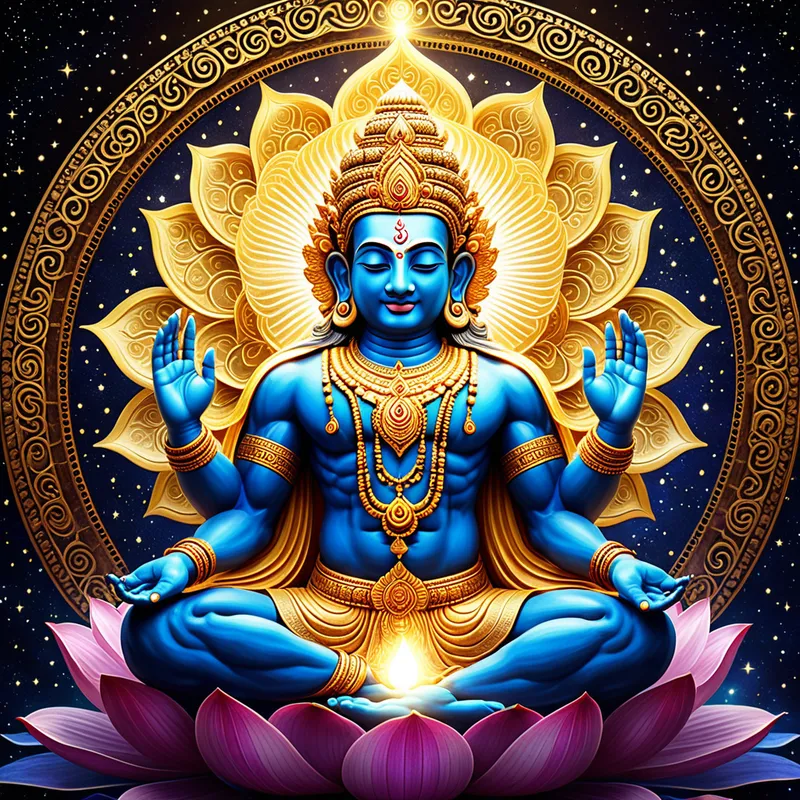
The Nada Brahma Myth Meaning & Symbolism
The cosmos is born from, sustained by, and dissolves into a primordial vibration, the sacred sound of OM, revealing reality as divine resonance.
The Tale of The Nada Brahma
Before the beginning, there was neither being nor non-being. There was only a vast, potential silence—a pregnant, boundless dark. Then, within that womb of absolute stillness, a tremor arose. Not a movement in space, for there was no space. Not a thought in mind, for there was no mind. It was a tendency, a primal urge towards manifestation. This was the first stirring of Brahman.
From this tremor emerged a single point of concentrated consciousness—a luminous egg of potentiality, the Hiranyagarbha. And within it, the urge became a hum, a low, pervasive drone that was both sound and substance. This was Anahata Nada, the Unstruck Sound. It had no source, for it was the source. It vibrated, and with each oscillation, the egg of reality began to pulse.
The hum focused, intensified, and refined itself into a tone. This tone was the seed-syllable, the Pranava, the sound OM. It was not a word to be spoken, but the very breath of existence. As it resonated—A-U-M—it unfolded. The “A” burst forth as the principle of creation, giving birth to the god Brahma seated on a lotus. The “U” expanded as the principle of preservation, manifesting as the god Vishnu resting on the cosmic serpent. The “M” resonated as the principle of dissolution, revealing the transformative dance of Shiva.
From the matrix of this one sound, all multiplicity was spun. The galaxies whirled into being as harmonics. The elements—earth, water, fire, air, ether—crystallized as specific frequencies. The rhythms of day and night, the cycles of birth and death, the very laws of Dharma were melodies within this grand symphony. Every mountain range was a frozen chord. Every river, a flowing melody. Every human heartbeat, a microcosmic echo of the primal thrum.
The sages, those with ears tuned to the subtle, heard it. In the deep silence of their meditation, they perceived not chaos, but a sublime, ordered resonance. They understood: the universe is not a silent machine, but a living, singing entity. Jagat itself is Nada Brahma—The World is Sound, The Sound is God. And one day, when the great cycle turns, all forms will dissolve back, not into a silent void, but into the reverberating hum from which they came, the echo returning to its source, the note resolving back into the eternal, unstruck chord.

Cultural Origins & Context
The doctrine of Nada Brahma is not a single, codified myth with a linear plot, but a profound metaphysical truth woven into the very fabric of Hindu thought. Its roots are ancient, found in the vibrational cosmology of the Vedas, particularly in the philosophical speculations of the Aranyakas and Upanishads. It was systematized and expounded upon in texts dedicated to music, yoga, and tantra, such as the Sangita-Ratnakara and various Tantras.
This knowledge was primarily transmitted orally from guru to disciple, a sacred lineage of listening. It was the domain of the rishis (seers) who “heard” the truths, and later, of the masters of Indian classical music and Nada Yoga. Its societal function was dual: it was a cosmological map explaining the origin and nature of reality, and a practical soteriological tool. By understanding and aligning with these sacred vibrations—through mantra, music, and meditation—an individual could tune their own being, harmonize their inner chaos, and ultimately recognize their own self (Atman) as non-different from the cosmic resonance (Brahman).
Symbolic Architecture
At its core, Nada Brahma dismantles the illusion of a silent, material universe and replaces it with a universe of conscious resonance. The symbolism is an acoustic model of existence.
The first myth was not an image, but a vibration. Before we saw the world, we heard it.
The progression from Silence (Shanta) to Unstruck Sound (Anahata Nada) to Struck Sound (Ahata Nada, like OM) symbolizes the process of manifestation from the unmanifest. OM is not merely a symbol; it is considered the sonic body of Brahman. Its three phonemes (A-U-M) represent the triune nature of time (past, present, future), consciousness (waking, dreaming, deep sleep), and the divine functions of creation, preservation, and destruction.
Psychologically, this maps the journey of the psyche from undifferentiated unconsciousness (silence), to the first stirring of a complex or impulse (unstruck sound), to its full manifestation in thought, emotion, or behavior (struck sound). The entire cosmos, therefore, becomes a projection of an inner, psychic vibration. Our internal state—our “vibe”—is not metaphorical but a literal participation in this foundational reality.
The Dreamer’s Resonance
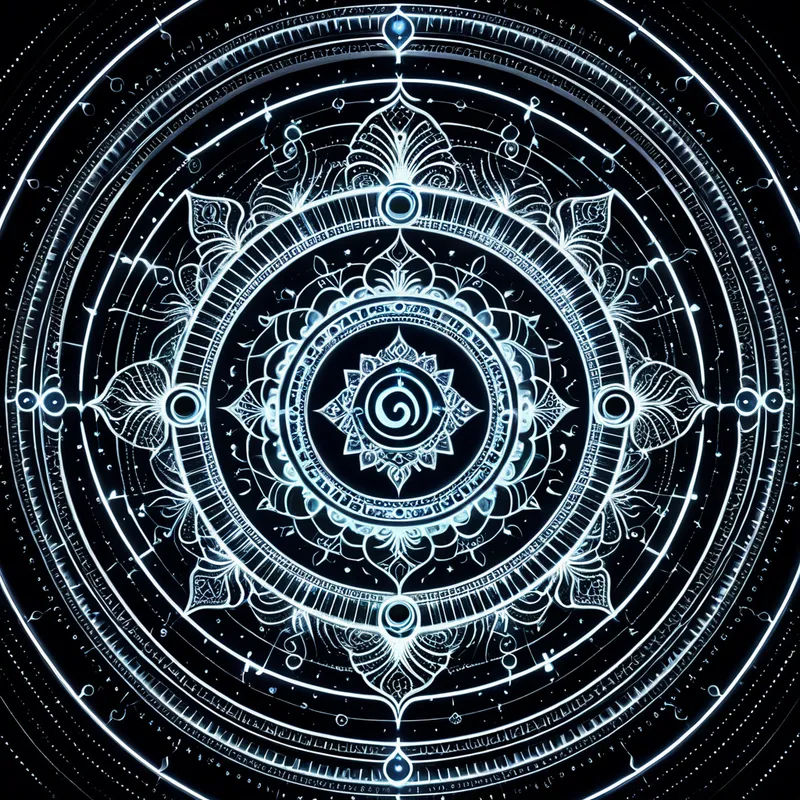
When the archetype of Nada Brahma stirs in the modern unconscious, it often surfaces in dreams not as a clear mythic narrative, but as a profound somatic experience of sound and vibration. The dreamer may not see a deity, but they feel a hum that permeates everything—a drone that makes their bones resonate or a pure tone that seems to reorganize the dreamscape. Walls may pulse like diaphragms, landscapes may warp like visualizations of sound waves, and objects may lose their solidity, appearing as interference patterns.
This dream signals a process of profound inner re-tuning. Psychologically, the individual is likely confronting the foundational “notes” of their own psyche—the core patterns, traumas, or potentials that structure their reality. The somatic resonance indicates these patterns are being vibrated, loosened, and potentially harmonized. It is the unconscious announcing that the dreamer’s reality is not fixed, but malleable and responsive to a deeper, more authentic frequency. The conflict is one of dissonance; the dream presents the possibility of resonance.

Alchemical Translation
The alchemical work modeled by Nada Brahma is the transmutation of psychic noise into sacred harmony, leading to the realization of the true Self. The modern individual lives in a cacophony of external stimuli and internal chatter—the ahata nada of the fragmented ego. The path of individuation, in this framework, is a practice of Nada Yoga: the yoga of sound.
Individuation is the process of silencing the struck sounds of the persona to hear the unstruck music of the Self.
The first step is Pratyahara (withdrawal of senses), turning inward to discern one’s own internal noise. Next is Dharana (concentration), focusing on a single, harmonious point—a chosen mantra, the breath, or even a personal symbol of wholeness. This focused vibration begins to organize the chaotic psychic material, much like a clear tone can cause scattered sand to form into a symmetrical pattern on a plate (a demonstration of cymatics).
Through sustained practice (Dhyana, meditation), the individual’s identified self begins to dissolve into the vibration. The petty conflicts, the rigid self-concepts, the historical wounds—all are seen as dissonant frequencies that can be re-tuned. The triumph is Samadhi, not as oblivion, but as perfect resonance. In that state, the mediator, the process of mediation, and the sacred sound (OM, the Self) are experienced as one. The individual realizes they are not a separate entity producing sound, but are themselves an expression of Nada Brahma. The personal psyche is understood as a unique and necessary note in the infinite symphony of consciousness, finally hearing its own part in the grand, eternal composition.
Associated Symbols
Explore related symbols from the CaleaDream lexicon: