
The Myth of Sisyphus Myth Meaning & Symbolism
A king condemned by the gods to eternally roll a boulder up a mountain, only to watch it fall again, in a stark parable of human struggle.
The Tale of The Myth of Sisyphus
Listen, and hear the tale of the cleverest and most wretched of kings. In the sun-scorched land of Corinth, there ruled a man named Sisyphus. His mind was a labyrinth, his wit sharper than any sword forged by Hephaestus. He saw the secret comings and goings of the river god Asopus, and for a price—a spring for his citadel—he whispered of a great eagle that had carried off a nymph. It was Zeus himself.
The king had betrayed the secret of the king of gods. The thunderer’s wrath was a silent, gathering storm. He sent Thanatos, the grim reaper, to chain Sisyphus and drag him to Tartarus. But Sisyphus was not like other men. He saw the cold, clinking chains in Death’s hands and feigned curiosity. “How do these remarkable bindings work?” he asked. And as Thanatos demonstrated, the cunning king snapped them shut on Death himself, imprisoning the very principle of demise. Upon the earth, no man could die. Wars raged without end, the wounded writhed in unending agony.
This chaos could not stand. The great war god Ares, furious that his battles had lost their final, satisfying point, stormed down, freed Thanatos, and delivered Sisyphus to his fate. Yet, even in the shadowy halls of Hades, Sisyphus’s cunning burned bright. He complained to Persephone that his wife had not given him proper funeral rites—a lie. He begged for a brief return to the world of light to chastise her. The queen of the dead, moved by this apparent neglect, granted his plea.
Sisyphus returned to the sun-drenched courtyards of Corinth, to the taste of wine and the feel of the sea breeze, and he laughed. He refused to go back. He had cheated Death twice.
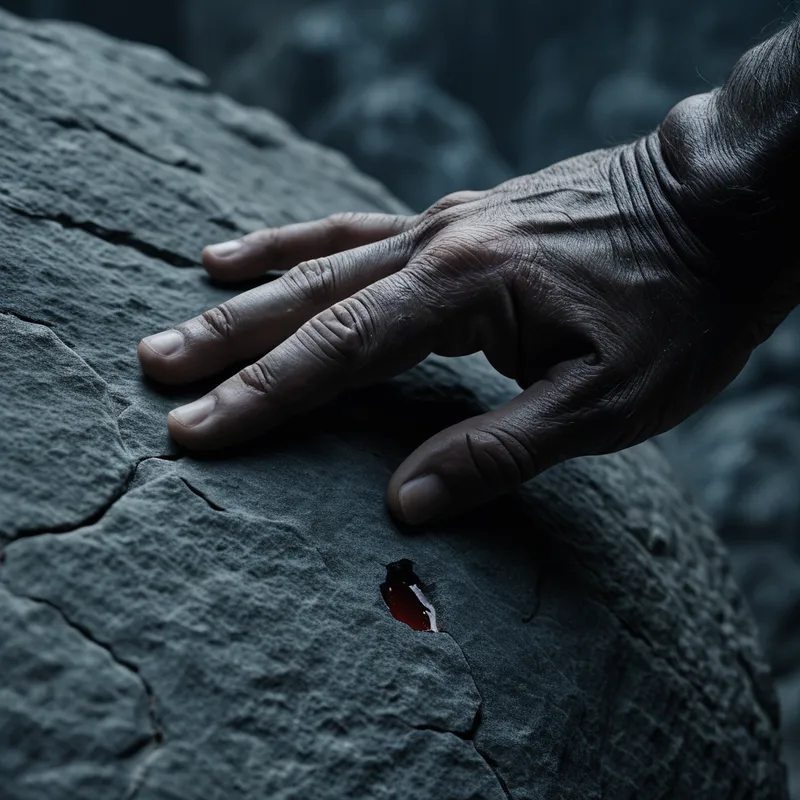
But the gods do not suffer such mockery forever. When Hermes, the swift messenger, finally seized him, the judgment was crafted with divine cruelty. No fiery pit, no gnashing teeth. His punishment was an eternal task. A massive, rounded boulder waited at the base of a high, steep mountain. His labor was to push this stone to the summit. He would strain, muscles cracking, back bowing, feet digging into the scree, inching the immense weight upward through sweat and agony. Just as the crest drew near, as his heart dared to hope, the stone’s own weight would betray him. It would shudder, slip from his grasp, and tumble back down to the plain, rolling past him with a hollow, final thunder.
And there, in the dust, he would turn. He would walk back down the silent mountain. He would set his shoulder once more against the cold, unyielding stone. And he would begin again. Forever. This was the sentence: the futile labor, the certain failure, the eternal return.
Cultural Origins & Context
This is not a myth from the deep, collective prehistory of a tribe. It is a polished gem from the later, more philosophical age of Greek antiquity, recorded most famously by the Roman poet Ovid and the travel-writer Pausanias. It functioned as a cautionary tale about hubris against the divine order, a stark reminder that human cleverness has its limits before cosmic law.
Yet, its true, profound cultural adoption is distinctly modern. It was resurrected from being a mere footnote on divine punishment by the 20th-century French philosopher Albert Camus in his 1942 essay, The Myth of Sisyphus. In the shadow of world wars and the collapse of old religious and philosophical certainties, Camus identified Sisyphus as the ultimate absurd hero. The myth was no longer about a king punished by gods, but about the human condition itself: our relentless, often futile striving within a universe that offers no ultimate answer, no final summit. Passed down now not by bards but by philosophers, novelists, and psychologists, its societal function shifted from enforcing piety to illuminating perseverance in the face of inherent meaninglessness.
Symbolic Architecture
The architecture of this myth is stark, almost minimalist, yet it contains the blueprint of a modern psyche. The mountain is the slope of our ambitions, our projects, our very lives. The boulder is the weight of our labor, our routines, our responsibilities—meaningful one moment, crushingly pointless the next. The cycle of ascent and fall is the core pattern of existence: we build only to see decay, we love knowing we will lose, we strive with no guaranteed success.
Sisyphus is the archetype of consciousness trapped in repetition, the part of us that knows the score but must play the game regardless.
Psychologically, he represents the ego confronted with the absurd. His cunning is the intellect’s attempt to cheat fate, to find an exception, a loophole in the contract of mortality and struggle. His punishment is the inevitable realization: there is no loophole. The struggle is the contract. The gods here are not external deities but the impersonal, unfeeling laws of existence—entropy, time, and chance.

The Dreamer’s Resonance
When this myth surfaces in modern dreams, it rarely appears as a classical Greek tableau. The dreamer may find themselves in an endless, fluorescent-lit hallway, pushing a heavy cart of files that spill out as soon as they reach a door. They may be running on a treadmill that speeds up exponentially, or trying to code a program that endlessly corrupts upon completion. The somatic feeling is one of deep, grinding exhaustion coupled with a frantic, trapped anxiety. The body feels the weight.
This is the psyche working through a state of burnout or profound existential stagnation. The dreamer is likely caught in a life pattern—a job, a relationship, a personal project—that feels utterly repetitive and devoid of authentic progress. The dream is not merely complaining; it is presenting the raw, symbolic structure of the impasse. It asks the dreamer to recognize the Sisyphean loop they are in. The psychological process is one of confrontation with the shadow side of perseverance: the point where noble endurance becomes a hollow, self-imposed prison. The dream begs the question: Why do you keep pushing this particular stone?

Alchemical Translation
The alchemy of this myth lies not in changing the task, but in transmuting the consciousness of the task-doer. Camus’s revolutionary conclusion provides the key: “The struggle itself toward the heights is enough to fill a man’s heart. One must imagine Sisyphus happy.”
The psychic transmutation, the individuation it models, is the shift from victim of the absurd to hero of the absurd. The first step is the full, lucid acceptance of the rock, the mountain, and the fall. This is the death of the ego’s hope for external salvation or final victory. The “gods” will not save you; the summit is an illusion.
The alchemical fire is lit in the moment of the turn, the walk back down the mountain. That is the moment of consciousness, of choice.
In that descent, Sisyphus is free. He is not pushing the stone. He owns his fate. The labor is no longer a punishment inflicted by another, but a domain of sovereignty. The modern individual’s “boulder” may be their daily work, caring for a loved one with a chronic illness, or the ongoing work of self-improvement. The alchemical translation is to find the dignity, the artistry, even the love, within the pushing itself. To become the rebel who says “yes” to his own struggle, thereby robbing the meaningless universe of its ultimate weapon: his despair. The stone remains heavy, the mountain steep, but the heart, filled with the struggle, becomes light. In this paradox lies the triumph.
Associated Symbols
Explore related symbols from the CaleaDream lexicon: