The myth of Psyche Myth Meaning & Symbolism
A mortal woman's love for an invisible god leads her through perilous trials to achieve immortality and the union of soul and spirit.
The Tale of The myth of Psyche
In a time when the breath of the gods still warmed the necks of mortals, there lived a princess whose beauty was not of this earth. Her name was [Psyche](/myths/psyche “Myth from Greek culture.”/), and her radiance was such that men ceased to worship at the altars of Aphrodite, turning instead to adore this mortal maiden. A silent, jealous fire ignited in the heart of the goddess. She summoned her son, the winged archer Eros, and commanded him to pierce [Psyche](/myths/psyche “Myth from Greek culture.”/) with a golden arrow, making her fall in love with the most vile creature he could find.
But destiny is a tapestry woven by hands unseen. When Eros beheld Psyche, the point of his own arrow grazed his heart, and he was undone by a love more profound than any he had ever inflicted. He could not obey his mother. Instead, an oracle declared Psyche was destined for no mortal husband, but a serpent-god who awaited her on a lonely mountain peak. In despair, her family conducted a funeral wedding, leaving her upon the crag to meet her fate.
Zephyr, the west wind, gentler than prophecy, lifted her and carried her not to death, but to a hidden valley and a palace wrought by magic. Invisible hands attended her. A voice, sweet and resonant as a nightingale’s song, spoke to her in the darkness—the voice of her husband. He came to her only under the cloak of night, a lover of shadow and touch, forbidding her ever to look upon his face. “If you see me,” he whispered, “you will lose me.” For a time, bliss was enough. But solitude and the whispers of her visiting sisters seeded a terrible doubt. Was her husband truly a monster?
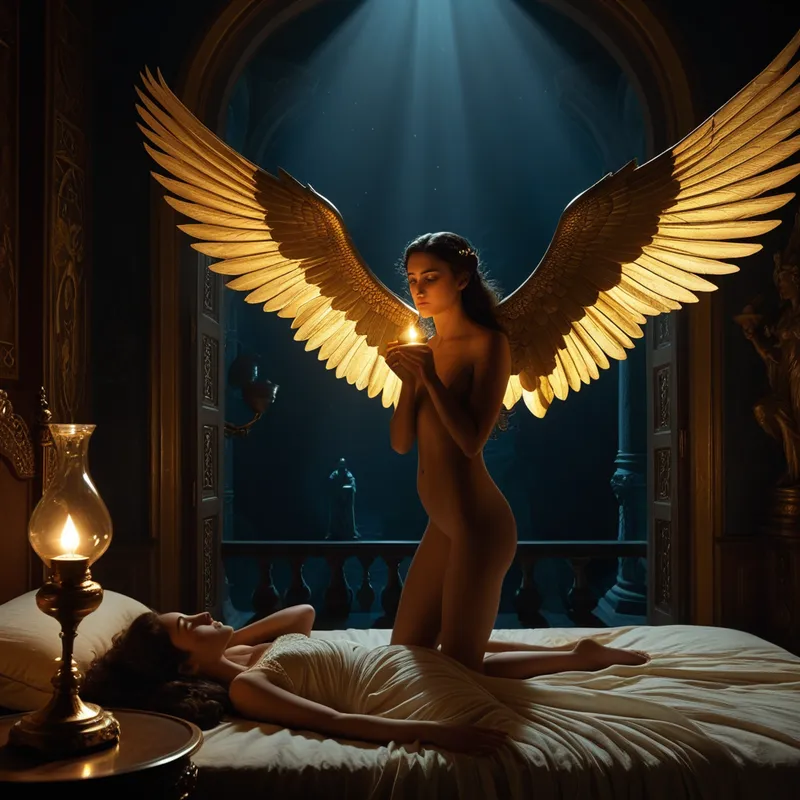
One night, armed with a dagger and a flickering oil lamp, Psyche betrayed her vow. The golden light fell not upon a serpent, but upon the most beautiful of the gods: Eros himself, his white wings folded in sleep. A drop of scalding oil fell upon his shoulder. He awoke, and in his wounded, betrayed eyes, she saw paradise shatter. “Love cannot live where there is no trust,” he said, and was gone. The palace, the gardens, the singing voices—all vanished into the morning mist, leaving Psyche alone in a barren field.
Her journey then became a pilgrimage of penance. She wandered [the earth](/myths/the-earth “Myth from Hindu culture.”/), a soul in exile, until the very goddess who had cursed her, Aphrodite, took her as a slave. The goddess set four impossible tasks. Psyche must sort a mountain of mixed grains before nightfall (accomplished by an army of ants). She must gather golden wool from fierce, sun-crazed sheep (guided by a whispering reed to collect the fleece caught on brambles). She must fetch black [water](/myths/water “Myth from Chinese culture.”/) from the source of the rivers Styx</ab title> and Cocytus (aided by Zeus’s eagle). Finally, she must descend into [the Underworld](/myths/the-underworld “Myth from Greek culture.”/) itself and procure a box of beauty from [Persephone](/myths/persephone “Myth from Greek culture.”/).
Guided by a talking tower, she navigated the land of the dead, paid [the ferryman](/myths/the-ferryman “Myth from Various culture.”/), pacified the three-headed hound Cerberus, and returned with the sealed box. But at the final threshold, human weakness overcame her. Thinking to borrow a drop of divine beauty to win back her love, she opened the box. Instead of beauty, she was engulfed by a deathlike sleep—the sleep of the soul.
It was Eros, his wing healed, who found her. He brushed the sleep from her lips and lifted her into the light. His love had grown stronger than his wound. He pleaded her case before Zeus, who granted Psyche immortality. The union of Psyche (Soul) and Eros (Love) was celebrated by all the gods, and from their union was born a daughter named Voluptas—Bliss.

Cultural Origins & Context
The myth of [Psyche and Eros](/myths/psyche-and-eros “Myth from Global/Universal culture.”/) is not a folk tale from the ancient fireside, but a literary masterpiece embedded within a larger novel, The Golden Ass (or [Metamorphoses](/myths/metamorphoses “Myth from Greek culture.”/)), written by the Roman author Apuleius in the 2nd century CE. This places it in a unique cultural context: a globalized Roman world steeped in Greek mythology, but also one increasingly fascinated with mystery religions, personal salvation, and the journey of the soul. Apuleius himself was an initiate into several cults, and his telling of Psyche’s story is widely interpreted as an allegory for the soul’s initiation and ascent.
The myth functioned on multiple levels. As entertainment, it was a riveting romance within a picaresque novel. Philosophically, it served as a Neoplatonic allegory for the descent of the soul into matter and its arduous return to the divine through trials and suffering. For the contemporary initiate, it mirrored the ordeals of mystery cults like those of Isis (to whom Apuleius’s protagonist is ultimately converted), where the individual underwent symbolic deaths to be spiritually reborn. It is a universal story because it was crafted, at its core, to speak directly to the universal human experience of longing, error, suffering, and the hope for redemption and union.
Symbolic Architecture
At its [heart](/symbols/heart “Symbol: The heart symbolizes love, emotion, and the core of one’s existence, representing deep connections with others and self.”/), this is the myth of the individuation of the feminine [soul](/symbols/soul “Symbol: The soul represents the essence of a person, encompassing their spirit, identity, and connection to the universe.”/). Psyche is not just a [character](/symbols/character “Symbol: Characters in dreams often signify different aspects of the dreamer’s personality or influences in their life.”/); she is the [human](/symbols/human “Symbol: The symbol of a human represents individuality, complexity of emotions, and social relationships.”/) Self in its raw, potential state—all [beauty](/symbols/beauty “Symbol: This symbol embodies aesthetics, harmony, and the appreciation of life’s finer qualities.”/) but no [consciousness](/symbols/consciousness “Symbol: Consciousness represents the state of awareness and perception, encompassing thoughts, feelings, and experiences.”/). Her initial worship is a state of unconscious identification with the [persona](/symbols/persona “Symbol: The social mask or outward identity one presents to the world, often concealing the true self.”/), which inevitably incites the envy of the deeper, instinctual world (Aphrodite).
The first task of the soul is to fall from grace. Only in exile from the naive paradise does consciousness begin.
Her invisible [husband](/symbols/husband “Symbol: In dreams, the symbol of a husband often represents commitment, partnership, and the dynamics of intimate relationships.”/), Eros, represents the animating, connecting principle of [life](/symbols/life “Symbol: The symbol of ‘Life’ represents a journey of growth, interconnectedness, and existential meaning, encompassing both the joys and challenges that define human experience.”/)—the [Animus](/symbols/animus “Symbol: In Jungian psychology, the masculine inner personality in a woman’s unconscious, representing logic, action, and spiritual guidance.”/) in its divine form. Their nocturnal union is the [bliss](/symbols/bliss “Symbol: A state of profound happiness and spiritual contentment, often representing fulfillment of desires or alignment with one’s true self.”/) of an unconscious [connection](/symbols/connection “Symbol: Connection symbolizes relationships, communication, and bonds among individuals.”/) to the inner [life](/symbols/life “Symbol: The symbol of ‘Life’ represents a journey of growth, interconnectedness, and existential meaning, encompassing both the joys and challenges that define human experience.”/) force. The fatal act of lighting the [lamp](/symbols/lamp “Symbol: A lamp symbolizes guidance, enlightenment, and the illumination of truth, often representing knowledge or clarity in dark times.”/) is the [dawn](/symbols/dawn “Symbol: The first light of day, symbolizing new beginnings, hope, and the transition from darkness to illumination.”/) of consciousness, of the desire to see and know the [nature](/symbols/nature “Symbol: Nature symbolizes growth, connectivity, and the primal forces of existence.”/) of this force. It is a necessary [betrayal](/symbols/betrayal “Symbol: A profound violation of trust in artistic or musical contexts, often representing broken creative partnerships or artistic integrity compromised.”/), for consciousness inevitably wounds the instinctual, spontaneous [nature](/symbols/nature “Symbol: Nature symbolizes growth, connectivity, and the primal forces of existence.”/) of love. The four impossible tasks are the systematic labors of [the ego](/myths/the-ego “Myth from Jungian culture.”/) to redeem this [loss](/symbols/loss “Symbol: Loss often symbolizes change, grief, and transformation in dreams, representing the emotional or psychological detachment from something or someone significant.”/), each representing a different psychic function: discrimination (sorting seeds), harnessing dangerous energies (the golden [wool](/symbols/wool “Symbol: A natural fiber representing warmth, protection, and connection to tradition. Often symbolizes comfort, labor, or spiritual purity.”/)), integrating the waters of the deep unconscious (Styx), and finally, confronting [death](/symbols/death “Symbol: Symbolizes transformation, endings, and new beginnings; often associated with fear of the unknown.”/) itself (the descent).
The ultimate prize, the “beauty” of Persephone, is the integrated wisdom of the [underworld](/symbols/underworld “Symbol: A symbolic journey into the unconscious, representing exploration of hidden aspects of self, transformation, or confronting repressed material.”/)—the [knowledge](/symbols/knowledge “Symbol: Knowledge symbolizes learning, understanding, and wisdom, embodying the acquisition of information and enlightenment.”/) that comes from facing one’s own [shadow](/symbols/shadow “Symbol: The ‘shadow’ embodies the unconscious, repressed aspects of the self and often represents fears or hidden emotions.”/). Psyche’s final failure, opening the box, is crucial. It signifies that the ego cannot assimilate this ultimate power; it will be overwhelmed (put to sleep). Salvation must come from the redeemed other—the healed Eros, now conscious and active. Their divine [marriage](/symbols/marriage “Symbol: Marriage symbolizes commitment, partnership, and the merging of two identities, often reflecting one’s feelings about relationships and social obligations.”/) is the sacred union, the hieros gamos, within the individual: the conscious ego (Psyche) united with the guiding, loving [spirit](/symbols/spirit “Symbol: Spirit symbolizes the essence of life, vitality, and the spiritual journey of the individual.”/) of the deep Self (Eros).
The Dreamer’s Resonance
When this myth stirs in the modern dreamer, it signals a profound initiation into the depths of relationship and selfhood. To dream of a beautiful but empty palace signifies a period of gifted, yet unconscious, potential—a relationship or life situation that feels blessed but lacks true seeing. The dream of a beloved whose face is hidden, or who vanishes when looked upon, points directly to an anima/animus [projection](/myths/projection “Myth from Alchemical culture.”/). The dreamer is in love with an ideal, not a real person (or a real part of themselves), and the psyche is warning that consciousness will dispel the magic.
Dreams of impossible, meticulous tasks—sorting endless tiny objects, climbing unscaleable walls, being given a mission by a stern, goddess-like figure—are somatic echoes of Psyche’s labors. The body-mind is processing the arduous, often frustrating, work of building ego strength, sorting through the chaos of one’s past (the seeds), and confronting fears. A dream of descending into a basement, cave, or subway that transforms into a mythic landscape marks the beginning of the nekyia, the night-sea journey into [the personal unconscious](/myths/the-personal-unconscious “Myth from Jungian Psychology culture.”/) to retrieve something vital that has been lost or locked away.

Alchemical Translation
The alchemical process mirrored in Psyche’s tale is the transformation of leaden, mortal suffering into the gold of a realized soul. It is a precise map for psychic transmutation.
The initial stage, [nigredo](/myths/nigredo “Myth from Alchemical culture.”/) (the blackening), is her abandonment on the mountain and the loss of her palace—the utter dissolution of her former life and identity. The four tasks represent albedo (the whitening), the rigorous purification and separation of elements. Sorting seeds is separating the valuable from the worthless in one’s history. Gathering the golden wool is learning to harness one’s aggressive, “sun-crazed” instincts not through direct confrontation, but through cunning and timing (collecting what is already caught on the brambles of life’s events).
The descent to the Styx is the crucial step: to consciously drink from the bitter waters of one’s own pain and ancestral sorrow, and not be poisoned.
[The underworld journey](/myths/the-underworld-journey “Myth from Various culture.”/) is the heart of the work—citrinitas (the yellowing). Here, the ego, armed only with humble provisions (the coins of willingness, the cakes of instinct to pacify the inner beast), must go into the realm of the dead, the repressed, the forgotten. To ask a boon from the Queen of the [Underworld](/myths/underworld “Myth from Greek culture.”/) is to respectfully engage with the deepest, often traumatic, complexes. The final sleep from the box is a symbolic death, the mortificatio, necessary before the final stage.
The return and awakening by Eros is [rubedo](/myths/rubedo “Myth from Alchemical culture.”/) (the reddening), the culmination. It represents the moment when the conscious effort of the ego is met and completed by the grace of [the Self](/myths/the-self “Myth from Jungian culture.”/). The transcendent function is achieved. The birth of Voluptas is the ultimate product: not a fleeting happiness, but a deep, abiding joy that is [the child](/myths/the-child “Myth from Alchemy culture.”/) of [the sacred marriage](/myths/the-sacred-marriage “Myth from Various culture.”/) between our human striving (Psyche) and the divine, loving essence that guides us from within (Eros). The myth teaches that wholeness is not a given, but a creation forged in the dark, through trials we believe will break us, guided by a love we must first betray in order to truly see.
Associated Symbols
Explore related symbols from the CaleaDream lexicon: