The myth of Pandora's box Myth Meaning & Symbolism
A divine punishment, a forbidden vessel, and the first woman unleashes all evils upon the world, leaving only hope trapped inside.
The Tale of The myth of Pandora’s box
Listen, and hear of the day the balance of [the world](/myths/the-world “Myth from Tarot culture.”/) was tipped, when the laughter of the gods turned to a grim smile. It began with a theft, a spark of rebellion in the smoky gloom of a mortal forge. [Prometheus](/myths/prometheus “Myth from Greek culture.”/), the Foreseer, dared to love the clay-born race too much. For his crime, the lord of Olympus devised a punishment not for the thief, but for all who would warm themselves by his stolen gift.
The great forger, [Hephaestus](/myths/hephaestus “Myth from Global/Universal culture.”/), was summoned. Not to shape a weapon, but a being. From the rich, moist earth and pure [water](/myths/water “Myth from Chinese culture.”/), he fashioned a form of breathtaking beauty—the first woman. Aphrodite breathed upon her the grace that drives men mad with longing. Athena clothed her in a shimmering silvery gown and taught her cunning craft. [Hermes](/myths/hermes “Myth from Global/Universal culture.”/) placed in her heart a shameless mind and a deceitful nature, and named her [Pandora](/myths/pandora “Myth from Greek culture.”/), “All-Gifted.”
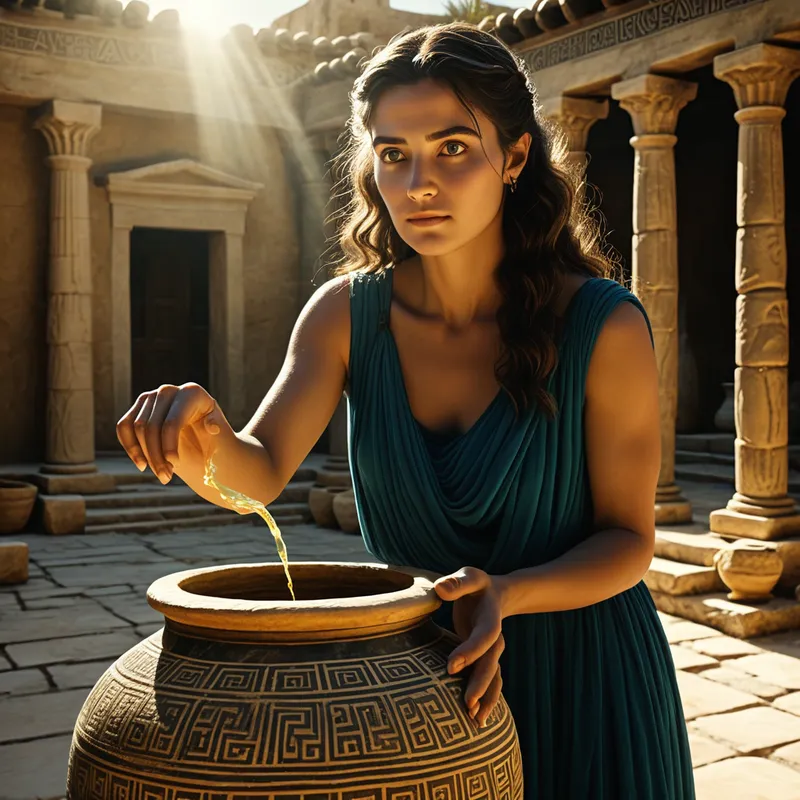
She was presented to Epimetheus, the Afterthinker. Though his stolen brother had warned him to accept no gift from Zeus, Epimetheus saw only her radiant form and took her as his bride. With her, she brought a dowry from the gods: a great jar, a pithos, of baked clay. Its lid was heavy, sealed with a warning. “Do not open it,” they said, their voices honey-sweet. “This contains treasures for your household.” But within, coiled and waiting, were not treasures.
It was her nature—the cunning, the curiosity, the gift of Hermes—that gnawed at her. The jar sat in the corner of their new home, a silent, looming presence. What splendors did it hold? What divine gifts were meant for her? One day, the whisper became too loud. She approached, her heart a drum in the silent room. Her fingers, delicate and strong, found the edge of the great lid. With a heave that echoed in the stillness, she lifted it.
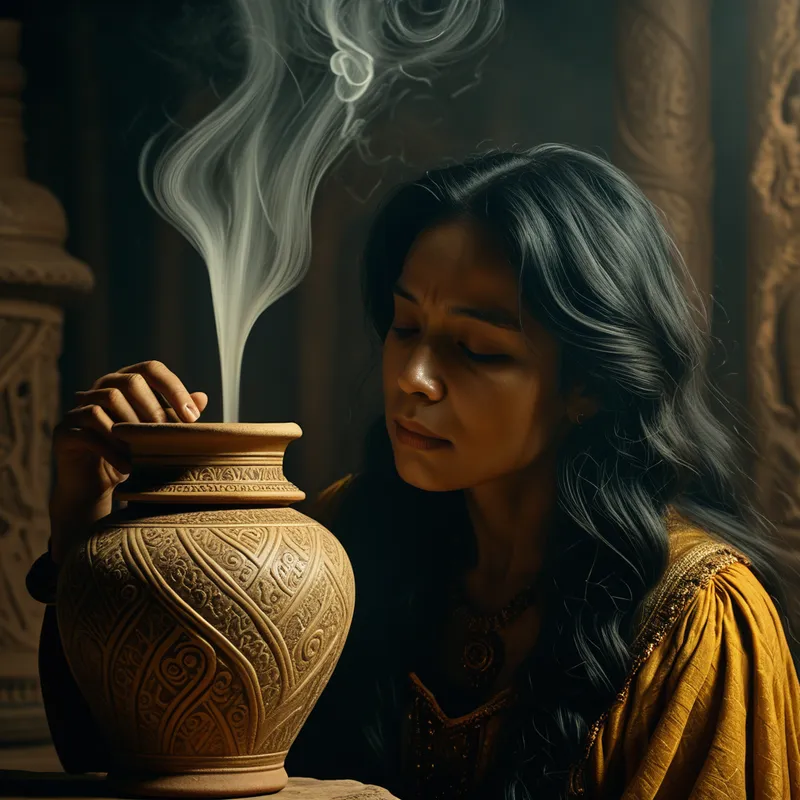
It was not a sound, but an absence of sound, followed by a rushing, sighing exhalation. From the jar’s mouth erupted a swirling, miasmatic cloud, darker than storm smoke, cold as a tomb. It was not one [thing](/myths/thing “Myth from Norse culture.”/), but a legion: Ponos, Nosos, Geras. Grief, Strife, Famine, and all the countless spirits of Misery that had never before walked the green earth. They spread wings of shadow and seeped into the world, into the water, the soil, the very breath of mortals.
Terrified, Pandora slammed the lid back down. The rushing ceased. The room was empty, the world forever changed. But in the sudden, echoing silence, she heard it—a faint, fluttering whisper against the clay from inside the jar. One thing had not escaped. One “treasure” remained, trapped under the lid she had sealed: Elpis. And there it stays, at the bottom of the jar, a fragile, fluttering thing, the final gift of the gods to humanity.
Cultural Origins & Context
This foundational narrative comes to us from the earliest strata of Greek literature, most definitively in Hesiod’s Works and Days (c. 700 BCE). For an ancient Greek audience, this was not merely a story of origins but an etiological myth—an explanation for why the human condition is one of toil, sickness, and sorrow. It functioned as a theodicy, justifying the presence of evil in a world governed by ostensibly powerful gods. The myth was transmitted orally by bards and poets before being codified, serving as a cultural warning about divine retribution, the dangers of unchecked curiosity (particularly female curiosity, reflecting patriarchal norms), and the perils of accepting seemingly benign gifts from more powerful forces. It established a primal, prelapsarian moment when humanity’s lot shifted from a simple, if difficult, existence to one inherently laced with psychic and physical suffering.
Symbolic Architecture
The myth’s power lies in its stark, almost brutal, symbolic [architecture](/symbols/architecture “Symbol: Architecture in dreams often signifies structure, stability, and the framing of personal identity or life’s journey.”/). Pandora herself is not a [villain](/symbols/villain “Symbol: A character representing opposition, moral corruption, or suppressed aspects of self, often embodying fears, conflicts, or societal threats.”/) but a [vector](/symbols/vector “Symbol: A directional line representing movement, force, or connection between points in architectural space.”/), the crafted [instrument](/symbols/instrument “Symbol: An instrument symbolizes creativity, communication, and the means by which one expresses oneself or influences the world.”/) of a divine plan. She represents the [arrival](/symbols/arrival “Symbol: The act of reaching a destination, marking the end of a journey and the beginning of a new phase or state.”/) of [consciousness](/symbols/consciousness “Symbol: Consciousness represents the state of awareness and perception, encompassing thoughts, feelings, and experiences.”/), complexity, and duality into a previously simpler order. She is the embodied “Other,” the bringer of both [beauty](/symbols/beauty “Symbol: This symbol embodies aesthetics, harmony, and the appreciation of life’s finer qualities.”/) and catastrophe, a [reflection](/symbols/reflection “Symbol: Reflection signifies self-examination, awareness, and the search for truth within oneself.”/) of the ancient ambivalence toward the feminine as both [life](/symbols/life “Symbol: The symbol of ‘Life’ represents a journey of growth, interconnectedness, and existential meaning, encompassing both the joys and challenges that define human experience.”/)-giving and potentially destructive.
The jar (often mistranslated as a “box” in later traditions) is the central [symbol](/symbols/symbol “Symbol: A symbol can represent an idea, concept, or belief, serving as a powerful tool for communication and understanding.”/). It is the vas, the [vessel](/symbols/vessel “Symbol: A container or structure that holds, transports, or protects something essential, representing the self, emotions, or life journey.”/) of the unconscious, containing the totality of latent [human](/symbols/human “Symbol: The symbol of a human represents individuality, complexity of emotions, and social relationships.”/) experience.
The sealed jar is the unexamined psyche, and to open it is to confront the shadow contents we have collectively and individually repressed.
The “evils” that escape are not external monsters but the internal, psychological conditions of existence: the [awareness](/symbols/awareness “Symbol: Conscious perception of self, surroundings, or internal states. Often signifies awakening, insight, or heightened sensitivity.”/) of [mortality](/symbols/mortality “Symbol: The awareness of life’s finitude, often representing transitions, impermanence, or existential reflection in dreams.”/), the burden of labor, the sting of [grief](/symbols/grief “Symbol: A profound emotional response to loss, often manifesting as deep sorrow, yearning, and a sense of emptiness.”/). They are the inevitable companions of a conscious, Promethean being who possesses the fire of intellect and ambition.
Most profound is the trapped entity, Elpis. Its ambiguous [nature](/symbols/nature “Symbol: Nature symbolizes growth, connectivity, and the primal forces of existence.”/) is the myth’s masterstroke. Is Hope a benevolent comfort, left to soothe our wounded world, or is it the cruelest evil of all—a deceptive, future-oriented delusion that keeps us striving in a world of suffering? The myth refuses to answer, leaving Hope imprisoned, a paradoxical and potent symbol of the human [condition](/symbols/condition “Symbol: Condition reflects the state of being, often focusing on physical, emotional, or situational aspects of life.”/): we are beings defined by suffering, yet perpetually animated by [anticipation](/symbols/anticipation “Symbol: A state of excited expectation about future events, often involving hope, anxiety, or readiness for what is to come.”/).
The Dreamer’s Resonance
When this myth pattern stirs in the modern dreamer, it often manifests as dreams of forbidden rooms, locked containers, or overwhelming curiosity about a sealed object. The somatic experience is one of intense tension—a pull between dread and desire in [the pit](/myths/the-pit “Myth from Christian culture.”/) of the stomach. Psychologically, this signals a critical threshold in the individuation process. The dream-ego stands before its own personal pithos, the repository of repressed memories, traumas, shame, and unlived potentials—the personal and collective shadow.
To dream of opening the box is to engage in active shadow-work. The ensuing “evils” that flood out in the dreamscape—perhaps as chaotic imagery, pursuing figures, or environmental collapse—represent the painful but necessary integration of these disowned parts. The dreamer is not being punished, but undergoing a psychic unburdening. The anxiety is [the ego](/myths/the-ego “Myth from Jungian culture.”/)’s resistance to this profound, often terrifying, act of self-honesty. The dream may end abruptly at the moment of opening, mirroring Pandora’s shock, leaving the dreamer with the lingering question: what, if anything, remains inside?
Alchemical Translation
The alchemical journey mirrored in Pandora’s tale is the [nigredo](/myths/nigredo “Myth from Alchemical culture.”/), the necessary descent into darkness that precedes any transformation. The initial state is a kind of psychic innocence or naivete (Epimetheus’s household before the jar). The catalyst is an irresistible, often fateful, curiosity—the call to consciousness itself.
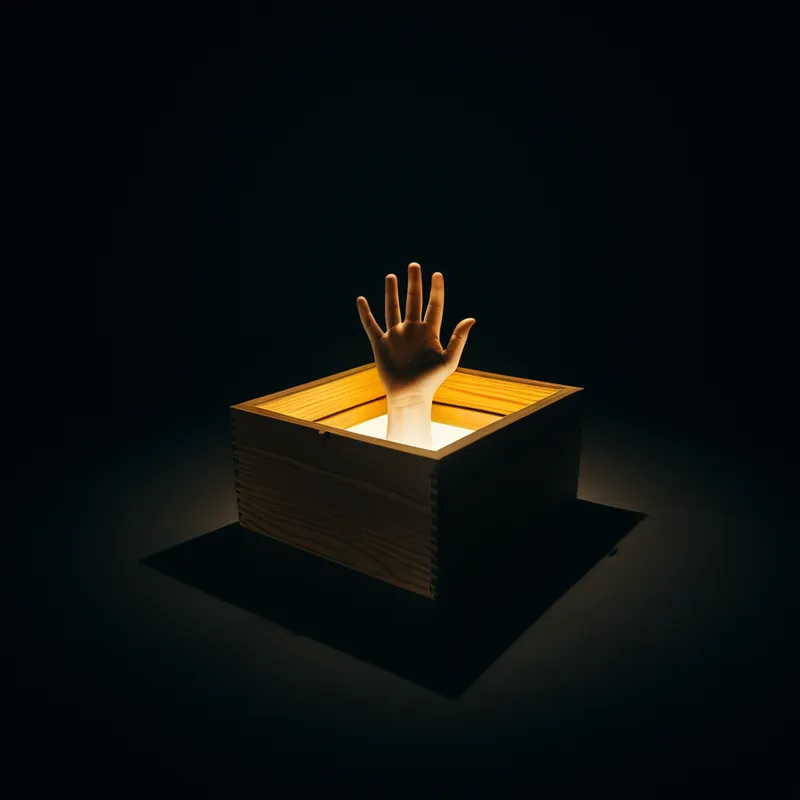
The act of opening the vessel is the first, irrevocable step in the opus. It is the dissolution of the old, defended self, allowing the chaotic prima materia of the psyche to surface.
The release of sufferings represents the brutal, confronting stage of confession and [putrefactio](/myths/putrefactio “Myth from Alchemical culture.”/). This is not a mistake, but the required operation. One cannot transmute what remains hidden and pressurized. The modern individual’s “[triumph](/myths/triumph “Myth from Roman culture.”/)” is not in avoiding this opening, but in having the courage to lift the lid and endure the chaotic eruption, to name the griefs, the envies, the despairs as they emerge.
Finally, the sealed Hope at the bottom is the promise of the albedo. It is the tiny, enduring core of [the Self](/myths/the-self “Myth from Jungian culture.”/) that survives the confrontation with [the shadow](/myths/the-shadow “Myth from Jungian culture.”/). It is not a naive optimism, but the psychological faculty of meaning-making, the part of us that can witness the devastation and still choose to engage with life. Our task is not to release it blindly, but to recognize it is there, contained within the very vessel of our suffering, the irreducible spark that makes the arduous work of becoming whole not just possible, but imperative. We are, each of us, both Pandora and the jar—the curious opener and [the vessel](/myths/the-vessel “Myth from Alchemical culture.”/) that contains both the plague and the promise.
Associated Symbols
Explore related symbols from the CaleaDream lexicon: