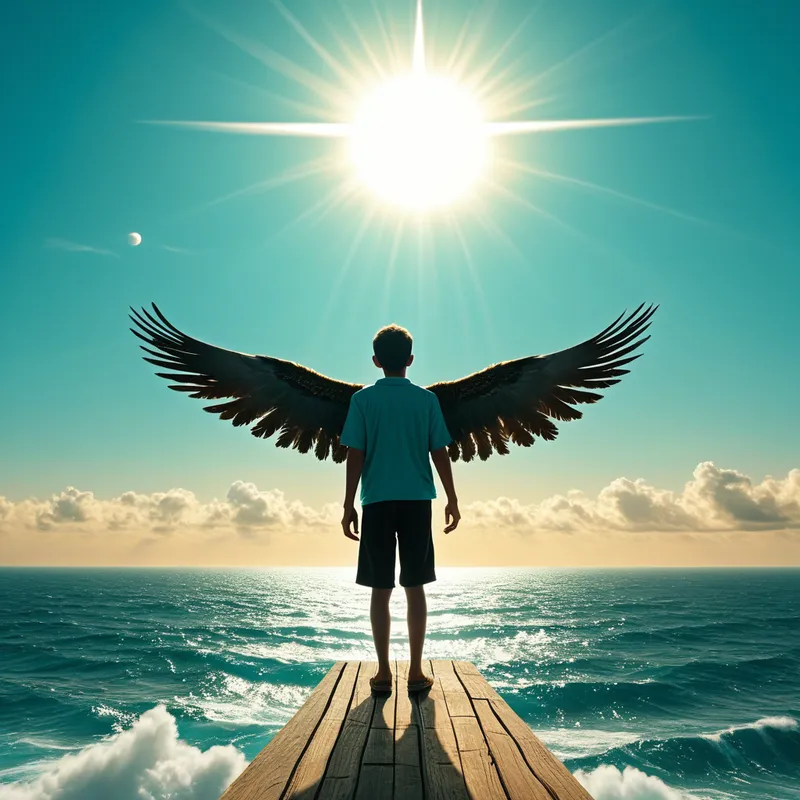
The myth of Icarus Myth Meaning & Symbolism
A father and son escape a labyrinth with wings of wax. The son, Icarus, flies too close to the sun, melting his wings and falling into the sea.
The Tale of The myth of Icarus
Hear now the tale of the boy who touched the sun, and of the sea that caught him. It begins not in the sky, but in a prison of stone—the Labyrinth of Crete, a twisting gut of shadows where the monstrous bellowed. Here, the master craftsman Daedalus was held captive, his genius turned against him. The air was thick with the smell of damp rock and despair.
But a mind that can conceive a maze can also conceive an escape. Daedalus watched the gulls wheel and cry against the free blue, and an idea was born—not from earth, but from air. He gathered feathers, great and small, from passing birds. He collected wax from hives, the labor of countless bees. With cunning hands, he fashioned two great pairs of wings, binding feather to feather with wax and cord, creating a second skin of flight for himself and his young son, Icarus.
On the day of their flight, Daedalus’s voice was grave, a low rumble against the cliff’s edge. “My son,” he said, fastening the wings to the boy’s shoulders, “follow my path. Fly the middle course. If you sink too low, the damp sea spray will clog your wings and drag you down. But if you fly too high…” He looked up, where the sun blazed in its silent, terrible majesty. “The heat of the sun will melt the wax. Hold to the middle way. It is the only way.”
Icarus nodded, but his eyes were already alight with a different fire. The first leap was terror and triumph. The ground fell away, a shrinking puzzle of stone and green. The prison became a toy below them. The air, once empty, became a solid, rushing river they could swim. Daedalus led, a steady, beating rhythm against the horizon.
But for Icarus, the middle way soon felt like a chain. The sun called. It was not just light; it was a golden throne, a promise of ascension. He felt the warmth on his face, a divine caress. He beat his wings harder, climbing the invisible staircase of the sky. The warnings became a whisper lost in the wind. Higher. The blue deepened. The world below curved. He was no longer a fugitive, but a god.
The warmth became a furnace. A single drop of liquid fell past his eye—not sweat, but melted wax. Then another. A feather loosened, spun away into the gulf. Panic, cold and sharp, pierced his ecstasy. He flailed, but the great wings were unraveling, feathers shedding like leaves in a fire. The glorious sun had betrayed him. The embrace of the sky became a void. His father’s distant cry was the last sound of the world above as he tumbled, a falling star in reverse, down, down, into the waiting, indifferent embrace of the sea. The waters, which he had been warned to avoid, closed over him without a sigh. Daedalus, landing on a distant shore, could only name the waters after his lost son: the Icarian Sea.
Cultural Origins & Context
The myth originates in the rich tapestry of ancient Greek mythology, most famously recorded in the Metamorphoses of the Roman poet Ovid, though its roots are older. It is a quintessential Hellenic narrative, reflecting core cultural values. Greek society venerated sophrosyne—moderation, self-control, and the avoidance of excess. This myth served as a powerful, memorable parable for that principle. It was not merely a warning to disobedient children, but a profound caution to the Greek mind itself, which so brilliantly sought to push the boundaries of knowledge, art, and exploration. The storytellers—bards, poets, and philosophers—used it to illustrate the delicate balance between human ingenuity (techne) and divine law or natural limit (moira or physis). It functioned as societal check, reminding a culture capable of building the Parthenon and conceiving geometry that some boundaries, whether imposed by the gods or by the nature of materials, are fatal to cross.
Symbolic Architecture
The myth is a perfect symbolic engine. Daedalus represents the Logos: the intellect, planning, and pragmatic wisdom. He is the father, the ego-consciousness that seeks to navigate the world through craft and caution. The Labyrinth is the complex, entrapping problem of life—be it a psychological complex, a societal prison, or an existential dilemma.
Icarus is the untamed spirit, the libido or the youthful, impulsive psyche. He represents the pure drive to transcend, to break free not just from the maze, but from all constraints, including the wise counsel of the father/ego.
The sun is not a villain; it is the ultimate symbol of consciousness, divinity, and the longing for the absolute. To fly toward it is the soul's deepest desire. To be consumed by it is the ego's greatest fear.
The wax and feathers are the ingenious but fragile synthesis of nature (feathers) and human artifice (wax)—our technology, our ambitions, our very identities. They are magnificent but impermanent. The sea is the unconscious, the primordial, maternal realm from which life emerged and to which it returns—not evil, but neutral and all-absorbing. The fall is the inevitable correction when aspiration loses its tether to reality.
The Dreamer's Resonance
When this myth erupts in modern dreams, it signals a critical moment of psychic inflation or impending deflation. To dream of soaring joyfully, only to feel the wings disintegrate, is to experience a somatic warning from the unconscious. The dreamer is likely in a state of manic ambition, spiritual bypassing, or identification with a success or idea that has become dangerously ungrounded.
The body in the dream may feel the exhilarating rush of ascent, followed by the gut-wrenching plunge—a direct somatic mapping of an psychological process. This is not about a simple failure. It is about the collapse of a self-image that flew too high. The dream is the psyche’s attempt to correct course, to rein in a persona that has become identified with the hero or the god, severing its connection to the human, the earthly, the limited. The dream-sea that receives the fall is not punishment, but a forced reintegration into the depths of the self, a humbling return to the foundational waters of the soul.
Alchemical Translation
In the alchemical process of individuation, the myth models the perilous stage of sublimatio—the spiritual ascension. The adept seeks to volatilize the base material of the psyche, to rise above the labyrinthine complexities of the personal unconscious. Daedalus provides the necessary opus, the careful work of building the vessel (the conscious attitude) for this journey.
But the pure, unintegrated sublimatio is the Icarus-flight. It is spirituality without embodiment, inflation without humility, insight without application. The melting is a necessary solutio—a dissolving in the waters of the unconscious. The fall is a brutal but vital act of psychic re-balancing.
The goal is not to forever avoid the sun, nor to never leave the labyrinth. The alchemical aim is to transform the wax, to create a vessel of flight that can withstand the divine gaze.
This requires integrating the Daedalus and the Icarus within. One must honor the craftsman’s meticulous respect for limits while still nurturing the son’s ecstatic reach for the infinite. The true triumph is not in the unchecked flight or the safe, low journey, but in the capacity to hold the tension between them—to fly the middle course with full awareness of both the abyss below and the glorious, consuming fire above. The individual who learns this does not escape the labyrinth to perish in the sky, but to find a new, conscious relationship with both earth and heaven. The myth, therefore, is not a condemnation of aspiration, but a sacred map of its most sacred and dangerous terrain.
Associated Symbols
Explore related symbols from the CaleaDream lexicon: