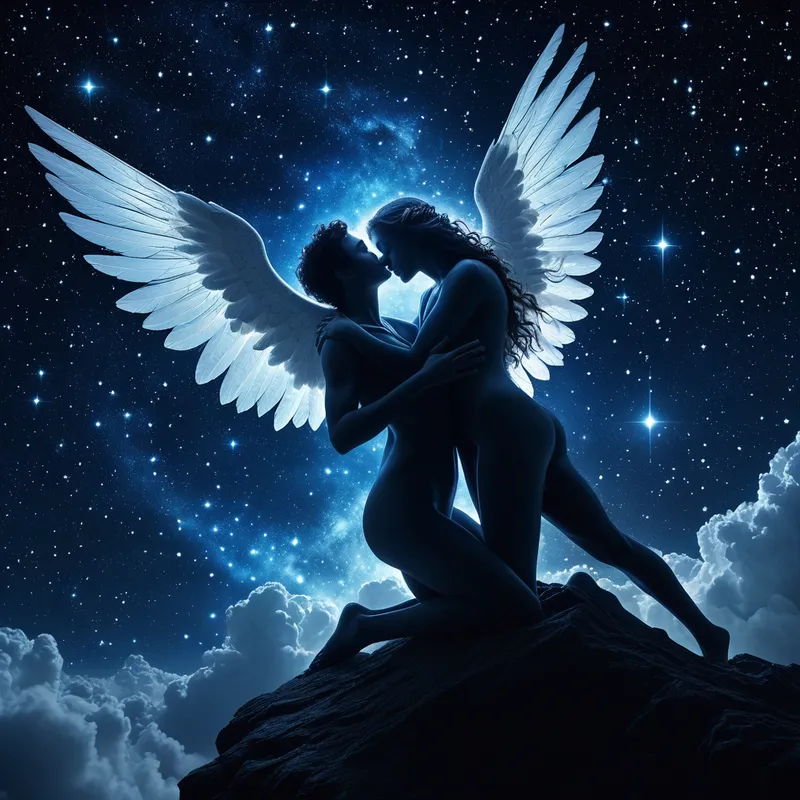
The myth of Eros and Psyche—lo Myth Meaning & Symbolism
A mortal's forbidden love for a divine being leads to betrayal, impossible trials, and a final, transcendent union that redeems both soul and spirit.
The Tale of The myth of Eros and Psyche—lo
Listen, and hear a tale not carved in any single stone, but whispered in [the wind](/myths/the-wind “Myth from Various culture.”/) of every longing heart. It begins in a kingdom of mortal splendor, where a princess named [Psyche](/myths/psyche “Myth from Greek culture.”/) was born with a beauty so devastating, it stole the breath from the very air. Men traveled from distant lands not to win her hand, but merely to glimpse her, leaving offerings as if to a goddess. The temples of Aphrodite grew cold and silent, for the people had found their divinity in a mortal girl.
This blasphemy stirred a divine wrath. Aphrodite, her pride a cold, white flame, summoned her son, the god Eros. “Go,” she commanded, her voice like shattering crystal. “Make the girl fall in love with the most vile, the most wretched creature that crawls upon [the earth](/myths/the-earth “Myth from Hindu culture.”/). Let her passion be her eternal shame.”
Eros descended, a shadow with golden wings, arrow nocked. But as he beheld Psyche, not in her waking glory, but in the vulnerable peace of sleep, a tremor passed through him. His own arrow, meant for her, grazed his divine flesh. In that instant, [the hunter](/myths/the-hunter “Myth from African culture.”/) was captured. A love more profound and perilous than any he had ever inflicted bloomed in his own immortal heart.
He could not obey his mother. Yet, he could not openly defy her. So, he wove a fate of shadows and whispers. An oracle, its voice thick with divine manipulation, declared Psyche must be sacrificed to a monstrous serpent-god on a lonely mountain crag. Her family, weeping, obeyed. But as Psyche waited for death on the windswept cliff, the West Wind himself, [Zephyrus](/myths/zephyrus “Myth from Greek culture.”/), gathered her in a gentle embrace and carried her not to doom, but to a hidden valley of impossible beauty.
There stood a palace wrought of light and melody, with invisible servants who attended her every need. When night fell, a profound darkness enveloped her chambers, and a voice, warm as honey and deep as the earth, spoke to her in the black. It was her husband. He came to her only in the utter dark, forbidding her ever to seek his face. “Trust in this love,” he pleaded. “To see me is to lose me.” For a time, in that cocoon of sensory bliss and intellectual darkness, Psyche was content. Her soul was loved, but it was a love without knowledge.
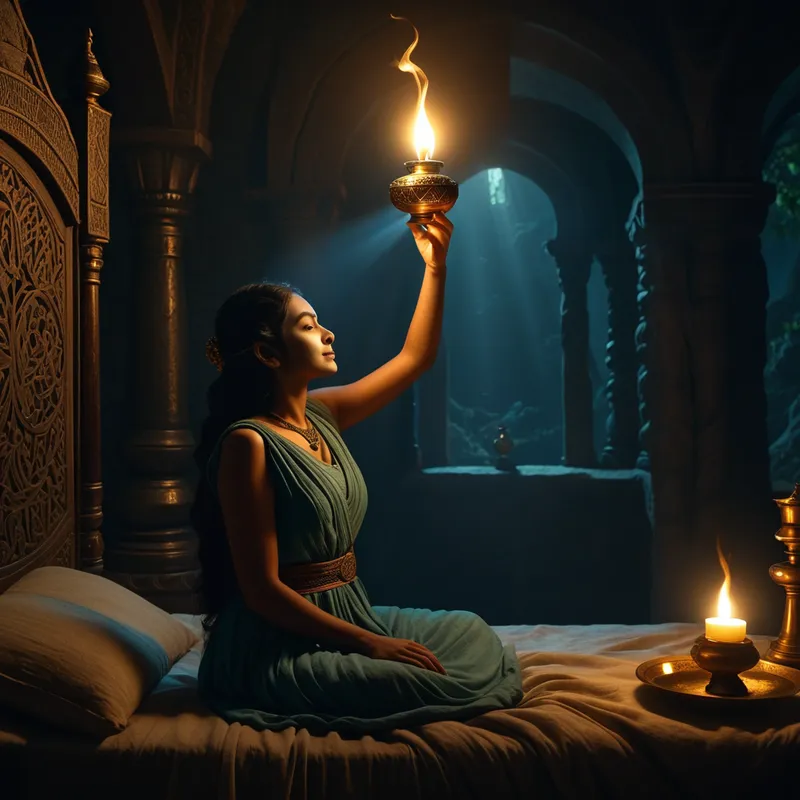
Yet, the human heart cannot abide an eternal mystery. Visited by her jealous sisters, who poisoned her mind with doubts—“Your husband is the serpent, he will devour you!”—Psyche’s curiosity curdled into a fatal resolve. One night, armed with a lamp and a dagger, she beheld not a monster, but the most beautiful being imaginable: the god of love himself, his wings shimmering, his face the very essence of desire. In her shock, a drop of scalding oil fell upon his shoulder.
He awoke. His eyes, once pools of adoration, filled with a betrayal deeper than any wound. “You have broken faith,” he said, his voice the sound of a world ending. “Love cannot live where there is no trust.” And he was gone, the palace vanishing into mist, leaving Psyche alone on the cold, hard ground of [the world](/myths/the-world “Myth from Tarot culture.”/).
Her journey then began in earnest—a descent into the raw matter of existence. She wandered, a soul in exile, until the very goddess who had cursed her, Aphrodite, appeared. With cruel glee, she set four impossible labors before the mortal: to sort a mountain of mixed grains, to gather golden wool from deadly rams, to fetch black [water](/myths/water “Myth from Chinese culture.”/) from [the river](/myths/the-river “Myth from Buddhist culture.”/) of [the underworld](/myths/the-underworld “Myth from Greek culture.”/), and finally, to descend into [Hades](/myths/hades “Myth from Greek culture.”/) itself and retrieve a box of beauty from [Persephone](/myths/persephone “Myth from Greek culture.”/).
Psyche, broken but not defeated, did not face these trials alone. The small beings of the world came to her aid: ants sorted the grains, a reed whispered the secret of the wool, an eagle bore the water, and a talking tower guided her through the descent. She succeeded, but on her return, a final, human weakness seized her. Opening the box, hoping for a drop of divine beauty to win back her love, she was instead overcome by a Stygian sleep—the sleep of death.
It was then that Eros, his wound healed by the greater agony of separation, flew to her. He wiped the sleep from her eyes, his love now tempered by her suffering and her hard-won strength. “See what your curiosity almost did,” he chided, but his touch was forgiveness. He carried her to Olympus, where he pleaded their case before Zeus himself. The father of gods was moved. He granted Psyche immortality, serving her ambrosia. Aphrodite was appeased, for a mortal soul was now a goddess. And in the full light of heaven, with the knowledge of all that had been lost and regained, Eros and Psyche were wed. From their union was born a daughter named Voluptas—Bliss.
Cultural Origins & Context
The myth of Eros and Psyche is uniquely positioned in the canon of world story. It is not a fragment of lost epic, but a complete, novelistic tale embedded within the larger work, The Golden Ass (or [Metamorphoses](/myths/metamorphoses “Myth from Greek culture.”/)), written in the 2nd century CE by the Roman author Apuleius. This places it in the late classical period, a time of syncretism where Greek philosophy, Roman civic religion, and emerging mystery cults intermingled.
Apuleius himself was an initiate into several mystery traditions, and his telling of the myth is widely interpreted as an allegory for the soul’s journey within these esoteric schools. Unlike state-sponsored myths that reinforced social order, this was a story for the individual seeker. It was passed down not by communal bardic tradition, but through the written word, intended for a literate audience contemplating the nature of the soul (psyche), its trials, and its potential for divinization. Its societal function was less about explaining natural phenomena and more about providing a symbolic roadmap for personal, spiritual transformation—a function that has allowed it to transcend its Greco-Roman origins and become a truly “global/universal” narrative.
Symbolic Architecture
At its core, this is the myth of the individuation of the [soul](/symbols/soul “Symbol: The soul represents the essence of a person, encompassing their spirit, identity, and connection to the universe.”/) through its [relationship](/symbols/relationship “Symbol: A representation of connections we have with others in our lives, often reflecting our emotional state.”/) with the animating principle of [life](/symbols/life “Symbol: The symbol of ‘Life’ represents a journey of growth, interconnectedness, and existential meaning, encompassing both the joys and challenges that define human experience.”/) and desire.
Psyche represents the [human](/symbols/human “Symbol: The symbol of a human represents individuality, complexity of emotions, and social relationships.”/) soul in its nascent state: beautiful, innocent, but unconscious. Her excessive mortal adoration signifies [the ego](/myths/the-ego “Myth from Jungian culture.”/)’s [inflation](/symbols/inflation “Symbol: A dream symbol representing feelings of diminishing value, loss of control, or expansion beyond sustainable limits in one’s life or psyche.”/), a state that inevitably provokes a [crisis](/symbols/crisis “Symbol: A crisis symbolizes turmoil, urgent challenges, and the need for immediate resolution or change.”/) from the deeper psyche (Aphrodite). Eros is not merely romantic love, but the divine, archetypal force of [connection](/symbols/connection “Symbol: Connection symbolizes relationships, communication, and bonds among individuals.”/), creativity, and life [impulse](/symbols/impulse “Symbol: A sudden, powerful urge or drive that arises without conscious deliberation, often linked to primal instincts or emotional surges.”/) itself. His command to remain unseen signifies that the deepest, most transformative energies of the psyche often work in darkness, beyond the scrutinizing light of the conscious ego.
The first marriage is in darkness, for the soul must first be loved by the divine before it can bear to see its face.
The four impossible labors are the archetypal trials of the heroine’s [journey](/symbols/journey “Symbol: A journey in dreams typically signifies adventure, growth, or a significant life transition.”/), representing the soul’s necessary confrontation with the neglected, chaotic, and “impure” aspects of [reality](/symbols/reality “Symbol: Reality signifies the state of existence and perception, often reflecting one’s understanding of truth and life experiences.”/) (sorting [chaos](/symbols/chaos “Symbol: In Arts & Music, chaos represents raw creative potential, uncontrolled expression, and the breakdown of order to forge new artistic forms.”/), gathering from [danger](/symbols/danger “Symbol: The symbol of ‘Danger’ often indicates a sense of threat or instability, calling for caution and awareness.”/), confronting [death](/symbols/death “Symbol: Symbolizes transformation, endings, and new beginnings; often associated with fear of the unknown.”/)). That she is aided by the small and overlooked—ants, a [reed](/symbols/reed “Symbol: A flexible plant symbolizing resilience, adaptability, and vulnerability. It bends without breaking, representing survival through yielding.”/)—symbolizes the help that comes from attending to the humble, instinctual layers of the psyche when the conscious mind is overwhelmed.
The final act—opening the box from the [underworld](/symbols/underworld “Symbol: A symbolic journey into the unconscious, representing exploration of hidden aspects of self, transformation, or confronting repressed material.”/)—is the ultimate test. It is the soul’s temptation to appropriate divine power ([beauty](/symbols/beauty “Symbol: This symbol embodies aesthetics, harmony, and the appreciation of life’s finer qualities.”/)) for its own egoic ends, which leads to a psychic death (the Stygian sleep). Salvation comes not from the soul’s own power, but from the return of the redeemed archetypal force (Eros). Their final, celestial [marriage](/symbols/marriage “Symbol: Marriage symbolizes commitment, partnership, and the merging of two identities, often reflecting one’s feelings about relationships and social obligations.”/) represents the sacred union of the conscious soul and the life-giving [spirit](/symbols/spirit “Symbol: Spirit symbolizes the essence of life, vitality, and the spiritual journey of the individual.”/), a hieros gamos that gives [birth](/symbols/birth “Symbol: Birth symbolizes new beginnings, transformation, and the potential for growth and development.”/) to a new, integrated state of being: Voluptas, or divine joy.
The Dreamer’s Resonance
When this mythic pattern stirs in the modern dreamscape, it signals a profound process of psychic reconfiguration centered on the relationship between the ego (the dreamer’s conscious identity) and a powerful, often hidden, animating force.
Dreams of a beloved whose face is obscured, or of a profound relationship conducted only in darkness or through voice, mirror Psyche’s first marriage. The dreamer may be in a phase where a vital new energy—creativity, spiritual calling, deep emotion—is entering their life, but its full nature is not yet ready to be consciously integrated. The somatic sensation is often one of deep, anxious longing mixed with nourishing warmth.
Dreams of being set impossible, meticulous tasks (sorting, organizing, navigating perilous landscapes) reflect the onset of the “labors.” Psychologically, this is the ego being compelled to deal with the neglected, shadowy, or overwhelming contents of [the personal unconscious](/myths/the-personal-unconscious “Myth from Jungian Psychology culture.”/). The body may feel heavy, burdened, or achingly weary upon waking.
Finally, dreams of a fatal mistake followed by a miraculous rescue—falling and being caught, dying and being revived—mark the crisis and potential redemption. This is the point where the individual’s own resources are exhausted, and the dream points toward a necessary surrender to a transpersonal, healing force. The resonance is one of cathartic release and the first flutter of a hope that is no longer naive, but earned.

Alchemical Translation
The myth of Eros and Psyche is a perfect allegory for the alchemical process of psychic transmutation, where base mortal consciousness is refined into the gold of a realized Self.
The initial state is [nigredo](/myths/nigredo “Myth from Alchemical culture.”/), the blackening. Psyche’s sacrifice on the cliff is the ego’s dissolution, the end of naive identification with one’s own specialness (her mortal beauty). Her marriage in the dark palace is the coniunctio (union) in the unconscious—the first, hidden mingling of soul and spirit before the work of conscious differentiation begins.
The four labors represent the arduous stage of albedo, the whitening. This is the meticulous work of analysis, of sorting the mixed contents of the psyche (the grains), gathering value from dangerous instincts (the golden wool), integrating the waters of the unconscious, and courageously confronting the personal [underworld](/myths/underworld “Myth from Greek culture.”/) of trauma and loss. It is a purification by ordeal.
The soul is not perfected by avoiding the impossible, but by being broken open upon its anvil.
The opening of the box and the Stygian sleep is a necessary mortificatio, a symbolic death. It is the final hubris of the ego that must be burned away so that a higher synthesis can occur. This death makes space for the final stage: [rubedo](/myths/rubedo “Myth from Alchemical culture.”/), the reddening. Eros’s return is the reintroduction of the transcendent function—the archetypal force that can unite opposites. Their celestial wedding is the creation of the [lapis philosophorum](/myths/lapis-philosophorum “Myth from Alchemical culture.”/), the Philosopher’s Stone: the integrated personality where mortal experience (Psyche) and divine spark (Eros) are inseparably united, giving birth to a sustainable, embodied state of joy (Voluptas).
For the modern individual, this myth maps the non-linear path of healing and wholeness. It teaches that trust must precede full understanding, that the descent into difficulty is not punishment but initiation, and that the ultimate goal is not the eradication of the human, but its [sacred marriage](/myths/sacred-marriage “Myth from Alchemy culture.”/) with [the divine spark](/myths/the-divine-spark “Myth from Gnostic culture.”/) within. The journey from the lonely cliff to the halls of Olympus is the soul’s odyssey home to itself.
Associated Symbols
Explore related symbols from the CaleaDream lexicon: