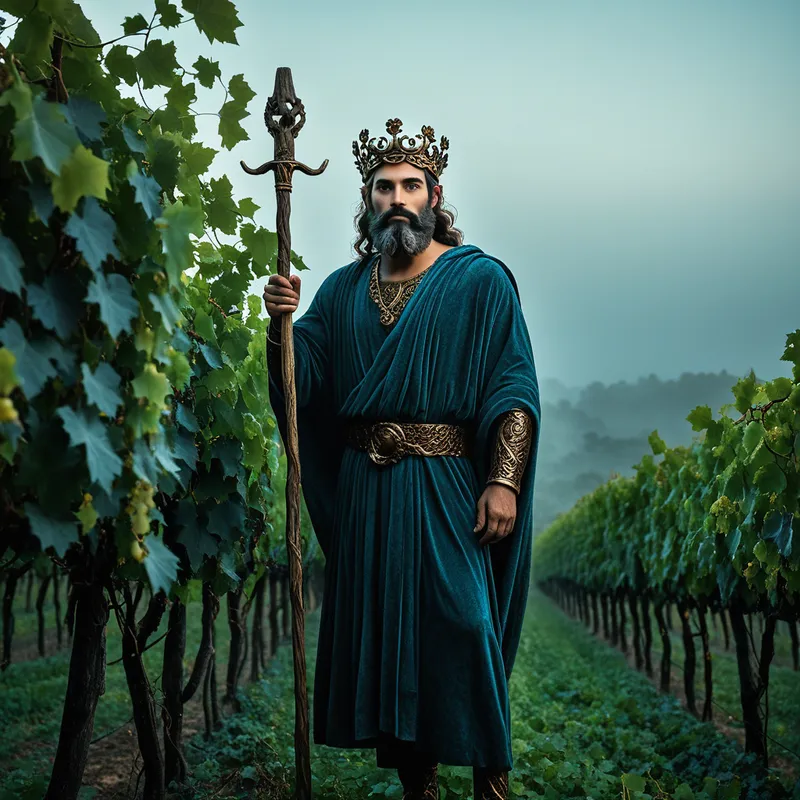
The myth of Dionysus Myth Meaning & Symbolism
The twice-born god of ecstasy, madness, and the vine, whose myth charts the sacred chaos of liberation and the terrifying joy of becoming whole.
The Tale of The myth of Dionysus
Hear now the tale of the god who arrives not with thunder, but with the rustle of leaves and the pounding of drums. The story of the one who is born, dies, and is born again.
In the fire of Zeus, a spark was kindled. The lord of the sky looked upon the mortal princess Semele, and love, that great leveler, took him. In the secret of her chamber, he swore by the dark waters of the Styx to grant her any wish. Poisoned by doubt, she asked to see him in his full, unshielded glory. A mortal cannot bear such sight. The divine fire consumed her, leaving only a smoldering child in her ashes.
But Zeus, the quick-witted, snatched the unborn babe and sewed him into his own thigh, a living womb of flesh and lightning. From this second birth emerged Dionysus, the twice-born, his first cries mingling with the scent of nectar and storm.
Cast out, wandering, he grew not in the halls of Olympus, but in the wild places. Nymphs and satyrs were his nurses; the rustling vine his tutor. He discovered the secret of the grape, the art of drawing forth joy and madness from the earth. And with this power, he began his long march home, a procession of chaos and song.
He walked the roads of the world, followed by a throng of ecstatic women, the Maenads, their hair wild, their hands clutching the thyrsus. Where he was met with scorn, as by the sailors who tried to bind him, madness broke loose. Ropes fell like snakes, the ship’s mast sprouted vines heavy with fruit, and the men, leaping into the sea in terror, were transformed into playful dolphins.
His greatest trial awaited in his mother’s city, Thebes. His own cousin, King Pentheus, refused him. The king, a man of rigid walls and stricter laws, saw only a corrupting vagabond leading the women of the city into the frenzied hills. He tried to imprison the god, but stone could not hold him. In a fatal deception, Dionysus, the master of illusion, persuaded Pentheus to spy on the Maenads’ rites. Disguised as a woman, the king crept to the mountain forest.
There, in the moonlight, the women moved as one body, possessed by the god’s spirit. They saw not their king, but a mountain lion, a beast to be torn apart. Led by Pentheus’s own mother, Agave, in her divine madness, they descended. There was no ceremony, only the raw, terrible act. Agave returned to the city in triumph, bearing the head of her son, believing it the prize of a glorious hunt, only for the god to lift the veil of madness and reveal the horror.
From this profound darkness, a resolution was born. Dionysus was not vindicated in vengeance, but in terrible, transformative recognition. His power was affirmed—not as a gentle god of wine, but as a fundamental force. He ascended to Olympus, taking his place among the twelve, the wildness of earth and the agony of mortality now woven irrevocably into the fabric of the divine. He is the god who comes, always, from the outside, and in his coming, nothing remains the same.

Cultural Origins & Context
The myth of Dionysus is not a singular story from one time or place, but a complex tapestry woven across the ancient Mediterranean. His worship likely entered Greece from Thrace or Phrygia, a foreign element that challenged and ultimately enriched the Hellenic pantheon. He was the “arriving god,” his cult spreading not through conquest but through ecstatic experience. The myths were preserved and performed in the very rituals he inspired—the secret Eleusinian Mysteries, the frenzied rural festivals of the Dionysia, and, most famously, the Great Dionysia in Athens, which gave birth to tragedy and comedy.
The societal function was profound and paradoxical. His worship provided a sanctioned, ritualized outlet for chaos—primarily for women, whose lives were otherwise tightly controlled. The Maenad allowed the oikos (the household) to be temporarily abandoned for the oros (the mountain), exchanging domestic order for ecstatic union with the wild. The myth, and its theatrical retellings in plays like Euripides’ The Bacchae, served as a cultural pressure valve and a dire warning: to deny the irrational, instinctual forces within the self and the community is to invite catastrophic, fragmenting madness.
Symbolic Architecture
Dionysus represents the archetypal force of undifferentiated life energy, the libido or life-force in its raw, pre-conscious state. He is not merely the god of wine, but of the intoxicating sap of existence itself—the ecstasy and terror that arises when the rigid structures of the ego are dissolved.
The vine teaches that life must be crushed to yield its spirit; the individual must be broken to touch the collective.
His “twice-born” nature symbolizes the necessary death of a prior, contained identity (the mortal son of Semele) to be reborn into a higher, more complex, and paradoxical wholeness (the divine son of Zeus). His thyrsus—a fennel stalk tipped with a pine cone—is a perfect symbol of this union: the hollow, fast-growing reed (the feminine, receptive) crowned with the seed of the evergreen (the masculine, eternal). He is the unity of opposites: male and female, young and old, foreign and native, cruel and bliss-bestowing.
The tragedy of Pentheus is the central psychological drama. Pentheus is the archetype of the hyper-rational, inflated ego, the “King” who believes his conscious order is the totality of reality. His spying on the Maenads represents the ego’s doomed attempt to observe and control the unconscious from a position of detached superiority. His dismemberment (sparagmos) is the symbolic, and often necessary, shattering of an outdated, tyrannical conscious attitude that refuses to acknowledge the deeper, wilder Self.
The Dreamer’s Resonance
When the pattern of the Dionysus myth stirs in modern dreams, it signals a profound somatic and psychological upheaval. It is the psyche’s declaration that a period of controlled, perhaps sterile, order is ending.
One may dream of wild, uncontrollable vegetation overgrowing a home or office; of finding oneself in a frenzied, rhythmic dance or ritual where social masks fall away; of being pursued or torn apart by a group, especially of feminine figures; or of drinking a potent, strangely glowing liquid that induces both terror and elation. These are not nightmares of mere anxiety, but visitations from the deep instinctual stratum. The body may feel restless, charged with unspent energy, or conversely, numb and disconnected—a somatic rebellion against an overly cerebral life.
The dreamer is undergoing a process of enantiodromia—the emergence of the unconscious opposite. The more one has identified solely with the Pentheus-like roles of ruler, critic, or ascetic, the more violently the Dionysian shadow will erupt, demanding recognition. This is the psyche’s attempt to reclaim its full vitality, its capacity for ecstatic connection and raw feeling, however chaotic that reclamation may initially appear.

Alchemical Translation
The alchemical journey modeled by Dionysus is the solutio—the dissolution. In the vessel of the self, the rigid prima materia of the fixed personality must be dissolved in the “water of life,” which is simultaneously the intoxicating wine and the blood of dismemberment.
The goal is not to become perpetually ecstatic, but to integrate ecstasy into the structure of consciousness, creating a self that can hold the tension of chaos and order.
The first birth (from Semele) is our given, mortal identity—our family, culture, and personal history. The “death by fire” is the inevitable crisis where this identity proves inadequate, incinerated by a glimpse of a larger reality (the divine). The sewing into the thigh of Zeus is the crucial, often lonely, period of gestation within a new, transpersonal container—the protective but isolating womb of deep introspection or a transformative ordeal.
The final rebirth is the emergence of the individuated self, one who carries the wild god within. This is not the Maenad’s total possession, but the capacity to consciously access that vital, creative, and irrational wellspring without being destroyed by it. One becomes like the god himself: able to induce madness in the rigid (Pentheus), but also to bestow the sacred gift of liberation and communal joy. The integrated individual holds the thyrsus—master of both the cultivating staff and the erupting vine, acknowledging that true wholeness includes the capacity for both divine joy and sacred, transformative terror.
Associated Symbols
Explore related symbols from the CaleaDream lexicon: