The Mustard Seed Myth Meaning & Symbolism
A grieving mother's quest for a cure leads her to a sage who reveals a universal truth, transforming her sorrow into wisdom.
The Tale of The Mustard Seed
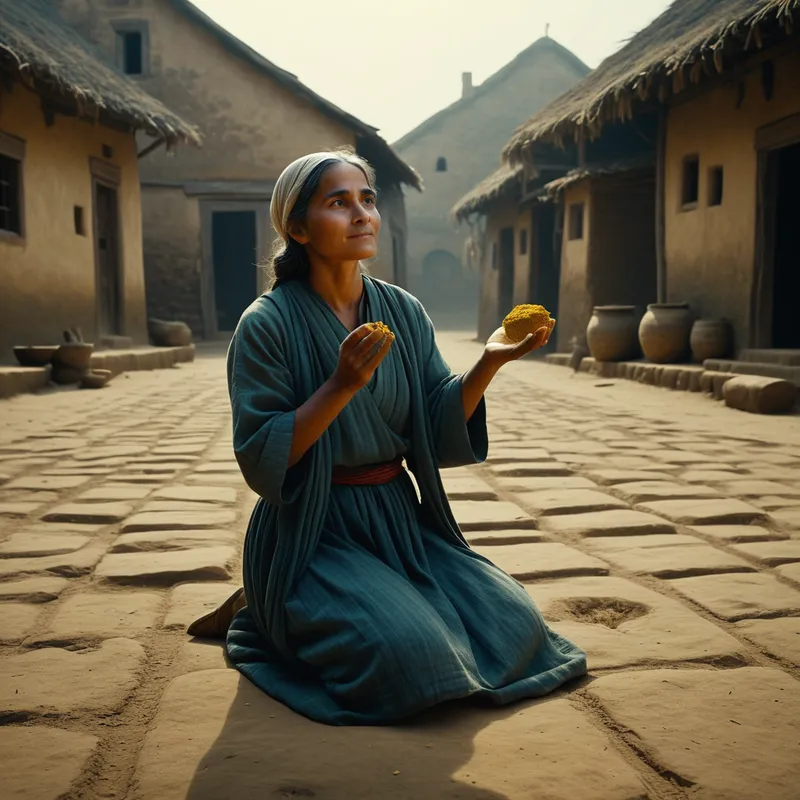
Listen. The story begins not with a king or a warrior, but with a sound. The sound of a mother’s silence, where a child’s laughter used to be. Her name was Kisa, and her world had shrunk to the four walls of a room that held only absence. The air was heavy with the scent of unused herbs and unmoving dust. Her grief was a stone in her chest, a weight that bent her spine and turned all food to ash.
She carried the small, cold form of her child, and a madness born of love took hold. She would not let [the earth](/myths/the-earth “Myth from Hindu culture.”/) claim him. There must be a cure, a medicine, a magic word spoken in a hidden place. She began to walk, her feet bare on the hot stones, her eyes seeing nothing but the road ahead. From hut to hut, village to village, she went. “Give me medicine for my child,” she pleaded, her voice a dry leaf rustling.
Some pitied her and gave a sprig of rosemary, a paste of turmeric. Others turned her away, muttering about fate. She applied every poultice, whispered every charm, but the little form remained still. Finally, a weary elder, his eyes deep with years, said, “You seek a power beyond herbs. Go to the Buddha. He dwells in the Jetavana Grove. If anyone holds the secret of life, it is he.”
Hope, a fragile and desperate bird, stirred in her. She journeyed to the grove, where the air was cool and the light fell in dappled patterns through the leaves. There, seated on a simple mat, was the sage. His presence was not like a storm, but like a deep, still pool. She fell before him, placing her child at his feet. “Great teacher,” she wept, the words tearing from her throat. “Bring him back. Give me the medicine for death.”
The sage looked at her, his gaze holding her agony without flinching. “There is a medicine,” he said, his voice quiet as the rustle of the trees. “But you must fetch its key ingredient. Go to every home in the city. From any family that has never known death, bring me a single [mustard seed](/myths/mustard-seed “Myth from Buddhist culture.”/).”
A wild, soaring relief filled Kisa. A mustard seed! The smallest of things! This was a task she could do. She left her child in the grove and ran back to the city, her heart pounding with a new rhythm. She knocked on the first grand door. “Has death ever visited this house?” she asked, breathless. The wealthy matron’s face softened, then crumpled. “Last spring,” she whispered, “my husband.” Kisa turned away, the first seed unclaimed.
She went to a bustling merchant’s home. “Has death ever visited this house?” The merchant pointed silently to a small shrine in the corner, where a toy horse sat gathering dust. Door after door, hovel after palace. An old woman spoke of a daughter lost in childbirth. A young man showed her his father’s walking staff. A child pointed to a empty space by the fire. As the sun began to set, painting [the sky](/myths/the-sky “Myth from Persian culture.”/) in hues of sorrow, Kisa stood in the empty market square. Her hand was empty. Not a single mustard seed weighed in her palm.
She walked slowly back to the Jetavana Grove, her body heavy not with fatigue, but with a new, terrible understanding. She stood again before the sage, her eyes now clear, washed clean by a river of shared grief. She did not need to speak. The sage nodded. “You have searched, and you have found. The mustard seed you sought does not exist in the house untouched by death. For death has visited all houses. Your sorrow is not a solitary curse, but the shared condition of all who love.” He gestured to the small form. “Now, build the funeral pyre.”
And Kisa did. This time, her hands were steady. As the flames rose, carrying their offering to the sky, she did not feel the stone of solitary despair, but the profound, aching connection to every other soul who had ever stood by such a fire. The medicine was not a seed, but the truth it revealed.
Cultural Origins & Context
This story, most famously preserved in the Buddhist [Jataka Tales](/myths/jataka-tales “Myth from Buddhist culture.”/) and the Pali Canon, is a quintessential piece of world Folk wisdom. Its roots are not in royal courts but in the soil of village squares and around communal hearths. It was told by traveling monks, village elders, and grandmothers—not to preach doctrine in the abstract, but to offer a container for the most visceral human experience: paralyzing grief.
Its societal function was profound and practical. In cultures without modern psychology, such narratives acted as communal psycho-technology. The story did not seek to eliminate grief, but to socialize it. By framing Kisa’s journey as one from isolated madness to communal recognition, the myth served to reintegrate the bereaved back into the fabric of the community. It whispered: Your pain is valid, but you are not alone in it. Look around. The evidence is in every face. It transformed a personal catastrophe into a universal rite of passage, allowing the individual to bear the unbearable by sharing its weight with all of humanity.
Symbolic Architecture
The myth’s power lies in its flawless symbolic [architecture](/symbols/architecture “Symbol: Architecture in dreams often signifies structure, stability, and the framing of personal identity or life’s journey.”/). Kisa is the [human](/symbols/human “Symbol: The symbol of a human represents individuality, complexity of emotions, and social relationships.”/) ego in a state of catastrophic [contraction](/symbols/contraction “Symbol: A symbolic process of compression, reduction, or inward movement, often representing preparation, transition, or the tension between opposing forces.”/). Her world has collapsed into a single, unbearable point: the [loss](/symbols/loss “Symbol: Loss often symbolizes change, grief, and transformation in dreams, representing the emotional or psychological detachment from something or someone significant.”/) of her [child](/symbols/child “Symbol: The child symbolizes innocence, vulnerability, and potential growth, often representing the dreamer’s inner child or unresolved issues from childhood.”/). Her [quest](/symbols/quest “Symbol: A quest symbolizes a journey or search for purpose, fulfillment, or knowledge, often representing life’s challenges and adventures.”/) for a “cure” represents [the ego](/myths/the-ego “Myth from Jungian culture.”/)’s desperate, magical thinking—the belief that a specific, external [solution](/symbols/solution “Symbol: A solution symbolizes resolution, clarity, and the overcoming of obstacles, often representing a sense of accomplishment.”/) can reverse an internal, existential [reality](/symbols/reality “Symbol: Reality signifies the state of existence and perception, often reflecting one’s understanding of truth and life experiences.”/).
The mustard seed is the perfect symbol of the infinitesimal containing the infinite. It represents the specific condition that, when sought, reveals the universal law.
The sage, or [Buddha](/symbols/buddha “Symbol: The image of Buddha embodies spiritual enlightenment, peace, and a quest for inner truth.”/) figure, is the archetypal Self—the deeper, wiser [aspect](/symbols/aspect “Symbol: A distinct feature, quality, or perspective of something, often representing a partial view of a larger whole.”/) of the [psyche](/myths/psyche “Myth from Greek culture.”/) that knows the true [nature](/symbols/nature “Symbol: Nature symbolizes growth, connectivity, and the primal forces of existence.”/) of reality. He does not offer comfort through falsehood. Instead, he prescribes the precise “[task](/symbols/task “Symbol: A task represents responsibilities, duties, or challenges one faces.”/)” (the search for the seed from a house untouched by [death](/symbols/death “Symbol: Symbolizes transformation, endings, and new beginnings; often associated with fear of the unknown.”/)) that will force the ego (Kisa) to confront reality on its own, through direct experience. This is the essence of wisdom: it cannot be given, only discovered.
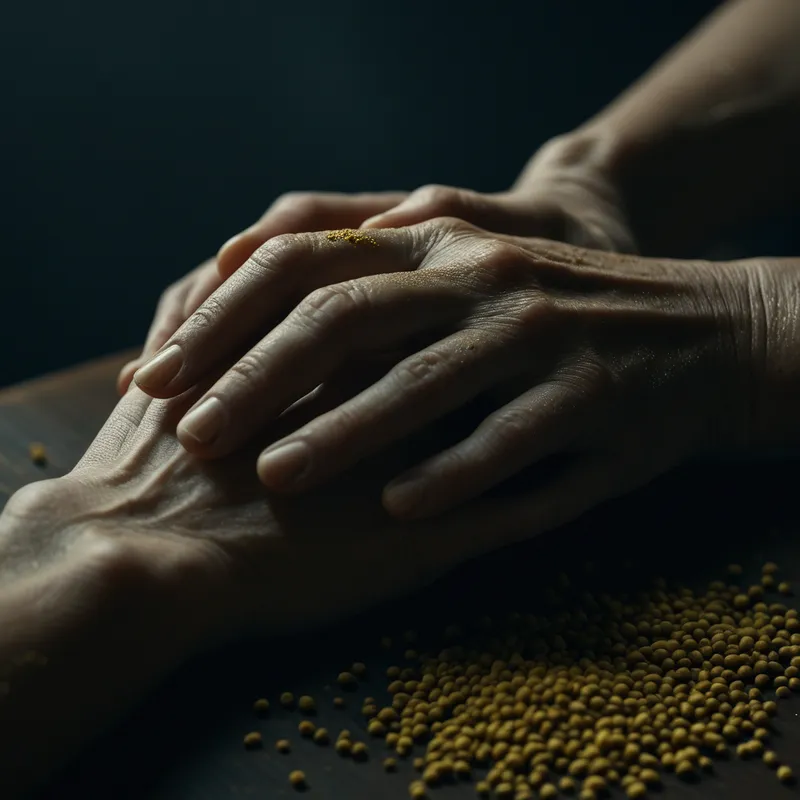
The empty hand at the end of the search is the pivotal [symbol](/symbols/symbol “Symbol: A symbol can represent an idea, concept, or belief, serving as a powerful tool for communication and understanding.”/). It is the [moment](/symbols/moment “Symbol: The symbol of a ‘moment’ embodies the significance of transient experiences that encapsulate emotional depth or pivotal transformations in life.”/) of Gestalt shift. The failure to acquire the literal seed is the success in acquiring the metaphorical [truth](/symbols/truth “Symbol: Truth represents authenticity, honesty, and the quest for knowledge beyond mere appearances.”/). The hand is empty of a seed but full of a [revelation](/symbols/revelation “Symbol: A sudden, profound disclosure of truth or insight, often through artistic or musical means, that transforms understanding.”/). The personal, isolating [story](/symbols/story “Symbol: The symbol of ‘Story’ represents the narrative woven through our lives, embodying experiences, lessons, and emotions that shape our identities.”/) (“I am uniquely cursed”) shatters, and the collective, connecting story (“This is the price of love for all”) is born.

The Dreamer’s Resonance
When this myth stirs in the modern unconscious, it rarely appears as a literal retelling. Instead, we dream of its patterns. You may dream of searching frantically for a lost, tiny object—a key, a pill, a specific document—in a vast, labyrinthine bureaucracy or a decaying house. The somatic feeling is one of urgent, futile anxiety. This is the psyche rehearsing Kisa’s quest. The “cure” you seek in the dream (the lost object) symbolizes a simplistic solution you are hoping for in waking life—a job to fix your worth, a partner to fix your loneliness, an apology to fix your past.
Alternatively, you may dream of being in a crowd where, one by one, every person turns to you and shows you a hidden wound or shares a secret sorrow. The mood is not of horror, but of profound, melancholic connection. This is the moment of the empty hand, the dream-ego moving from isolation to shared humanity. The psyche is working to socialize a grief or a shame you have been carrying in secret, telling you that your condition is part of the human condition.

Alchemical Translation
The alchemy of this myth models the psychic process of sublimation—the transmutation of a raw, personal, potentially destructive emotion (like paralyzing grief) into a universal, life-connected understanding.
The [prima materia](/myths/prima-materia “Myth from Alchemical culture.”/), the leaden starting point, is Kisa’s contracted, identificatory grief: “I am my loss.” This is psychic imprisonment. The sage’s instruction is the opus, the work. The laborious, door-to-door search is the necessary circumambulatio—the circling of the problem until its true nature is revealed. The ego must exhaust itself in its own limited perspective.
The triumph is not in changing the fact of death, but in changing one’s relationship to it. The gold produced is not an end to sorrow, but the end of solitary sorrow.
The final pyre is the symbol of sacred release. It is no longer an act of despair, but a ritual of acceptance. The energy that was bound up in fighting reality (“This cannot be!”) is freed and now available to connect with life. The individual is no longer an island of suffering but a conscious participant in the shared human journey. This is the heart of individuation: moving from a state of ego-identification with a single complex to an alignment with the Self, which comprehends and integrates the totality of life’s experiences, joy and sorrow alike. The mustard seed, therefore, is the catalyst for the ultimate alchemy: turning the lead of personal agony into the gold of compassionate wisdom.
Associated Symbols
Explore related symbols from the CaleaDream lexicon: