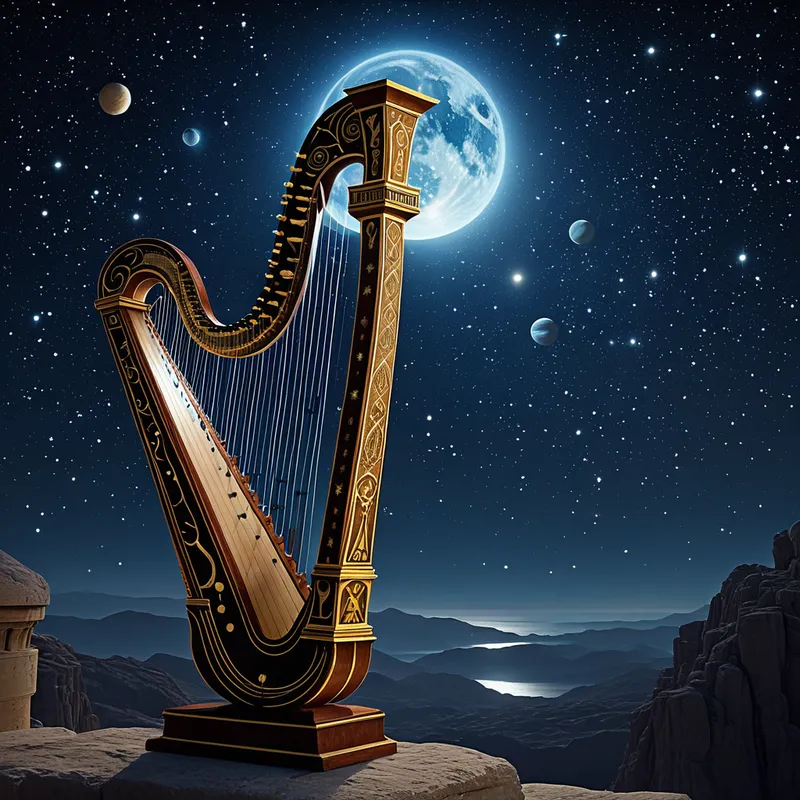
The Music of the Spheres Myth Meaning & Symbolism
The Pythagorean doctrine that the cosmos is ordered by divine, inaudible harmonies, a celestial symphony reflecting perfect mathematical and spiritual proportion.
The Tale of The Music of the Spheres
Before history was written, in the time when gods walked just beyond the veil of mist, there existed a silence so profound it was a presence. It was the silence of the void, of Chaos itself. Then came the first movement. Not a sound for mortal ears, but a vibration in the soul of the cosmos. It was the breath of the Demiurge, drawing order from the formless deep.
With a thought that was a chord, he spun the first sphere: the sphere of the fixed stars, a crystalline shell encrusted with diamond fire. It hummed a single, perfect note, the foundation of all that would be. Dissatisfied with monotony, the Demiurge’s will stirred again. He placed within that outer sphere another, and another—seven in total, each nested within the last like the layers of a divine onion. These were the wandering spheres, the paths of the planētai.
Each sphere was a living entity, a divine intelligence. The sphere of Selene moved with a slow, silvery glissando. The sphere of Hermes trilled a rapid, mercurial melody. Aphrodite’s sphere resonated with a warm, intoxicating harmony, while Helios blazed with a brilliant, central tone that was less a sound and more a feeling of radiant certainty. Ares rang with a fierce, martial rhythm, Zeus with a deep, authoritative bass, and Kronos with a slow, profound drone that measured eternity.
The conflict was not one of battle, but of potential discord. Left to themselves, these mighty voices could have clashed in a cacophony that would tear the fabric of reality. But the Demiurge was the supreme composer. He bound them with the immutable laws of geometry and number. The distances between the spheres were not random; they corresponded to the perfect intervals of the musical scale—the octave, the fifth, the fourth. Their speeds were in harmonious proportion. Thus, the individual songs of the planets wove together into a single, overwhelming symphony: the Harmonia of the Spheres.
This music was the very essence of cosmic order, the Logos made audible to the soul. It poured forth ceaselessly, a river of sublime sound that bathed all of creation. Yet, a veil was drawn. The Demiurge, in a final act of mysterious grace or necessary separation, made this music inaudible to the crude physical ears of humanity. We are born into its resonance, swim in its currents, but from the moment we draw first breath, we forget the song. We hear only its faintest echo in the perfect consonance of a plucked lyre string, in the rhythm of our own pulse, and in the silent, aching beauty of a star-strewn night. The symphony plays on, an eternal, forgotten lullaby at the heart of all things.
Cultural Origins & Context
This myth, more a philosophical revelation than a traditional narrative of gods and heroes, springs not from the epic poets but from the school of Pythagoras in the 6th century BCE. In the Greek colony of Croton in southern Italy, Pythagoras and his followers cultivated a secretive, ascetic community dedicated to the pursuit of wisdom (Sophia). For them, number (arithmos) was not merely a tool for counting but the sacred, underlying reality of the cosmos—the language in which the gods had written the world.
The “Music of the Spheres” was the auditory expression of this mathematical divinity. It was passed down through oral teaching within the Pythagorean brotherhood, a mystical doctrine for initiates. Its societal function was profound: it provided a model of a perfectly ordered universe (Kosmos, meaning both “world” and “adornment/order”), a direct challenge to the chaotic, capricious universe of older myths. This harmony was the ultimate justification for their strict ethical and dietary codes; to live in accordance with this cosmic music was to achieve personal harmony and purify the soul for its eventual ascent back to the stars. The myth was later preserved and elaborated by philosophers like Plato (in the myth of Er in The Republic) and, centuries later, by astronomers and mystics of the Renaissance.
Symbolic Architecture
At its core, the myth symbolizes the human intuition of a hidden, intelligible order behind the apparent chaos of sensory experience. The deafening silence of mortal existence is not an absence of meaning, but a failure of perception. The spheres represent the archetypal layers of reality, from the dense, slow realm of matter (associated with Saturn/Kronos) to the swift, intellectual realm (Mercury/Hermes), all the way to the fixed, eternal realm of ideal forms (the fixed stars).
The most profound truths are not shouted; they are hummed by the universe itself, felt in the bones long before they are understood by the mind.
The inaudibility of the music is the central, poignant symbol. It represents the Fall—not from a garden, but from a state of cosmic awareness. We are exiled from the symphony by our embodiment, by our attachment to the noisy, discordant world of becoming. Yet, the harmony remains, a psychic substrate of order. The lyre, which when tuned properly can replicate the celestial intervals, becomes a symbolic tool for anamnesis—the soul’s recollection of its divine origin. To hear the music, even inwardly, is to remember who and what we truly are: fragments of the cosmic order, yearning to resonate in tune.
The Dreamer’s Resonance
When this myth stirs in the modern unconscious, it rarely appears as literal planets and lyres. Instead, it manifests as dreams of profound, wordless harmony. A dreamer might find themselves in a vast, architectural space—a cathedral, a library, or a geometric crystal—where the very walls emit a calming, resonant frequency that dissolves anxiety. They may dream of hearing a beautiful, overwhelming piece of music that exists nowhere on earth, a song that brings tears of inexplicable recognition and homesickness upon waking.
Somatically, this points to a process of psychic re-tuning. The dreamer is likely navigating a period of internal disorder—stress, conflicting life demands, a loss of purpose. The dream is the Self’s attempt to re-impose order, not through forceful control, but by aligning the disparate parts of the psyche (the personal “spheres” of thought, emotion, instinct) into a harmonious whole. The feeling is often one of deep, somatic relief, as if a tension held in the body for years has suddenly been released by an invisible, benevolent force. It signals a move from fragmentation toward integration, guided by an innate, archetypal blueprint for wholeness.

Alchemical Translation
The alchemical process mirrored here is that of coagulatio—the bringing together of disparate elements into a sacred, unified body. The individual’s journey of individuation is the laborious task of learning to hear their own inner “Music of the Spheres.”
Initially, the psyche is in a state of prime materia: chaotic, noisy, with competing inner voices (complexes) clashing like untuned instruments. The first step is observatio—the Pythagorean practice of silent listening, meditation, and introspection. This is the tuning of the inner ear. Next comes disciplina—the careful study of one’s own patterns, the mathematical laws of one’s emotions and reactions, akin to understanding the intervals. This is the hard work of self-knowledge.
Individuation is not the invention of a new self, but the patient removal of static until the soul’s native frequency can finally be heard.
The “triumph” is not a heroic conquest, but a sublime attunement. It is the moment when the ego, having identified with one screeching note (a single ambition, trauma, or role), finally relaxes its grip and allows itself to become an instrument for a larger melody. The personal will aligns with the transpersonal pattern. Conflict transforms into creative tension. What was experienced as neurotic suffering is revealed as a single note out of place in a grand composition. To achieve this is to perform the ultimate alchemy: transmuting the leaden noise of a suffering life into the golden silence that contains the celestial song. One becomes, in a small but essential way, a local embodiment of the Demiurge’s harmony, a quiet center from which order and meaning can once again flow into the world.
Associated Symbols
Explore related symbols from the CaleaDream lexicon: