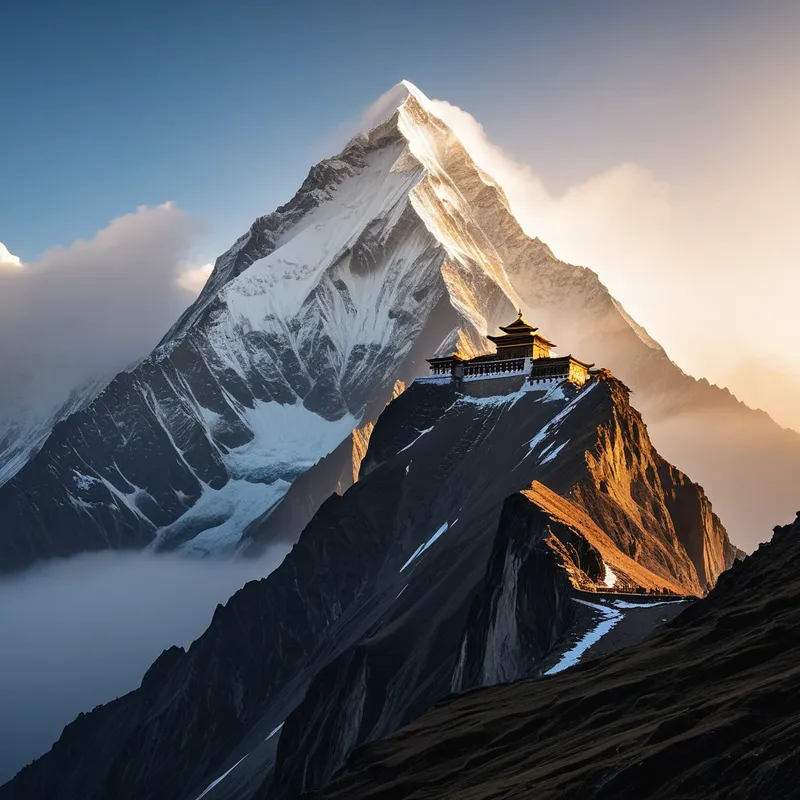
The Mountain Hermitage Myth Meaning & Symbolism
A master retreats to a sacred mountain, confronts demonic forces with unwavering compassion, and transforms the wilderness into a sanctuary of wisdom.
The Tale of The Mountain Hermitage
Listen. Beyond the clamor of the world, where the air grows thin and the earth reaches for the sky, there is a silence so profound it has a voice. It is in this realm of stone and sky that our tale unfolds.
There was once a master, a bodhisattva of profound realization, whose very presence in the monastery had become a gentle storm. Students flocked, debates flourished, and the incense of devotion clouded the clear mirror of his mind. He heard the call not of people, but of the mountain—a distant, snow-crowned sentinel known as Riwo Sangpo, the Glorious Mountain. Its call was a pull in his bones, a whisper in the marrow: Come and be unmade.
With a begging bowl and a worn-out robe, he turned his back on the warmth of human hearths. His journey was a shedding: first paths, then trees, then breath itself, as he climbed into the domain of rock and relentless wind. He found not a shelter, but a scar in the mountain’s face—a shallow cave open to the teeth of the elements. This was his hermitage. His bed was stone, his blanket the cold, his companions the howling void.
But the wilderness is not empty. It is the mirror of the mind. As the master sat in the deepening stillness of samadhi, the mountain stirred. From the crevices of forgotten fears and the blizzards of latent arrogance, the dregs pa arose. They came as tempests that sought to freeze his heart, as avalanches of doubt meant to crush his resolve. Phantom voices echoed the pleas of his abandoned students. Most fearsome of all came the sinpo, embodiments of raw, formless terror. They filled the cave with monstrous shapes, with the stench of decay and the cacophony of a thousand hells.
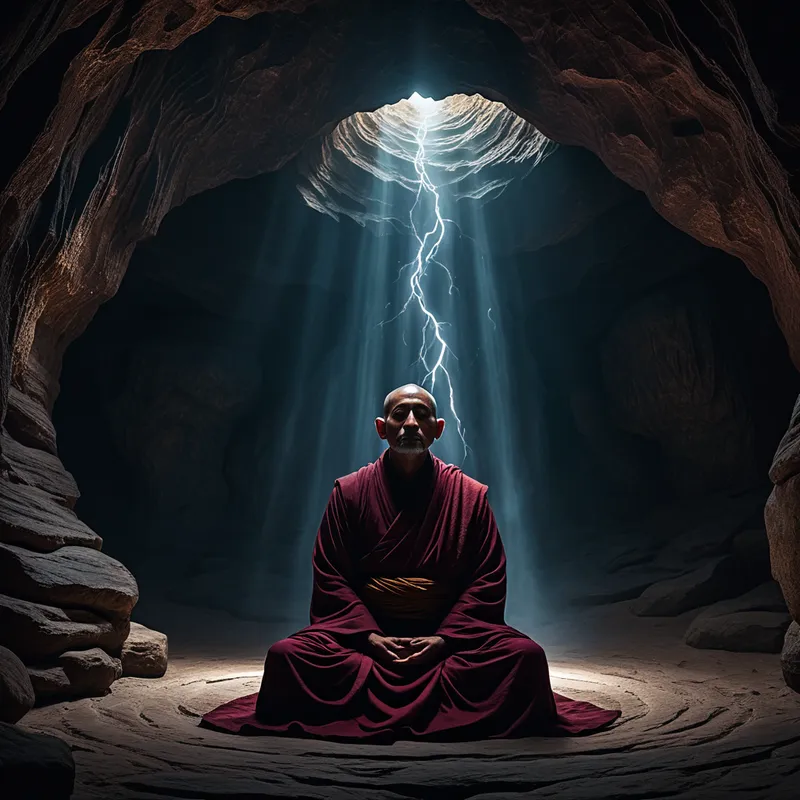
The master did not flee. He did not summon weapons of light to smite them. He simply sat, turning his awareness inward, to the very source of the spectacle. He recognized the demons not as external invaders, but as the final, desperate projections of his own clinging self—the last ghosts of “I” and “mine.” To the roaring sinpo, he offered the silent mantra of compassion. To the seductive phantoms, he offered the unshakable ground of emptiness. He met each horrific form with the same unwavering gaze, seeing not a monster, but a lost aspect of his own being crying out for recognition.
And in that seeing, a great alchemy occurred. The blizzard’s fury softened into a blanket of pristine snow, insulating his cave. The demonic roars melted into the deep, resonant hum of the mountain’s own song. The sinpo, disarmed by compassion, dissolved into wisps of mist that caught the morning sun, becoming rainbows that arched over his hermitage. The cave was no longer a scar, but a womb. The mountain was no longer a trial, but a protector. The master had not conquered the wilderness; he had married it. The hermitage had become a dharmakaya palace, and his solitude, the most intimate communion with all that is.
Cultural Origins & Context
This archetypal narrative is woven into the very fabric of Tibetan Buddhist history and hagiography. It is not a single myth but a recurring template found in the namthars (liberation stories) of countless mahāsiddhas and yogis, from Milarepa to Padmasambhava. Passed down orally by disciples and later codified by scholars, these tales served multiple vital functions.
In a culture where the physical landscape is imbued with sacred geography, the myth validated the extreme asceticism of mountain retreat as the ultimate crucible for enlightenment. It provided a map for the spiritual journey, warning of the inner perils (the “demons”) that arise in solitude, while affirming that these are the path itself. Societally, these stories created a revered cultural role: the hermit-yogi, whose radical withdrawal was not an abandonment of the world, but a profound service to it. Their realized presence was believed to bless and stabilize the entire region, turning wild mountains into sacred sanctuaries (ne ri). The myth thus bridged the communal monastic life and the ultimate imperative of solitary awakening.
Symbolic Architecture
The Mountain Hermitage is not a location, but a state of consciousness. Each element is a precise symbol for the psyche’s journey toward integration.
The Mountain represents the irreducible core of being, the Self in its majestic, daunting totality. The arduous ascent is the stripping away of persona, social identity, and comfort—the necessary dissolution before integration. The Cave is the interiority of the heart-mind, the temenos or sacred enclosure where the work of transformation occurs.
The demonic horde is the shadow, not as a minor flaw, but as the accumulated, personified force of all that has been denied, repressed, and unlived within the psyche.
These are not enemies to be destroyed, but energies to be metabolized. The master’s non-combative recognition is the key. It symbolizes the act of conscious suffering—holding the tension of opposites without fleeing into distraction or identification. This is the essence of shunyata (emptiness) applied as a psychological process: seeing the insubstantial, dream-like nature of one’s own afflictions. The final transmutation—demons into rainbows, storm into solace—is the symbol of psychic alchemy complete. The shadow, integrated, becomes a source of vitality and protection. The isolated ego, dissolved, finds itself at home in the cosmos.
The Dreamer’s Resonance
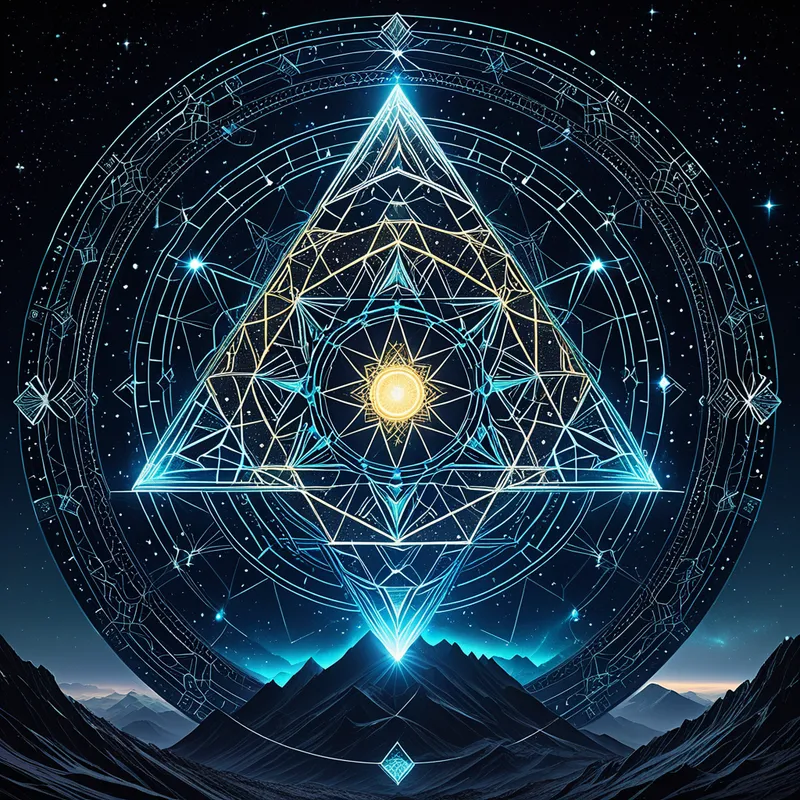
When this myth stirs in the modern dreamer, it often signals a profound, if daunting, call to interiority. To dream of seeking or being in a mountain hermitage reflects a soul’s yearning to retreat from the incessant noise of external demands, digital chatter, and performed identities. It is a somatic signal of overwhelm, a deep need for simplification and essence.
Dreams of being besieged in such a place—by shadowy figures, violent weather, or eerie silences—mirror the “dark night of the soul” that accompanies any serious inward turn. The demons are the waking world’s anxieties, unresolved traumas, and core fears, now amplified in the echo chamber of solitude. The dream body may feel cold, paralyzed, or exposed. This is not a nightmare of failure, but a depiction of the critical stage of confrontation. The psyche is daring the dreamer to do what the mythic master does: to stop running, to turn and face the tumult with steady awareness. The resolution in the dream, if it comes, is often a sudden, quiet shift—a sense of deep warmth, an enveloping light, or a simple, profound calm—signaling the beginning of integration.
Alchemical Translation
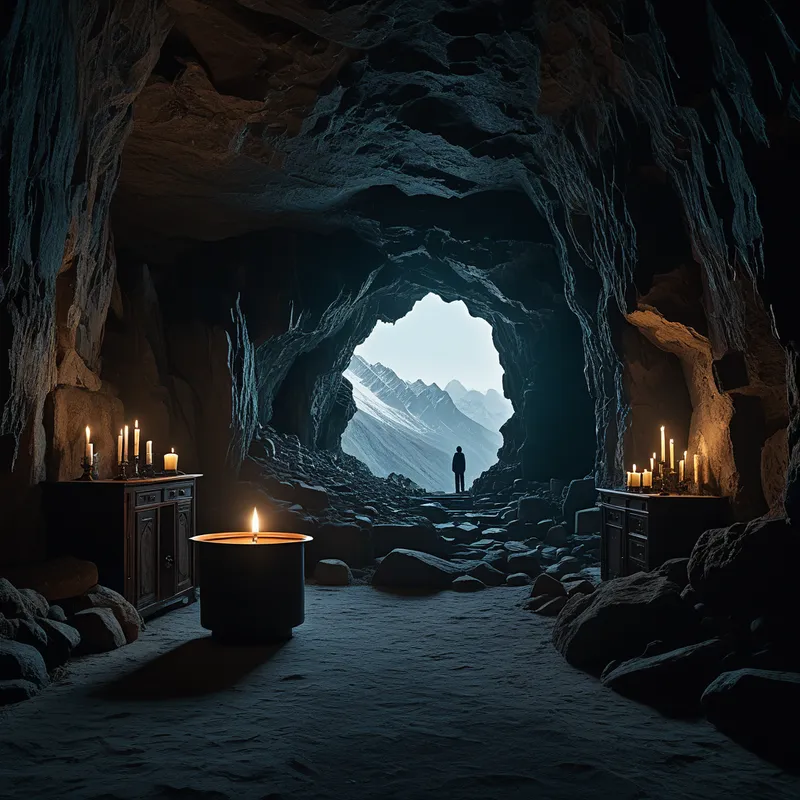
For the individual navigating the path of individuation, the myth of the Hermitage provides a master blueprint for psychic transmutation. The first step is the conscious withdrawal of psychic energy from the outer world of collective values and expectations. This is the “ascent”—creating inner space through meditation, journaling, or therapy.
The ensuing confrontation with the “demons”—depression, rage, profound insecurity—is the alchemical nigredo, the blackening. It feels like disintegration.
The myth teaches that the fire that seems to consume you is the very fire of transformation. The demon at the door is the guardian of the treasure.
The master’s strategy is the alchemical secret: solve et coagula. First, dissolve the solidity of the demon by seeing it as a process within your own mind, not an absolute truth. Apply the solvent of mindful observation. Then, coagulate; integrate its energy. The fury of a repressed anger demon, when held with compassion, can coalesce into the fierce energy needed to set boundaries. The icy fear demon can become the cool, clear discernment of wisdom.
The final stage, where the hermitage becomes a palace and the mountain a protector, symbolizes the birth of the inner guru. You are no longer a fragile ego in a hostile universe, but a center of consciousness that finds the universe inherently supportive. The solitude sought becomes the discovery of a boundless, inner-connectedness. The hermit’s triumph is the realization that one has never been, and could never be, truly alone.
Associated Symbols
Explore related symbols from the CaleaDream lexicon: