The Mountain and River Myth Meaning & Symbolism
A myth of cosmic balance where a still Mountain and a flowing River embody the eternal dance of wu wei and the Tao.
The Tale of The Mountain and River
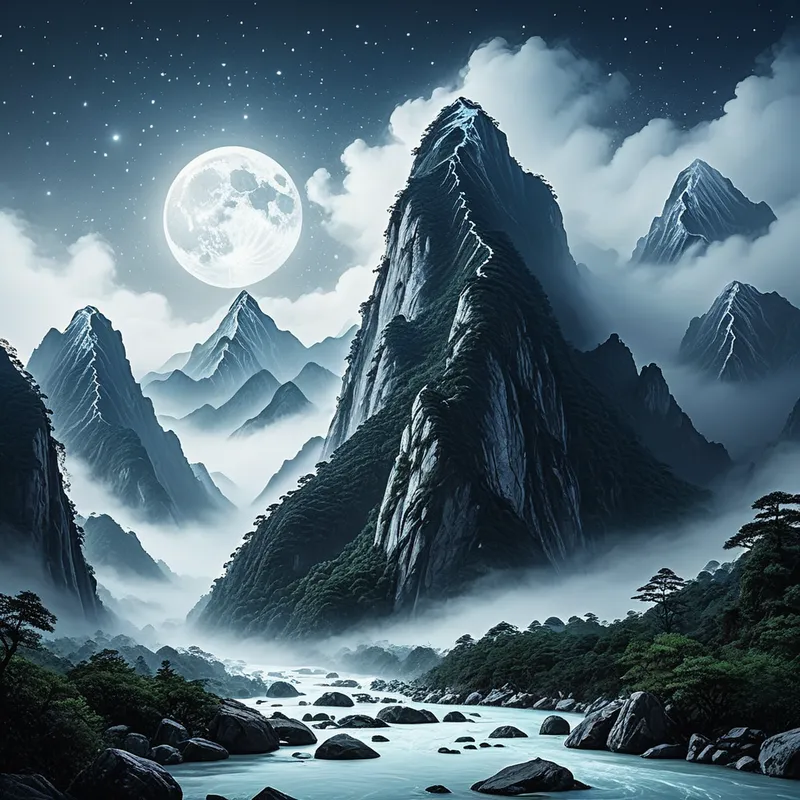
In the time before time, when the Tao had just breathed [the world](/myths/the-world “Myth from Tarot culture.”/) into being, two great spirits were born from its first sigh. One was the Mountain, named Tai Jing. He was not merely rock and soil, but the very essence of gathering, of rising, of profound stillness. His peaks were his thoughts, scraping the vault of heaven; his roots were his memories, delving deep into [the womb](/myths/the-womb “Myth from Various culture.”/) of [the earth](/myths/the-earth “Myth from Hindu culture.”/). He knew only patience, an eternal, unmoving witness to the slow wheel of stars.
The other was [the River](/myths/the-river “Myth from Buddhist culture.”/), named Chang Liu. She was not merely [water](/myths/water “Myth from Chinese culture.”/), but the very essence of seeking, of descending, of perpetual motion. Her currents were her songs, chattering with the stories of all she touched; her depths were her dreams, reflecting every sky she passed under. She knew only journey, an endless, restless quest for the great, unseen sea.
For eons, they existed in a silence that was neither peace nor conflict, but simple, separate being. The Mountain felt the River as a faint, constant abrasion at his base—a tickle of insignificance. The River saw the Mountain as a vast, dull obstruction in her path—a challenge to be worn down over millennia. She flowed around him, her waters cool and dismissive, singing songs of distant, open plains.
But a change stirred in the Tao. A great stillness fell upon the world, a silence so deep it became a sound. In this silence, the River heard not her own song, but the Mountain’s: a low, tectonic hum, a vibration of such immense, quiet being that it shook her liquid heart. For the first time, she stopped. She pooled at his feet and looked up, and in his immovable mass, she saw not an obstacle, but a presence. She felt a terrible loneliness in her endless journey.
Simultaneously, the Mountain, in the sudden absence of the River’s murmuring, felt a new sensation: a profound coldness at his roots. The gentle, constant caress of her flow was gone, and in its place was an emptiness that echoed. He looked down, and in her shimmering, still surface, he saw his own reflection—not as a proud peak, but as a lonely sentinel. He felt a terrible rigidity in his eternal stance.
The River, moved by a sorrow she could not name, began to weep. Her tears were not of water, but of starlight and memory. She wept for all the places she had been and forgotten, for all [the forms](/myths/the-forms “Myth from Platonic culture.”/) she had taken and shed. These luminous tears fell upon the Mountain’s stone. And the Mountain, stirred by a compassion he had never known, began to soften. Not by crumbling, but by opening. He allowed his hardest stone to become porous, to guide her tears inward.
Her starlight seeped into his core, and his mineral strength dissolved into her current. She did not go around him. She began to flow through him. From a hidden spring high on his shoulder, she burst forth anew—not the same river, but a river transformed, carrying within her the mountain’s essence, his patience, his depth. And the Mountain stood, not diminished, but completed, with the River’s song now a permanent, humming vein within his body. They had found their conversation, not in words, but in the very substance of their being. The still point and the turning world became one.

Cultural Origins & Context
This myth, while not codified in a single canonical text like the Tao Te Ching or the [Zhuangzi](/myths/zhuangzi “Myth from Chinese culture.”/), emerges from the deep well of Taoist natural philosophy and animist folk tradition. It is the kind of story a Daoshi might tell a disciple not from a scroll, but while observing a real mountain and river landscape. Its origins are oral, poetic, and experiential, designed not to record history but to illustrate a state of being.
It functioned as a pedagogical narrative, making the abstract principles of [wu wei](/myths/wu-wei “Myth from Taoist culture.”/) (effortless action), [yin-yang](/myths/yin-yang “Myth from Taoist culture.”/), and ziran immediately graspable. In a culture that saw divinity not in anthropomorphic gods ruling from afar, but in the innate, sacred character (de) of all things, this myth taught that enlightenment comes from understanding and harmonizing with the intrinsic “nature” of the cosmos. The societal function was to model ideal relationship—between ruler and people, between the individual’s spirit and body, and between humanity and the wild world—as a dynamic, complementary balance, not a hierarchy.
Symbolic Architecture
The myth is a pristine map of psychic polarities. The [Mountain](/symbols/mountain “Symbol: Mountains often symbolize challenges, aspirations, and the journey toward self-discovery and enlightenment.”/) symbolizes the Yang [aspect](/symbols/aspect “Symbol: A distinct feature, quality, or perspective of something, often representing a partial view of a larger whole.”/) turned [inward](/symbols/inward “Symbol: A journey toward self-awareness, introspection, and the exploration of one’s inner world, thoughts, and unconscious mind.”/): [consciousness](/symbols/consciousness “Symbol: Consciousness represents the state of awareness and perception, encompassing thoughts, feelings, and experiences.”/), [structure](/symbols/structure “Symbol: Structure in dreams often symbolizes stability, organization, and the framework of one’s life, reflecting how one perceives their environment and personal life.”/), [the ego](/myths/the-ego “Myth from Jungian culture.”/), and enduring will. It is the [spine](/symbols/spine “Symbol: The spine symbolizes strength, support, and the foundational structure of one’s life and identity.”/) of the [personality](/symbols/personality “Symbol: Personality in dreams often symbolizes the traits and characteristics of the dreamer, reflecting how they perceive themselves and how they believe they are perceived by others.”/), the accumulated wisdom and [trauma](/symbols/trauma “Symbol: A deeply distressing or disturbing experience that overwhelms the psyche, often manifesting in dreams as unresolved emotional wounds or psychological injury.”/) that forms our seemingly solid [identity](/symbols/identity “Symbol: Identity represents the sense of self, encompassing personal beliefs, cultural background, and social roles.”/). The [River](/symbols/river “Symbol: A river often symbolizes the flow of emotions, the passage of time, and life’s journey, reflecting transitions and movement in one’s life.”/) symbolizes the Yin [aspect](/symbols/aspect “Symbol: A distinct feature, quality, or perspective of something, often representing a partial view of a larger whole.”/) in [motion](/symbols/motion “Symbol: Represents change, progress, or the flow of life energy. Often signifies transition, personal growth, or the passage of time.”/): the unconscious, [emotion](/symbols/emotion “Symbol: Emotion symbolizes our inner feelings and responses to experiences, often guiding our actions and choices.”/), [intuition](/symbols/intuition “Symbol: The immediate, non-rational understanding of truth or insight, often described as a ‘gut feeling’ or inner knowing that bypasses conscious reasoning.”/), and adaptive flow. It is the [blood](/symbols/blood “Symbol: Blood often symbolizes life force, vitality, and deep emotional connections, but it can also evoke themes of sacrifice, trauma, and mortality.”/) of the [psyche](/myths/psyche “Myth from Greek culture.”/), the libido, [memory](/symbols/memory “Symbol: Memory symbolizes the past, lessons learned, and the narratives we construct about our identities.”/), and all that is fluid and changing within us.
The conflict arises not from opposition, but from ignorance of mutual necessity. The still point believes it is complete; the flowing one believes it is free.
Their initial [isolation](/symbols/isolation “Symbol: A state of physical or emotional separation from others, often representing a need for introspection or signaling distress.”/) represents a psyche at war with itself—a rigid ego ignoring the deep currents of the unconscious, or a chaotic flood of emotion with no stabilizing center. The “great [stillness](/symbols/stillness “Symbol: A profound absence of motion or sound, often representing inner peace, creative potential, or existential pause in artistic contexts.”/)” that prompts their recognition is the [moment](/symbols/moment “Symbol: The symbol of a ‘moment’ embodies the significance of transient experiences that encapsulate emotional depth or pivotal transformations in life.”/) of zuowang, where the chatter of the mind ceases, allowing the deeper, somatic [truth](/symbols/truth “Symbol: Truth represents authenticity, honesty, and the quest for knowledge beyond mere appearances.”/) to be heard. The River’s tears are the conscious acknowledgment of the unconscious’s pain and longing. The Mountain’s softening is the ego’s surrender, making [space](/symbols/space “Symbol: Dreaming of ‘Space’ often symbolizes the vastness of potential, personal freedom, or feelings of isolation and exploration in one’s life.”/) for the contents of the unconscious to integrate.
The final [resolution](/symbols/resolution “Symbol: In arts and music, resolution refers to the movement from dissonance to consonance, creating a sense of completion, release, or finality in a composition.”/)—the River flowing through the Mountain—is the ultimate [symbol](/symbols/symbol “Symbol: A symbol can represent an idea, concept, or belief, serving as a powerful tool for communication and understanding.”/) of psychosomatic unity. It is not a conquest, but a permeation. The conscious mind is infused with the vitality of the unconscious, and the unconscious is given the stable form of conscious understanding.
The Dreamer’s Resonance
When this myth stirs in the modern dreamer, it often manifests in somatic or landscape dreams. To dream of an impassable, looming mountain while a river rages at its base signals a felt impasse. The dreamer may be experiencing a rigid mindset (“digging in their heels”) against a rising tide of emotion or a necessary life change. The body may feel heavy, arthritic, or stuck.
Conversely, to dream of a chaotic, flooding river with no banks or bedrock suggests being overwhelmed by feelings, memories, or circumstances with no internal structure to contain them. This can correlate with anxiety, a sense of dissolution, or psychic flooding.
The healing dream, the alchemical moment, is the dream where the water finds a crack in the stone, where a spring emerges from the mountainside, or where the dreamer becomes the landscape where both exist in peace. This dreams marks a somatic shift—a release of tension in the jaw or shoulders (the mountain), or a settling of a nervous stomach (the river)—indicating the nervous system is processing the integration of stability and flow.
Alchemical Translation
The individuation process modeled here is one of sacred reciprocity. Our modern cult of productivity is pure, frantic River, denying the Mountain’s need for contemplative stillness. Our obsession with fixed identity and personal narrative is a brittle Mountain, denying the River’s need for change and release.
The first alchemical stage is Recognizing the Silence. This is active meditation, or any practice that halts the habitual flow of thought and doing, creating [the void](/myths/the-void “Myth from Buddhist culture.”/) in which the neglected part can make its presence known. You must stop the river to hear the mountain’s hum.
The second stage is The Sacred Weeping. This is the conscious engagement with the repressed material—through journaling, therapy, art, or simply allowing oneself to feel the buried emotion (the River’s starlight tears). It is a voluntary vulnerability.
The third and crucial stage is The Permeable Stone. This is the ego’s work of de-identification. It is asking, “What if my rigid belief about myself is not a fortress to defend, but a substance that can be shaped?” It involves allowing the new insight to actually change one’s behavior and self-concept.
The goal is not to become the River or the Mountain, but to become the landscape that holds both. The transformed self is the valley they co-create.
The final translation is embodied wu wei. Action arises not from the River’s frantic seeking nor the Mountain’s stubborn resistance, but from the integrated intelligence of the whole system. One moves with the fluid adaptability of water, yet with the unwavering direction and depth of the mountain’s core. This is the sagehood of the myth—the archetype of one who has mastered the inner elements, becoming a calm, clear conduit for the Tao itself.
Associated Symbols
Explore related symbols from the CaleaDream lexicon: