The Mount of Olives Myth Meaning & Symbolism
A sacred ridge witnessing divine agony, prophetic hope, and final judgment, embodying the ultimate threshold between despair and redemption.
The Tale of The Mount of Olives
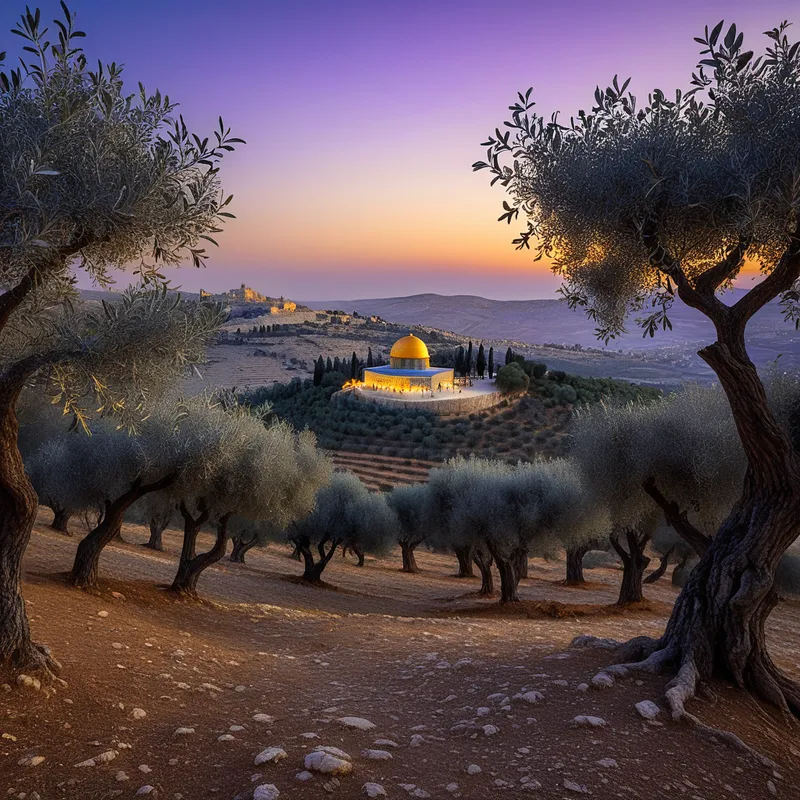
Listen, and let the dust of the ages settle upon your tongue. East of the city of [Jerusalem](/myths/jerusalem “Myth from Biblical culture.”/), there lies a ridge, a sleeping beast of stone and earth. Its skin is a forest of ancient, twisted olive trees, their leaves whispering silver secrets to [the wind](/myths/the-wind “Myth from Various culture.”/) that blows from [the desert](/myths/the-desert “Myth from Biblical culture.”/). This is the Mount of Olives. It is not merely a place, but a silent witness, a stage for the most profound drama of the spirit.
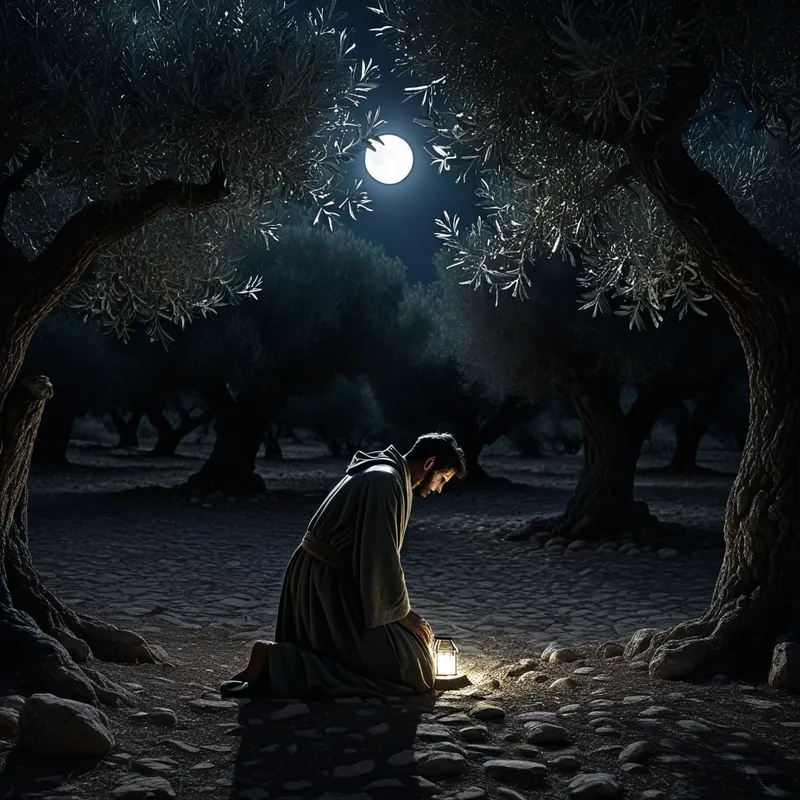
On a night thick with the scent of crushed herbs and impending doom, a man walked up its slope. His footsteps were heavy, each one a prayer pressed into the dust. [The moon](/myths/the-moon “Myth from Tarot culture.”/), a sliver of cold iron, cast long, grasping shadows from the gnarled trees. He was known to his companions as a teacher, a healer, the promised one. Yet here, on this mount, he was utterly alone. He left his friends sleeping, their bodies like fallen stones, and went a little farther into the grove’s embrace. The air grew cold. He fell to his knees, then onto his face, his form dissolving into [the shadow](/myths/the-shadow “Myth from Jungian culture.”/) of the rock. “Let this cup pass from me,” he whispered, a raw sound torn from the depths of being. Sweat fell like great drops of blood, mingling with the soil of the mount. Here was the agony of a soul stretched between the human terror of annihilation and a divine acceptance of a terrible purpose. The mount held his anguish, absorbing it into its ancient roots.
But this mount has many faces. Kings once fled across its back, weeping as their city burned. Prophets stood upon its crest, their voices carried by the east wind, speaking of a day when the Lord would stand upon it, and the mountain would split in two, creating a great valley of escape and renewal. They saw a future where life would spring from this very place, a river of healing flowing from its sides. It became the promised ground of resurrection and the seat of final judgment, where [the veil](/myths/the-veil “Myth from Various culture.”/) between this world and the next would grow thin and finally tear.
And so it was. From this very ridge, the same man who wept in the garden, having passed through death and back, later ascended. His feet, which had once knelt in despair, took their last steps on earthly soil upon this mount. A cloud received him, and his followers stood staring, rooted to the spot on the Mount of Olives, until a voice told them he would return in like manner. The mountain became a door, a hinge between heaven and earth, its soil imprinted with the final footprint of the divine and the first hope of a promised return.
Cultural Origins & Context
The Mount of Olives is not a myth born of a single story, but a sacred geography woven from historical event, prophetic poetry, and ritual practice across centuries of Biblical tradition. Its significance is cumulative. Historically, it was a literal place: a ridge overlooking the Temple Mount, covered in olive groves that supplied oil for lamps and sanctification. It served as a burial ground for millennia, its slopes becoming a city of the dead facing the holy city, a tangible expression of the hope for resurrection.
Its mythological weight was built by [the prophets](/myths/the-prophets “Myth from Biblical culture.”/)—[Zechariah](/myths/zechariah “Myth from Christian culture.”/) and Ezekiel—who envisioned it as the locus of God’s apocalyptic intervention and the source of eschatological healing. These visions were not mere metaphor but were rooted in the Israelite understanding of specific mountains as places of divine encounter (like Sinai or Moriah). The Mount of Olives became the next and final mountain in this theological sequence.
The stories of [Jesus](/myths/jesus “Myth from Christian culture.”/)’ agony and ascension, recorded in the Gospels and the Acts of the Apostles, grafted a new and intensely personal layer onto this existing symbolic landscape. Told and retold in early Christian worship and pilgrimage, these narratives transformed the mount from a general prophetic symbol into a specific testament to the humanity and divinity of Christ, anchoring the Christian narrative of sacrifice and [triumph](/myths/triumph “Myth from Roman culture.”/) to a tangible piece of earth. It functioned societally as both a comfort (a place where God experienced human frailty) and a cosmic compass (pointing to the promised future).
Symbolic Architecture
At its core, the Mount of Olives is the archetypal Threshold. It is the liminal [space](/symbols/space “Symbol: Dreaming of ‘Space’ often symbolizes the vastness of potential, personal freedom, or feelings of isolation and exploration in one’s life.”/) where the most profound polarities of existence meet and are held in [tension](/symbols/tension “Symbol: A state of mental or emotional strain, often manifesting physically as tightness, pressure, or unease, signaling unresolved conflict or anticipation.”/).
It is the garden of agony and the gate of glory; the hill of despair and the platform of ascension. It symbolizes the sacred ground where the soul must fully embrace its mortality to touch the eternal.
Psychologically, the [mountain](/symbols/mountain “Symbol: Mountains often symbolize challenges, aspirations, and the journey toward self-discovery and enlightenment.”/) represents the conscious ego’s [journey](/symbols/journey “Symbol: A journey in dreams typically signifies adventure, growth, or a significant life transition.”/) to its own limits. The olive [grove](/symbols/grove “Symbol: A grove symbolizes a sacred space of nature, tranquility, and introspection, often associated with spiritual growth and connection.”/) ([Gethsemane](/myths/gethsemane “Myth from Christian culture.”/)) is the [depth](/symbols/depth “Symbol: Represents profound layers of consciousness, hidden truths, or the unknown aspects of existence, often symbolizing introspection and existential exploration.”/) of [the personal unconscious](/myths/the-personal-unconscious “Myth from Jungian Psychology culture.”/), where one faces the [shadow](/symbols/shadow “Symbol: The ‘shadow’ embodies the unconscious, repressed aspects of the self and often represents fears or hidden emotions.”/) of one’s [destiny](/symbols/destiny “Symbol: A predetermined course of events or ultimate purpose, often linked to spiritual forces or cosmic order, representing life’s inherent direction.”/)—the “cup” of suffering that feels too bitter to drink. The act of kneeling there, in absolute solitude, is [the ego](/myths/the-ego “Myth from Jungian culture.”/)’s surrender to a larger, often terrifying, Self. The splitting of the [mountain](/symbols/mountain “Symbol: Mountains often symbolize challenges, aspirations, and the journey toward self-discovery and enlightenment.”/) prophesied by Zechariah symbolizes the radical psychic restructuring that occurs when this tension becomes unbearable; the old, rigid structures of the [personality](/symbols/personality “Symbol: Personality in dreams often symbolizes the traits and characteristics of the dreamer, reflecting how they perceive themselves and how they believe they are perceived by others.”/) must crack open to create a new [valley](/symbols/valley “Symbol: A valley often symbolizes a period of transition or a place of respite between two extremes.”/) of possibility.
The Olive itself is key. It is not a mighty [cedar](/symbols/cedar “Symbol: Aromatic wood symbolizing purification, protection, and sacred connection, often associated with spiritual cleansing and enduring strength.”/) but a gnarled, resilient [tree](/symbols/tree “Symbol: In dreams, the tree often symbolizes growth, stability, and the interconnectedness of life.”/) whose [fruit](/symbols/fruit “Symbol: Fruit symbolizes abundance, nourishment, and the fruits of one’s labor in dreams.”/) must be crushed to yield its illuminating oil. This mirrors the process where profound [insight](/symbols/insight “Symbol: A sudden, deep understanding of a complex situation or truth, often arriving unexpectedly and illuminating hidden connections.”/) and [peace](/symbols/peace “Symbol: Peace represents a state of tranquility and harmony, both internally and externally, often reflecting a desire for resolution and serenity in one’s life.”/) (the oil) are only produced through the pressure and “crushing” of experience. The mount, therefore, is not a place of easy transcendence but of necessary, often painful, [transmutation](/symbols/transmutation “Symbol: A profound, alchemical process of fundamental change where one substance or state transforms into another, often representing spiritual evolution or personal metamorphosis.”/).
The Dreamer’s Resonance
When the Mount of Olives arises in the modern dreamscape, it rarely appears as a literal Biblical scene. Instead, it manifests as a somatic and emotional landscape. The dreamer may find themselves on a steep path at night, feeling an overwhelming weight of responsibility or dread. They may be searching for a specific, ancient tree in a grove, or trying to keep watch but falling repeatedly into a heavy, helpless sleep. The core somatic experience is one of agonizing tension—a feeling of being stretched between two unbearable outcomes, coupled with a profound sense of solitude.
Psychologically, this dream pattern signals a critical inner crossroads. The dream-ego is facing its own “Gethsemane moment”: a life decision, a moral crisis, the acceptance of a painful truth, or the burden of a calling that demands personal sacrifice. The “sleeping companions” in the dream often represent parts of the [psyche](/myths/psyche “Myth from Greek culture.”/) or external relationships that cannot accompany the dreamer into this deepest level of confrontation. The dream is a process of moving “a little farther” into one’s own depths, to a place where the collective supports fall away and one must meet one’s destiny alone. It is a preparation for a death—not necessarily physical, but the death of an old identity, a naive hope, or a cherished illusion.
Alchemical Translation
The myth of the Mount of Olives provides a complete map for the alchemical process of Individuation. It models the [solve et coagula](/myths/solve-et-coagula “Myth from Alchemical culture.”/)—the dissolution and reconstitution—of the psyche.
The journey begins with the descent into the olive grove (the [nigredo](/myths/nigredo “Myth from Alchemical culture.”/), or blackening). This is the conscious confrontation with the shadow and the pain of existence. The ego’s prayer (“remove this cup”) is its last resistance. The acceptance (“yet not my will”) is the moment of surrender, where the ego yields its central authority to the guiding function of [the Self](/myths/the-self “Myth from Jungian culture.”/). This surrender is the crucial dissolution.
The mountain that splits east and west is the psyche breaking its rigid binaries, creating a passage where before there was an impasse. The new valley is the emergent third way, born of endured tension.
The prophetic visions of healing waters flowing from the mount represent the albedo (whitening) and citrinitas (yellowing)—the cleansing and illumination that follow the dark night. Insights and a new sense of purpose begin to flow from the very site of the prior agony.
Finally, the ascension is the [rubedo](/myths/rubedo “Myth from Alchemical culture.”/) (reddening), the culmination. It is not an escape from earth but the integration of the transcendent experience back into the fabric of the mortal perspective. The “cloud” that receives the figure symbolizes the mystery that always remains, the irreducible numinous core of the Self. For the modern individual, the “ascension” is the achieved state where one can live fully in [the world](/myths/the-world “Myth from Tarot culture.”/), yet no longer be solely of it, carrying the wisdom of [the threshold](/myths/the-threshold “Myth from Folklore culture.”/) within. The promise of return “in like manner” signifies that this is not a one-time event, but a cyclical process; each new life challenge calls us back to our own inner Mount of Olives, to kneel again, surrender again, and be reconstituted again, ever more wholly.
Associated Symbols
Explore related symbols from the CaleaDream lexicon: