The Mound of Creation in Egypt Myth Meaning & Symbolism
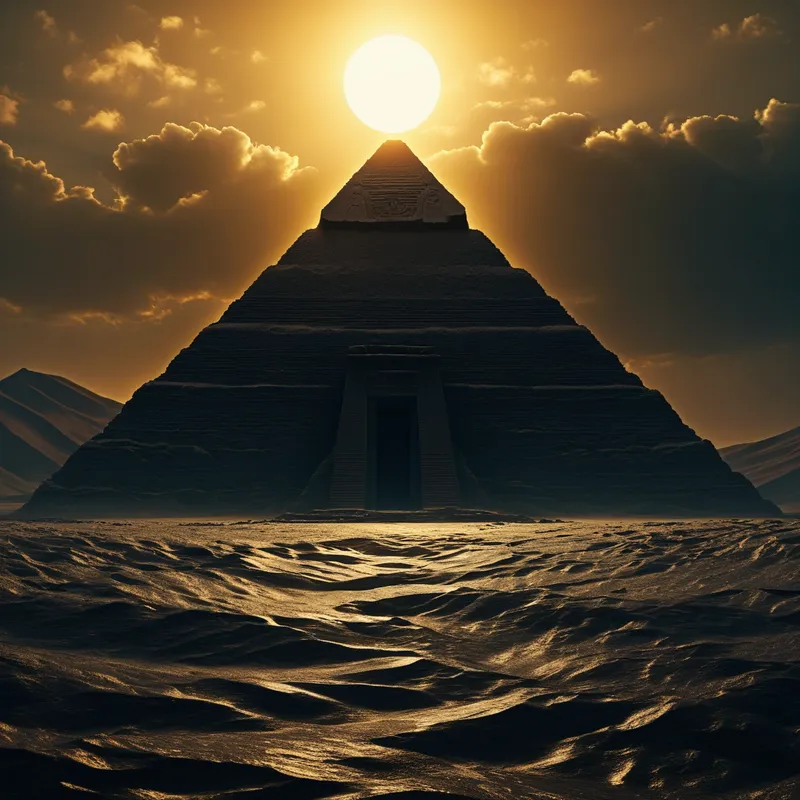
In the dark, infinite waters of Nun, a mound of fertile earth rises, birthing the sun god Atum and the ordered cosmos from primordial chaos.
The Tale of The Mound of Creation in Egypt
Before time had a name, there was only the deep. Not a sea, for a sea has shores and a sky above it. This was Nun—a boundless, black, silent ocean of non-being. It was the unformed, the potential, the endless night that held everything and nothing within its cold, watery embrace. No wind stirred its surface. No light pierced its depths. It was the great, dreaming void.
Yet, within that infinite stillness, a stirring began. Not a movement of water, but a gathering of intention. A whisper of “I Am” echoed in the silence that was not sound. And from the heart of the formless Nun, something began to rise.
It was a mound. Not a mountain, but a hummock of rich, dark, fertile earth. It pushed upwards, slowly, irresistibly, breaking the perfect plane of the black waters. It was the first thing that was not water. The first solid. The first “here” in a universe of “nowhere.” This was the Benben stone, the primeval hill. Upon its damp, dark soil, a presence coalesced.
He was Atum, the Complete One. He stood upon the mound, the sole inhabitant of existence. He looked out upon the endless Nun and knew solitude. But within him burned the fire of creation, a need to fill the silence. From his own being, using the sheer force of his will and his sacred essence, he brought forth the first pair. He spat out Shu, and vomited forth Tefnut. Air and Moisture. The first principles of differentiation were born from the One.
Shu and Tefnut, in turn, gave birth to Geb and Nut, and from their union came the stars. But Nut and Geb were locked in such a tight embrace that no space existed for life to flourish. So Shu, their father, forced himself between them. He pushed Nut high above, her body becoming the starry vault of heaven, and pressed Geb down below, his body becoming the land. In that space—the space created by separation—the world we know was born. The mound of creation was now the axis of a cosmos: the fixed point around which the sun, Atum-Ra, would rise each dawn, re-enacting that first, glorious moment of emergence from the dark waters.
Cultural Origins & Context
This is not one story, but the foundational layer of many. The myth of the primordial mound is the bedrock of Egyptian cosmogony, appearing in texts from the Pyramid Texts (c. 2400-2300 BCE) to the later Coffin Texts and the Book of the Dead. Its telling was not for the marketplace, but for the sacred spaces: the inner sanctuaries of temples, the walls of royal tombs, and the rituals of priests. The tellers were the Hem-netjer, the “Servants of the God,” who saw their daily temple rituals as a direct re-enactment of this first creation, maintaining Ma’at against the ever-lurking chaos of Nun.
The myth’s societal function was profound. It explained the origin of the world, yes, but more importantly, it explained and justified the Egyptian state and the role of the pharaoh. The pharaoh was the living heir to Atum, the guardian of the Benben. His capital city, his very throne, was symbolically this first mound. The annual flooding of the Nile, which deposited fresh, fertile silt, was a yearly repetition of this event—chaos (Nun) bringing forth life (the mound). The myth was a map of reality, a divine mandate for order, and a promise that creation was not a one-time event, but a continuous, sacred process requiring active participation.
Symbolic Architecture
The myth’s power lies in its stark, elegant symbolism. The Nun represents the unconscious in its purest state—undifferentiated, potential-laden, but also terrifying in its formlessness. It is the psychic soup before the “I” emerges. The Benben mound is the first act of consciousness. It is the ego emerging from the unconscious, the first stable thought from a sea of feeling, the initial spark of self-awareness that says, “I am here.”
The mound is not just land; it is the first island of meaning in an ocean of potential. It is the birth of distinction from unity.
Atum’s act of self-creation—Kheper, “to come into being”—models the psyche’s own journey. Consciousness does not come from outside; it emerges from within the depths of the unconscious itself. His subsequent creation of Shu (air, spirit, intellect) and Tefnut (moisture, emotion, intuition) from his own body signifies the necessary differentiation of psychic functions. The painful but necessary separation of Nut (heaven, potential) and Geb (earth, manifestation) by Shu is the archetypal act of creating psychic space—the distance between desire and reality, idea and action, where a life can actually be lived.
The Dreamer’s Resonance
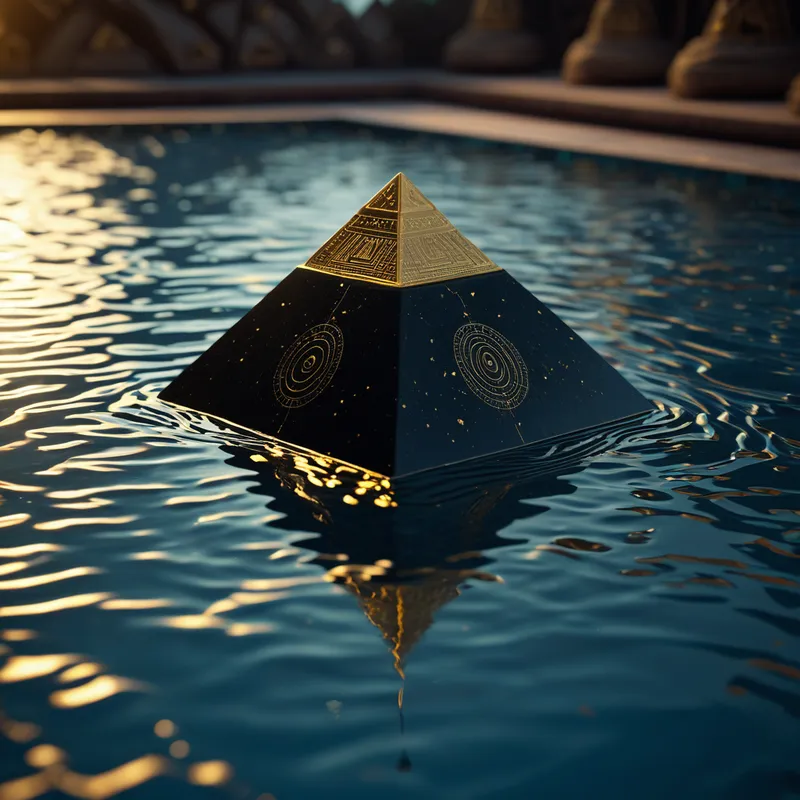
When this myth stirs in the modern dreamer, it speaks to a profound process of psychic emergence or re-foundation. To dream of a small island or a hill rising from a vast, dark ocean is to dream the Benben. This often occurs during life transitions: the beginning of a new creative project, the slow dawn of a new self-understanding after a period of depression or confusion (“the dark night of the soul”), or the first solid feeling after a time of emotional flooding.
Somatically, it may be felt as a grounding, a centering—a literal feeling of “finding your feet” when you felt adrift. Psychologically, it is the moment when chaotic inner experience (the waters of Nun) begins to coalesce around a core insight, a decision, or a new identity. The dream is an affirmation from the deep unconscious: “A new structure is forming. A new consciousness is being born from your own depths. Hold fast to this mound.”

Alchemical Translation
For the modern individual, the myth maps the alchemical process of individuation—becoming an integrated, self-realized whole. The prima materia, the worthless starting substance of the alchemist, is the Nun: our unexamined life, our bundled complexes, our latent potentials and repressed shadows. The first major operation is coagulatio (coagulation), the making solid. This is the rising of the mound—the formation of the conscious standpoint, the ego, from the unconscious.
The journey is not away from the waters of Nun, but towards a conscious relationship with them. The mound is the vantage point from which we behold our own depths.
Atum’s self-creation mirrors the difficult realization that we must, in a sense, create ourselves. We must take responsibility for our own being, emerging from the passive state of being shaped solely by family, culture, and trauma. The separation of Nut and Geb is the ongoing psychological work of creating inner space—differentiating between our fantasies (sky) and our capabilities (earth), between our spiritual aspirations and our embodied reality.
The ultimate alchemical goal is not to escape the mound and return to undifferentiated unity, but to become like the temple built upon it: a stable, sacred structure that maintains a conscious, living connection to the fertile, chaotic waters below. We become the Benben and the guardian of Ma’at within our own psyche, daily re-enacting the miracle of creation by bringing conscious order to our inner world, while respectfully honoring the dark, creative, endless deep from which we—and every new thought, feeling, and beginning—eternally emerge.
Associated Symbols
Explore related symbols from the CaleaDream lexicon: