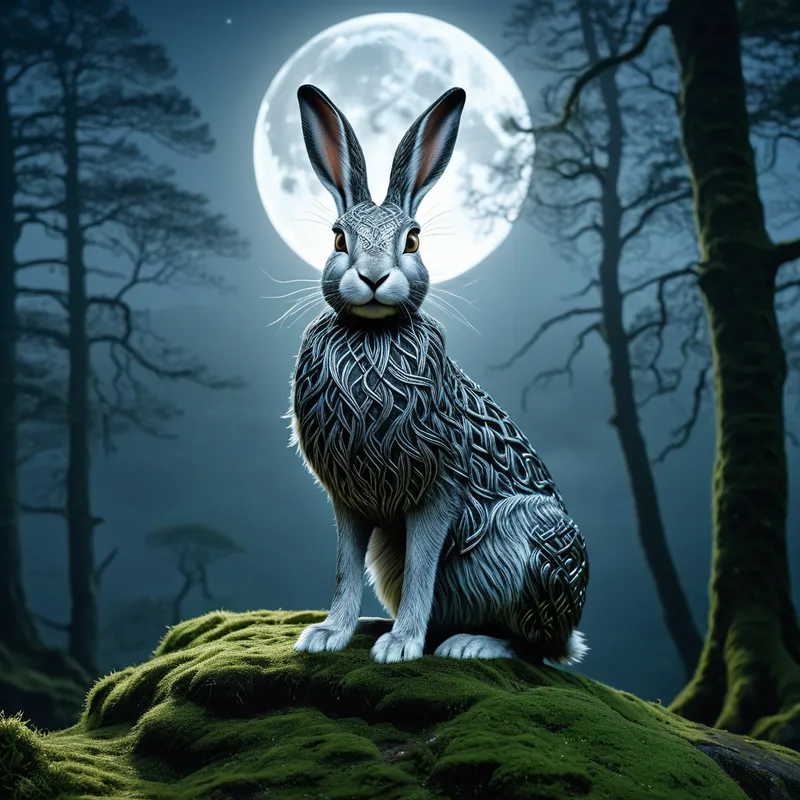
The Moon Hare Myth Meaning & Symbolism
A hare offers itself to the starving goddess Cerridwen, becoming immortalized in the moon as a symbol of ultimate sacrifice and cyclical rebirth.
The Tale of The Moon Hare
Listen, and let the firelight carry you back, to a time when [the world](/myths/the-world “Myth from Tarot culture.”/) was younger and [the veil](/myths/the-veil “Myth from Various culture.”/) between the worlds was thin as a [spider](/myths/spider “Myth from Native American culture.”/)’s sigh. The great wheel of the year had turned to its darkest spoke. The [Samhain](/myths/samhain “Myth from Celtic culture.”/) fires had burned to ash, and the grip of the Cailleach was iron upon the land. Frost gnawed at the roots of the oak, and a silence deeper than sleep lay over the forest.
In this time of barren hunger, the goddess Cerridwen walked [the earth](/myths/the-earth “Myth from Hindu culture.”/). Not in her aspect as the keeper of [the cauldron of inspiration](/myths/the-cauldron-of-inspiration “Myth from Celtic culture.”/), but as the raw, hungry mother of all things, her vitality drained by the long night. Her steps were heavy, her form gaunt. The life-force of the land was her own, and it was ebbing. She wandered the frozen glens, her eyes hollow, seeking sustenance where there was none. The wells were iced over. The berries were long gone. The world held its breath, waiting to see if the light would ever return.
In a clearing silvered by hoarfrost, a hare watched. It was a small creature, its brown fur patched with the white of the coming snow. It had seen the goddess’s suffering, had felt the tremor of starvation in the very soil. The other creatures had hidden, governed by the primal law of survival. But this hare felt a different law stir within its breast—a law older than fear, older than the winter itself. It was [the law](/myths/the-law “Myth from Biblical culture.”/) of the sacred exchange.
Without a sound, the hare stepped from the bracken into the open moonlight. It did not flee. It turned its dark, liquid eyes to the towering, sorrowful form of Cerridwen. Then, in an act of unimaginable will, it offered itself. It lay down upon the frost, a small, warm pulse in the vast, cold dark.
Cerridwen paused. She saw the sacrifice, not as predation, but as sacrament. Her hand, which could command the stars, trembled as she reached down. But she did not take the gift in [the way](/myths/the-way “Myth from Taoist culture.”/) of a hunter. Instead, a profound tenderness overcame her. She touched the hare, and in that touch, a miracle of transmutation occurred. The physical life was not taken; it was transformed.
The hare’s form dissolved into a swirl of luminous mist, rising from the frozen earth. It spiraled upward, past the bare branches, into the vault of the night sky. It flew to the great, pale disc of [the moon](/myths/the-moon “Myth from Tarot culture.”/) and settled upon its face. Its image was etched there, forever—a silhouette of perfect offering. And as the hare took its place in the heavens, a warmth returned to Cerridwen’s limbs. The first promise of the returning sun stirred in the east. The sacrifice of one had broken the fast of the world.
Cultural Origins & Context
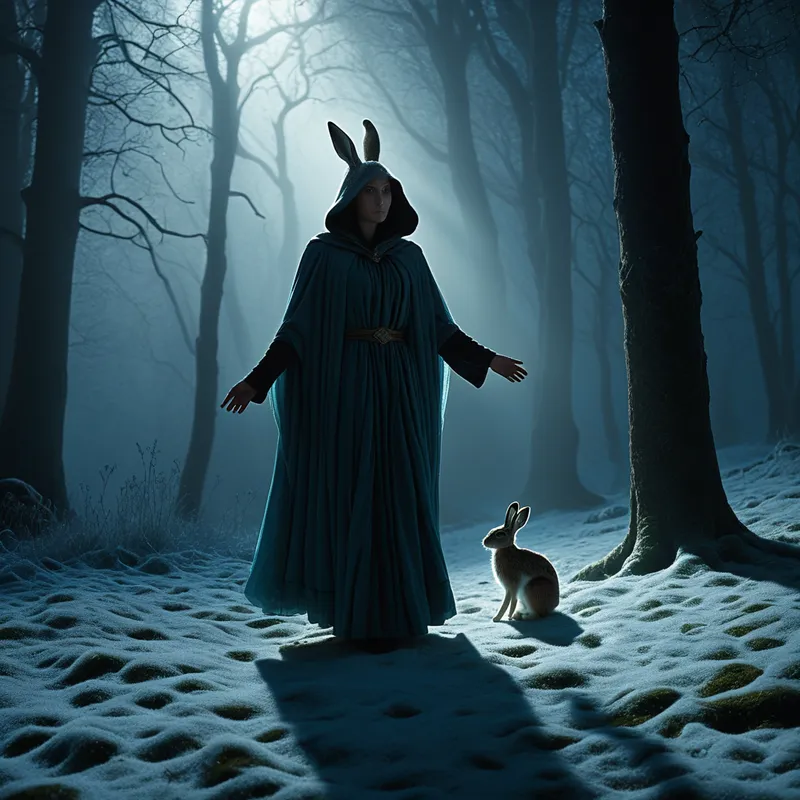
The figure of the Moon Hare is a powerful, though elusive, strand in the tapestry of Celtic lore. It is less a singular, codified myth from one text and more a pervasive folk motif, whispered in stories and seen in the silent language of symbols. Its primary cultural home is within the Brythonic traditions of Wales and Cornwall, often intertwining with the lore of the powerful goddess Cerridwen. As a keeper of the Awen, the cauldron of inspiration and rebirth, Cerridwen’s myths are inherently about cycles of consumption, transformation, and renewal.
This tale was not written in illuminated manuscripts but carried on the breath of storytellers—the cyfarwyddiaid of Wales—around hearth fires during the long nights of winter. Its societal function was multifaceted. On one level, it was an etiological story, explaining the markings on the moon. On a deeper, more vital level, it served as a sacred parable for a culture intimately tied to the land. It taught the hard, beautiful truth of the reciprocal relationship between life and death, between the individual and the whole. The hare, a creature of incredible fertility and speed, becoming a symbol of eternal sacrifice, spoke directly to an agricultural and hunting society about the sacredness of the gift that sustains life.
Symbolic Architecture
The myth’s power lies in its stark, beautiful symbology. The Hare is not a mighty [hero](/symbols/hero “Symbol: A hero embodies strength, courage, and the ability to overcome significant challenges.”/) but a small, vulnerable [creature](/symbols/creature “Symbol: Creatures in dreams often symbolize instincts, primal urges, and the unknown aspects of the psyche.”/). It represents the part of the [psyche](/myths/psyche “Myth from Greek culture.”/)—and of [life](/symbols/life “Symbol: The symbol of ‘Life’ represents a journey of growth, interconnectedness, and existential meaning, encompassing both the joys and challenges that define human experience.”/) itself—that is quick, fertile, instinctual, and often prey. In its ultimate act, it transcends its [nature](/symbols/nature “Symbol: Nature symbolizes growth, connectivity, and the primal forces of existence.”/). It moves from being subject to the cycle to becoming a conscious participant in it.
The greatest offering is not of what we have in abundance, but of our very nature, transmuted for a purpose beyond the self.
The [Moon](/symbols/moon “Symbol: The Moon symbolizes intuition, emotional depth, and the cyclical nature of life, often reflecting the inner self and subconscious desires.”/) is the perfect [receptacle](/symbols/receptacle “Symbol: A container that holds, receives, or stores something, often symbolizing the capacity to accept, contain, or process experiences, emotions, or resources.”/) for this sacrifice. It is the celestial [body](/symbols/body “Symbol: The body in dreams often symbolizes the dreamer’s self-identity, personal health, and the relationship they have with their physical existence.”/) of cycles, [reflection](/symbols/reflection “Symbol: Reflection signifies self-examination, awareness, and the search for truth within oneself.”/), the unconscious, and the feminine principle. To be placed upon the [moon](/symbols/moon “Symbol: The Moon symbolizes intuition, emotional depth, and the cyclical nature of life, often reflecting the inner self and subconscious desires.”/) is to be eternalized within the [realm](/symbols/realm “Symbol: The symbol of ‘Realm’ often signifies the boundaries of one’s consciousness, experiences, or emotional states, suggesting aspects of reality that are either explored or ignored.”/) of [pattern](/symbols/pattern “Symbol: A ‘Pattern’ in dreams often signifies the underlying structure of experiences and thoughts, representing both order and the repetitiveness of life’s situations.”/), [rhythm](/symbols/rhythm “Symbol: A fundamental pattern of movement or sound in time, representing life’s cycles, emotional flow, and universal order.”/), and psychic [truth](/symbols/truth “Symbol: Truth represents authenticity, honesty, and the quest for knowledge beyond mere appearances.”/). The Hare does not die; it becomes an [archetypal image](/symbols/archetypal-image “Symbol: A universal, primordial symbol from the collective unconscious that transcends individual experience and carries profound spiritual or mythic meaning.”/), a permanent fixture in the collective imagination of the [night](/symbols/night “Symbol: Night often symbolizes the unconscious, mystery, and the unknown, representing the realm of dreams and intuition.”/).
Cerridwen, in her starved [aspect](/symbols/aspect “Symbol: A distinct feature, quality, or perspective of something, often representing a partial view of a larger whole.”/), represents the Great [Mother](/symbols/mother “Symbol: The symbol of ‘Mother’ represents nurturing, protection, and the foundational aspect of one’s emotional being, often associated with comfort and unconditional love.”/) in her devouring, [winter](/symbols/winter “Symbol: Winter symbolizes a time of reflection, introspection, and dormancy, often representing challenges or a period of transformation.”/) phase. She is the necessary void, the [cauldron](/symbols/cauldron “Symbol: A large metal pot for cooking or brewing, symbolizing transformation, nourishment, and hidden potential.”/) that must be empty before it can be filled. Her [acceptance](/symbols/acceptance “Symbol: The experience of being welcomed, approved, or integrated into a group or situation, often involving validation of one’s identity or actions.”/) of the gift is not one of greed, but of sacred acknowledgment. The act restores balance, initiating the turn from [winter](/symbols/winter “Symbol: Winter symbolizes a time of reflection, introspection, and dormancy, often representing challenges or a period of transformation.”/) to spring, from [emptiness](/symbols/emptiness “Symbol: Emptiness signifies a profound sense of void or lack in one’s life, often related to existential fears, loss, or spiritual quest.”/) to potential.
The Dreamer’s Resonance
When the Moon Hare leaps into the dreams of a modern individual, it signals a profound inner process is underway. To dream of offering oneself, of willingly stepping toward a devouring darkness or a consuming force, points to a critical juncture in the psyche. The somatic sensation is often one of both dread and profound calm—a chilling emptiness in the gut coupled with a strange, expansive lightness in the chest.
Psychologically, this is the dreamer confronting a necessary “sacrifice.” This is not about literal martyrdom, but about the conscious relinquishing of an old identity, a cherished belief, a compulsive behavior, or a source of security that has, paradoxically, begun to starve the soul. The “Cerridwen” figure in the dream may appear as a demanding job, a draining relationship, a deep depression, or simply as an overwhelming, faceless void. The dream is mapping the terrifying, yet sacred, choice to offer up this part of [the self](/myths/the-self “Myth from Jungian culture.”/) to be transformed. The promise of the myth is that on the other side of this offering is not annihilation, but eternalization—the small, scared part of the self is reborn as a guiding symbol in the inner cosmos.
Alchemical Translation
In the alchemical journey of individuation—the process of becoming one’s whole, integrated self—the Moon Hare myth models the stage of [nigredo](/myths/nigredo “Myth from Alchemical culture.”/) and its transcendence. The [nigredo](/myths/nigredo “Myth from Alchemical culture.”/) is [the dark night of the soul](/myths/the-dark-night-of-the-soul “Myth from Christian Mysticism culture.”/), the winter where all seems barren and [the ego](/myths/the-ego “Myth from Jungian culture.”/) feels starved of meaning. The instinctive response is to hoard, to contract, to hide in the bracken of old patterns.
The Hare’s choice represents the crucial, conscious ego decision to engage with the darkness, not fight it. It is the alchemical sacrificium, the sacred making. We must offer our “hare-ness”—our quick fixes, our fertile but scattered energies, our timid, prey-like identities—to the devouring, transformative power of the unconscious (Cerridwen and her cauldron).
Individuation demands the sacrifice of the merely natural creature to become a citizen of the symbolic world.
The result is not the destruction of that energy, but its sublimation. The base instinct is transmuted into a celestial guide. The personal struggle becomes an archetypal truth. The individual who undergoes this process finds that their former “weakness” or sacrifice is now a permanent, illuminating part of their inner landscape—a quiet, luminous wisdom that guides them through all future cycles of darkness and light. They carry the moon within them.
Associated Symbols
Explore related symbols from the CaleaDream lexicon: