The Moon Myth Meaning & Symbolism
A journey through the nocturnal psyche, where primal guardians must be passed to reach the hidden self beyond the veil of illusion.
The Tale of The Moon
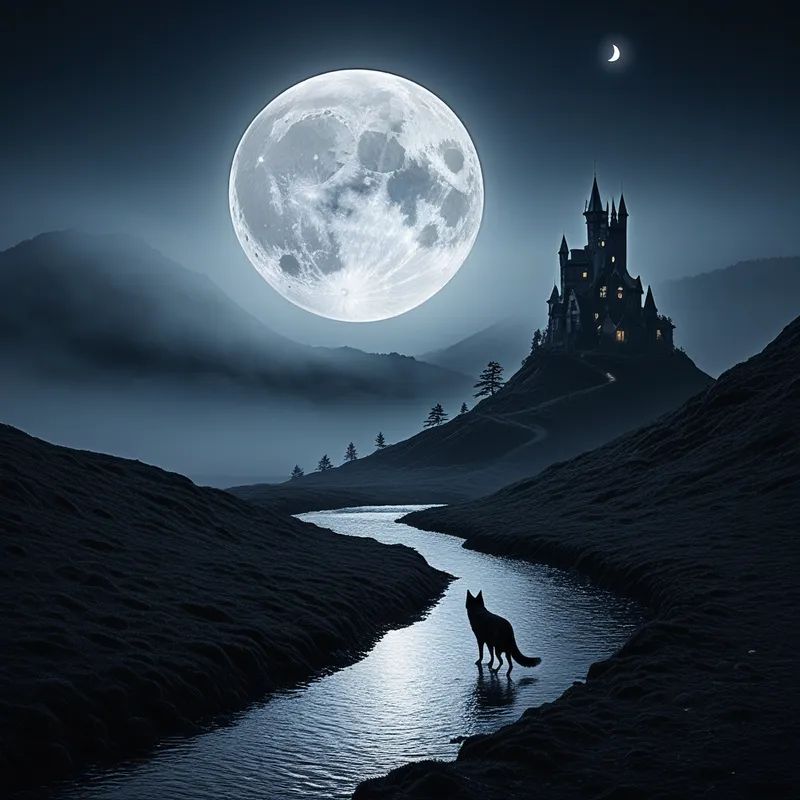
Beneath a sky drained of sun, the world holds its breath. This is the hour of Tehom, the hour when the solid earth remembers it is but a dream of the deep. A single, baleful eye opens in the heavens—the Moon, not gentle, but watchful, pouring its liquid silver light onto a landscape that is no longer what it was by day.
A path, pale as a bone, unspools from your feet. It winds between two sentinels of the threshold. On one side, a dog, whining, hackles raised, tethered to the post of civilization. On the other, a wolf, silent, its eyes twin pools of amber fire, belonging wholly to the wild night. They do not attack, but their gaze is a test. To walk this path is to pass between what you have tamed and what terrifies you, knowing both are yours.
The path leads to the edge of a still, black pool. From its depths, a crayfish emerges, slow and ancient, its shell glistening. It crawls onto the shore, a creature of the abyss now in the realm of air. It does not speak, but its movement is a question: will you follow it back into the deep, or continue the path that now climbs toward distant, twin towers on the far horizon?
The air thrums with a silent vibration. Droplets of that same lunar light fall from the sky, not as rain, but as a slow, ceaseless distillation of doubt and memory. They seed the ground with phantoms. Shapes shift at the corner of your vision—loved ones with unfamiliar eyes, landscapes that rearrange themselves when you blink. The towers, your destination, seem to waver, sometimes close, sometimes impossibly far. The only truth is the path underfoot, the watching beasts, the dripping moon, and the deep, calling water. The journey is not to conquer, but to endure the unraveling. To walk until the illusions either break you or become transparent, revealing the secret they guard.

Cultural Origins & Context
The imagery of The Moon card is a palimpsest of esoteric thought, woven from threads of Renaissance astrology, medieval bestiaries, and Hermetic symbolism. It found its canonical form in decks like the 1909 Rider-Waite-Smith, which synthesized earlier European occult traditions. This “myth” was not told around campfires but was encoded in visual language for initiates and seekers.
Its primary societal function was pedagogical, serving as a meditative map within the Major Arcana’s “Fool’s Journey.” It depicted the stage of the journey where intellectual light (The Sun) fails, and one must navigate by the reflected, uncertain light of the subconscious. It was a warning and a guide for those engaged in inner work, illustrating the disorienting but necessary descent into the psyche’s basement before any higher synthesis could occur. The myth was passed down through the silent contemplation of the card itself, a static image demanding an active, interior journey from the viewer.
Symbolic Architecture
The Moon represents the dominion of the unconscious, the psychic substrate where personal and collective memories swim like sea creatures. It is the realm of the shadow, not as a single monster, but as a fecund, shifting ecosystem.
- The Path: The winding road of life through uncertainty. It is the thread of consciousness itself, threatened on all sides by dissolution.
- The Wolf & The Dog: The dual nature of instinct. The dog symbolizes the fears we have socialized and live with; the wolf represents the raw, untamed terrors we exile. The journey requires acknowledging both as aspects of the self.
- The Crayfish: The crawling, evolving consciousness emerging from the primal waters of the unconscious (the collective unconscious). It is the slow, often regressive, but persistent movement toward awareness.
- The Falling Droplets: The constant, dripping influence of unconscious content—memory, intuition, paranoia, inspiration—into the conscious mind. They are the seeds of dreams and madness.
- The Distant Towers: Symbols of a distant goal or consciousness, often representing the duality of mind (intellect and intuition) or a longed-for but unclear destination. Their distance emphasizes the journey’s length and the lure of false promises.
The Moon does not lie, but it shows everything through the veil of reflection. Its truth is not in the clarity of the image, but in the depth of the water that holds it.
Psychologically, this myth maps the encounter with the non-rational self. The “hero” here is not a conqueror but a psychic orphan, cast out from the daylight certainty of the ego and forced to navigate a world where meaning is fluid and the guides are primal.
The Dreamer’s Resonance
When this myth stirs in the modern soul, it manifests in dreams of profound disorientation and symbolic richness. It is the dream of being lost in a familiar house that has become a labyrinth. It is the dream of trying to run from a threat through water or sand, limbs heavy and slow. It is the dream where loved ones speak in riddles or with alien voices.
Somatically, this process feels like a low-grade anxiety, a humming dread with no clear source—the “droplets” falling into the psyche. The dreamer is undergoing a necessary psychic digestion. The conscious mind is being forced to process material from the deep unconscious that it has refused or been unable to handle in waking life. The wolves and dogs of the dream are the somaticized fears—the tight chest, the quickened pulse—attached to half-seen images. This is not a pathology, but a purification; the unconscious is vomiting up its contents so the psyche can see what it has swallowed.
Alchemical Translation
In the alchemy of individuation, The Moon represents the crucial stage of solutio—dissolution. The solid structures of the persona, the carefully built identity, are dissolved in the lunar waters of the unconscious. This is not destruction, but a return to a primal state for reconstitution.
The journey through the moonlit landscape is the ego’s humble submission to this process. To walk the path is to consent to being unmade. The triumph is not in reaching the towers, which may themselves be illusions, but in surviving the journey with awareness intact. By facing the wolf and the dog without fleeing, by observing the crayfish without disgust, the individual transmutes raw fear into witnessed experience. The paralyzing terror of the unknown becomes a respectful awe of the inner cosmos.
The gold sought in this operation is not a final answer, but the acquisition of lunatic wisdom—the ability to see by an inner, reflected light, to find one’s way through the dark by feeling rather than knowing, and to recognize that the most profound truths often emerge distorted, from the deep, before they can be clarified by the sun.
The modern individual enacting this myth learns to navigate depression, creative blocks, and existential anxiety not by banishing them with positive thinking, but by following their thread down into the shadowy pool. They learn that the path to wholeness requires periodic journeys into dislocation, where the only compass is the faint, reflected light of a hidden self, waiting to be discovered in the dark.
Associated Symbols
Explore related symbols from the CaleaDream lexicon: