The Monad in Pythagorean philo Myth Meaning & Symbolism
The silent, perfect One, the Monad, births the Dyad and all numbers, generating the cosmos from pure, undivided thought and mathematical harmony.
The Tale of The Monad in Pythagorean philo
Before the world was number, there was the One. Before harmony, there was silence. Before the many, there was the Alone.
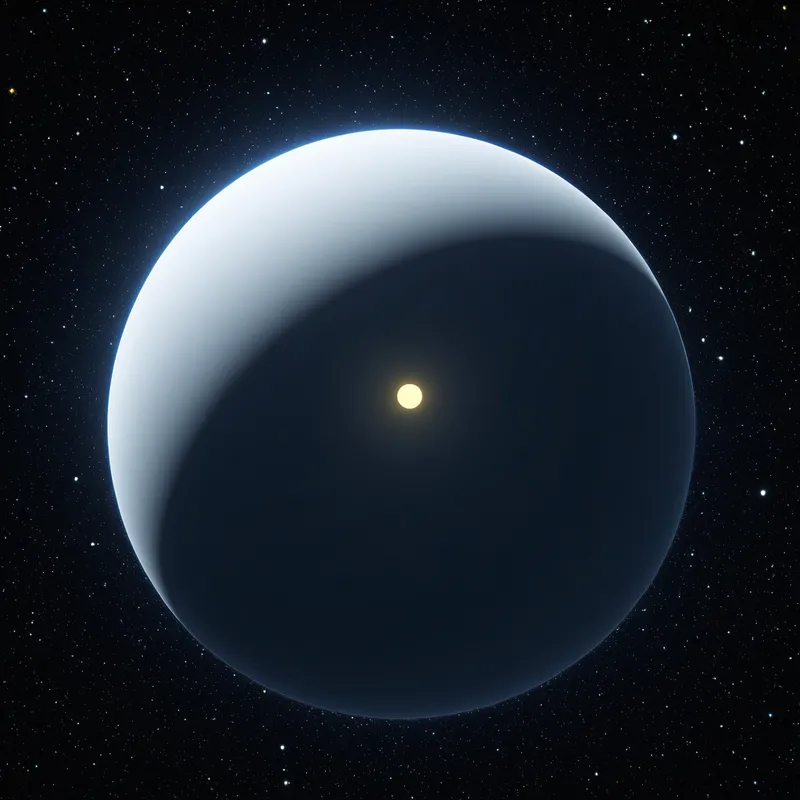
In the beginning, which was not a time but a condition, there existed only the Monad. It was not a god with a face, nor a titan with limbs, but a perfect, boundless point. A thought so complete it needed no other. A sphere whose center was everywhere and circumference nowhere. It rested in the Apeiron, the limitless, not as a prisoner, but as a sovereign in its own profound solitude. It was stillness. It was unity. It was the principle of boundary itself, the very idea of limit emerging from the limitless.
This solitude was not loneliness, but a fullness so absolute it pulsed with potential. From its own perfect rest, a yearning awoke—not a desire for something other, but the necessity of expression. The Monad, in a motion that was not a movement, turned its awareness upon itself. In that act of self-reflection, a shadow was cast, not of darkness, but of distinction. Where there was only One, now there was the act of observing, and the One being observed. From its own substance, it breathed forth the Dyad.
The Dyad was the Other. It was the principle of division, of comparison, of line and distance. It was the womb of multitude. With the Dyad came vibration, a tension between the Same and the Different. This tension was the first music, a silent chord struck across the void. From the interplay of Monad and Dyad—the Limit and the Unlimited—the Triad was born. The Triad was harmony, the child that reconciles the parents, the shape that gives form to the formless. It was the triangle, the first plane figure, and the resolution of the primal strain.
And so it flowed, a sacred and inevitable procession. From the Triad came the Tetrad, the four elements and the solidity of the cube. From the Tetrad, the Pentad. On and on, the numbers unfolded from the heart of the One, each a divine entity, each a law of the universe being written into existence. They danced, these numerical spirits, arranging themselves into proportions and ratios. These ratios became the intervals of a scale, the music of the spheres. This music spun the stars into their orbits, condensed fire and air, water and earth, and shaped the very soul of the world and the souls of those who would walk upon it. All of cosmos, in its breathtaking complexity and order, was the echoed song of the solitary Monad, remembering itself through the many.
Cultural Origins & Context
This is not a myth told around a fire with roaring gods and epic battles. It is a mystery whispered in the hushed synedria of Croton and Metapontum. Its bearers were the Pythagoreans, a religious and philosophical brotherhood of the 6th century BCE who saw the universe as a living, mathematical harmony. For them, number was not an abstract tool but the sacred, ontological substance of reality. The myth of the Monad was their creation story, passed orally from master to initiate under vows of severe secrecy.
Its function was twofold. Societally, it provided a cosmic justification for their strict, hierarchical order and pursuit of harmonia—balance in the city-state, the body, and the soul, mirroring the balance of the cosmos. Psychologically, it was an initiatory map. To understand the emanation of the Many from the One was to understand the path of the soul’s descent into matter and, crucially, the path of its return to unity through purification, intellectual discipline, and the study of the mathematical arts that govern all things.
Symbolic Architecture
The Monad is the ultimate symbol of the primordial, undifferentiated state. It represents the origin point of consciousness before it splits into subject and object, self and world. It is the psyche in its potential wholeness, prior to the fragmenting trauma of experience.
The Monad is the silence before the first word, the darkness before the first distinction, the self-contained seed of the entire cosmic tree.
The ensuing emanation—Monad to Dyad to Triad—is not a fall but a necessary unfolding. The Dyad symbolizes the birth of consciousness itself, which requires duality: knower and known, light and shadow, masculine and feminine principles. It is the inevitable pain of separation that makes awareness possible. The Triad is the transcendent function, the reconciling third that arises from the tension of opposites, creating the first pattern, the first meaning, the first step toward ordered complexity. The entire numerical series that follows represents the structuring of chaos into the kosmos—a world that is, at its heart, intelligible, beautiful, and musical because it sprang from a single, perfect source.
The Dreamer’s Resonance
When this myth stirs in the modern unconscious, it rarely appears as numbers. It manifests as dreams of profound solitude that feel like completion, not loneliness. It is the dream of finding a perfect, round stone on a beach and knowing it contains everything. It is the vision of a single, blinding point of light that resolves chaotic noise into a harmonious pattern.
Somatically, one might experience a centering, a pulling-inward, a consolidation of energy. Psychologically, this dream pattern surfaces during times of overwhelming fragmentation—when life feels like a barrage of unrelated demands, roles, and conflicts. The psyche is dreaming of the Monad. It is attempting to remember its own point of origin, to gather the scattered complexes and conflicting impulses back toward a central, unifying principle. The dream is a somatic call to cease identifying with the chaotic Many (the Dyad’s realm) and to seek the grounding silence of the One within.

Alchemical Translation
The Pythagorean path is a blueprint for individuation, the alchemical process of becoming an integrated, unique whole. The modern individual begins not in unity, but in the fragmented, chaotic Many—the dispersed psyche of the unexamined life. The alchemical work is a regressus ad originem, a return to the origin.
The first operation is via negativa—the stripping away. One must consciously encounter the Dyad within: the opposing tensions of persona and shadow, conscious attitudes and unconscious compulsions. This is the stage of conflict and honest self-division. The next stage is the search for the Triad—the reconciling symbol or insight that arises from holding this tension without collapsing into one side or the other. This might be a creative act, a new perspective, or a moment of profound understanding that brings order to inner chaos.
Individuation is not about becoming the Monad, for we are destined to live in the world of the Many. It is about making the conscious, living connection to it, so that the Many are organized by its centering light.
Through continual work—self-knowledge, ethical living, and engaging with the deep patterns (the “numbers”) that structure our reality—one builds the lapis philosophorum. This is not a return to infantile oneness, but the achievement of a complexio oppositorum, a complex unity where the multiplicity of the self is harmonized around a central, indestructible core. The individual becomes a microcosm, a living reflection of the macrocosm: a diverse, vibrant cosmos of thoughts, feelings, and instincts, all singing in the harmonic ratios first sounded when the One, in its fullness, chose to know itself.
Associated Symbols
Explore related symbols from the CaleaDream lexicon: