
The Moiraimeasuring t Myth Meaning & Symbolism
A cosmic entity measures the threads of destiny, revealing the tension between predetermined fate and the soul's capacity for self-determination.
The Tale of The Moiraimeasuring t
Listen. In the time before time’s own name, when the cosmos was a breath held in the dark, there existed the Moiraimeasuring t. It was not a god of wrath or love, but a principle given form, a silent architect in the chamber of becoming. Its realm was the Apeiron, the boundless, where possibility swirled like mist before dawn.
The Moiraimeasuring t did not spin the threads—that was the work of [the Three Sisters](/myths/the-three-sisters “Myth from Native American culture.”/), whose fingers danced with the stuff of souls. Its task was more profound, more terrible in its precision. As each luminous thread, vibrant with a life’s potential joy and sorrow, was drawn from the source, the Moiraimeasuring t would approach.
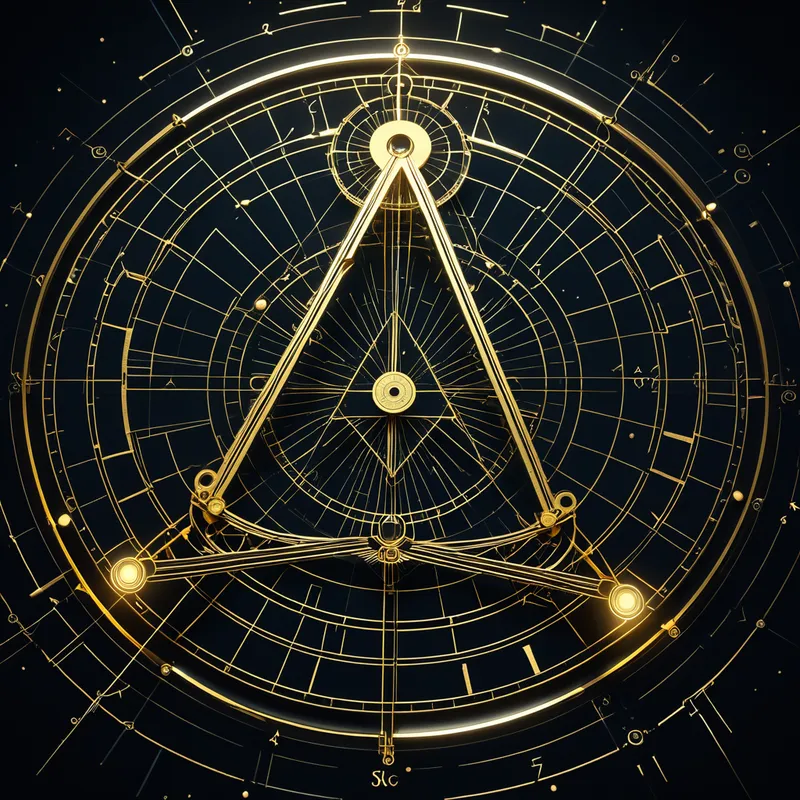
It carried the Instrument, a device of no metal known, singing with a soft, crystalline hum. With movements of infinite care, it would lay the Instrument against the glowing strand. Where it touched, the thread would resonate, and a measure was taken—not of length, but of destiny. It quantified the scope of a love, the weight of a grief, the exact arc of a choice not yet made. It defined the boundaries of the possible, the allotted laughter, the destined tears. The measured thread was then woven into the Tapestry, its place and relation to all others fixed by this celestial arithmetic.
For eons, this was the silent law. The hum of the Instrument was the background music of creation. But into the Tapestry one day was woven a thread of a different quality. It did not shine with a steady light, but flickered, pulsed with a strange, questioning rhythm. It was the thread of a being who dreamed not just of its own story, but of the Loom itself.
When the Moiraimeasuring t came to measure it, a tremor passed through the Apeiron. The Instrument touched the thread, but instead of a clear resonance, a discordant note sounded. The thread resisted. It did not break, but it bent away from the probe, its light flaring. The Moiraimeasuring t, for the first time, paused. Its function was measurement, but this thread introduced a variable it had no calculus for: will.
A silent struggle ensued in that non-place. The Moiraimeasuring t applied the Instrument again, seeking to define the thread’s limits. The thread pulsed, not with defiance, but with a profound inquiry that echoed back into the Instrument itself. It was as if the measured was asking the measurer, “What are your limits?”
In that eternal moment of resonance and feedback, a crack appeared in the absolute law. The Moiraimeasuring t did not snap the thread. It did not force a final measure. Instead, it withdrew the Instrument. And where the measurement had been left incomplete, the thread was woven into the Tapestry with a faint, shimmering question mark woven into its core—a space of uncertainty, a pocket of pure potential within the grand design. The hum of the Instrument resumed, but it was forever changed, now containing the memory of that which it could not fully quantify.

Cultural Origins & Context
The myth of the Moiraimeasuring t is a foundational narrative from what scholars term the “Global/Universal” culture—a hypothetical, primordial stratum of human consciousness from which later, localized mythologies differentiated. It was not a story told around fires in one specific land, but a metaphysical understanding that permeated the earliest human conceptions of order and destiny. It functioned as the deep psychological substrate for later, more personified fate deities like the [Moirai](/myths/moirai “Myth from Greek culture.”/), the [Norns](/myths/norns “Myth from Nordic culture.”/), or the Wyrd.
It was likely transmitted not as a simple tale, but as a contemplative framework, preserved by proto-philosophers and mystic technicians—those who pondered the architecture of reality itself. Its societal function was dual: it provided a comforting explanation for the apparent limits and patterns in life (famine, fortune, lifespan), while simultaneously encoding within itself the seed of transcendence of those very limits through the archetype of the “unmeasurable thread.” It reconciled the human experience of external constraint with the inner whisper of free will.
Symbolic Architecture
At its core, the myth symbolizes the [psyche](/myths/psyche “Myth from Greek culture.”/)’s encounter with [the principle](/symbols/the-principle “Symbol: A fundamental truth, law, or doctrine that serves as a foundation for a system of belief, behavior, or reasoning, often representing moral or ethical standards.”/) of Ananke, or necessity. The Moiraimeasuring t represents the impersonal, structuring [aspect](/symbols/aspect “Symbol: A distinct feature, quality, or perspective of something, often representing a partial view of a larger whole.”/) of the unconscious—the complexes, inherited patterns, biological imperatives, and cultural conditioning that seem to “measure out” the boundaries of our lives.
The measure is not the enemy; it is the ground upon which form becomes possible. Without it, there is only chaos. But to be only measured is to be a thing, not a soul.
The [Instrument](/symbols/instrument “Symbol: An instrument symbolizes creativity, communication, and the means by which one expresses oneself or influences the world.”/) symbolizes the cognitive faculties of judgment, categorization, and prediction—the mind’s attempt to map and define the fluid territory of the [soul](/symbols/soul “Symbol: The soul represents the essence of a person, encompassing their spirit, identity, and connection to the universe.”/). The “unmeasurable thread” is the indomitable spark of individual [consciousness](/symbols/consciousness “Symbol: Consciousness represents the state of awareness and perception, encompassing thoughts, feelings, and experiences.”/), [the Self](/myths/the-self “Myth from Jungian culture.”/) in its nascent, rebellious state. Its [resistance](/symbols/resistance “Symbol: An object or tool representing opposition, struggle, or the act of pushing back against external forces or internal changes.”/) is not destruction, but the introduction of a psychological qualitative value into a quantitative [system](/symbols/system “Symbol: A system represents structure, organization, and interrelated components functioning together, often reflecting personal or social order.”/). The resulting “question [mark](/symbols/mark “Symbol: A ‘mark’ often symbolizes identity, achievement, or a defining characteristic in dreams.”/)” in the [Tapestry](/symbols/tapestry “Symbol: The tapestry represents interconnected stories, creativity, and the weaving of personal and collective experiences into a cohesive narrative.”/) is the sacred [space](/symbols/space “Symbol: Dreaming of ‘Space’ often symbolizes the vastness of potential, personal freedom, or feelings of isolation and exploration in one’s life.”/) of individuation—the gap between [stimulus](/symbols/stimulus “Symbol: An external or internal trigger that provokes a response, often representing sensitivity, reactivity, or the need for attention.”/) and [response](/symbols/response “Symbol: Response in dreams symbolizes how one reacts to situations, often reflecting the subconscious mind’s processing of events.”/), between [destiny](/symbols/destiny “Symbol: A predetermined course of events or ultimate purpose, often linked to spiritual forces or cosmic order, representing life’s inherent direction.”/) and [choice](/symbols/choice “Symbol: The concept of choice often embodies decision-making, freedom, and the multitude of paths available in life.”/), where true [personality](/symbols/personality “Symbol: Personality in dreams often symbolizes the traits and characteristics of the dreamer, reflecting how they perceive themselves and how they believe they are perceived by others.”/) is born.
The Dreamer’s Resonance
When this myth activates in the modern psyche, it often manifests in dreams of being assessed, tested, or confined by incomprehensible systems. You may dream of being in a vast, bureaucratic hall where your life is being calculated by a silent machine, or of trying to run while an invisible ruler measures your stride, making each step awkward. The somatic sensation is one of constriction, of being “boxed in” by invisible parameters.
Psychologically, this signals a profound encounter with what feels like personal fate: a recurring relationship pattern, a career ceiling, a health diagnosis, or a deep-seated belief that “this is just who I am.” The dream is the psyche’s dramatization of the soul chafing against its perceived measurements. The emotional tone—whether of terror, frustration, or curious defiance—indicates the dreamer’s current relationship to these inner structures. The appearance of a flaw in the measuring tool, or a sudden ability to affect it, marks the beginning of conscious engagement with these fateful patterns.

Alchemical Translation
The alchemical process modeled here is the [solve et coagula](/myths/solve-et-coagula “Myth from Alchemical culture.”/)—dissolve and coagulate—applied to the very concept of the self. [The first stage](/myths/the-first-stage “Myth from Alchemical culture.”/) is the humble recognition and acceptance of the “measurements”: our genetic lot, our childhood wounds, our societal place. This is the coagula, the acceptance of form and limit. The Moiraimeasuring t must be acknowledged, not demonized.
The revolutionary stage is the solve, the dissolution, initiated by the “unmeasurable thread.” This is the moment of psychological awakening where we ask, “Is this measurement absolute, or is it a story I have consented to?” It is the question that cracks the instrument. The modern individual engages in this alchemy by shadow work—meeting the unconscious patterns that feel like fate—and through active imagination, dialoguing with these inner structures.
The goal is not to destroy the Loom, but to become conscious weavers alongside it, introducing the gold of our unique question into the fabric of our being.
The final, transcendent stage is the creation of the “question mark” in one’s own life tapestry. This is the achieved state of psychological liberation, where one lives with conscious ambiguity. One honors the patterns (the measurements) but no longer is enslaved by them. Destiny becomes a dialogue between the given and the chosen, between the measured thread and the one who holds it. The individual becomes, like the Moiraimeasuring t itself after the encounter, a complex entity containing both [the law](/myths/the-law “Myth from Biblical culture.”/) and the exception, the fate and the freedom.
Associated Symbols
Explore related symbols from the CaleaDream lexicon: